SOLD! A Minnie Evans Work on Paper Sold For (Scroll Down to See)
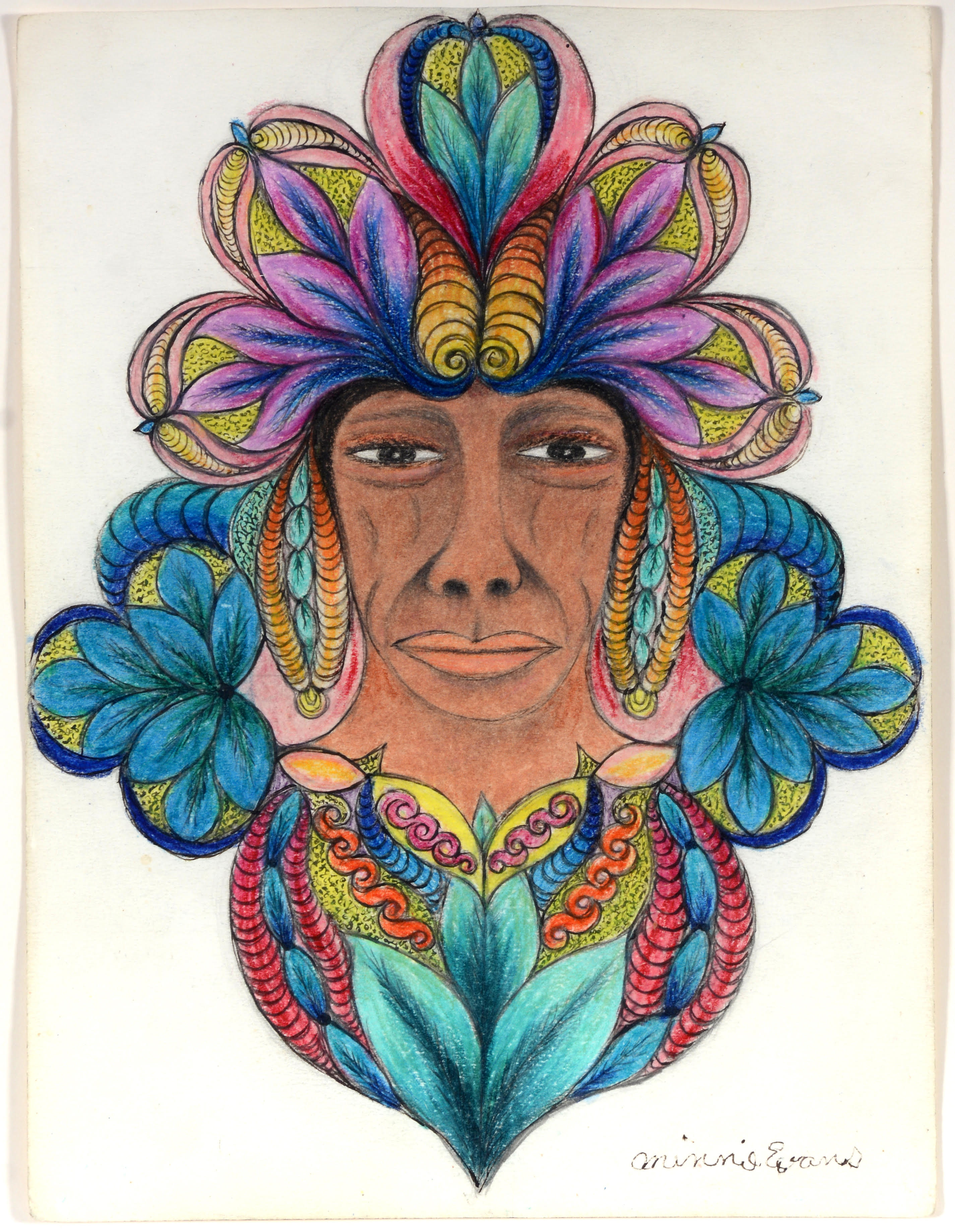
A circa 1960s portrait by Minnie Evans shows a copper-colored face of indeterminate gender crowned with an elaborate, colorful headdress and surrounded by flourishing plants.

Update: The circa 1960s Minnie Evans work sold for $8,000.

What you see: Beautiful Portrait Surrounded by Vivid Flora, a circa 1960s work on paper by self-taught African-American artist Minnie Evans. Slotin Folk Art estimates it at $5,000 to $8,000.

The expert: Steve Slotin of Slotin Folk Art in Buford, Georgia.

I’d like to start by talking about Evans herself, and how she became a self-taught artist, and how her story matches other people who became self-taught artists. She seemed compelled to make art. Is that true of many other self-taught artists? It’s very typical. We like to say our artists are untrained and unschooled in art, but something happens and they’re driven to create art. She was definitely driven to create art, and create garden-like drawings that came from her surroundings as a gatekeeper for a garden. [Evans worked as the gatekeeper for Airlie Gardens in Wilmington, North Carolina from 1948 until she retired in 1974.]

She started making art at the age of 43. Is that unusually late for a self-taught artist to embark on a career? It’s hard to say what’s typical. Most artists don’t have the opportunity [to make art] until later in life. Evans created art as the gatekeeper because she had the time to do it.

Was she prolific? She was very prolific. She did a lot of drawings. Like a lot of these artists, she was somewhat obsessed with making art.

Has anyone come up with a conservative number of works that she made over her lifetime? I don’t know if there’s an actual number. She did a lot as the gatekeeper of the garden, selling them for 50 cents. There’s probably an untold number out there.

Was Evans discovered and recognized in her lifetime? She was. There was a folk art show at the Corcoran in the 1980s of self-taught African American artists [Black Folk Art in America, 1930-1980]. The show kicked off outsider art mania. It woke people up to what incredible artists we have in this country who are not influenced by academic or European masters.
Is this piece typical of Evans’s work? It’s very typical and very desirable. It’s got a central face with flora around it, and the colors are beautiful and strong, with one color bleeding into the next. It’s a really good indication of what her work looks like.

Is this a self-portrait? I don’t think it’s a self-portrait. It doesn’t look like her. She had a rounder face. I think there’s one distinct facial type that she does, and like the colors, the faces range the gamut from Caucasian to Native American to African-American depending on the individual piece.

How is she producing the effect of colors bleeding into the next–by mixing crayon and colored pencil? Back in the day I’m sure no one thought this would be as important as it is. [She worked with] everything she could get her hands on. That’s how most folk artists worked. Because no one considered them artists, they didn’t have the means to buy the best materials. I don’t know how she did it [the effect], but she did the best with what she had.

This is undated, but it has a circa date of the 1960s. Is that the period of her career that collectors prefer? Her strongest periods were the 1950s and 1960s. The look of it is really powerful and detailed. People like this period because the colors are strong and vivid and just beautiful. This is what they want to live with. In the 1970s, she was older, and not as strong, and may have spent less time on [each work].

The lot notes describe the piece as being in excellent condition. What does that mean here? I’m looking at the condition of the paper and the work. There’s no tears, no holes, and if it had paint on it, it means there’s no cracking or crazing or flaking off. Overall it’s in great condition.

Is that unusual for an Evans, given that she sold them directly to visitors to the garden where she worked as a gatekeeper? Remarkably, her paintings did well over time. We typically find them in really good condition. It would have been easy just to discard it if it was bought as a fluke. People saved them. Even if you didn’t know what it was, it’s very likable. You’d enjoy having it in your house and looking at it.

What’s the provenance for this work? This is from a longtime collector who had a fabulous collection [they’re] selling most of in this auction.

What is the work like in person? Are there aspects of it that the camera doesn’t quite pick up? The only thing you don’t see in the photo when you look at it in person is how the colors bleed into each other and how calming it is to be around the piece. It’s a wonderful piece.

How many Minnie Evans works have you handled at Slotin over the years? I’ve sold between 50 to 70 pieces, with her highest being over $30,000.

Would that be the auction record for Minnie Evans? That is the auction record. It was a larger piece, maybe two times the size of the one here. It was from the Rosenak collection, Chuck and Jan, who wrote the Museum of American Folk Art Encyclopedia of Twentieth Century American Folk Art and Artists. It had a lot of detail in it, faces and flowers and birds. I sold it 10 years ago. Maybe now it would go for $50,000 to $60,000. Prices have jumped so much on her work, if I had it back, it might have doubled by now.

How to bid: The Minnie Evans portrait is lot 0161 in the Spring Masterpiece Sale at Slotin Folk Art in Buford, Georgia on April 27 and 28, 2019.

How to subscribe to The Hot BidClick the trio of dots at the upper right of this page.

Image is courtesy of Slotin Folk Art Auction.

Steve Slotin previously spoke to The Hot Bid about a sculpture by Ab the Flag Manwhich ultimately sold for $1,200. He also discussed a painting by African-American artist Sam Doyle that later commanded $17,000.

Minnie Evans died in 1987 at the age of 95, but her memory lives on at Airlie Gardens through a sculpture garden that bears her name.

Would you like to hire Sheila Gibson Stoodley for writing or editing work? Click the word “Menu” at the upper right for contact details.

SOLD! Original D for Delinquent Pulp Paperback Cover Art Fetched (Scroll Down to See)

The cover art for the 1958 pulp novel D for Delinquent shows a nubile blonde in jeans and a yellow sweater leaning against the doorway of a shack. Inside, a tough-looking teen with greased black hair and a cigarette dangling from his mouth locks eyes with her.  Behind him, two couples grapple.

Update: The original cover art for D for Delinquent sold for $6,875.

What you see: Original cover art for D for Delinquent, a 1958 juvenile delinquent-themed pulp paperback. Heritage Auctions estimates it at $5,000 to $7,000.

The expert: Meagen McMillan, junior specialist and cataloger for illustration art and American art at Heritage Auctions.

First, could you talk about how rare it is for any original pulp cover art to survive at all? Most often, when an artist created a cover for a pulp or a paperback magazine, they’d send in the artwork and never see it again. The publisher used it for publication and then threw it away, or gave it to friends, or sold it at charity events. The majority of art from this period was thrown in the trash. These come up extremely rarely.

How did this particular piece of art evade the trash bin? It was most likely due to Charles Martignette [pronounced Martin-etty]. While he was collecting he actively went to publishing houses to buy directly–stacks of art for bulk prices. I don’t know if this one was bought that way.

The lot notes call this “the finest single example of the juvenile delinquent genre from the estate of Charles Martignette”. What makes it so? It’s just got the classic [details]–the blonde bombshell with the overly tight sweater and the greaser character, in an abandoned house. It perfectly contains what you want to see from this genre.

What makes it an effective pulp novel cover? It’s immediately dynamic. The print version has a large D in D for Delinquent, and the D is yellow. It draws your eye directly to the blonde.

Do we know who the artist is? We don’t know who the artist is. It’s similar to a lot of different artists’ works. It’s similar to James Avati. It’s similar to Raymond Pease. It’s similar to Norman Saunders. But we don’t know who did this. The publishing house didn’t have records. Back then, it was something done quickly, and they didn’t acknowledge who did these incredible covers. It makes it special. While we can’t assign it to a specific artist, it’s so well-done that it still has value. Normally, if you can’t assign it to an artist, it cuts its value. It’s valuable by the image alone.

I realize we don’t know who did this, but what would have been the typical way to create images like these? Would the artist have used models, or shot reference photos, or just imagined the scene? It depends on each individual artist. Gil Elvgren used models and photos. Norman Rockwell used [models and] photos. Others used their imaginations. It’s really hard to tell what the process would have been [here].

This image was used for an American paperback in 1958 and a British one two years later. Does that speak to its power as an image? It was actually very common. Paperbacks were released in the U.S., the U.K., and maybe Australia. Sometimes they had different covers, and sometimes they re-used the covers. The artist didn’t own the image. They gave it to the publisher and they could use it as many times as they wanted.

What condition is the artwork in, given that it was created as a piece of functional art? It’s actually in surprisingly wonderful condition. The margins might have been trimmed at one point.

Does it show any wear from having passed through several hands at the publishing house? I’d have to unframe it to be certain, but I can give you an example of unframed cover art. Lot #71317 has all sorts of writing and dings to the edges. [You might have to click on the alternate image, which is  shown below the main shot.]

How did you arrive at the estimate? Have you sold this piece of art before? I believe we did sell it before, when it was in the Martignette collection. We handled the Martignette estate. We sold it previously in 2011 for $7,170, with an estimate of $4,000 to $6,000. The market showed the value is there, though there is no artist associated with it. We look at it and see what we’re all looking for–a beautiful girl, a dangerous guy, action, the setting, and it’s a published cover. If it was an interior [a piece of art used inside the book, rather than on the cover]. or we couldn’t prove it was published, it goes down [in value].

What is the piece like in person? Are there aspects that the camera does not pick up? I guess the only difference is really, when you see it in person, it evokes something in you–an emotional response and a sense of presence. This definitely has it.

And this image was painted at a larger size than it would have appeared as on a pulp cover, yes? A paperback cover is four inches by six inches. This is 24.75 inches by 16 inches. It’s definitely larger.

Do we know what the auction record is for original pulp cover art for a juvenile delinquent-themed book, or would we have to look at pulp cover art in general? We’d have to be more broad. We sold a piece of pulp cover art in 2009 by James Avati, called Goodbye to Berlin, for $26,290. You have to do it [search for auction records] by artist. Doing it by pulp covers is nearly impossible.

Might this piece set a record for original pulp cover art by an unknown artist? It could, but I don’t know that anyone keeps that data point.

Why will this piece stick in your memory? The rarity of it, for sure. I’ve handled probably thousands of pieces of illustration art per year. I’m a big fan of pulp art. When you have a piece come across your desk where you don’t know who the artist is, and it doesn’t matter–that’s rare. It’s still amazing. It’s going to do well, no matter what. It’s an image that speaks for itself.

How to bid: The D for Delinquent art is lot #71185 in the Illustration Art Signature Auction at Heritage Auctions on April 23, 2019.

How to subscribe to The Hot BidClick the trio of dots at the upper right of this page. You can also follow The Hot Bid on Instagram and follow the author on Twitter.

Heritage Auctions is on Twitter and Instagram.

Image is courtesy of Heritage Auctions.

Would you like to hire Sheila Gibson Stoodley for writing or editing work? Click the word “Menu” at the upper right for contact details.

Will Original Pulp Paperback Cover Art for D for Delinquent Soar to $7,000 at Heritage Tomorrow?

The cover art for the 1958 pulp novel D for Delinquent shows a nubile blonde in jeans and a yellow sweater leaning against the doorway of a shack. Inside, a tough-looking teen with greased black hair and a cigarette dangling from his mouth locks eyes with her.  Behind him, two couples grapple.

What you see: Original cover art for D for Delinquent, a 1958 juvenile delinquent-themed pulp paperback. Heritage Auctions estimates it at $5,000 to $7,000.

The expert: Meagen McMillan, junior specialist and cataloger for illustration art and American art at Heritage Auctions.

First, could you talk about how rare it is for any original pulp cover art to survive at all? Most often, when an artist created a cover for a pulp or a paperback magazine, they’d send in the artwork and never see it again. The publisher used it for publication and then threw it away, or gave it to friends, or sold it at charity events. The majority of art from this period was thrown in the trash. These come up extremely rarely.

How did this particular piece of art evade the trash bin? It was most likely due to Charles Martignette [pronounced Martin-etty]. While he was collecting he actively went to publishing houses to buy directly–stacks of art for bulk prices. I don’t know if this one was bought that way.

The lot notes call this “the finest single example of the juvenile delinquent genre from the estate of Charles Martignette”. What makes it so? It’s just got the classic [details]–the blonde bombshell with the overly tight sweater and the greaser character, in an abandoned house. It perfectly contains what you want to see from this genre.

What makes it an effective pulp novel cover? It’s immediately dynamic. The print version has a large D in D for Delinquent, and the D is yellow. It draws your eye directly to the blonde.

Do we know who the artist is? We don’t know who the artist is. It’s similar to a lot of different artists’ works. It’s similar to James Avati. It’s similar to Raymond Pease. It’s similar to Norman Saunders. But we don’t know who did this. The publishing house didn’t have records. Back then, it was something done quickly, and they didn’t acknowledge who did these incredible covers. It makes it special. While we can’t assign it to a specific artist, it’s so well-done that it still has value. Normally, if you can’t assign it to an artist, it cuts its value. It’s valuable by the image alone.

I realize we don’t know who did this, but what would have been the typical way to create images like these? Would the artist have used models, or shot reference photos, or just imagined the scene? It depends on each individual artist. Gil Elvgren used models and photos. Norman Rockwell used [models and] photos. Others used their imaginations. It’s really hard to tell what the process would have been [here].

This image was used for an American paperback in 1958 and a British one two years later. Does that speak to its power as an image? It was actually very common. Paperbacks were released in the U.S., the U.K., and maybe Australia. Sometimes they had different covers, and sometimes they re-used the covers. The artist didn’t own the image. They gave it to the publisher and they could use it as many times as they wanted.

What condition is the artwork in, given that it was created as a piece of functional art? It’s actually in surprisingly wonderful condition. The margins might have been trimmed at one point.

Does it show any wear from having passed through several hands at the publishing house? I’d have to unframe it to be certain, but I can give you an example of unframed cover art. Lot #71317 has all sorts of writing and dings to the edges. [You might have to click on the alternate image, which is  shown below the main shot.]

How did you arrive at the estimate? Have you sold this piece of art before? I believe we did sell it before, when it was in the Martignette collection. We handled the Martignette estate. We sold it previously in 2011 for $7,170, with an estimate of $4,000 to $6,000. The market showed the value is there, though there is no artist associated with it. We look at it and see what we’re all looking for–a beautiful girl, a dangerous guy, action, the setting, and it’s a published cover. If it was an interior [a piece of art used inside the book, rather than on the cover]. or we couldn’t prove it was published, it goes down [in value].

What is the piece like in person? Are there aspects that the camera does not pick up? I guess the only difference is really, when you see it in person, it evokes something in you–an emotional response and a sense of presence. This definitely has it.

And this image was painted at a larger size than it would have appeared as on a pulp cover, yes? A paperback cover is four inches by six inches. This is 24.75 inches by 16 inches. It’s definitely larger.

Do we know what the auction record is for original pulp cover art for a juvenile delinquent-themed book, or would we have to look at pulp cover art in general? We’d have to be more broad. We sold a piece of pulp cover art in 2009 by James Avati, called Goodbye to Berlin, for $26,290. You have to do it [search for auction records] by artist. Doing it by pulp covers is nearly impossible.

Might this piece set a record for original pulp cover art by an unknown artist? It could, but I don’t know that anyone keeps that data point.

Why will this piece stick in your memory? The rarity of it, for sure. I’ve handled probably thousands of pieces of illustration art per year. I’m a big fan of pulp art. When you have a piece come across your desk where you don’t know who the artist is, and it doesn’t matter–that’s rare. It’s still amazing. It’s going to do well, no matter what. It’s an image that speaks for itself.

How to bid: The D for Delinquent art is lot #71185 in the Illustration Art Signature Auction at Heritage Auctions on April 23, 2019.

How to subscribe to The Hot BidClick the trio of dots at the upper right of this page. You can also follow The Hot Bid on Instagram and follow the author on Twitter.

Heritage Auctions is on Twitter and Instagram.

Image is courtesy of Heritage Auctions.

Would you like to hire Sheila Gibson Stoodley for writing or editing work? Click the word “Menu” at the upper right for contact details.

The True History of Pepper’s Ghost–a Rare Book on the Famous Special Effect–Could Sell for $900

The cover of The True History of Pepper's Ghost depicts a skeleton seated cross-legged and lifting a white cloth or veil off itself. The book cover has a black background.

What you see: A copy of The True History of Pepper’s Ghost, an 1890 book by Professor John Henry Pepper. Potter & Potter estimates it at $600 to $900.

The expert: Gabe Fajuri, president of Potter & Potter.

What is Pepper’s Ghost, and how was John Pepper involved in it? It’s a theatrical effect used to manifest figures on a stage. They could be ghosts, they could be people, they could be objects, even. It was devised in the mid-19th century by Henry Dircks and popularized by John Pepper.

How did he popularize it? Pepper came up with a way to streamline the installation of the device. Dircks wanted to modify every theater in a major way to install the invention. Pepper made it adaptable and practical.

Why was the special effect such a big deal when it debuted in 1862? Because it made ghosts walk on stage.

Were there previous attempts to do something like Pepper’s Ghost, which fell short? I’m not aware of any, and I’m not an authority, but people had played with using glass in a similar way going back centuries.

To what extent, if at all, was the impact of Pepper’s Ghost amplified by debuting in a play based on a book by Charles Dickens? My recollection is the play it was used in involved the appearance of a ghost. What I like about that was Charles Dickens was an amateur magician. They probably chose it [the debut of the effect] coincidentally, but there’s some serendipity there.

What I find interesting is Pepper tried, almost heroically, to give due credit to Dircks, but the public persisted in calling the effect “Pepper’s Ghost.” But look at songwriting. Maybe it’s a stretch, but how many of Whitney Houston’s songs did she actually write? It’s the performance that makes the memory in the public mind.

But it’s not typical for someone to try as hard as Pepper did to share credit. No, especially when the profit motive is involved. But, eventually, Henry Dircks signed the patent over to Pepper. It shows he had no animosity to Pepper. It helped cement it in the public mind, I suppose, but the public doesn’t go back and read patent papers.

Have you read the book? Do we know why Pepper felt he had to write a book titled The True History of Pepper’s Ghost? I have not read it, and I don’t know his motivation.

Does it go into detail about how to produce the Pepper’s Ghost effect? Oh, yeah. The folding frontispiece shows you how to set it up. It’s literally the first page.

How is the Pepper’s Ghost effect used today? I know it’s been adapted for many practical and entertaining purposes. One you probably don’t think of is the headsup display on a car’s windshield. A more frivolous use brought Tupac Shakur to life on stage. It’s been used for decades in carnivals to turn a girl into a gorilla.

It’s a surprisingly durable special effect, given that it’s more than 150 years old. Sometimes, you know, simplicity is an art. It’s hard to improve upon something so direct and effective.

Do we know how many copies of the book were printed? Also, how many copies have you handled? I don’t know the number printed, but I’ve handled two or three in 11 years.

What condition is the book in? Lovely. It’s not in fine condition, but considering its age and scarcity, it’s good, in bookseller’s terms.

Who would have been the audience for this book? I imagine it would be scientists, or theater owners, or people who wanted to incorporate effects into a production. It could have been magicians or curiosity seekers as well. The cover is beautiful–one of its main attractions these days. The skeleton on the cover says it all.

How to bid: The True History of Pepper’s Ghost is lot 405 in The Magic Collection of Ray Goulet, a sale taking place at Potter & Potter on April 27, 2019.

How to subscribe to The Hot BidClick the trio of dots at the upper right of this page. You can also follow The Hot Bid on Instagram and follow the author on Twitter.

Follow Potter & Potter on Instagram and Twitter.

Gabe Fajuri is a favorite on The Hot Bid. He’s talked about a Will & Finck brass sleeve holdout–a device for cheating at cards–which sold for $9,000a Snap Wyatt sideshow banner advertising a headless girl, a record-setting stage-worn magician’s tuxedo; a genuine 19th century gambler’s case that later sold for $6,765; a scarce 19th century poster of a tattooed man that fetched $8,610; a 1908 poster for the magician Chung Ling Soo that sold for $9,225; a Golden Girls letterman jacket that belonged to actress Rue McClanahan; and a 1912 Houdini poster that set the world record for any magic poster at auction.

Gabe rightly points out that the peerless Jim Steinmeyer wrote the definitive book on the Pepper’s Ghost special effect: The Science Behind the Ghost, which you can purchase from Steinmeyer’s website.

Image is courtesy of Potter & Potter.

Would you like to hire Sheila Gibson Stoodley for writing or editing work? Click the word “Menu” at the upper right for contact details.
SOLD! A Punch Ladle from Gorham’s Narragansett Pattern Commanded (Scroll Down to See)

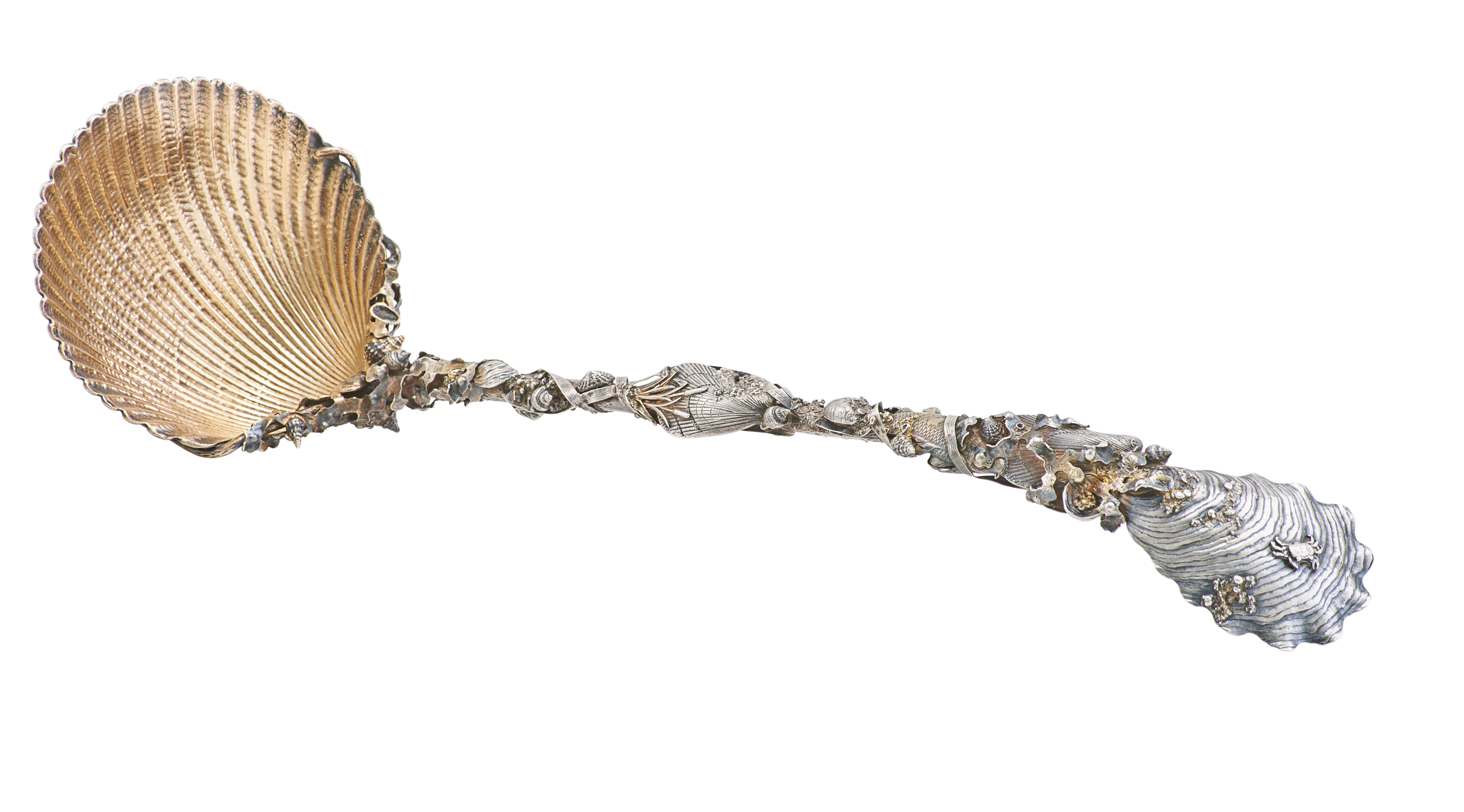
This circa 1880s parcel gilt sterling silver punch ladle in the Narragansett pattern by Gorham has a shell-shaped spoon that truly resembles a cockle shell. The interior of the spoon is gold. The stem of the ladle is festooned with with seaweed, fish, and grains of sand. The top of the handle resembles an oyster shell.

Update: The circa 1880s parcel gilt sterling silver punch ladle in the Narragansett pattern by Gorham sold for $16,250.

What you see: A parcel gilt sterling silver punch ladle in the Narragansett pattern by Gorham, circa 1880. Rago Auctions estimates it at $10,000 to $15,000.

The expert: Jenny Pitman, specialist with Rago Auctions.

This ladle dates to 1880. How important was punch then? It was very important and popular in the 19th century. Around that time it was served chilled or even iced. Punch was used not only as a drink but as a sorbet between courses. I found a recipe for Roman punch that had a dollop of meringue. This could have been a punch ladle or a soup ladle, but it was typically known as a punch ladle, and it’s illustrated in the Gorham archive as a punch ladle.

Did everybody in 1880 feel like they needed one of these? In the 19th century, American silversmiths began to take over worldwide. Gorham became the largest silver manufacturer in the world. During the Gilded Age, [clients] ordered extraordinary silver services with hundreds and hundreds of pieces, including flatware. They held multi-course dinner parties and had individual place pieces [such as] citrus spoons and oyster forks. Tiffany and Gorham introduced silver patterns of 40 pieces plus serving pieces. The Narragansett pattern was very specialized and small.

It wasn’t a fully fledged line? It was only about a dozen pieces. It included the soup ladle, the punch ladle–

Two different ladles? There’s a difference of about half an inch [between the two]. There was a gravy ladle, a sugar spoon, a berry spoon, a preserves spoon, a sugar sifter, about a dozen pieces. The pattern, I understand, was introduced in 1884. Some were illustrated in a catalog in 1885. The reason we know so much is Bill Hood, an expert in American flatware, went to the Gorham archive and researched it for an article.

Do we know what this ladle would have cost in 1880? We do. We know this pattern was really quite expensive, about one to one-and-a-half times more expensive to produce. This ladle was $29 in 1887. It was really intended as a showpiece. [According to the inflation calculator at westegg.com, $29 in 1887 amounts to more than $818 in 2018 dollars.]

Was it actually used? I would hope so. I would hope they would use it.

Would this have been the sort of thing that would have been assigned to a servant, who would keep hold of it all night while dispensing punch? [Laughs] If you had the means to afford a ladle like this, you had a servant to ladle the punch.

What can we tell by looking about how it was made? The stem is cast and embellished with marine details. They apply not just to the front, but to the back and bottom of the bowl. The shell [that comprises the bowl of the spoon] is a cockle shell, and it has an oyster for the terminal. The seaweed, fish, and little grains of sand have been picked out in parcel gilt. The purpose of that is to highlight certain elements. It’s a feature of the pattern.

What else can we tell by looking at the ladle? If you compare one [Narragansett] ladle to another, each is slightly different. The person working on the ladle had latitude in putting it together. They’re one of a kind. That’s what makes them so special.

What is parcel gilt, and is this a technique that can be safely done today? Parcel gilt is electro-gilding. It’s like electroplating. It can still be done now.

What kind of condition is the ladle in? It seems to have a lot of sticky-up bits that could snag a sleeve… [Laughs] I guess it could snag on a sleeve, but when they come to auction, they’re in uniformly good shape. They’re probably not used and they’re kept in their original boxes. A lot of special pieces had specially-made boxes.

Does this one have a box? No, it does not.

And this single piece could still go for five figures, without a box, when large, complete sets of brand name sterling silver flatware in their original custom chests go for less? It comes up rarely at auction. This is the third one I’ve sold in my life, and I’ve been in the business for 20 years. Because it’s so rare, it brings huge sums. What’s so amazing about these pieces is there’s a feeling they’ve been plucked out of the bay or the ocean, crusted with sea life decorations. It’s kind of an extraordinary idea, and it captures a sense of ingenuity of American silversmiths in the late 19th century who devoted their expertise and design prowess to flatware.

What’s the auction record for a Narragansett ladle, and for something from the Narragansett pattern? A single ladle sold at Christie’s in May 2014 for $21,250. In January 2019, Christie’s sold a punch ladle with two sauce ladles for $32,500.

Do we know how many Narragansett ladles Gorham made and sold? No, I’m not aware of that.

Was the ladle not popular? I think that the production was limited. Whether it was popular or not, it was expensive. And it was not to everyone’s taste, and it was not a full line pattern.

Was there a matching punch bowl? There was. It’s in the Boston Museum of Fine Arts collection. It [the ladle] doesn’t match it exactly, but it has shell handles and it’s decorated with sea monsters and fish. [The one in the Boston MFA appears to be the only example.]

How does it feel to hold the ladle in your hand? It feels good. You’d think it would feel awkward and barnacle-ly, but it feels good. The pointy shells encrusting it are on a part of the ladle that you don’t necessarily hold onto. It’s really exquisitely designed.

What’s your favorite detail of the ladle? I like the bowl the best. I’ve seen a lot of ladles in my time. With many designs, the shell is stylized. I love the naturalism of this bowl.

Why will this piece stick in your memory? [Laughs] I’ll tell you what sticks in my memory. How to spell “Narragansett” correctly! Two Rs, two Ts.

How to bid: The circa 1880 Gorham parcel gilt sterling silver punch ladle is lot 1210 in the Remix: Classic + Contemporary auction at Rago on April 14, 2019.

How to subscribe to The Hot BidClick the trio of dots at the upper right of this page. You can also follow The Hot Bid on Instagram and follow the author on Twitter.

Rago Auctions is on Twitter and Instagram.

Image is courtesy of Rago Auctions.

Would you like to hire Sheila Gibson Stoodley for writing or editing work? Click the word “Menu” at the upper right for contact details.

SOLD! A 1960s-era Coin-Op Recording Booth Fetched (Scroll Down to See)

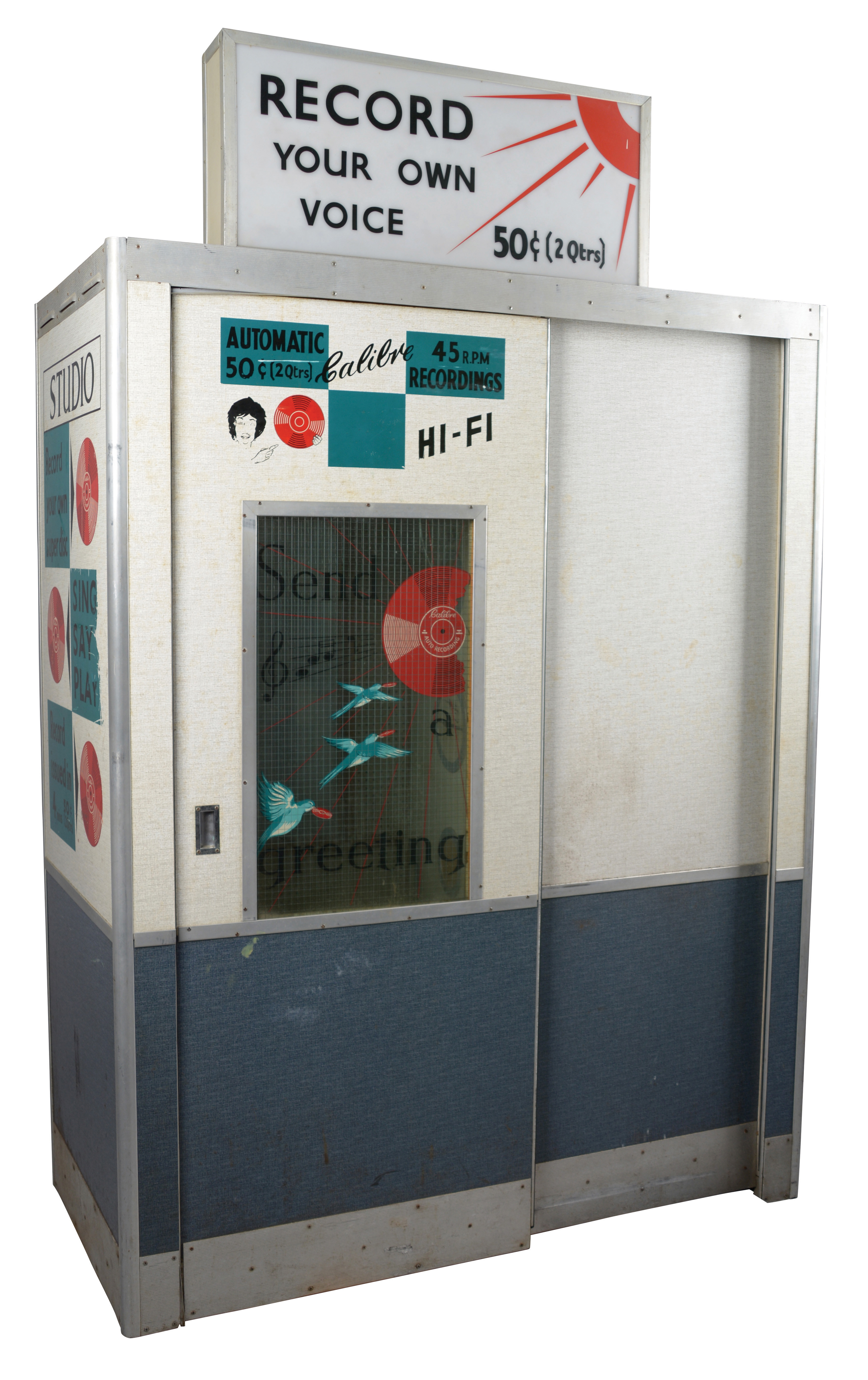
The booth has fabulous 1960s graphics rendered in red, teal green, and black on a white background. It's about twice as big as an old-school phone booth. On top is a sign with a red sun on a white background that says "Record Your Own Voice, 50 cents (2 Qtrs). The top of the booth is white and the bottom is slate blue.

Update: The 50-cent Calibre Auto Recording Booth sold for $44,000.

What you see: A 50-cent Calibre Auto Recording Booth. Morphy Auctions estimates it at $80,000 to $100,000.

The expert: Don Grimmer, vice president of Morphy Auctions Las Vegas.

So let’s imagine I’m wandering along a boardwalk, or in an amusement park or an arcade, and I see this and I want to use it. How do I do that? You open the door, go in, and close the door behind you to keep the outside noise from coming in. You inserted two quarters and began speaking or singing when the red light was on. It was recommended that you stand six to 12 inches from the microphone.

And the recording time lasted about four minutes? A few minutes per record, I don’t know how many. It stopped on its own. A machine behind the microphone created the record for you.

Do we know how many of these units were made? We don’t know, but they were popular in the UK also.

And this is the only version of the unit that the manufacturer produced? I think this is the only style. It’s very rare. It’s the only style I’ve seen.

Is this the first one you’ve handled? This is the first one we’ve had to auction. One sold privately recently, which is how we created the estimate.

Do we know when this particular unit was made? Mid- to late 60s. That’s what I’d say as a guy who’s been around coin-op [machines], judging by the look and feel of it.

Does it work? Everything is there. It appears to be complete. It hasn’t been tested, and you’d need to fill it with blank discs. The collector will be the one to get it wired and working. We don’t have the discs to put in it. It probably needs maintenance to get it in full working condition.

Have you heard any records that were made by a booth such as this one? How do they sound? It’s mostly a low-fi recording, despite the hi-fi ad on the exterior. It’s not a great quality record. It’s a cool novelty.

So you hear pop and hiss? Right. Sometimes you can find one somebody made. They pop up in old record stores and thrift stores.

The lot notes describe its condition as “very good.” What does that mean in this context? It’s structurally sound. The graphics are intact. The mechanism is intact, which is a major  plus. It’s not a hunk of crap. Perfect equals mint. Because the mechanism is there, that makes it very good. It’s very easy to see the wear markers, the scratches, the condition.

Have you sat in it? What is that like? There’s no seat present in it. You stand inside and it makes you want to put a coin in the slot and give it a try. It’s a good experience. It gets you excited that this will be a great thing to try.

How many people can comfortably fit inside the booth, really, knowing that you have to close the door to get a legible recording? It measures only about two and a half feet by two feet. You could possibly get two or three skinny people in there, or five kids, but honestly, it’s made for one.

What do we know about the provenance of this unit? It comes from the Seaside Heights boardwalk in New Jersey, and was used in Seaside Heights and Wildwood, New Jersey.

Is there anything we can say about the graphics decorating the machine? The good thing is that they’re intact. They’re legible and clear. There are wear issues. This thing was used! You climb in it and your friends climb in with you, having fun and being rowdy, especially when you start singing. It’s lucky to be in the condition it’s in.

How did you arrive at the estimate for this, knowing that none of these units have been to auction before? What are its comparables, beyond private sales? Very few exist, and very few survive. I’ve talked to two guys who know of these. The market will do what the market will do, but you’ve gotta start somewhere.

Why will this piece stick in your memory? When you get in it, it makes you want to use the machine. And it records you. Not many things out there actually records yourself. It makes you want to something silly, like stand in a booth and sing to yourself. And this is a rare, fresh to market piece, which makes it even more desirable.

How to bid: The Calibre Auto Recording Booth is lot 1179 in the Coin-op & Advertising sale at Morphy Auctions Las Vegas on April 13 and 14, 2019.

How to subscribe to The Hot BidClick the trio of dots at the upper right of this page. You can also follow The Hot Bid on Instagram and follow the author on Twitter.

Image is courtesy of Morphy Auctions.

Would you like to hire Sheila Gibson Stoodley for writing or editing work? Click the word “Menu” at the upper right for contact details.
A Minnie Evans Work on Paper Could Sell for $8,000

unnamed

What you see: Beautiful Portrait Surrounded by Vivid Flora, a circa 1960s work on paper by self-taught African-American artist Minnie Evans. Slotin Folk Art estimates it at $5,000 to $8,000.

The expert: Steve Slotin of Slotin Folk Art in Buford, Georgia.

I’d like to start by talking about Evans herself, and how she became a self-taught artist, and how her story matches other people who became self-taught artists. She seemed compelled to make art. Is that true of many other self-taught artists? It’s very typical. We like to say our artists are untrained and unschooled in art, but something happens and they’re driven to create art. She was definitely driven to create art, and create garden-like drawings that came from her surroundings as a gatekeeper for a garden. [Evans worked as the gatekeeper for Airlie Gardens in Wilmington, North Carolina from 1948 until she retired in 1974.]

She started making art at the age of 43. Is that unusually late for a self-taught artist to embark on a career? It’s hard to say what’s typical. Most artists don’t have the opportunity [to make art] until later in life. Evans created art as the gatekeeper because she had the time to do it.

Was she prolific? She was very prolific. She did a lot of drawings. Like a lot of these artists, she was somewhat obsessed with making art.

Has anyone come up with a conservative number of works that she made over her lifetime? I don’t know if there’s an actual number. She did a lot as the gatekeeper of the garden, selling them for 50 cents. There’s probably an untold number out there.

Was Evans discovered and recognized in her lifetime? She was. There was a folk art show at the Corcoran in the 1980s of self-taught African American artists [Black Folk Art in America, 1930-1980]. The show kicked off outsider art mania. It woke people up to what incredible artists we have in this country who are not influenced by academic or European masters.

Is this piece typical of Evans’s work? It’s very typical and very desirable. It’s got a central face with flora around it, and the colors are beautiful and strong, with one color bleeding into the next. It’s a really good indication of what her work looks like.

Is this a self-portrait? I don’t think it’s a self-portrait. It doesn’t look like her. She had a rounder face. I think there’s one distinct facial type that she does, and like the colors, the faces range the gamut from Caucasian to Native American to African-American depending on the individual piece.

How is she producing the effect of colors bleeding into the next–by mixing crayon and colored pencil? Back in the day I’m sure no one thought this would be as important as it is. [She worked with] everything she could get her hands on. That’s how most folk artists worked. Because no one considered them artists, they didn’t have the means to buy the best materials. I don’t know how she did it [the effect], but she did the best with what she had.

This is undated, but it has a circa date of the 1960s. Is that the period of her career that collectors prefer? Her strongest periods were the 1950s and 1960s. The look of it is really powerful and detailed. People like this period because the colors are strong and vivid and just beautiful. This is what they want to live with. In the 1970s, she was older, and not as strong, and may have spent less time on [each work].

The lot notes describe the piece as being in excellent condition. What does that mean here? I’m looking at the condition of the paper and the work. There’s no tears, no holes, and if it had paint on it, it means there’s no cracking or crazing or flaking off. Overall it’s in great condition.

Is that unusual for an Evans, given that she sold them directly to visitors to the garden where she worked as a gatekeeper? Remarkably, her paintings did well over time. We typically find them in really good condition. It would have been easy just to discard it if it was bought as a fluke. People saved them. Even if you didn’t know what it was, it’s very likable. You’d enjoy having it in your house and looking at it.

What’s the provenance for this work? This is from a longtime collector who had a fabulous collection [they’re] selling most of in this auction.

What is the work like in person? Are there aspects of it that the camera doesn’t quite pick up? The only thing you don’t see in the photo when you look at it in person is how the colors bleed into each other and how calming it is to be around the piece. It’s a wonderful piece.

How many Minnie Evans works have you handled at Slotin over the years? I’ve sold between 50 to 70 pieces, with her highest being over $30,000.

Would that be the auction record for Minnie Evans? That is the auction record. It was a larger piece, maybe two times the size of the one here. It was from the Rosenak collection, Chuck and Jan, who wrote the Museum of American Folk Art Encyclopedia of Twentieth Century American Folk Art and Artists. It had a lot of detail in it, faces and flowers and birds. I sold it 10 years ago. Maybe now it would go for $50,000 to $60,000. Prices have jumped so much on her work, if I had it back, it might have doubled by now.

How to bid: The Minnie Evans portrait is lot 0161 in the Spring Masterpiece Sale at Slotin Folk Art in Buford, Georgia on April 27 and 28, 2019.

How to subscribe to The Hot BidClick the trio of dots at the upper right of this page.

Text is copyright Sheila Gibson Stoodley. Image is courtesy of Slotin Folk Art Auction.

Steve Slotin previously spoke to The Hot Bid about a sculpture by Ab the Flag Manwhich ultimately sold for $1,200. He also discussed a painting by African-American artist Sam Doyle that later commanded $17,000.

Minnie Evans died in 1987 at the age of 95, but her memory lives on at Airlie Gardens through a sculpture garden that bears her name.

Would you like to hire Sheila Gibson Stoodley for writing or editing work? Click the word “Menu” at the upper right for contact details.

A Punch Ladle from Gorham’s Narragansett Pattern Could Command $15,000

This circa 1880s parcel gilt sterling silver punch ladle in the Narragansett pattern by Gorham has a shell-shaped spoon that truly resembles a cockle shell. The interior of the spoon is gold. The stem of the ladle is festooned with with seaweed, fish, and grains of sand. The top of the handle resembles an oyster shell.

What you see: A parcel gilt sterling silver punch ladle in the Narragansett pattern by Gorham, circa 1880. Rago Auctions estimates it at $10,000 to $15,000.

The expert: Jenny Pitman, specialist with Rago Auctions.

This ladle dates to 1880. How important was punch then? It was very important and popular in the 19th century. Around that time it was served chilled or even iced. Punch was used not only as a drink but as a sorbet between courses. I found a recipe for Roman punch that had a dollop of meringue. This could have been a punch ladle or a soup ladle, but it was typically known as a punch ladle, and it’s illustrated in the Gorham archive as a punch ladle.

Did everybody in 1880 feel like they needed one of these? In the 19th century, American silversmiths began to take over worldwide. Gorham became the largest silver manufacturer in the world. During the Gilded Age, [clients] ordered extraordinary silver services with hundreds and hundreds of pieces, including flatware. They held multi-course dinner parties and had individual place pieces [such as] citrus spoons and oyster forks. Tiffany and Gorham introduced silver patterns of 40 pieces plus serving pieces. The Narragansett pattern was very specialized and small.

It wasn’t a fully fledged line? It was only about a dozen pieces. It included the soup ladle, the punch ladle–

Two different ladles? There’s a difference of about half an inch [between the two]. There was a gravy ladle, a sugar spoon, a berry spoon, a preserves spoon, a sugar sifter, about a dozen pieces. The pattern, I understand, was introduced in 1884. Some were illustrated in a catalog in 1885. The reason we know so much is Bill Hood, an expert in American flatware, went to the Gorham archive and researched it for an article.

Do we know what this ladle would have cost in 1880? We do. We know this pattern was really quite expensive, about one to one-and-a-half times more expensive to produce. This ladle was $29 in 1887. It was really intended as a showpiece. [According to the inflation calculator at westegg.com, $29 in 1887 amounts to more than $818 in 2018 dollars.]

Was it actually used? I would hope so. I would hope they would use it.

Would this have been the sort of thing that would have been assigned to a servant, who would keep hold of it all night while dispensing punch? [Laughs] If you had the means to afford a ladle like this, you had a servant to ladle the punch.

What can we tell by looking about how it was made? The stem is cast and embellished with marine details. They apply not just to the front, but to the back and bottom of the bowl. The shell [that comprises the bowl of the spoon] is a cockle shell, and it has an oyster for the terminal. The seaweed, fish, and little grains of sand have been picked out in parcel gilt. The purpose of that is to highlight certain elements. It’s a feature of the pattern.

What else can we tell by looking at the ladle? If you compare one [Narragansett] ladle to another, each is slightly different. The person working on the ladle had latitude in putting it together. They’re one of a kind. That’s what makes them so special.

What is parcel gilt, and is this a technique that can be safely done today? Parcel gilt is electro-gilding. It’s like electroplating. It can still be done now.

What kind of condition is the ladle in? It seems to have a lot of sticky-up bits that could snag a sleeve… [Laughs] I guess it could snag on a sleeve, but when they come to auction, they’re in uniformly good shape. They’re probably not used and they’re kept in their original boxes. A lot of special pieces had specially-made boxes.

Does this one have a box? No, it does not.

And this single piece could still go for five figures, without a box, when large, complete sets of brand name sterling silver flatware in their original custom chests go for less? It comes up rarely at auction. This is the third one I’ve sold in my life, and I’ve been in the business for 20 years. Because it’s so rare, it brings huge sums. What’s so amazing about these pieces is there’s a feeling they’ve been plucked out of the bay or the ocean, crusted with sea life decorations. It’s kind of an extraordinary idea, and it captures a sense of ingenuity of American silversmiths in the late 19th century who devoted their expertise and design prowess to flatware.

What’s the auction record for a Narragansett ladle, and for something from the Narragansett pattern? A single ladle sold at Christie’s in May 2014 for $21,250. In January 2019, Christie’s sold a punch ladle with two sauce ladles for $32,500.

Do we know how many Narragansett ladles Gorham made and sold? No, I’m not aware of that.

Was the ladle not popular? I think that the production was limited. Whether it was popular or not, it was expensive. And it was not to everyone’s taste, and it was not a full line pattern.

Was there a matching punch bowl? There was. It’s in the Boston Museum of Fine Arts collection. It [the ladle] doesn’t match it exactly, but it has shell handles and it’s decorated with sea monsters and fish. [The one in the Boston MFA appears to be the only example.]

How does it feel to hold the ladle in your hand? It feels good. You’d think it would feel awkward and barnacle-ly, but it feels good. The pointy shells encrusting it are on a part of the ladle that you don’t necessarily hold onto. It’s really exquisitely designed.

What’s your favorite detail of the ladle? I like the bowl the best. I’ve seen a lot of ladles in my time. With many designs, the shell is stylized. I love the naturalism of this bowl.

Why will this piece stick in your memory? [Laughs] I’ll tell you what sticks in my memory. How to spell “Narragansett” correctly! Two Rs, two Ts.

How to bid: The circa 1880 Gorham parcel gilt sterling silver punch ladle is lot 1210 in the Remix: Classic + Contemporary auction at Rago on April 14, 2019.

How to subscribe to The Hot BidClick the trio of dots at the upper right of this page. You can also follow The Hot Bid on Instagram and follow the author on Twitter.

Rago Auctions is on Twitter and Instagram.

Image is courtesy of Rago Auctions.

Would you like to hire Sheila Gibson Stoodley for writing or editing work? Click the word “Menu” at the upper right for contact details.

SOLD! An Antonio Jacobsen Schooner Portrait Sailed Away with (Scroll Down to See)

Antonio Jacobsen's 1911 portrait of the schooner dubbed Goldfield depicts the white-bodied vessel in profile, prow to the left. Its four masts are topped by, respectively, an American jack, a line flag, a flag with the ship's name, and the American flag.

Update: The Antonio Jacobsen portrait of the Goldfield sold for $8,400.

What you see: A portrait of the Goldfield, a four-masted schooner, painted in 1911 by Antonio Nicole Gasparo Jacobsen. Eldred’s estimates it at $8,000 to $10,000.

The expert: Joshua Eldred, president of Eldred’s and head of its fine arts department.

How prolific was Jacobsen? Extremely prolific. It’s estimated that he painted over 6,000 works. He had a long career, and he was also good and reasonable, so he was popular.

Did he only paint portraits of ships? Pretty much. 99 percent of what we see are ship portraits.

Do we know how many of his ship portraits depict schooners? I’m not sure, but what’s interesting about Antonio Jacobsen’s career is it follows the development of American naval history. Earlier paintings are more likely to be traditional sailing ships.

This is a schooner, and he painted it in 1911. Is that unusual for him? It’s pretty classic for him. It’s a little late for him. After 1905, you start to see yachts and racing scenes and more interesting things. He had achieved success in his career [by then]. He was financially sound. The captain or the lead engineer might have commissioned it. If there were multiple owners, he might do multiple portraits of the same ship.

What do we know about the Goldfield? We don’t know too much about it.

Do collectors have a preference for an era or phase of his career? Every collector is different. Certain Antonio Jacobsen collectors only want certain lines of steamships. Some like to collect family ships–their great-grandfather might have invested in a certain ship, and they want that. Generic collectors prefer them to 1890 to 1895. When you start to get to the early 1900s, unless it’s a great example, they don’t pay quite as much.

What details mark this as an Antonio Jacobsen? The treatment of the ship is very typical, and the water is very typical. For post-1905 paintings, Jacobsen employed his kids sometimes to do the water and the sky. With this one, and it’s more of a feeling, he did the water rather than his kids. In my opinion, and there’s no way to tell for sure, his kids might have played a part in the sky in this one, but I think the water and the ship are all him.

What points to the waves being typical of him? It’s more the way he painted the waves. They have a wonderful modulation of colors, and [it’s in] the way the boat touches the water.

Could you explain the meanings behind the pennants that top some of the masts? Obviously one is the American flag and one has the ship’s name. What are the second and the first ones? The line was part of WW. They co-owned the ship. The pennant on the foremast [the one with a blue background and white speckles] is the American jack. It represents it as an American ship. A lot of times it was on when the ship was moored. Above the American flag, there’s a wind indicator.

How did he do this? Would he have worked from a template, or did he view the ship in person? Most likely, he observed it in person and created a sketch. Generally what would happen is the ship would come into port and the captain or the owner would ask [would commission a painting from Jacobsen]. He’d sketch it and would deliver it the next time they were in town.

What condition is it in? This one is in pretty good shape. There’s a little inpainted sky. At one point in its life it suffered some sort of paint loss or damage, and the restorer carefully fixed it.

How did you arrive at the estimate? We’ve been in business since 1948, and we’ve sold hundreds of Jacobsens over the years. When you have 6,000, 7,000 paintings, there’s a lot of art out there. A lot of the paintings are owned by New England people.

What is it like in person? It’s a pretty fair representation. It’s a vibrant picture in person. The sails have a little air in them. It’s in movement. One of the things I like about it is the activity on the deck. It’s a nice detail to have.

How to bid: Jacobsen’s portrait of the Goldfield is lot 423 in the Spring Sale at Eldred’s on April 5 and 6, 2019.

How to subscribe to The Hot BidClick the trio of dots at the upper right of this page. You can also follow The Hot Bid on Instagram and follow the author on Twitter.

Eldred’s is also on Twitter and Instagram.

Image is courtesy of Eldred’s.

Would you like to hire Sheila Gibson Stoodley for writing or editing work? Click the word “Menu” at the upper right for contact details.

SOLD! A Winston Churchill Photograph by Yousuf Karsh Commanded (Scroll Down to See)

Yousuf Karsh's famous black and white 1941 portrait of Winston Churchill shows the British prime minister scowling directly at the camera, with one hand on his waist and the other resting on the head of a cane. It is the scowl to end all scowls, designed to reduce offenders to a gibbering mess.

Update: The vintage gelatin silver print of Yousuf Karsh’s 1941 portrait of Winston Churchill sold for $5,000.

What you see: A vintage gelatin silver print of a portrait of Winston Churchill, taken by Yousuf Karsh in 1941 and printed in the 1940s or 1950s. Heritage Auctions estimates it at $3,000 to $5,000.

The expert: Nigel Russell, photographs director at Heritage.

I wanted to start by talking about how this photo came about. Could you tell the story of how Karsh got this image? He set up a studio in Ottawa in the early 1930s. He was friendly with the Canadian prime minister Mackenzie King. He had a reputation in Canada, but he wasn’t that well-known. Churchill was doing a tour during World War II. He came to Washington and then Ottawa to get support for the war. He gave an electrifying speech in Ottawa. The Canadian Prime Minister asked Karsh to take a picture of Churchill, but apparently, no one told Churchill he was going to have his picture taken. He was annoyed to begin with. He lit a cigar, puffed away, and said, “OK, you can quickly take the picture,” very angrily. Karsh held out an ashtray [so Churchill could] take the cigar out of his mouth. He didn’t. He ignored him. Karsh made his final settings [on his camera] and just before taking the picture, he said, “Excuse me, Sir,” and took the cigar out of his mouth. That’s why you get a scowling look in the picture.

This image made Karsh’s reputation. How soon did he know the strength of what he had? When he took the photo, he knew it was good and important, but he didn’t know how important it would be. He went from a Canadian photographer to an international photographer. It launched his career of photographing heads of state and important people around the world.

I was thinking about that act–plucking the cigar from Winston Churchill’s mouth–and I’m not sure I’d be brave enough to do it… Karsh was a rather small man, and Churchill was an imposing figure who wasn’t paying any attention to him. He felt the need to get his attention and probably felt he didn’t have much to lose. He was not a very important photographer at the time, so he just did it. There is another photo that’s not very well-known because it’s just not the same, where Churchill is smiling. I think Churchill was actually impressed with what Karsh did, and let him take another picture.

When I think of Winston Churchill, I think of this photo. That’s the image that winks into my head. What makes it so effective? It’s exactly the way you picture him giving powerful speeches in World War II–a powerful, no-nonsense person. It’s one of those few instances where the portrait is what you imagine the personality of the person [to be] and conveys something more than a plain portrait. It makes you feel you have an idea that you can understand the person better.

How is the image a testament to Karsh’s talent? A couple of things make Karsh the most important portrait photographer of the mid-20th century. From a technical point of view, he was excellent–impeccable technique, fantastic lighting, print quality, all of that. The Churchill portrait marked a turning point. From then on, he’d try to get the subject to make a unique expression that shows their inner power, or shoot them in such a way that you wouldn’t normally see.

We know he took the photo in 1941, but I don’t see anything about the date when he printed this one. Can we pin that down? We don’t know exactly when he printed this particular one, but we are listing it as a vintage print. It’s an early print. Karsh did early prints at different sizes, 8 1/2 by 11 inches or 11 by 14 inches. We know it was early because he signed it in white ink, which he seemed to stop doing sometime in the 1950s. It has silver mirroring, which a photograph doesn’t get unless it’s quite old. It’s an oxidation of the silver in the print. If you hold it at an angle, there’s a silvery sheen to the darker areas of the print. Usually it takes 50 years or so to show up. Another indication of age is the print is warm in tone. It’s printed on cream paper, where later prints were on white paper.

The secondary market for photographs didn’t evolve until the 1970s. For whom would Karsh have made this gelatin silver print of his Churchill portrait? I think you have to look at it a little differently. Though the fine art photography market wasn’t created until the 1970s, there was a market for portraits of statesmen and celebrities. People would buy a portrait of someone they admired and hang it in their study. Karsh didn’t make a huge amount of money [from these prints] but you see early prints of Einstein, Charles De Gaulle, Dwight Eisenhower… even though the market for fine art photography didn’t exist, there was a market for this kind of portraiture earlier.

And it was not part of a limited edition? Right. Not until you get to the 1970s, to the fine art market, does he start making larger sizes and start doing editions.

How often does this pre-1970s print show up in auction records? I did a search in general of all different Karsh Churchill prints. There have been 187 up for auction since 1987, so about five or six a year, of which maybe one is vintage, or maybe less than that. [Standard reminder: 187 auction results doesn’t mean 187 individual prints went to auction. Some might have been the same print, consigned twice or more.]

And to be clear–because there was demand for portraits of statesmen before the 1970s, there would be more vintage prints of Karsh’s Churchill portrait floating around than you’d get for other types of vintage prints. Yes. I would say from a vintage point of view it’s fairly popular.

How involved would Karsh have been in physically making the print? From what I’ve read, he printed in the darkroom with assistants. He might have been supervising. It’s not clear if he handmade each print himself or if he told his assistants what to do. He was certainly not like some photographers who let their assistants do [the work] and never entered the darkroom. He was very much hands-on.

Is the world auction record for a Karsh photograph a Churchill photograph? And if so, what is it? It’s interesting. I did a search and it turns out the auction record for any Karsh is this image, and it was set at a Beijing auction house by a vintage 8 by 10 in 2015. That was kind of the peak of the Chinese art market auctions. It sold for $39,713. The next-highest result is for a vintage 16 by 20. It’s unusual because he didn’t [normally] make vintage prints that big. It would have been a special order in that size. It sold at Sotheby’s in 2008 for $20,000. Later on, once the photography art market got going, he made 16 by 20s and 20 by 24s.

Of all the collectible photographs of Churchill, is this the one that collectors want most? Oh yeah, by far. If someone’s looking for a Churchill portrait by any photographer, they gravitate toward this one. It’s one of the few where we do have crossover appeal to people who collect Churchilliana, people who collect World War II in general, and people who want a nice Churchill portrait.

Do collectors care if the portrait is vintage or not? A lot of the people who want this picture like it in the later, larger size. We sold a 20 by 24 for $11,300.

What condition is the print in? Silver mirroring is noticeable at an angle, and there are a few small spots of retouching. It’s in overall good condition.

How many Karsh Churchill portraits have you had at Heritage? In all, we’ve sold 11 since we’ve been having photograph auctions [the house began holding them in 2004]. Of those, three were vintage.

As we speak I’m looking at a digital version of the print. What is it like in person? Again, it gets into the realm of connoisseurship. Later black and white prints reproduce fine digitally. They’re what you kind of expect. With vintage prints, there’s a color to them, a warmth to them. The paper often has a bit of texture to it that you can’t see [in a digital reproduction]. It’s really nice to see them in person. They have a certain presence that you don’t get in later prints.

How to bid: The vintage print of Yousuf Karsh’s 1941 portrait of Winston Churchill is lot #73197 in the Photographs Signature Auction at Heritage Auctions in New York on April 6, 2019.

How to subscribe to The Hot BidClick the trio of dots at the upper right of this page. You can also follow The Hot Bid on Instagram and follow the author on Twitter.

Heritage Auctions is on Twitter and Instagram.

Image is courtesy of Heritage Auctions.

Would you like to hire Sheila Gibson Stoodley for writing or editing work? Click the word “Menu” at the upper right for contact details.

A Coin-Op Recording Booth from the 1960s Could Sell for $100,000

The booth has fabulous 1960s graphics rendered in red, teal green, and black on a white background. It's about twice as big as an old-school phone booth. On top is a sign with a red sun on a white background that says "Record Your Own Voice, 50 cents (2 Qtrs). The top of the booth is white and the bottom is slate blue.

What you see: A 50-cent Calibre Auto Recording Booth. Morphy Auctions estimates it at $80,000 to $100,000.

The expert: Don Grimmer, vice president of Morphy Auctions Las Vegas.

So let’s imagine I’m wandering along a boardwalk, or in an amusement park or an arcade, and I see this and I want to use it. How do I do that? You open the door, go in, and close the door behind you to keep the outside noise from coming in. You inserted two quarters and began speaking or singing when the red light was on. It was recommended that you stand six to 12 inches from the microphone.

And the recording time lasted about four minutes? A few minutes per record, I don’t know how many. It stopped on its own. A machine behind the microphone created the record for you.

Do we know how many of these units were made? We don’t know, but they were popular in the UK also.

And this is the only version of the unit that the manufacturer produced? I think this is the only style. It’s very rare. It’s the only style I’ve seen.

Is this the first one you’ve handled? This is the first one we’ve had to auction. One sold privately recently, which is how we created the estimate.

Do we know when this particular unit was made? Mid- to late 60s. That’s what I’d say as a guy who’s been around coin-op [machines], judging by the look and feel of it.

Does it work? Everything is there. It appears to be complete. It hasn’t been tested, and you’d need to fill it with blank discs. The collector will be the one to get it wired and working. We don’t have the discs to put in it. It probably needs maintenance to get it in full working condition.

Have you heard any records that were made by a booth such as this one? How do they sound? It’s mostly a low-fi recording, despite the hi-fi ad on the exterior. It’s not a great quality record. It’s a cool novelty.

So you hear pop and hiss? Right. Sometimes you can find one somebody made. They pop up in old record stores and thrift stores.

The lot notes describe its condition as “very good.” What does that mean in this context? It’s structurally sound. The graphics are intact. The mechanism is intact, which is a major  plus. It’s not a hunk of crap. Perfect equals mint. Because the mechanism is there, that makes it very good. It’s very easy to see the wear markers, the scratches, the condition.

Have you sat in it? What is that like? There’s no seat present in it. You stand inside and it makes you want to put a coin in the slot and give it a try. It’s a good experience. It gets you excited that this will be a great thing to try.

How many people can comfortably fit inside the booth, really, knowing that you have to close the door to get a legible recording? It measures only about two and a half feet by two feet. You could possibly get two or three skinny people in there, or five kids, but honestly, it’s made for one.

What do we know about the provenance of this unit? It comes from the Seaside Heights boardwalk in New Jersey, and was used in Seaside Heights and Wildwood, New Jersey.

Is there anything we can say about the graphics decorating the machine? The good thing is that they’re intact. They’re legible and clear. There are wear issues. This thing was used! You climb in it and your friends climb in with you, having fun and being rowdy, especially when you start singing. It’s lucky to be in the condition it’s in.

How did you arrive at the estimate for this, knowing that none of these units have been to auction before? What are its comparables, beyond private sales? Very few exist, and very few survive. I’ve talked to two guys who know of these. The market will do what the market will do, but you’ve gotta start somewhere.

Why will this piece stick in your memory? When you get in it, it makes you want to use the machine. And it records you. Not many things out there actually records yourself. It makes you want to something silly, like stand in a booth and sing to yourself. And this is a rare, fresh to market piece, which makes it even more desirable.

How to bid: The Calibre Auto Recording Booth is lot 1179 in the Coin-op & Advertising sale at Morphy Auctions Las Vegas on April 13 and 14, 2019.

How to subscribe to The Hot BidClick the trio of dots at the upper right of this page. You can also follow The Hot Bid on Instagram and follow the author on Twitter.

Image is courtesy of Morphy Auctions.

Would you like to hire Sheila Gibson Stoodley for writing or editing work? Click the word “Menu” at the upper right for contact details.

WOW! Emma Amos’s Let Me Off Uptown Set a New World Auction Record for the Artist

Emma Amos's mixed-media work Let Me Off Uptown is a large, square piece that showcases a dancing couple who hold hands. The black, besuited gentleman dancer tips his hat to the light-skinned woman, who has black stiletto heels and a spaghetti-strap red dress that falls to the knee. A green circle behind the couple draws the eye to them. Tiny figures appear across the background. All are jubilant. Most are dancing. All races and ages are represented, and there's at least one dancing dog.

Update: Let Me Off Uptown sold for $125,000, more than tripling the previous world auction record for the artist at auction. Hooray!

What you see: Let Me Off Uptown, which measures 80 inches by 78 7/8 inches and was created by African-American artist Emma Amos between 1999 and 2000. It incorporates several media, including oil and photo transfer on linen canvas, metallic paint, glitter, collage, and African fabric borders. Swann Auction Galleries estimates it at $40,000 to $60,000.

The expert: Nigel Freeman, director of Swann’s African-American fine art department.

The lot notes say Let Me Off Uptown is “a significant work from Emma Amos’s important series of paintings on fabric from the late 1990s that celebrate African-American women”. How big is the series? Is it still ongoing? She did a large group of work in the 90s where images of women were painted on canvas not on stretcher bars [a traditional treatment for paintings] but on hanging cloth. It extended to the mid-2000s. She’s not working on it now.

What do we know about how Amos made the mixed media work? Artists like Emma Amos and Faith Ringgold, when they came up in the 1960s and 1970s, the gallery system was very difficult for women to get any representation. Male abstract painters predominated. There were few spaces in the art world for empowering images of African-American women. She was very much a part of the African-American movement and the women’s movement. She took all those elements in the 1980s and 1990s and found a way to paint the imagery and make it her own–large figurative subjects about women, the bodies of women, and the roles women had in society. This is more celebratory. It’s about African-American culture and about jazz. It shows how jazz brings different people together.

Is the woman in red a self-portrait? Is she Amos? I don’t believe so.

Why did she name the work Let Me Off Uptown? It’s a reference to Harlem. That was where you got off the train to listen to jazz music.

Did she use models for the main figures or any of the smaller figures? I don’t know precisely her practice, but I would think it’s a variety of sources. [The man] could be someone she knows, I really can’t say, but it’s not portraiture. It’s not important who these people are–it’s what they represent. For centuries, images of African-Americans in art were either put on the sidelines, completely secondary, or they were caricatures. Since the Harlem Renaissance, [African-American artists have] taken over the representation of their figures and made a viable language. Like other contemporary artists, Amos has focused on the figure, and has embraced making figurative art that shows African-Americans doing things. In her case, they have larger symbolic meanings. They speak to a larger discourse about how we view African-Americans and African-American figures in our art. She wants to change the way we look at art.

The lot notes say Amos “has long sought to deconstruct traditional representations of beauty”. How does she do that here? With these images of celebratory figures and dancers [she asks] what is a beautiful figure? Can an African-American woman stand in for other figures that traditionally represent women and ideals of beauty? That is where she’s coming from. The classical models from art history are Eurocentric. Black bodies, shapes and colors and the way they look, are not necessarily considered ideal in art. She makes ordinary people heroic. These [the two main figures] are painted six feet high, at a scale and size that are almost lifelike, if not lifelike. She says they are people we should celebrate.

Do any of the smaller figures carry meanings that might not be immediately obvious? When you first look at it, it looks like lots of fun, dancing figures, but a lot of them are subversive. Some are unclothed. Different races and genders together. Music and freedom. At the beginning of the 20th century, jazz was revolutionary. It represented freedom and improvisation. She’s definitely tapping into that here. It’s a great party of twirling figures, having a great time.

What details stand out to you? The fun thing about her work is the different levels it works on. It’s a really strong image of a dancing couple, but as you look at it, little details show her sense of humor and intelligence. Look at her [the main female figure’s] dress. The bodice is covered with smiling lips. [laughs] It’s a cheeky, fun thing. You don’t notice it at first, and it’s all very seamless. She really integrates everything well. It comes from her great sense of material–from her fabric and printmaking and painting, which she brings together in works from the 1990s and 2000s.

Amos included this work in her 2000 application for a Pollock-Krasner Foundation fellowship, which she won. Does that affect collectors’ interest in the work, or its value, at all? I think it’s a nice plus. It certainly shows the reputation of her work strongly.

I’d been calling her a fabric artist but it seems like “mixed media artist” is better… She’s really a painter, a collage artist, and a printmaker. It’s a bit simplistic to call her a fabric artist. That’s one element of her work. Sometimes she paints on textile, but she’s a multimedia artist, absolutely.

What is Let Me Off Uptown like in person? It has a human scale to it. It’s about six feet high. What you can’t necessarily see in the catalog is there’s a wonderful variety of texture. The surface has a wonderful shimmer. There’s a richness to it. It doesn’t just have a flat, uniform surface.

Are her works usually this colorful and lively? Let Me Off Uptown is not an anomaly. Her works are often dynamic and brightly colored, with large figures taking up the whole picture plane.

How rarely do pieces by Amos appear at auction? We’ve been selling her work in our auctions since the start of our African-American Fine Art auctions in 2007. Primarily they were prints and works on paper. Then last year [in October 2018], we sold Arched Swimmer, the first large, unique painting we had of hers. It was estimated at $10,000 to $15,000 and, with the buyer’s premium, sold for $40,000 and set an auction record for her. That painting set the stage for this one. It’s quite possible this work will set a new record. Her work is in people’s minds. That’s why it felt like a good time to bring this to auction now.

Why might Let Me Off Uptown beat the sum achieved by Arched Swimmer? First of all, it’s a larger, more complex piece. Arched Swimmer was 30 inches by 32 inches, and it was a stretch canvas. It was not one of the larger hanging pieces, and it’s a quarter of the size of the work we’re selling now. I think we’ll have a lot of interest in it.

Why will this piece stick in your memory? I think it’s a fantastic image of dance and jazz. It’s a joyous image, and it’s what her work is all about.

How to bid: Let Me Off Uptown is lot 163 in the African-American Fine Art sale taking place at Swann Auction Galleries on April 4, 2019.

How to subscribe to The Hot BidClick the trio of dots at the upper right of this page. You can also follow The Hot Bid on Instagram and follow the author on Twitter.

Swann Galleries is on Instagram and Twitter.

Nigel Freeman has appeared on The Hot Bid many times before, talking about a set of Emperor Jones prints by Harlem Renaissance artist Aaron Douglas, a story quilt that Oprah Winfrey commissioned Faith Ringgold to make about Dr. Maya Angelou, an Elizabeth Catlett painting, and a Sargent Johnson copper mask. The Ringgold and the Johnson set records for the respective artists.

Emma Amos has a website. She’s represented by the Ryan Lee Gallery.

Image is courtesy of Swann Auction Galleries.

Would you like to hire Sheila Gibson Stoodley for writing or editing work? Click the word “Menu” at the upper right for contact details.

SOLD! A Brass Sleeve Holdout Device for Cheating at Cards Fetched (Scroll Down to See)

This brass sleeve holdout device by Will & Finck, dating to the 1880s, allowed the wearer to cheat at cards. When the player received a valuable card they wanted to save for a later hand, they'd touch the button that extends the device, surreptitiously tuck the choice card into the gripper, and then hit another button that pulled the card back up their sleeve. The card cheat would wear the device strapped to the underside of an arm, hidden beneath clothing. The photograph shows the device upside down.

Update: The Will & Finck circa 1880s brass sleeve holdout sold for $9,000.

What you see: A brass sleeve holdout device by Will & Finck, dating to the 1880s. Potter & Potter estimates it at $4,000 to $6,000.

The expert: Gabe Fajuri, president of Potter & Potter.

Are Will and Finck real people, or are they made-up names, seeing as the company made gear for gamblers who want to cheat? And did the company make straightforward products, too? I assume they are [real people]. It was a pretty well-known business in San Francisco. They were best known as knife-makers.

How does a sleeve holdout work? Let’s say you play a hand and you see a card that will be useful down the line. The clip [shown above, holding the King of Spades card], which is called a thief, you pop it out of your sleeve with pressure on the lever [in the photo above, it is attached to the cuff and has a cross-hatch pattern on one end] and take it for later. You put it in the thief and it goes back in your sleeve. Let’s say you need the card. You put pressure on the lever. It will activate the device, and the tongs will come out of your sleeve. The knobs are where you attach the elastic [which eases the movement of the device]. One is directly behind the lever, and one is on the tongs themselves.

It looks uncomfortable to wear. Was it? It certainly required some getting used to. I imagine it might be like wearing an artificial leg–you strap a metal device to yourself with a tether under your clothes. In a way, it’s like a third hand. In some instances later in the 20th century, the sleeve holdout is called a third hand. I think we have an example in the auction. [Yes indeed, Potter & Potter have a circa 1960 holdout in the sale lineup.]

And the user would wear the device under his forearm? It depended on what you were wearing. It’s tough if you wear a shirt that has buttons on it [on the cuff]. You have to have clear passage out of your shirt. It’d have to be a bare arm under a jacket, or, and I don’t know anyone who did this, a shirt under a jacket. [Later Fajuri clarified: There were plenty of people who wore them over a shirt and under a jacket, but they had strategies to get the device to clear the cuff of the shirt or the opening of their sleeve.] It’s got to move swiftly and silently without hanging up or you’re a dead man, literally. [To point out something that might not be inherently clear–the photograph shows the device upside down.]

Did people use holdouts during card games? Yes. In many ways, it takes more guts and skill to use a holdout than to deal from the bottom of the deck. If you’re caught with a holdout, you have no defense. You literally have no defense.

Did anyone actually get caught using a holdout, for real? Plenty of people have used them. The technology has improved somewhat from what you see here. There are plenty of books filled with gambling lore, and stories of people being caught in the act of using a holdout are numerous. I saw a guy who did it professionally, and it took my breath away. If you’re skilled at using one of these things, it’s a miracle. Personally, I think you’ve got to have nerves of steel.

Did anyone running a card game pat players down before dealing? Seldom does the man exist who has the guts to use one of these things. If someone was particularly suspicious, yeah, you could do that. But anyone who takes the time and effort to use one of these things would take the time and effort to sneak it into a game. The amount of energy people expend to beat the system, cheating at cards, dice, et cetera–it boggles the mind. The ingenuity is considerable. Isn’t there an easier way to make a buck?

Are people using holdouts to cheat at cards today, right now? Where there’s a will, there’s a way. Absolutely. I guy I knew once said, “I have to commit three felonies a week to keep my family fed.” He was an expert when it came to using a holdout.

Have you tried it on? No.

How long has the concept of the sleeve holdout been around? Does it predate the 1880s? I believe it does, but I’m not a subject matter expert. I’d have to defer to someone else. I don’t have an exact date in mind when something like this existed. Lot 151 in the auction, a rare book by F. R. Ritter, is the first to show a Jacob’s ladder-style sleeve holdout [like the one pictured above]. The book has sold for as much as $19,000. And it doesn’t hurt that all of these cheating strategies have been mythologized by movies set in the old West. Hollywood has done its part in creating the stories around dodges and subterfuges.

How rarely do antique sleeve holdouts appear at auction? We do them on the regular, but that doesn’t mean they’re common. Once you cross the 1900 mark, they’re slightly more available, which is not to say that any of it is easy to find. In our auctions, they appear about once a year, generally speaking.

How unusual is it to find one of this vintage that’s original and intact, as this one is? Is it rare? We sold a Will & Finck holdout last year for $10,000. [It was lot 249 in the May 19, 2018 auction.] In all our years of gambling auctions, it was the first Will & Finck we’ve sold. Their name is like sterling on silver–the highest quality. I’ve seen one or two others in personal collections.

The lot notes say this sleeve holdout was pictured in the section on cheaters in Time-Life’s 1978 Old West series of books, on page 124. How does that affect its value? A hardcore collector has that book and has ogled it for how long now? We’ve been fortunate to sell [items] from the book. It’s a lot of fun seeing things you’ve been dreaming of for decades and being the one to bring it back to market after all that time. [This is as close as I was able to get to finding a reproduction of page 124 online.]

How to bid: The Will & Finck brass sleeve holdout is lot 448 in Gambling Memorabilia: Featuring the Collection of Tom Blue, taking place March 30, 2019 at Potter & Potter.

How to subscribe to The Hot BidClick the trio of dots at the upper right of this page. You can also follow The Hot Bid on Instagram and follow the author on Twitter.

Follow Potter & Potter on Instagram and Twitter.

Gabe Fajuri is a favorite on The Hot Bid. He’s talked about a Snap Wyatt sideshow banner advertising a headless girl, a record-setting stage-worn magician’s tuxedo; a genuine 19th century gambler’s case that later sold for $6,765; a scarce 19th century poster of a tattooed man that fetched $8,610; a 1908 poster for the magician Chung Ling Soo that sold for $9,225; a Golden Girls letterman jacket that belonged to actress Rue McClanahan; and a 1912 Houdini poster that set the world record for any magic poster at auction.

Image is courtesy of Potter & Potter.

Would you like to hire Sheila Gibson Stoodley for writing or editing work? Click the word “Menu” at the upper right for contact details.

An Antonio Jacobsen Schooner Portrait from 1911 Could Command $10,000

Antonio Jacobsen's 1911 portrait of the schooner dubbed Goldfield depicts the white-bodied vessel in profile, prow to the left. Its four masts are topped by, respectively, an American jack, a line flag, a flag with the ship's name, and the American flag.

What you see: A portrait of the Goldfield, a four-masted schooner, painted in 1911 by Antonio Nicole Gasparo Jacobsen. Eldred’s estimates it at $8,000 to $10,000.

The expert: Joshua Eldred, president of Eldred’s and head of its fine arts department.

How prolific was Jacobsen? Extremely prolific. It’s estimated that he painted over 6,000 works. He had a long career, and he was also good and reasonable, so he was popular.

Did he only paint portraits of ships? Pretty much. 99 percent of what we see are ship portraits.

Do we know how many of his ship portraits depict schooners? I’m not sure, but what’s interesting about Antonio Jacobsen’s career is it follows the development of American naval history. Earlier paintings are more likely to be traditional sailing ships.

This is a schooner, and he painted it in 1911. Is that unusual for him? It’s pretty classic for him. It’s a little late for him. After 1905, you start to see yachts and racing scenes and more interesting things. He had achieved success in his career [by then]. He was financially sound. The captain or the lead engineer might have commissioned it. If there were multiple owners, he might do multiple portraits of the same ship.

What do we know about the Goldfield? We don’t know too much about it.

Do collectors have a preference for an era or phase of his career? Every collector is different. Certain Antonio Jacobsen collectors only want certain lines of steamships. Some like to collect family ships–their great-grandfather might have invested in a certain ship, and they want that. Generic collectors prefer them to 1890 to 1895. When you start to get to the early 1900s, unless it’s a great example, they don’t pay quite as much.

What details mark this as an Antonio Jacobsen? The treatment of the ship is very typical, and the water is very typical. For post-1905 paintings, Jacobsen employed his kids sometimes to do the water and the sky. With this one, and it’s more of a feeling, he did the water rather than his kids. In my opinion, and there’s no way to tell for sure, his kids might have played a part in the sky in this one, but I think the water and the ship are all him.

What points to the waves being typical of him? It’s more the way he painted the waves. They have a wonderful modulation of colors, and [it’s in] the way the boat touches the water.

Could you explain the meanings behind the pennants that top some of the masts? Obviously one is the American flag and one has the ship’s name. What are the second and the first ones? The line was part of WW. They co-owned the ship. The pennant on the foremast [the one with a blue background and white speckles] is the American jack. It represents it as an American ship. A lot of times it was on when the ship was moored. Above the American flag, there’s a wind indicator.

How did he do this? Would he have worked from a template, or did he view the ship in person? Most likely, he observed it in person and created a sketch. Generally what would happen is the ship would come into port and the captain or the owner would ask [would commission a painting from Jacobsen]. He’d sketch it and would deliver it the next time they were in town.

What condition is it in? This one is in pretty good shape. There’s a little inpainted sky. At one point in its life it suffered some sort of paint loss or damage, and the restorer carefully fixed it.

How did you arrive at the estimate? We’ve been in business since 1948, and we’ve sold hundreds of Jacobsens over the years. When you have 6,000, 7,000 paintings, there’s a lot of art out there. A lot of the paintings are owned by New England people.

What is it like in person? It’s a pretty fair representation. It’s a vibrant picture in person. The sails have a little air in them. It’s in movement. One of the things I like about it is the activity on the deck. It’s a nice detail to have.

How to bid: Jacobsen’s portrait of the Goldfield is lot 423 in the Spring Sale at Eldred’s on April 5 and 6, 2019.

How to subscribe to The Hot BidClick the trio of dots at the upper right of this page. You can also follow The Hot Bid on Instagram and follow the author on Twitter.

Eldred’s is also on Twitter and Instagram.

Image is courtesy of Eldred’s.

Would you like to hire Sheila Gibson Stoodley for writing or editing work? Click the word “Menu” at the upper right for contact details.

Yousuf Karsh Plucked Winston Churchill’s Cigar From His Mouth and Made This Immortal Photo. Heritage Could Sell It for $5,000

Yousuf Karsh's famous black and white 1941 portrait of Winston Churchill shows the British prime minister scowling directly at the camera, with one hand on his waist and the other resting on the head of a cane. It is the scowl to end all scowls, designed to reduce offenders to a gibbering mess.

What you see: A vintage gelatin silver print of a portrait of Winston Churchill, taken by Yousuf Karsh in 1941 and printed in the 1940s or 1950s. Heritage Auctions estimates it at $3,000 to $5,000.

The expert: Nigel Russell, photographs director at Heritage.

I wanted to start by talking about how this photo came about. Could you tell the story of how Karsh got this image? He set up a studio in Ottawa in the early 1930s. He was friendly with the Canadian prime minister Mackenzie King. He had a reputation in Canada, but he wasn’t that well-known. Churchill was doing a tour during World War II. He came to Washington and then Ottawa to get support for the war. He gave an electrifying speech in Ottawa. The Canadian Prime Minister asked Karsh to take a picture of Churchill, but apparently, no one told Churchill he was going to have his picture taken. He was annoyed to begin with. He lit a cigar, puffed away, and said, “OK, you can quickly take the picture,” very angrily. Karsh held out an ashtray [so Churchill could] take the cigar out of his mouth. He didn’t. He ignored him. Karsh made his final settings [on his camera] and just before taking the picture, he said, “Excuse me, Sir,” and took the cigar out of his mouth. That’s why you get a scowling look in the picture.

This image made Karsh’s reputation. How soon did he know the strength of what he had? When he took the photo, he knew it was good and important, but he didn’t know how important it would be. He went from a Canadian photographer to an international photographer. It launched his career of photographing heads of state and important people around the world.

I was thinking about that act–plucking the cigar from Winston Churchill’s mouth–and I’m not sure I’d be brave enough to do it… Karsh was a rather small man, and Churchill was an imposing figure who wasn’t paying any attention to him. He felt the need to get his attention and probably felt he didn’t have much to lose. He was not a very important photographer at the time, so he just did it. There is another photo that’s not very well-known because it’s just not the same, where Churchill is smiling. I think Churchill was actually impressed with what Karsh did, and let him take another picture.

When I think of Winston Churchill, I think of this photo. That’s the image that winks into my head. What makes it so effective? It’s exactly the way you picture him giving powerful speeches in World War II–a powerful, no-nonsense person. It’s one of those few instances where the portrait is what you imagine the personality of the person [to be] and conveys something more than a plain portrait. It makes you feel you have an idea that you can understand the person better.

How is the image a testament to Karsh’s talent? A couple of things make Karsh the most important portrait photographer of the mid-20th century. From a technical point of view, he was excellent–impeccable technique, fantastic lighting, print quality, all of that. The Churchill portrait marked a turning point. From then on, he’d try to get the subject to make a unique expression that shows their inner power, or shoot them in such a way that you wouldn’t normally see.

We know he took the photo in 1941, but I don’t see anything about the date when he printed this one. Can we pin that down? We don’t know exactly when he printed this particular one, but we are listing it as a vintage print. It’s an early print. Karsh did early prints at different sizes, 8 1/2 by 11 inches or 11 by 14 inches. We know it was early because he signed it in white ink, which he seemed to stop doing sometime in the 1950s. It has silver mirroring, which a photograph doesn’t get unless it’s quite old. It’s an oxidation of the silver in the print. If you hold it at an angle, there’s a silvery sheen to the darker areas of the print. Usually it takes 50 years or so to show up. Another indication of age is the print is warm in tone. It’s printed on cream paper, where later prints were on white paper.

The secondary market for photographs didn’t evolve until the 1970s. For whom would Karsh have made this gelatin silver print of his Churchill portrait? I think you have to look at it a little differently. Though the fine art photography market wasn’t created until the 1970s, there was a market for portraits of statesmen and celebrities. People would buy a portrait of someone they admired and hang it in their study. Karsh didn’t make a huge amount of money [from these prints] but you see early prints of Einstein, Charles De Gaulle, Dwight Eisenhower… even though the market for fine art photography didn’t exist, there was a market for this kind of portraiture earlier.

And it was not part of a limited edition? Right. Not until you get to the 1970s, to the fine art market, does he start making larger sizes and start doing editions.

How often does this pre-1970s print show up in auction records? I did a search in general of all different Karsh Churchill prints. There have been 187 up for auction since 1987, so about five or six a year, of which maybe one is vintage, or maybe less than that. [Standard reminder: 187 auction results doesn’t mean 187 individual prints went to auction. Some might have been the same print, consigned twice or more.]

And to be clear–because there was demand for portraits of statesmen before the 1970s, there would be more vintage prints of Karsh’s Churchill portrait floating around than you’d get for other types of vintage prints. Yes. I would say from a vintage point of view it’s fairly popular.

How involved would Karsh have been in physically making the print? From what I’ve read, he printed in the darkroom with assistants. He might have been supervising. It’s not clear if he handmade each print himself or if he told his assistants what to do. He was certainly not like some photographers who let their assistants do [the work] and never entered the darkroom. He was very much hands-on.

Is the world auction record for a Karsh photograph a Churchill photograph? And if so, what is it? It’s interesting. I did a search and it turns out the auction record for any Karsh is this image, and it was set at a Beijing auction house by a vintage 8 by 10 in 2015. That was kind of the peak of the Chinese art market auctions. It sold for $39,713. The next-highest result is for a vintage 16 by 20. It’s unusual because he didn’t [normally] make vintage prints that big. It would have been a special order in that size. It sold at Sotheby’s in 2008 for $20,000. Later on, once the photography art market got going, he made 16 by 20s and 20 by 24s.

Of all the collectible photographs of Churchill, is this the one that collectors want most? Oh yeah, by far. If someone’s looking for a Churchill portrait by any photographer, they gravitate toward this one. It’s one of the few where we do have crossover appeal to people who collect Churchilliana, people who collect World War II in general, and people who want a nice Churchill portrait.

Do collectors care if the portrait is vintage or not? A lot of the people who want this picture like it in the later, larger size. We sold a 20 by 24 for $11,300.

What condition is the print in? Silver mirroring is noticeable at an angle, and there are a few small spots of retouching. It’s in overall good condition.

How many Karsh Churchill portraits have you had at Heritage? In all, we’ve sold 11 since we’ve been having photograph auctions [the house began holding them in 2004]. Of those, three were vintage.

As we speak I’m looking at a digital version of the print. What is it like in person? Again, it gets into the realm of connoisseurship. Later black and white prints reproduce fine digitally. They’re what you kind of expect. With vintage prints, there’s a color to them, a warmth to them. The paper often has a bit of texture to it that you can’t see [in a digital reproduction]. It’s really nice to see them in person. They have a certain presence that you don’t get in later prints.

How to bid: The vintage print of Yousuf Karsh’s 1941 portrait of Winston Churchill is lot #73197 in the Photographs Signature Auction at Heritage Auctions in New York on April 6, 2019.

How to subscribe to The Hot BidClick the trio of dots at the upper right of this page. You can also follow The Hot Bid on Instagram and follow the author on Twitter.

Heritage Auctions is on Twitter and Instagram.

Image is courtesy of Heritage Auctions.

Would you like to hire Sheila Gibson Stoodley for writing or editing work? Click the word “Menu” at the upper right for contact details.

A Porphyry Popeye Fantail Birdstone Could Soar to $350,000

A porphyry popeye fantail birdstone, created by the people of the Glacial Kame Culture sometime between 3,000 and 500 BCE in what is now DeKalb County, Indiana. It looks like a small dog, except it has two loops where the front and back feet should be. It is slate gray with pale cream-colored blobs of varying sizes across its body. It has two wide nailhead-like protuberances where its ears should be, but the protuberances are called "eyes".

What you see: A porphyry popeye fantail birdstone, created by the people of the Glacial Kame Culture sometime between 3,000 and 500 BCE in what is now DeKalb County, Indiana. Cowan’s Auctions estimates it at $250,000 to $350,000.

The expert: Erin Rust, specialist in the department of American Indian Art at Cowan’s.

What is a birdstone, and what do we know about how the Glacial Kame Culture people might have used it? It’s an effigy, usually carved from a softer stone, and it’s kind of unclear what, exactly, the artifacts were used for. They’re usually field finds. This was found in a potato field in northern Indiana. It was possibly an atlatl [pronounced at-el-at-el] weight–a throwing device used to achieve a higher power when throwing.

Kind of like a counterweight on a trebuchet? It’s an extension of the arm throwing a spear. Harder and faster and for high-powered hunting. We don’t really find them in archeological contexts. It’s up for conjecture what they were actually used for.

How were birdstones made? They were expertly carved, chipped away from a larger block of stone. They roughed out the form in the shape they wanted, then polished it into the final form.

Sounds like a lot of work. Especially if it’s a hard, granite-type stone.

How hard is it to carve porphyry? It’s pretty difficult. It’s a hard hard stone. They’d typically use banded slate, which is a lot easier to carve. There are not as many porphyry birdstones. They’re much more labor-intensive, and much more rare. About 10 percent of the known birdstones are carved out of porphyry.

Would the cream-colored splotches have drawn the carver to the stone, and influenced how they carved it, in the way that jade carvers in China work with rust-colored inclusions in the stone? Exactly. They would look at the material and decide to carve it based on the cream-colored splotches, which are called phenocrysts.

And why is it called a birdstone? This one, to me, looks more like a dog than a bird. It could be a dog, it could be a bird, but it’s commonly called a birdstone. Some look like bears, some look like birds, some look like dogs. It’s the interpretation of the viewer. “Birdstone” is the general term for it.

And the things protruding from the head are called eyes? I thought they were ears. They’re called eyes, but whether they’re actually ears or eyes is open to interpretation as well.

Is it made to be held in the hand? It is small, but because of the perforations on the ridges at the bottom, it [was probably] meant to be attached to something like an atlatl rather than held.

To be clear–if birdstones were found in an archeological context, they’d be more likely to be considered jewelry. Because they’re found in fields, it’s more likely they were attached to an atlatl with a sinew and maybe the sinew broke. It could be jewelry, but they’re found in fields. We don’t really find them in an archeological context.

Cameron Parks, who owned this piece, deemed it the finest birdstone in the world. Is it? What makes it so? This piece is regarded as one of the top five examples of Popeye porphyry birdstones. What makes it unique is the blue hue to the stone. Porphyry can be quite dark. The blue hue with the cream phenocrysts make it pop and makes it unique. Also, the popeyes are large on the top of his head, and the form tapers into his head. And the bodies are usually long and slender, but with this, the body expands into a circular form, and a tail that widens to a fantail, and tips up.

This birdstone was found in 1950. Was the mid-20th century a time when many birdstones were being discovered? Among the top five greatest birdstones, this piece was discovered the latest. The Smithsonian birdstone was discovered in 1882. The majority of them had been discovered by 1950.

What condition is it in, and what does “condition” mean when we’re talking about something that’s thousands of years old? As old as this piece is, it’s in exceptional condition. With these, the head breaks off, the tail breaks off, the eyes or ears break off. On this, nothing has broken off. It has two small nicks, one on the bottom near a perforated ridge, and one on the top edge of the left eye. The fact that it’s never broken and it’s as old as it is is pretty amazing.

The lot notes say it retains its original polish. What does that mean here? This piece did not spend time buried in acidic soil. It has not deteriorated. The polish is the same as it was when it went in the ground. The surface is very smooth. There’s no pitting to it. It’s incredible.

So, it being made of porphyry made it more resilient? Birdstones made from banded slate lose their polish faster and the ground erodes them quicker. Porphyry ones are less likely to erode.

Has this piece been auctioned before? It’s been in the same family for 70 years. They have offered it before at auction, probably eight years ago.

What does the Cameron Parks provenance add to the piece? Cameron Parks had one of the largest and better collections [of artifacts] in the country. That makes artifacts from his collection are more sought-after.

What’s the record for a birdstone at auction? Very few, if any birdstones of this caliber have been offered at public auction. They have been offered privately, but not at auction. We had a very nice collection of 30 to 35 birdstones, but not of this caliber. We sold them starting in 2017 and finishing in September 2018. That was a very large collection of birdstones, but normally when they come up there are one or two, not 30 to 35.

What is it like in person? He’s small, but he’s pretty mighty. [Laughs] I call him “he”. It has a very strong presence to it. The craftsmanship of it is absolutely incredible. Very few [other birdstones] compare to this piece because of its craftsmanship, the material, everything about it.

What is it like to hold it in your hand? It fits perfectly in your hand, but it doesn’t feel like something [designed] to hold on to. The perforations at the bottom makes it sit oddly in the hand. That’s why it might have been used with an atlatl.

Is there anything that the camera doesn’t pick up? The camera really emphasizes its presence. When you first see it, you think, “Whoa, he’s kinda small.” Then you handle it, and its aura is magnificent. I think the photographer really captured the presence in this piece.

Why will this piece stick in your memory? It’s a rare opportunity to have close access to such a high-level artifact. I probably won’t have the opportunity to see this caliber of birdstone come through the door again. It’s pretty remarkable.

How to bid: The porphyry popeye fantail birdstone is lot 22 in the American Indian and Western Art: Premier Auction taking place at Cowan’s Auctions on April 5, 2019.

How to subscribe to The Hot BidClick the trio of dots at the upper right of this page. You can also follow The Hot Bid on Instagram and follow the author on Twitter.

Cowan’s is on Twitter and Instagram.

Image is courtesy of Cowan’s.

Would you like to hire Sheila Gibson Stoodley for writing or editing work? Click the word “Menu” at the upper right for contact details.
SOLD! Original Art from Neil Gaiman’s The Sandman Sold For… (Click to See)

Original artwork for page 33 of the Volume 2, Number 14 issue of The Sandman, which was released in March 1990. It was penciled by Mike Dringenberg and inked by Malcolm Jones III. At the top we see a splash page featuring Rose Walker and Dream. Fun Land appears in some of the lower panels. The page depicts Dream planting dreams in the characters' heads, and we see the dream he planted in Fun Land's head. The page is rendered in black and white.

Update: The page sold for $14,278–a new record for artwork from the original series of The Sandman.

What you see: Original artwork for page 33 of the Volume 2, Number 14 issue of The Sandman, which was released in March 1990. Penciled by Mike Dringenberg and inked by Malcolm Jones III, Hake’s Americana & Collectibles estimates it at $5,000 to $10,000.

The expert: Alex Winter, President of Hake’s Americana & Collectibles.

How often do original pieces of art from the Sandman series of comic books come to auction? The Sandman is its own universe at this point. The basis of The Sandman is the 75 [issues] plus one special that ran between 1989 and 1996. [There are also two later series.] Upwards of 2,000 original pieces of art could come from that series. We don’t know how many have come on the market, but we’ve had two. It’s safe to say it’s a fraction of what was created for the comic book.

I see three images with the lot. Is that what the winning bidder gets, or are some of the images there solely for context? You just get the first piece [the piece on the left of the three shown with the lot]. The next image is a detail of the panel, and the next is the cover of the comic book it was published in.

The lot notes says there are seven panels in the original art, but I only see five. Where are the two that I missed? The middle panel of the bottom three panels, the Fun Land panels, has three different narrative scenes in it. [It looks like one panel, but it counts as three.]

The lot notes say the artwork contains a “splash panel.” What is a splash panel, and why might the artist have used one here? In the beginning stages, it meant a full page of art. As it evolved [it came to mean] a bigger than normal panel. A true splash is one full page, one scene, almost like a cover.

The illustration at the top, of Dream holding Rose Walker, is the splash panel? Yes.

Why might Dringenberg have used a splash panel here? That’s a question for the artist, but what’s interesting about The Sandman is the different artists he [Neil Gaiman] used, and their styles are all incorporated with the comic book. He worked closely with the artists and co-created with the artists. The Sandman series let them do different things no one had seen in comic books before. It was a groundbreaking series. Gaiman picked artists with very different styles for different story lines. There were no rules. Every artist was very distinct, and not every artist did a complete story line. The Doll’s House story line [depicted in this panel] ran from issues nine to 16.

The art comprises two boards that together measure 11 inches by 17 inches. Is that typical for art created for comic books? No, it’s never been a typical practice. Usually there’s one sheet and that’s that. It’s not like it’s never been done by anybody before, but it’s not the norm, no.

Why might Dringenberg have done that here? I guess it’s his artistic process. Maybe it was easier for him to do this and put it on the page. I would think the effect [of the splash page] is the reason why it was done the way it was done.

And Dringenberg did the watercolor effect we see behind Dream and Rose Walker? It’s all him. It’s not penciled in by anybody else. This is a guy who did many different things, unlike a comic book artist. Usually, comic book artists who paint just paint, and those who draw just draw. He mixed media together, which is why his art is well liked. It’s different and quite striking. What makes the page so nice is that top panel.

Could you explain why most comic books have a pencil artist and an ink artist? Many times an artist does pencil and another does ink. Sometimes one does it all. You look for a team that works together and makes a page look cohesive. Here, Dringenberger did the penciling and Malcolm Jones III came in over the top of the penciling [with ink] and made it more detailed.

What is happening on this particular page? What is happening in the story? The Sandman is a very tough series to describe. It’s very deep, very literate. It won awards that no comic book had won before. It’s on another level in many different ways. There might have been stand-alone issues, but most were multi-story arc issues, with three to four [storylines] in an issue. Some comic books can be summed up as “Batman beats Superman.” With The Sandman, you can’t say that.

The page shows three characters from The Sandman–Dream, Rose Walker, and Fun Land. Which one do collectors most want to see? Dream is the lead character of the series. His official name is Morpheus, but he’s also called Dream and The Sandman. Every time you have the Sandman, it’s desirable. The top splash panel makes it unique. As a collector, it’s what you look for.

Dream is depicted planting dreams in the other characters’ heads. Does that make the original artwork more interesting to collectors than panels or pages that show Dream doing other things? It’s something he was known to do, yes. It’s more interesting. As a Sandman fan, it’s an element that I like.

Did Neil Gaiman have veto power over the artwork that was created for The Sandman comic book? I don’t know his work process, but I think he would have been right there with the artist every step of the way. I think he picked artists who he knew would work well. It was a collaborative process.

Is there any indication that Gaiman asked for changes or edits to the artwork that we see in this panel? No, there’s no indication of it here.

Do collectors of original comic book art for The Sandman have a preference for a specific era within the series, or do they go after everything and anything because so little has come to auction? It’s a combination of it being so rare, and I don’t think you’ll find Sandman fans who don’t like the entire run. It had a definite story line. It didn’t go on and on. It was very much Neil Gaiman’s creation. People who love Neil Gaiman love everything he did. Some fans of Sandman go for one page from every artist associated with the series. Then it comes down to the fact that relatively few pages have come to market.

Where are the rest of the hundreds of pieces of art used to create the original 75-plus-one-special series of The Sandman? Are they with the artists who made them, or with DC Comics, which published the series, or with Neil Gaiman…? That’s a question probably everybody is asking, because there are so few pages that have come up. One of the other artists on the series, Jill Thompson, she had some Sandman art herself and sold it. It’s a combination of Neil Gaiman probably kept some art and the artists certainly kept some art. DC, I don’t know. It’s one of the great questions–where is it, who has it.

The owners have generally been closed-mouthed? Typically, if the artist has the art, it’s not a big secret. I don’t know if it’s a well-kept secret or if the question has never really been asked of the right people. There could be plenty in the hands of private collectors that we don’t know about, either.

How did this panel come to you? This and another killer piece, the Rob Liefeld Deadpool, came from the same person. He passed away, and the family liquidated. The story from the family is he bought it at a comic book convention in the early 90s. I don’t know if he bought it from a dealer or the artist. It’s been off the market since it was created. That makes it more desirable. It is, as they say, fresh to market.

The lot notes describe the panel as “clean.” What does “clean” mean here, when we’re talking about a functional piece of art that wasn’t created to be collected? It’s a term that lets you know it was well cared for. The art has no notable defects or blemishes.

What’s the current auction record for an original piece of comic book art for The Sandman? It’s a hard thing to track down because some auction houses don’t track results. Heritage Auctions sold the paperback cover art to Sandman: Preludes & Nocturnes for $26,290 in 2017, but it’s technically not from the original run. The next result Heritage had happens to be from page 30 of Number 14, the same issue we have. It sold for $13,145 in 2014. That was five years ago, and the market has changed dramatically. I’d love to say we’ll exceed what they got. The fact that it’s already at $6,000 bodes well, but it’s hard to predict where it will end up. [The Heritage example] didn’t have a splash, but it had Dream in every panel, and it’s very distinct.

Yes, let’s talk about how the lot is doing. We’re conducting this interview on February 26, 2019. The online bids are just above $6,000, with 15 days to go until the auction closes. Is that meaningful? To have a piece jump off to where it is already does bode well. I personally like to see an item take off early. Usually, it translates to more action in the later days, but not always. A lot of art guys are used to bidding feverishly in the final hours.

What is this piece like in person? You definitely get the impact of it. The splash takes it to a different dimension.

How does this panel from The Sandman compare to the other two sold at Hake’s? The other two we had were very nice. The Jill Thompson brought $7,000 in 2014, and the Sam Kieth featured a character, John Constantine, who existed [In the DC Comics world] previous to The Sandman. There was no Sandman character, but it still brought $3,500 in 2015.

Why will this piece stick in your memory? The splash art at the top makes it different from the run of the series. This one you look at and boom, you focus on the top panel. Even if you’re a fringe comic book person, if you see it hanging somewhere, you think, “Oh, that’s Sandman.” There was stunning art through the whole run. As much as The Sandman was about the writing, the artwork is spectacular. With comic books, sometimes the art is great but the story is just ok, or the art is just ok but the story is great. With this, all 75 issues plus the special are great. It never jumped the shark. I’m a lifelong comic book geek. If someone came in and asked me, “What should I read?” I’d hand them The Sandman.

How to bid: The original comic book art from The Sandman is item 1112 in Hake’s Americana & Collectibles Auction #226, which ends on March 14, 2019.

How to subscribe to The Hot BidClick the trio of dots at the upper right of this page. You can also follow The Hot Bid on Instagram and follow the author on Twitter.

Hake’s Americana & Collectibles is on Twitter and Instagram. Neil Gaiman is on Twitter and Instagram as well.

Image is courtesy of Hake’s.

Alex Winter spoke to The Hot Bid previously about a record-setting 1978 Obi-Wan Kenobi action figure and a 1939 copy of Batman’s comic book debut, which ultimately sold for almost $570,000.

Learn more about The Sandman comic book on the DC Vertigo site.

Would you like to hire Sheila Gibson Stoodley for writing or editing work? Click the word “Menu” at the upper right for contact details.

Emma Amos’s Let Me Off Uptown Could Sell for $60,000

Emma Amos's mixed-media work Let Me Off Uptown is a large, square piece that showcases a dancing couple who hold hands. The black, besuited gentleman dancer tips his hat to the light-skinned woman, who has black stiletto heels and a spaghetti-strap red dress that falls to the knee. A green circle behind the couple draws the eye to them. Tiny figures appear across the background. All are jubilant. Most are dancing. All races and ages are represented, and there's at least one dancing dog.

What you see: Let Me Off Uptown, which measures 80 inches by 78 7/8 inches and was created by African-American artist Emma Amos between 1999 and 2000. It incorporates several media, including oil and photo transfer on linen canvas, metallic paint, glitter, collage, and African fabric borders. Swann Auction Galleries estimates it at $40,000 to $60,000.

The expert: Nigel Freeman, director of Swann’s African-American fine art department.

The lot notes say Let Me Off Uptown is “a significant work from Emma Amos’s important series of paintings on fabric from the late 1990s that celebrate African-American women”. How big is the series? Is it still ongoing? She did a large group of work in the 90s where images of women were painted on canvas not on stretcher bars [a traditional treatment for paintings] but on hanging cloth. It extended to the mid-2000s. She’s not working on it now.

What do we know about how Amos made the mixed media work? Artists like Emma Amos and Faith Ringgold, when they came up in the 1960s and 1970s, the gallery system was very difficult for women to get any representation. Male abstract painters predominated. There were few spaces in the art world for empowering images of African-American women. She was very much a part of the African-American movement and the women’s movement. She took all those elements in the 1980s and 1990s and found a way to paint the imagery and make it her own–large figurative subjects about women, the bodies of women, and the roles women had in society. This is more celebratory. It’s about African-American culture and about jazz. It shows how jazz brings different people together.

Is the woman in red a self-portrait? Is she Amos? I don’t believe so.

Why did she name the work Let Me Off Uptown? It’s a reference to Harlem. That was where you got off the train to listen to jazz music.

Did she use models for the main figures or any of the smaller figures? I don’t know precisely her practice, but I would think it’s a variety of sources. [The man] could be someone she knows, I really can’t say, but it’s not portraiture. It’s not important who these people are–it’s what they represent. For centuries, images of African-Americans in art were either put on the sidelines, completely secondary, or they were caricatures. Since the Harlem Renaissance, [African-American artists have] taken over the representation of their figures and made a viable language. Like other contemporary artists, Amos has focused on the figure, and has embraced making figurative art that shows African-Americans doing things. In her case, they have larger symbolic meanings. They speak to a larger discourse about how we view African-Americans and African-American figures in our art. She wants to change the way we look at art.

The lot notes say Amos “has long sought to deconstruct traditional representations of beauty”. How does she do that here? With these images of celebratory figures and dancers [she asks] what is a beautiful figure? Can an African-American woman stand in for other figures that traditionally represent women and ideals of beauty? That is where she’s coming from. The classical models from art history are Eurocentric. Black bodies, shapes and colors and the way they look, are not necessarily considered ideal in art. She makes ordinary people heroic. These [the two main figures] are painted six feet high, at a scale and size that are almost lifelike, if not lifelike. She says they are people we should celebrate.

Do any of the smaller figures carry meanings that might not be immediately obvious? When you first look at it, it looks like lots of fun, dancing figures, but a lot of them are subversive. Some are unclothed. Different races and genders together. Music and freedom. At the beginning of the 20th century, jazz was revolutionary. It represented freedom and improvisation. She’s definitely tapping into that here. It’s a great party of twirling figures, having a great time.

What details stand out to you? The fun thing about her work is the different levels it works on. It’s a really strong image of a dancing couple, but as you look at it, little details show her sense of humor and intelligence. Look at her [the main female figure’s] dress. The bodice is covered with smiling lips. [laughs] It’s a cheeky, fun thing. You don’t notice it at first, and it’s all very seamless. She really integrates everything well. It comes from her great sense of material–from her fabric and printmaking and painting, which she brings together in works from the 1990s and 2000s.

Amos included this work in her 2000 application for a Pollock-Krasner Foundation fellowship, which she won. Does that affect collectors’ interest in the work, or its value, at all? I think it’s a nice plus. It certainly shows the reputation of her work strongly.

I’d been calling her a fabric artist but it seems like “mixed media artist” is better… She’s really a painter, a collage artist, and a printmaker. It’s a bit simplistic to call her a fabric artist. That’s one element of her work. Sometimes she paints on textile, but she’s a multimedia artist, absolutely.

What is Let Me Off Uptown like in person? It has a human scale to it. It’s about six feet high. What you can’t necessarily see in the catalog is there’s a wonderful variety of texture. The surface has a wonderful shimmer. There’s a richness to it. It doesn’t just have a flat, uniform surface.

Are her works usually this colorful and lively? Let Me Off Uptown is not an anomaly. Her works are often dynamic and brightly colored, with large figures taking up the whole picture plane.

How rarely do pieces by Amos appear at auction? We’ve been selling her work in our auctions since the start of our African-American Fine Art auctions in 2007. Primarily they were prints and works on paper. Then last year [in October 2018], we sold Arched Swimmer, the first large, unique painting we had of hers. It was estimated at $10,000 to $15,000 and, with the buyer’s premium, sold for $40,000 and set an auction record for her. That painting set the stage for this one. It’s quite possible this work will set a new record. Her work is in people’s minds. That’s why it felt like a good time to bring this to auction now.

Why might Let Me Off Uptown beat the sum achieved by Arched Swimmer? First of all, it’s a larger, more complex piece. Arched Swimmer was 30 inches by 32 inches, and it was a stretch canvas. It was not one of the larger hanging pieces, and it’s a quarter of the size of the work we’re selling now. I think we’ll have a lot of interest in it.

Why will this piece stick in your memory? I think it’s a fantastic image of dance and jazz. It’s a joyous image, and it’s what her work is all about.

How to bid: Let Me Off Uptown is lot 163 in the African-American Fine Art sale taking place at Swann Auction Galleries on April 4, 2019.

How to subscribe to The Hot BidClick the trio of dots at the upper right of this page. You can also follow The Hot Bid on Instagram and follow the author on Twitter.

Swann Galleries is on Instagram and Twitter.

Nigel Freeman has appeared on The Hot Bid many times before, talking about a set of Emperor Jones prints by Harlem Renaissance artist Aaron Douglas, a story quilt that Oprah Winfrey commissioned Faith Ringgold to make about Dr. Maya Angelou, an Elizabeth Catlett painting, and a Sargent Johnson copper mask. The Ringgold and the Johnson set records for the respective artists.

Emma Amos has a website. She’s represented by the Ryan Lee Gallery.

Image is courtesy of Swann Auction Galleries.

Would you like to hire Sheila Gibson Stoodley for writing or editing work? Click the word “Menu” at the upper right for contact details.
SOLD! The Berlin Wall Segment Sold For (Scroll Down to See)

An original four-piece segment of the Berlin Wall, standing almost 12  almost eight feet deep, and spanning more than 15 feet (including the base slabs). It once belonged to the Parliament of Trees memorial in Berlin. The German phrase stencil-graffitied on the section, spoken by then-German president Richard von Weizsäcker, translates as: "To Unite Means to Learn to Share". It is gray, with black lettering, and was photographed outdoors against a blue sky.

Update: The segment of the Berlin Wall offered by Summers Place in lot 22 sold for £15,000, or about $19,700. The smaller segment offered in lot 23 fetched £6,250, or about $8,200.

What you see: An original four-piece segment of the Berlin Wall, standing almost 12 feet high, almost eight feet deep, and spanning more than 15 feet (including the base slabs). It once belonged to the Parliament of Trees memorial in Berlin. The German phrase stencil-graffitied on the section, spoken by then-German president Richard von Weizsäcker, translates as: “To Unite Means to Learn to Share”. Summers Place Auctions estimates it at £12,000 to £18,000 ($15,600 to $23,400).

The expert: James Rylands, director of Summers Place.

For those who don’t remember the Berlin Wall, let’s talk about it–why did it go up? Why was it notorious? Why was its dismemberment celebrated? The Berlin Wall was one of the most defining things of the 20th century, from a physical and a psychological point of view. It went up in 1961, and a huge amount of East Germans fled to the west by the time it went up. Something like 20 percent of the population fled to the west. It was put up by the German Democratic Republic, which is an oxymoron–it was an Eastern Bloc Soviet state that restricted movement, and personal movement. Barbed wire went up overnight, and over 10 to 15 years, they refined the wall. It became more elaborate and secure. Literally overnight, families were divided.

How many people tried to breach the Berlin Wall? About 5,000 did. We don’t know [exactly] how many died [in their attempt to escape], but it was about 150.

Do you remember where you were when the Berlin Wall came down? I remember it very well. I’m 60, and I remember it so clearly. Through the Cold War years, we thought we would all die in our beds [from a nuclear bomb dropped by the USSR]. Total obliteration. When the wall came down, it was just huge. Scenes of euphoria. The Berlin Wall was a very obvious physical manifestation of the regime. It went from people attacking it as a symbol of oppression to being attacked by souvenir hunters. It became an instrument of capitalism, people chipping off sections and selling souvenirs. In the news section of our site, we have a story about 16 places around the world where sections of the Berlin Wall ended up–South Korea, the Vatican, Schengan in Luxembourg–it’s worth reading. The Berlin Wall ran for 96 miles, and most of it was turned to rubble and used to build highways.

The fall of the Berlin Wall is one of those ‘where were you when’ moments, but it’s unusual for being a happy moment. Most of those moments–Pearl Harbor, the Kennedy Assassination, 9/11–are tragic. This isn’t. You’re right. It rarely gets concrete.

Literally! Exactly.

It must have been a heck of a party when the Berlin Wall came down. Can you imagine the hangovers after that?

I see in the lot notes that the Berlin Wall section in lot 22 stands almost 12 feet tall, but what does it weigh? It’s in four sections, and each bit weighs just under four tons. All together [with the base slabs] it’s about 15 tons, total.

The dimensions note that the section is more than 15 feet wide “overall.” What does that mean here? [In the photo ] you can see a bit that hasn’t been painted–

Like a stand? Yes. The same thing goes out on the other side. Front to back.

So the wall section sits on slabs? Yes. It’s not an easy thing to hop over, especially considering it [the vertical surface] would have been smooth, and it had things [deterrents] on the top as well. To get over that was quite a feat.

And this was once part of the Parliament of Trees monument in Berlin, but it was deaccessed? When? Artist Ben Wagin painted on it in 1990, when it became part of the Parliament of Trees. They [the stewards of the monument] built out at that stage and sold it or disposed of it [to reshape the monument]. The consigner acquired it literally after they sold it [later in 1990].

So the section was part of the Parliament of Trees very briefly, and then it was released? I think it was. With the Parliament of Trees, parts were moved because they were putting up other buildings on it [the site].

How did Wagin choose the von Weizsäcker quote–“To Unite Means to Learn to Share”–to stencil on this segment of the wall? Von Weizsäcker was then president of Germany, commenting on gathering and sharing. West Germany was one of the few countries that could afford to make that happen, to underwrite the whole of East Germany. It was only 45 years since World War II, and then it underwrote a whole new country.

Do you know how many other pieces of the Berlin Wall have gone to auction? I’ve been doing sales for 30 years. I started four years before the wall came down. This is the first time I’ve seen or been aware of a large section going up for sale.

How did you set the estimate? That was the most difficult thing of all. Most things in an auction have an intrinsic value. With something like this, I’m selling chunks of concrete. What price do you put on the provenance and the history? I think it’s a modest estimate. If it [and its consecutive sister lot] fetch £100,000, I’d be pleased and not surprised.

Were the two lots of Berlin Wall segments consigned by the same person? Yes.

What is the segment with the Von Weizsäcker quote on it like in person? It’s powerful. It’s got a real wow factor. We’ve got seven acres on the Summers Place grounds. We only managed to stand one section up. [They had crane issues.] A point I should make is it’s equally at home outside as inside. In a modern building, a corporate building, a museum with a glass atrium, it will look stunning. It really will. Brutalism and urban street art–it combines the two.

How will you sell the Berlin Wall segment on the day? I take it you won’t do the auction outdoors in England in March… Bear in mind that a lot of what we sell is very big. In the sale room, each lot will go up on a TV screen.

Who do you think is going to buy this? Who is the audience? In a way, that’s what makes it a rich man’s lot. It’s going to be an institution or someone with a sufficient indoor-outdoor space. And I don’t preclude selling this to the Russians. We sell quite a lot to Russians. I just pray, and this is me taking off my auctioneer hat here, I hope it ends up in a public institution.

What about an ex-East German? People who were young when it came down… Berlin is a rich city now. What a wonderful thing, to buy it back.

How to bid: The segment of the Berlin Wall is lot 22 in the Garden and Natural History sale on March 12, 2019 at Summers Place Auctions.

How to subscribe to The Hot BidClick the trio of dots at the upper right of this page. You can also follow The Hot Bid on Instagram and follow the author on Twitter.

Summers Place Auctions is on Twitter and Instagram.

Image is courtesy of Summers Place Auctions.

Would you like to hire Sheila Gibson Stoodley for writing or editing work? Click the word “Menu” at the upper right for contact details.

A Brass Sleeve Holdout–A Device for Cheating at Cards–Could Sell for $6,000

This brass sleeve holdout device by Will & Finck, dating to the 1880s, allowed the wearer to cheat at cards. When the player received a valuable card they wanted to save for a later hand, they'd touch the button that extends the device, surreptitiously tuck the choice card into the gripper, and then hit another button that pulled the card back up their sleeve. The card cheat would wear the device strapped to the underside of an arm, hidden beneath clothing. The photograph shows the device upside down.

What you see: A brass sleeve holdout device by Will & Finck, dating to the 1880s. Potter & Potter estimates it at $4,000 to $6,000.

The expert: Gabe Fajuri, president of Potter & Potter.

Are Will and Finck real people, or are they made-up names, seeing as the company made gear for gamblers who want to cheat? And did the company make straightforward products, too? I assume they are [real people]. It was a pretty well-known business in San Francisco. They were best known as knife-makers.

How does a sleeve holdout work? Let’s say you play a hand and you see a card that will be useful down the line. The clip [shown above, holding the King of Spades card], which is called a thief, you pop it out of your sleeve with pressure on the lever [in the photo above, it is attached to the cuff and has a cross-hatch pattern on one end] and take it for later. You put it in the thief and it goes back in your sleeve. Let’s say you need the card. You put pressure on the lever. It will activate the device, and the tongs will come out of your sleeve. The knobs are where you attach the elastic [which eases the movement of the device]. One is directly behind the lever, and one is on the tongs themselves.

It looks uncomfortable to wear. Was it? It certainly required some getting used to. I imagine it might be like wearing an artificial leg–you strap a metal device to yourself with a tether under your clothes. In a way, it’s like a third hand. In some instances later in the 20th century, the sleeve holdout is called a third hand. I think we have an example in the auction. [Yes indeed, Potter & Potter have a circa 1960 holdout in the sale lineup.]

And the user would wear the device under his forearm? It depended on what you were wearing. It’s tough if you wear a shirt that has buttons on it [on the cuff]. You have to have clear passage out of your shirt. It’d have to be a bare arm under a jacket, or, and I don’t know anyone who did this, a shirt under a jacket. [Later Fajuri clarified: There were plenty of people who wore them over a shirt and under a jacket, but they had strategies to get the device to clear the cuff of the shirt or the opening of their sleeve.] It’s got to move swiftly and silently without hanging up or you’re a dead man, literally. [To point out something that might not be inherently clear–the photograph shows the device upside down.]

Did people use holdouts during card games? Yes. In many ways, it takes more guts and skill to use a holdout than to deal from the bottom of the deck. If you’re caught with a holdout, you have no defense. You literally have no defense.

Did anyone actually get caught using a holdout, for real? Plenty of people have used them. The technology has improved somewhat from what you see here. There are plenty of books filled with gambling lore, and stories of people being caught in the act of using a holdout are numerous. I saw a guy who did it professionally, and it took my breath away. If you’re skilled at using one of these things, it’s a miracle. Personally, I think you’ve got to have nerves of steel.

Did anyone running a card game pat players down before dealing? Seldom does the man exist who has the guts to use one of these things. If someone was particularly suspicious, yeah, you could do that. But anyone who takes the time and effort to use one of these things would take the time and effort to sneak it into a game. The amount of energy people expend to beat the system, cheating at cards, dice, et cetera–it boggles the mind. The ingenuity is considerable. Isn’t there an easier way to make a buck?

Are people using holdouts to cheat at cards today, right now? Where there’s a will, there’s a way. Absolutely. I guy I knew once said, “I have to commit three felonies a week to keep my family fed.” He was an expert when it came to using a holdout.

Have you tried it on? No.

How long has the concept of the sleeve holdout been around? Does it predate the 1880s? I believe it does, but I’m not a subject matter expert. I’d have to defer to someone else. I don’t have an exact date in mind when something like this existed. Lot 151 in the auction, a rare book by F. R. Ritter, is the first to show a Jacob’s ladder-style sleeve holdout [like the one pictured above]. The book has sold for as much as $19,000. And it doesn’t hurt that all of these cheating strategies have been mythologized by movies set in the old West. Hollywood has done its part in creating the stories around dodges and subterfuges.

How rarely do antique sleeve holdouts appear at auction? We do them on the regular, but that doesn’t mean they’re common. Once you cross the 1900 mark, they’re slightly more available, which is not to say that any of it is easy to find. In our auctions, they appear about once a year, generally speaking.

How unusual is it to find one of this vintage that’s original and intact, as this one is? Is it rare? We sold a Will & Finck holdout last year for $10,000. [It was lot 249 in the May 19, 2018 auction.] In all our years of gambling auctions, it was the first Will & Finck we’ve sold. Their name is like sterling on silver–the highest quality. I’ve seen one or two others in personal collections.

The lot notes say this sleeve holdout was pictured in the section on cheaters in Time-Life’s 1978 Old West series of books, on page 124. How does that affect its value? A hardcore collector has that book and has ogled it for how long now? We’ve been fortunate to sell [items] from the book. It’s a lot of fun seeing things you’ve been dreaming of for decades and being the one to bring it back to market after all that time. [This is as close as I was able to get to finding a reproduction of page 124 online.]

How to bid: The Will & Finck brass sleeve holdout is lot 448 in Gambling Memorabilia: Featuring the Collection of Tom Blue, taking place March 30, 2019 at Potter & Potter.

How to subscribe to The Hot BidClick the trio of dots at the upper right of this page. You can also follow The Hot Bid on Instagram and follow the author on Twitter.

Follow Potter & Potter on Instagram and Twitter.

Gabe Fajuri is a favorite on The Hot Bid. He’s talked about a Snap Wyatt sideshow banner advertising a headless girl, a record-setting stage-worn magician’s tuxedo; a genuine 19th century gambler’s case that later sold for $6,765; a scarce 19th century poster of a tattooed man that fetched $8,610; a 1908 poster for the magician Chung Ling Soo that sold for $9,225; a Golden Girls letterman jacket that belonged to actress Rue McClanahan; and a 1912 Houdini poster that set the world record for any magic poster at auction.

Image is courtesy of Potter & Potter.

Would you like to hire Sheila Gibson Stoodley for writing or editing work? Click the word “Menu” at the upper right for contact details.

SOLD! A George Nelson Ball Wall Clock Commanded (Scroll Down to See)

George Nelson's ball wall clock is a mid-century design icon. It resembles a sun with rays streaming from it. Each of the twelve "rays" ends with a ball that represents an hour. This particular version featured balls that had different colors: black, green, yellow, white, and orange.

Update: The George Nelson ball wall clock sold for $704.

What you see: A George Nelson ball wall clock, designed for the Howard Miller company and dating to 1949. Rago Arts and Auctions estimates it at $250 to $450.

The expert: Michael Ingham, Rago’s COO and director of its Unreserved department.

The Howard Miller company produced the ball wall Clock from 1948 to 1969. Do we know how many it made? There are no records that I know of. They made them for 21 years. That shows you how much people liked them. They were very popular and remain so today.

So the clock was a hit from day one? From the day it arrived on the market. 1948 was right at the beginning of the atomic age. The Trinity test was July of 1945, and by August 1946, we dropped Little Boy at Hiroshima. Americans were feeling pretty powerful at that point.

Why was it such a hit right away? It was the end of the war and the beginning of a great boom in America. It was considered radically modern–it was the first clock not to have numbers on the face. That was a big departure. And it looked perfect on a kitchen wall.

Howard Miller offered the clock in six different versions. How popular is the multi-color example coming up for sale at Rago? I call it polychrome. They were, in my opinion, the most popular model, and the one we’ve seen the most of.  The runner up is the black ball version, which looks a bit sleeker. The polychrome version is the epitome of the design, and it’s what people look for. [Vitra creates reproductions of all six versions of the clock.]

George Nelson didn’t personally design everything that bears his name. Did he design this clock, or did someone else in his studio do it? Nelson was not the designer of this. Nelson felt it was important, as a branding thing, that he get the credit in the public arena. He would name the designers in technical journals. That’s how Nelson chose to run his firm. It was not a secret that others made the designs, it just wasn’t out for public consumption. Irving Harper designed this. He was a famous guy in his own right.

Officially, the name of this timepieces is “Clock 4755.” A quick glance makes clear why people call it “The Ball Clock,” but do we know when and how it got its popular name? The model number is the driest name possible. I don’t know how it got the name “The Ball Clock.” It was possibly a savvy marketer at Howard Miller. But in my 20 years here, no one has referred to it as anything but.

The original run of this clock was long, and while we don’t know exactly how many were made, we know there had to be a whole honking lot of them. What does it take for a mass-produced object to remain popular enough to command a three-figure auction estimate seventy years after it left the factory? Most of the 20th century design market was made for mass production, but good design is always good design. Fifty years ago, it was a good design, and now, it’s still a good design.

The ball clock is definitely of its era, and yet it manages not to look old. How does it pull off that neat little trick? It definitely references a specific period in history, and I think people like that. Speaking as an older guy, I can remember them hanging on the walls of parents’ houses as a kid. It’s a very clean, modern design. It is radically modern in its way. It’s so clean, you can project what you want onto it. And it’s small. It’s not a big commitment. It’s not like buying a giant sofa. It’s like buying a throw pillow, in the design world.

What condition is it in? And do collectors tend to be fussy about these clocks, given that there’s so many from the original run still out there? People can be very fussy. This one is not in the greatest of condition. The hands are a little bit loose. The enamel on the body of the clock got stained and chipped over time. The enameling on the balls is pretty good, and these are good colors. This particular one is electric, and is meant to plug into a wall.

What condition issues do you tend to see with the Ball wall clocks? The hands often are a bit bent because [the metal] is very thin and very soft. The balls can often be repainted. Most auction houses don’t sell them guaranteed to function. I’ve never plugged it in, so I don’t know if it functions.

How often do original-run George Nelson Ball wall clocks come up at auction? We’ve handled at least one for every year I’ve worked here. Probably closer to 25.

How did you arrive at the estimate? It’s a pretty standard item for us. This particular model, in this particular condition, should go in the $250 to $300 range. A really, really pristine one would get $600 to $800. The dirty little secret of auctions is that estimates should be a little bit enticing, they should be a tad lower. If I can get you to raise your hand once, I can get you to raise your hand again.

What’s the auction record for a George Nelson Ball wall clock? The early 2000s were the hottest moment for these things. The record was $1,527 at at Los Angeles Modern Auctions (LAMA) in June 2004.

When I think of George Nelson, I think of his marshmallow sofa, and this clock. Why has it come to symbolize his work? It was right at the beginning of his career. It was considered radically modern at the time, and it summed up a period of time [in America]. A lot of what Nelson did was square, with clean lines. And Nelson designs are clever. Not that they’re funny, but they make you smile. This clock has that same sort of feeling to it.

How to bid: The George Nelson Ball Wall clock is lot 1530 in the Rago Unreserved auction at Rago on February 24, 2019.

How to subscribe to The Hot BidClick the trio of dots at the upper right of this page. You can also follow The Hot Bid on Instagram and follow the author on Twitter.

Rago Auctions is on Twitter and Instagram.

Image is courtesy of Rago Auctions.

Special thanks to Shannon Loughrey at Los Angeles Modern Auctions (LAMA) for digging into auction records that aren’t online to confirm the record sale price for the ball clock.

Would you like to hire Sheila Gibson Stoodley for writing or editing work? Click the word “Menu” at the upper right for contact details.

Fans of Neil Gaiman and Comic Books, Rejoice. Hake’s Has an Original Page From The Sandman That Could Fetch $10,000

Original artwork for page 33 of the Volume 2, Number 14 issue of The Sandman, which was released in March 1990. It was penciled by Mike Dringenberg and inked by Malcolm Jones III. At the top we see a splash page featuring Rose Walker and Dream. Fun Land appears in some of the lower panels. The page depicts Dream planting dreams in the characters' heads, and we see the dream he planted in Fun Land's head. The page is rendered in black and white.

What you see: Original artwork for page 33 of the Volume 2, Number 14 issue of The Sandman, which was released in March 1990. Penciled by Mike Dringenberg and inked by Malcolm Jones III, Hake’s Americana & Collectibles estimates it at $5,000 to $10,000.

The expert: Alex Winter, President of Hake’s Americana & Collectibles.

How often do original pieces of art from the Sandman series of comic books come to auction? The Sandman is its own universe at this point. The basis of The Sandman is the 75 [issues] plus one special that ran between 1989 and 1996. [There are also two later series.] Upwards of 2,000 original pieces of art could come from that series. We don’t know how many have come on the market, but we’ve had two. It’s safe to say it’s a fraction of what was created for the comic book.

I see three images with the lot. Is that what the winning bidder gets, or are some of the images there solely for context? You just get the first piece [the piece on the left of the three shown with the lot]. The next image is a detail of the panel, and the next is the cover of the comic book it was published in.

The lot notes says there are seven panels in the original art, but I only see five. Where are the two that I missed? The middle panel of the bottom three panels, the Fun Land panels, has three different narrative scenes in it. [It looks like one panel, but it counts as three.]

The lot notes say the artwork contains a “splash panel.” What is a splash panel, and why might the artist have used one here? In the beginning stages, it meant a full page of art. As it evolved [it came to mean] a bigger than normal panel. A true splash is one full page, one scene, almost like a cover.

The illustration at the top, of Dream holding Rose Walker, is the splash panel? Yes.

Why might Dringenberg have used a splash panel here? That’s a question for the artist, but what’s interesting about The Sandman is the different artists he [Neil Gaiman] used, and their styles are all incorporated with the comic book. He worked closely with the artists and co-created with the artists. The Sandman series let them do different things no one had seen in comic books before. It was a groundbreaking series. Gaiman picked artists with very different styles for different story lines. There were no rules. Every artist was very distinct, and not every artist did a complete story line. The Doll’s House story line [depicted in this panel] ran from issues nine to 16.

The art comprises two boards that together measure 11 inches by 17 inches. Is that typical for art created for comic books? No, it’s never been a typical practice. Usually there’s one sheet and that’s that. It’s not like it’s never been done by anybody before, but it’s not the norm, no.

Why might Dringenberg have done that here? I guess it’s his artistic process. Maybe it was easier for him to do this and put it on the page. I would think the effect [of the splash page] is the reason why it was done the way it was done.

And Dringenberg did the watercolor effect we see behind Dream and Rose Walker? It’s all him. It’s not penciled in by anybody else. This is a guy who did many different things, unlike a comic book artist. Usually, comic book artists who paint just paint, and those who draw just draw. He mixed media together, which is why his art is well liked. It’s different and quite striking. What makes the page so nice is that top panel.

Could you explain why most comic books have a pencil artist and an ink artist? Many times an artist does pencil and another does ink. Sometimes one does it all. You look for a team that works together and makes a page look cohesive. Here, Dringenberger did the penciling and Malcolm Jones III came in over the top of the penciling [with ink] and made it more detailed.

What is happening on this particular page? What is happening in the story? The Sandman is a very tough series to describe. It’s very deep, very literate. It won awards that no comic book had won before. It’s on another level in many different ways. There might have been stand-alone issues, but most were multi-story arc issues, with three to four [storylines] in an issue. Some comic books can be summed up as “Batman beats Superman.” With The Sandman, you can’t say that.

The page shows three characters from The Sandman–Dream, Rose Walker, and Fun Land. Which one do collectors most want to see? Dream is the lead character of the series. His official name is Morpheus, but he’s also called Dream and The Sandman. Every time you have the Sandman, it’s desirable. The top splash panel makes it unique. As a collector, it’s what you look for.

Dream is depicted planting dreams in the other characters’ heads. Does that make the original artwork more interesting to collectors than panels or pages that show Dream doing other things? It’s something he was known to do, yes. It’s more interesting. As a Sandman fan, it’s an element that I like.

Did Neil Gaiman have veto power over the artwork that was created for The Sandman comic book? I don’t know his work process, but I think he would have been right there with the artist every step of the way. I think he picked artists who he knew would work well. It was a collaborative process.

Is there any indication that Gaiman asked for changes or edits to the artwork that we see in this panel? No, there’s no indication of it here.

Do collectors of original comic book art for The Sandman have a preference for a specific era within the series, or do they go after everything and anything because so little has come to auction? It’s a combination of it being so rare, and I don’t think you’ll find Sandman fans who don’t like the entire run. It had a definite story line. It didn’t go on and on. It was very much Neil Gaiman’s creation. People who love Neil Gaiman love everything he did. Some fans of Sandman go for one page from every artist associated with the series. Then it comes down to the fact that relatively few pages have come to market.

Where are the rest of the hundreds of pieces of art used to create the original 75-plus-one-special series of The Sandman? Are they with the artists who made them, or with DC Comics, which published the series, or with Neil Gaiman…? That’s a question probably everybody is asking, because there are so few pages that have come up. One of the other artists on the series, Jill Thompson, she had some Sandman art herself and sold it. It’s a combination of Neil Gaiman probably kept some art and the artists certainly kept some art. DC, I don’t know. It’s one of the great questions–where is it, who has it.

The owners have generally been closed-mouthed? Typically, if the artist has the art, it’s not a big secret. I don’t know if it’s a well-kept secret or if the question has never really been asked of the right people. There could be plenty in the hands of private collectors that we don’t know about, either.

How did this panel come to you? This and another killer piece, the Rob Liefeld Deadpool, came from the same person. He passed away, and the family liquidated. The story from the family is he bought it at a comic book convention in the early 90s. I don’t know if he bought it from a dealer or the artist. It’s been off the market since it was created. That makes it more desirable. It is, as they say, fresh to market.

The lot notes describe the panel as “clean.” What does “clean” mean here, when we’re talking about a functional piece of art that wasn’t created to be collected? It’s a term that lets you know it was well cared for. The art has no notable defects or blemishes.

What’s the current auction record for an original piece of comic book art for The Sandman? It’s a hard thing to track down because some auction houses don’t track results. Heritage Auctions sold the paperback cover art to Sandman: Preludes & Nocturnes for $26,290 in 2017, but it’s technically not from the original run. The next result Heritage had happens to be from page 30 of Number 14, the same issue we have. It sold for $13,145 in 2014. That was five years ago, and the market has changed dramatically. I’d love to say we’ll exceed what they got. The fact that it’s already at $6,000 bodes well, but it’s hard to predict where it will end up. [The Heritage example] didn’t have a splash, but it had Dream in every panel, and it’s very distinct.

Yes, let’s talk about how the lot is doing. We’re conducting this interview on February 26, 2019. The online bids are just above $6,000, with 15 days to go until the auction closes. Is that meaningful? To have a piece jump off to where it is already does bode well. I personally like to see an item take off early. Usually, it translates to more action in the later days, but not always. A lot of art guys are used to bidding feverishly in the final hours.

What is this piece like in person? You definitely get the impact of it. The splash takes it to a different dimension.

How does this panel from The Sandman compare to the other two sold at Hake’s? The other two we had were very nice. The Jill Thompson brought $7,000 in 2014, and the Sam Kieth featured a character, John Constantine, who existed [In the DC Comics world] previous to The Sandman. There was no Sandman character, but it still brought $3,500 in 2015.

Why will this piece stick in your memory? The splash art at the top makes it different from the run of the series. This one you look at and boom, you focus on the top panel. Even if you’re a fringe comic book person, if you see it hanging somewhere, you think, “Oh, that’s Sandman.” There was stunning art through the whole run. As much as The Sandman was about the writing, the artwork is spectacular. With comic books, sometimes the art is great but the story is just ok, or the art is just ok but the story is great. With this, all 75 issues plus the special are great. It never jumped the shark. I’m a lifelong comic book geek. If someone came in and asked me, “What should I read?” I’d hand them The Sandman.

How to bid: The original comic book art from The Sandman is item 1112 in Hake’s Americana & Collectibles Auction #226, which ends on March 14, 2019.

How to subscribe to The Hot BidClick the trio of dots at the upper right of this page. You can also follow The Hot Bid on Instagram and follow the author on Twitter.

Hake’s Americana & Collectibles is on Twitter and Instagram. Neil Gaiman is on Twitter and Instagram as well.

Image is courtesy of Hake’s.

Alex Winter spoke to The Hot Bid previously about a record-setting 1978 Obi-Wan Kenobi action figure and a 1939 copy of Batman’s comic book debut, which ultimately sold for almost $570,000.

Learn more about The Sandman comic book on the DC Vertigo site.

Would you like to hire Sheila Gibson Stoodley for writing or editing work? Click the word “Menu” at the upper right for contact details.

WHOA! An Andrew Clemens Patriotic Sand Bottle Fetched (Scroll Down to See)

Andrew Clemens created this example of bottled sand art in 1887. It has a patriotic theme that showcases a flying eagle and a streaming American flag. Clemens developed his own techniques for arranging the layers and sections of colored sand to create elaborate, distinct imagery.

Update: The 1887 Andrew Clemens bottle sold for $102,000–more than double its high estimate.

What you see: A patriotic-themed sand bottle by Andrew Clemens, dated 1887. Cowan’s Auctions estimates it at $35,000 to $45,000.

The expert: Wes Cowan, founder, Cowan’s Auctions.

Did Clemens invent this form of sand art? We don’t know entirely, but near McGregor, Iowa, there’s what is now a state park, Pikes Peak State Park. There’s a sandstone formation where different colored sand is exposed in layers. At some point, some enterprising person in McGregor collected sand and put it into bottles. I don’t think Clemens was the guy who invented it, but he took it to a level others could only dream of. Once Clemens started to do it, others imitated him.

So the artistic sand bottles made before Clemens appeared were what, just stacked colors of sand? I think so. The McGregor Historical Society has examples of bottles made by other folks–stacked colors or very simple geometric designs. They don’t look anything like Andrew Clemens bottles.

How did Clemens make these artistic bottles of sand? I think a large part of Clemens’ genius was he spent a lot of time preparing the sand–sorting it, sifting it, and he may have ground it so it could be packed. The sand granules coming out of the deposit are not the same size. It’s an advantage to make it as uniform as you can to arrange it in the bottle.

What tools did he use to arrange the grains of sand? He’d use tiny scoops to add sand to the bottle where he wanted it to be. He’d manipulate the colors with what looked like little hooks. And he would pack the sand–imagine a wooden tamping tool inside the bottle to pack the sand.

Did he or anyone else document his methods in detail? There are contemporary accounts that describe the process, but they’re not detailed enough to provide information on it. The bottom line is he practiced and practiced and became expert at doing this. That’s the secret of his work.

What challenges did he face in creating these artistic bottles? It was not physically difficult to do at all. Obviously, it was mentally challenging. The fact that he was deaf [means he] had no outside distractions. [Clemens came down with encephalitis at the age of five, and lost the ability to speak as well.] That’s part of the genius of this guy. [His deafness] allowed for intense levels of focus or concentration. By the end of his career, he could make them with relative ease. An upside-down bottle took him two days to make. He came up with techniques to make bottles faster and more efficiently.

Did he sell the bottles? Apparently, he got so good, and was recognized as such, that he printed a price list. He said he could do any design inside a bottle. I’ve seen a piano, an angel, a horse’s head, and a house. This is a standard spread-wing eagle with an urn and flowers on the other side. There are trains and steamboats, but the eagle [motif] is most common.

The other side of the bottle is dated. Is that typical? I wouldn’t say it’s typical. I would say sometimes the side with the floral urn would have a presentation: “To Clara, 1873.” He’d do anything you wanted. Sometimes it’s block letters, sometimes it’s script. [The third photo in the series of images below the main lot shows the other side of the bottle.]

Did he work alone, or did he train others to help him? Newspaper accounts from the time suggest his brother helped by going to Pikes Peak to get sand. But he did it by himself. He didn’t train anyone else. There are no pictures of himself in his studio with his bottles, and there are no pictures of him working. That doesn’t mean they don’t exist. It means no one has come up with any so far.

So when he died, the knowledge went with him? I don’t know that you could teach anybody [how to do what he did]. He was a self-taught genius. He mastered the technique and no one ever came close.

And he didn’t use any glue when making these bottles? Zero. It’s all hand-packed sand.

Where did he get the bottles? An apothecary supplier? I’m sure he ordered apothecary bottles eventually. He had a thriving business. McGregor is a town on the Mississippi River. There was no problem shipping to McGregor.

Because they were alive at the same time, I should ask–was Andrew Clemens related to the author Samuel Clemens (aka Mark Twain)? No, he was not related to Samuel Clemens.

How was Clemens’s work received in his day? He was incredibly well-regarded. He was recognized as a genius then and now. Anyone who holds a bottle in their hands is flabbergasted.

How did he choose his subject matter? His earliest bottles were strictly geometric, block shapes. I don’t know how he was inspired to create the spread-winged eagle, but it could have had to do with the centennial. But he wasn’t making these things up. He saw things in brochures and copied them. Eighty percent of them [the bottles] are eagles with flags and floral urns.

Do we have a notion of how many bottles he made? If he kept records, we don’t know where they are. He worked for 15, 16 years. Assuming he could make a bottle once every two days, or three to four a week, my guess is he made between 1,500 and 2,000 bottles. Maybe 150 are known to exist today, and they keep popping up. People curated these because they recognized the genius needed to make them, and how fragile they are. I’ve handled about 40, publicly and privately. I think I played a role in rediscovering the bottles when taping an episode of Antiques Roadshow in Hot Springs, Arkansas 17 years ago. It was the first seen outside of McGregor. People in Iowa knew who he was. No one had really done too much research on him.

What was that experience like, 17 years ago, when you saw that Clemens bottle? As an auctioneer, it’s rare to see something that you’ve absolutely never seen before. I think I was at the folk art table with representatives from Christie’s and Sotheby’s, thinking, “What? Where did this come from? How have we never heard of this?” It was pretty fun. I was able to Google his name and find a very primitive website where there were a few bottles and a bio. I thought, “Oh, he’s not unknown, he’s just unknown to us.” I think we [Cowan’s] were the first auction house to promote him nationally. The first bottle brought $11,000 or $12,000 and I think I estimated it at $3,500 to $4,500. It’s gone up and up since then.

How does this bottle compare to other bottles of his that you’ve handled? It’s an outstanding example of his late period work, but he didn’t make any crappy examples [laughs]. The only thing that happens is if they’re put out in the sun, the color might fade a bit. This one is very vibrant.

This bottle has an 1887 date. Clemens died in 1894. Do collectors prefer specific periods or eras of his work? No. The collectors I know are happy to get one.

What’s the world auction record for a Clemens sand bottle? And was it similar to this bottle? It was $132,000. It’s on the site. [The record was set at Cowan’s Auctions in October 2018]. It was a typical eagle. There just happened to be two people who really wanted it. That’s all that was.

What’s it like to hold the bottle in your hands? Is it substantial? It probably weighs about a pound, a pound and a half. The bigger they are, the more substantial they get. This is not by any means the biggest bottle he made. That’s in the State Historical Museum of Iowa. It took him two years to make, and he made it for his mom. It’s remarkable. [Scroll down a bit to see both sides of that bottle.]

And what’s it like to hold it in your hands and examine it? You hold one of these bottles and just marvel at the genius who made it. That’s the real reward. But the real story here is not necessarily the genius of the guy, It’s about a guy who had a disability in the 19th century [Clemens was a deaf-mute] who found a way to make a living.

How to bid: The Andrew Clemens 1887 sand bottle is lot 815 in the Fine and Decorative Art, Including Americana auction on February 23, 2019 at Cowan’s.

How to subscribe to The Hot BidClick the trio of dots at the upper right of this page. You can also follow The Hot Bid on Instagram and follow the author on Twitter.

Cowan’s is on Twitter and Instagram.

Speaking of Antiques RoadshowSeason 22 began in January 2019 and continues through late May. I’m one of several who live-tweet new episodes of the show with the #antiquesroadshow hash tag at 8 pm EST. See you there on Twitter?

Image is courtesy of Cowan’s.

Would you like to hire Sheila Gibson Stoodley for writing or editing work? Click the word “Menu” at the upper right for contact details.

A Berlin Wall Segment Could Command More Than $23,000 at Summers Place

An original four-piece segment of the Berlin Wall, standing almost 12  almost eight feet deep, and spanning more than 15 feet (including the base slabs). It once belonged to the Parliament of Trees memorial in Berlin. The German phrase stencil-graffitied on the section, spoken by then-German president Richard von Weizsäcker, translates as: "To Unite Means to Learn to Share". It is gray, with black lettering, and was photographed outdoors against a blue sky.

What you see: An original four-piece segment of the Berlin Wall, standing almost 12 feet high, almost eight feet deep, and spanning more than 15 feet (including the base slabs). It once belonged to the Parliament of Trees memorial in Berlin. The German phrase stencil-graffitied on the section, spoken by then-German president Richard von Weizsäcker, translates as: “To Unite Means to Learn to Share”. Summers Place Auctions estimates it at £12,000 to £18,000 ($15,600 to $23,400).

The expert: James Rylands, director of Summers Place.

For those who don’t remember the Berlin Wall, let’s talk about it–why did it go up? Why was it notorious? Why was its dismemberment celebrated? The Berlin Wall was one of the most defining things of the 20th century, from a physical and a psychological point of view. It went up in 1961, and a huge amount of East Germans fled to the west by the time it went up. Something like 20 percent of the population fled to the west. It was put up by the German Democratic Republic, which is an oxymoron–it was an Eastern Bloc Soviet state that restricted movement, and personal movement. Barbed wire went up overnight, and over 10 to 15 years, they refined the wall. It became more elaborate and secure. Literally overnight, families were divided.

How many people tried to breach the Berlin Wall? About 5,000 did. We don’t know [exactly] how many died [in their attempt to escape], but it was about 150.

Do you remember where you were when the Berlin Wall came down? I remember it very well. I’m 60, and I remember it so clearly. Through the Cold War years, we thought we would all die in our beds [from a nuclear bomb dropped by the USSR]. Total obliteration. When the wall came down, it was just huge. Scenes of euphoria. The Berlin Wall was a very obvious physical manifestation of the regime. It went from people attacking it as a symbol of oppression to being attacked by souvenir hunters. It became an instrument of capitalism, people chipping off sections and selling souvenirs. In the news section of our site, we have a story about 16 places around the world where sections of the Berlin Wall ended up–South Korea, the Vatican, Schengan in Luxembourg–it’s worth reading. The Berlin Wall ran for 96 miles, and most of it was turned to rubble and used to build highways.

The fall of the Berlin Wall is one of those ‘where were you when’ moments, but it’s unusual for being a happy moment. Most of those moments–Pearl Harbor, the Kennedy Assassination, 9/11–are tragic. This isn’t. You’re right. It rarely gets concrete.

Literally! Exactly.

It must have been a heck of a party when the Berlin Wall came down. Can you imagine the hangovers after that?

I see in the lot notes that the Berlin Wall section in lot 22 stands almost 12 feet tall, but what does it weigh? It’s in four sections, and each bit weighs just under four tons. All together [with the base slabs] it’s about 15 tons, total.

The dimensions note that the section is more than 15 feet wide “overall.” What does that mean here? [In the photo ] you can see a bit that hasn’t been painted–

Like a stand? Yes. The same thing goes out on the other side. Front to back.

So the wall section sits on slabs? Yes. It’s not an easy thing to hop over, especially considering it [the vertical surface] would have been smooth, and it had things [deterrents] on the top as well. To get over that was quite a feat.

And this was once part of the Parliament of Trees monument in Berlin, but it was deaccessed? When? Artist Ben Wagin painted on it in 1990, when it became part of the Parliament of Trees. They [the stewards of the monument] built out at that stage and sold it or disposed of it [to reshape the monument]. The consigner acquired it literally after they sold it [later in 1990].

So the section was part of the Parliament of Trees very briefly, and then it was released? I think it was. With the Parliament of Trees, parts were moved because they were putting up other buildings on it [the site].

How did Wagin choose the von Weizsäcker quote–“To Unite Means to Learn to Share”–to stencil on this segment of the wall? Von Weizsäcker was then president of Germany, commenting on gathering and sharing. West Germany was one of the few countries that could afford to make that happen, to underwrite the whole of East Germany. It was only 45 years since World War II, and then it underwrote a whole new country.

Do you know how many other pieces of the Berlin Wall have gone to auction? I’ve been doing sales for 30 years. I started four years before the wall came down. This is the first time I’ve seen or been aware of a large section going up for sale.

How did you set the estimate? That was the most difficult thing of all. Most things in an auction have an intrinsic value. With something like this, I’m selling chunks of concrete. What price do you put on the provenance and the history? I think it’s a modest estimate. If it [and its consecutive sister lot] fetch £100,000, I’d be pleased and not surprised.

Were the two lots of Berlin Wall segments consigned by the same person? Yes.

What is the segment with the Von Weizsäcker quote on it like in person? It’s powerful. It’s got a real wow factor. We’ve got seven acres on the Summers Place grounds. We only managed to stand one section up. [They had crane issues.] A point I should make is it’s equally at home outside as inside. In a modern building, a corporate building, a museum with a glass atrium, it will look stunning. It really will. Brutalism and urban street art–it combines the two.

How will you sell the Berlin Wall segment on the day? I take it you won’t do the auction outdoors in England in March… Bear in mind that a lot of what we sell is very big. In the sale room, each lot will go up on a TV screen.

Who do you think is going to buy this? Who is the audience? In a way, that’s what makes it a rich man’s lot. It’s going to be an institution or someone with a sufficient indoor-outdoor space. And I don’t preclude selling this to the Russians. We sell quite a lot to Russians. I just pray, and this is me taking off my auctioneer hat here, I hope it ends up in a public institution.

What about an ex-East German? People who were young when it came down… Berlin is a rich city now. What a wonderful thing, to buy it back.

How to bid: The segment of the Berlin Wall is lot 22 in the Garden and Natural History sale on March 12, 2019 at Summers Place Auctions.

How to subscribe to The Hot BidClick the trio of dots at the upper right of this page. You can also follow The Hot Bid on Instagram and follow the author on Twitter.

Summers Place Auctions is on Twitter and Instagram.

Image is courtesy of Summers Place Auctions.

Would you like to hire Sheila Gibson Stoodley for writing or editing work? Click the word “Menu” at the upper right for contact details.

SOLD! The Dr. Mary Edwards Walker Tintype Commanded (Scroll Down to See)

In this circa 1865 tintype, American physician Mary Edwards Walker wears her Medal of Honor. It appears on the upper left of her chest. She wears matching trousers under her black dress. She's depicted in three-quarter view, looking to the right, with her hands clasped.

Update: The circa 1865 tintype of American physician Mary Edwards Walker wearing her Medal of Honor sold for $9,375.

What you see: A circa 1865 tintype of American physician Mary Edwards Walker, taken in the year she received the Medal of Honor for her service during the Civil War. Swann Auction Galleries estimates it at $6,000 to $9,000.

The expert: Deborah Rogal, associate director of photographs and photobooks at Swann Auction Galleries.

How often was Walker photographed around this time, and during her life? Do we know how many photos of her exist, tintype or otherwise? There are several known photos of her from all periods of her life, but fewer than ten, I’d say.

Do we have a more precise date on the tintype than 1865? I’m wondering if this is the first portrait of her wearing her Medal of Honor. No. I wish we did. There’s no way for us to pinpoint a more specific date. It’s dated primarily on the presence of the medal, which she won in 1865, and the overall appearance.

Could we talk a bit about Walker’s life story? I did not know about her until I spotted this lot in the Swann catalog. I also didn’t know about her until we received the object. She was an extraordinary person. It’s amazing she’s not more widely appreciated for who she was.

Her parents were progressive. They encouraged her education and encouraged her to dress how she wanted. She went to Syracuse Medical College and graduated as a doctor. She married [a fellow medical student] and privately practiced together. As far as I understand, trusting female doctors was not something patients found easy to do [so the practice struggled]. From her youth, she wore uncommon dress. In some ways, that was the most radical thing she did. She carried on, progressively getting more masculine [in her choice of clothing], but she wouldn’t refer to it that way. She didn’t wear corsets and was really outspoken about it. It caused a lot of backlash.

Let’s talk about her work during the Civil War, which led to her becoming the first, and so far, only woman to receive the Medal of Honor. When war broke out, she volunteered her services as a doctor. She crossed enemy lines [to tend to patients]. I think she believed powerfully in the ability to serve, and she was proud of her service. She wore her Medal of Honor in almost every photo taken of her after the war, and she refused to relinquish it. She was very proud of it, and deservedly so. After the war, she became a vocal proponent of women’s rights.

M38897-6_8 002

How did she win the Medal of Honor? As far as I understand, she attempted to retroactively receive a commission from the Army, partly to receive benefits. People didn’t know what to do with her. I think the medal was a way for them to give her recognition without giving her formal status as a veteran, which she was asking for. It was the first time a woman was awarded the medal. She believed she earned it for her bravery. She was very brave. She traveled in the south, and she was taken as a prisoner of war. [She was captured in April 1864 and released in a prisoner exchange four months later.]

The government rescinded the medal in 1917, two years before she died. But her medal was NOT taken away because she was an outspoken activist for women’s rights, correct? I do think her being a woman was an element, but it was not because of that. [The government of the time] questioned how the Medal of Honor was awarded in the past. Many others had theirs retroactively rescinded. [More than 900 recipients suffered the same fate as Walker. Some were removed because they were not technically members of the military when they earned the honor.] She got it back after her death. [President Jimmy Carter restored the honor to Walker in 1977.]

M38897-6_8 002

The tintype shows her wearing pants. Was it a brave act for a woman to pose for a photo in 1865 while wearing pants? Absolutely. There are women willing to record themselves wearing pants–women in bloomers, and women who served in the army and dressed as men to do that. But I don’t think they dressed that way as a matter of course through their lives. What sets Walker apart is her commitment. She dressed this way throughout her life. [She felt] women should not be forced to wear clothing that impacted their health and denied them the range of possibilities that men had. There was another level on which she was very brave. There are anecdotal stories of her wearing pants and being chased or having objects thrown at her, and she was arrested at least once for dressing this way. But she was very sure of herself. An appealing aspect to her personality was that she was so confident and articulate about her choices.

Would she have worn an outfit like this on the battlefield, or are these more formal clothes? The outfit in the tintype, I’d say, is certainly more formal than what she wore during the war. She would have dressed in a more casual manner. I understand that she styled herself a uniform like the Army uniform.

Is there any information recorded on the tintype itself? There is not, which is typical for tintypes of the period. Tintypes were an incredibly popular medium for doing portraits. There were studios, and there were itinerant tintypists. They were accessible and quick to produce. You see a lot of soldiers commemorating their own service or giving them to family members while they are away.

Can we tell by looking why Walker might have had this tintype made–whether she did it for herself, or for someone else, or to promote herself? It’s impossible to know for sure, given that tintypes are unique objects by definition. It’s possible to imagine she made it for herself or someone close to her.

What’s that light-colored thing that’s behind her in the picture? It looks like a studio prop. It could be a partially obscured portrait stand, which was used to position your body so you don’t make a move during the exposure and make a blurry image.

How did this tintype come to you? Was Walker identified as the sitter when it was consigned, or did you identify her? It came from a consigner we have a relationship with, who has a lot of expertise in the period and its images. He came to us with the attribution, and we did additional research. We were not able to find a previous publication of the piece, and we believe it’s unique and undocumented.

How did the tintype manage to go unpublished until now? Anything I could say would be guessing. It probably descended through family members. It was not part of her estate when she died. We do see this all the time–things appear out of nowhere, and we’re able to rediscover them.

I imagine Walker would have been easy to identify regardless, given that she’s wearing pants and a Medal of Honor. The object is small, but an aspect of tintypes is the detail. The medal is really quite clear when you look at it with magnification. It’s incredible to see that.

Have any other images of Walker gone to auction? What did they fetch? Records for Walker are very scarce. Christie’s sold a signed 1877 photograph of her in April 1996 for $4,370.

I imagine you’ll get cross-competition for this from several groups–tintype collectors, fans of early photographs, medical historians, military history fans, people interested in women’s rights… We expect that, certainly. It touches a lot of aspects of history in America, and it appeals to a wide audience. The conversations happening in the country now are relevant to the conversations that happened in Walker’s lifetime–what she could wear, could women vote, how we respond to women who have strong opinions. I see the line of conversation through history. Has it changed or not changed? She’s clearly still relevant. Her passion and her strength resonates strongly, and I hope collectors will feel that.

What condition is the tintype in? The image itself has not faded. I do see handling issues that are common with this piece, but the details retained in the image are incredible. I was looking at it yesterday. Her hands are clasped, and under the loupe, you can see the veins in her hands. The tintype format allows us to retain a sense of immediacy. I felt her presence strongly in the image. Paper images of the period don’t retain detail at the same level.

M38897-6_8 002

When I saw this lot, I felt angry, because I had never heard about Walker before, and this is how I learned about her–not in school, but by leafing through an online auction catalog. Do you understand what I mean? Exactly. I felt some of the things you’re describing. I feel lucky to be able to offer the image and expose her more. She was a bit of a difficult person, so opinionated, so strong, and so unable to cede to the [women’s rights] movement around her. It had an impact on how she’s remembered today. It’s unfortunate. She should be remembered for her foresight and her contributions. History is not written by women. That’s not new, but we can change that. She’s the only female Medal of Honor winner. She’s one of the first female doctors in the country. She’s incredible, and I hope we’ll be able to reenter her in our history.

How to bid: The circa 1865 tintype of Mary Edwards Walker wearing her Medal of Honor is lot 15 in the Photographs: Art & Visual Culture auction at Swann, taking place February 21, 2019.

How to subscribe to The Hot BidClick the trio of dots at the upper right of this page. You can also follow The Hot Bid on Instagram and follow the author on Twitter.

Swann Galleries is on Instagram and Twitter.

Image is courtesy of Swann Auction Galleries.

Would you like to hire Sheila Gibson Stoodley for writing or editing work? Click the word “Menu” at the upper right for contact details.
This Civil War-era Quilt Has a Heartbreaking Backstory. Skinner Could Sell It for $60,000

A stunning pieced and appliquéd cotton memorial quilt, created circa 1863 by Mary (aka Polly) Bell Shawvan. Its background is a warm yellow, almost a school bus yellow. At its center is a spread-winged eagle with an American shield on its chest. It is surrounded by blooming branches and vines in a winding but symmetrical pattern. Several small birds with black wings perch on the branches. Unlike most quilt-makers, Shawvan treated the quilt as a large canvas to spread her imagery upon, rather than stitching blocks together.

What you see: A pieced and appliquéd cotton memorial quilt, created circa 1863 by Mary (aka Polly) Bell Shawvan. Skinner estimates it at $40,000 to $60,000.

The expert: Chris Barber, deputy director of American furniture and decorative arts at Skinner.

How do we know that Mary Shawvan made this quilt around 1863? The answer to both is family tradition. [The family] consigned it in 2003, and it was well-enough documented when it was made to know it was 1863, more or less. He [John, Mary’s husband] died later in 1863. The supposition is she finished it in 1863, then he died. We found no reason to argue. The family always thought that she finished it before he died.

And the family showed it in quilt competitions after John’s death? They showed it because Mary was proud of her work, and it was a symbol of lamentation in the family. It was meant to be a homecoming gift for John [who was fighting for the Union in the Civil War when he was killed in the Battle of Chickamauga]. It was put away after his death. It doesn’t change the fact that it’s a pure distillation of folk quiltwork. Mary Shawvan shows herself at her most artistic. She didn’t follow a pattern. This is a fully freehand design.

How often do you see 19th century quilts designed like this–as if the entire thing is a single canvas? Not often. Certainly not to this degree. Quilts with one overarching design throughout are not unprecedented, but they’re rare.

What challenges did she face in making this quilt? To distill an image across 84 by 81 1/2 inches is difficult. It would require a lot of planning and effort. It’s easier to lay out 36 blocks. That’s why you don’t see many done like this.

Would she have worked alone on this quilt, or might her children have helped? Traditionally, this kind of thing was done by one person. There’s no reason to believe she had help. Certainly, she would have worked it over the course of several months. She was essentially a single mother when he was at war, and they had six children. She probably put hundreds of hours into it unless she was really good and really fast.

I was going to ask if she was inspired to make the quilt after learning that he died at the Battle of Chickamauga, but it sounds like he died after or around the time she finished it. We term it a memorial quilt, but it’s a memorial quilt by circumstance. It was not intentional. It imbues the whole thing with a sense of melancholy, but it doesn’t diminish its beauty.

Is it unusual to see a 19th century quilt with a yellow background? That is a lot of yellow. It is. You probably can’t see it, but there’s a pattern to it. It’s printed. It’s a very subtle pattern in the color itself. It’s not sewn on. It gives the background color of the quilt a bit more life.

Are there other details that don’t quite show up on camera? Every single bird is done by what’s called stuffed work. It’s cotton batting that gives them a three-dimensionality. It’s very unusual in quilt-making. The kind of stuffed work you see on this quilt is especially difficult work, requiring an incredibly talented hand to do it.

Are the birds and the flowers there just because they look nice, or is there an iconography to the quilt? Do the birds represent John, Mary, and the kids, for example? As far as I can tell, the only real symbol is the eagle, which denotes patriotism. It [any iconographic significance] was possibly known to Mary, but it was not passed down in the family. What you’re looking at are choices of design and color. There’s no memorial imagery here.

The quilt measures 84 by 81 1/2 inches. Is that a typical size for a 19th century American quilt? It’s about the typical size. The smallest dimensions you see are six feet, or 72 inches, and maybe they go up to 100 inches. It’s no bigger or smaller than typical quilts of the period.

Do we know how the Shawvans used the quilt? All we know is what we were told from family lore. John was such a beloved husband and father that [the quilt] represented melancholy, and it was put away and not used. Because it was not used, it remained as vibrant as the day it was made when it was consigned to us 130 years later. That’s unusual for a quilt of any kind, never mind a folk art masterpiece like this one. Usually, the reds and pinks have a tendency to go light brown quicker than others, or lose their vitality. The fact that they’re as vibrant as they are speaks to it not seeing the light of day for a century and a half. In addition, I think the birds’ wings use silk, which has a tendency to shatter in place, and shred. “Shatter” is a word used to describe what happens to silk when it loses its integrity. It shatters like glass, but it doesn’t come out of where it is. The black silk [on the birds’ wings] is totally intact.

Skinner first sold the quilt in 2003. How did it perform then? We offered it at $50,000 to $75,000 at the time, and it sold for $149,000. It was purchased by a private collector in the Boston area who knew the story, and knew it was put away in melancholy circumstances. He put it away in the same plastic bag that the family consigned it in. This is undoubtedly the best quilt we’ve ever sold.

Really? What makes it the best quilt Skinner has ever sold? All the different ways a piece of folk art can be valuable, this is [valuable]. It has a great story, it has great artistry, it has a charming and whimsical approach to composition, and the condition is as good as any quilt can be.

How many different types of collectors will compete for this quilt? Certainly quilt and textile people. Also, folk art people, which can include quilt people. The person who bought it in 2003 was not a quilt collector, but a folk art collector. And lovers of history, and American history, specifically. John Shawvan was a color sergeant and a father of six. He enlisted when he didn’t have to, for a cause he believed in. There’s a huge group of collectors of American historical items who appreciate it when you can identify specific persons and families [connected to the item].

How do we know he believed in the Union cause? He enlisted in October of 1861 though he had substantial family obligations. That implies to me that he believed so strongly in the cause he was almost compelled to leave his family. What other reason could there be?

Were you at Skinner when the quilt sold the first time? No. I was here in 2003, but it predates my tenure by about seven months.

Why will this quilt stick in your memory? I will never forget it because it’s so rare to have this confluence of characteristics. It’s a fully realized folk masterpiece of a quilt, with a full family history, a compelling story, and impeccable condition.

How to bid: The Shawvan memorial quilt is lot 65 in the American Furniture & Decorative Arts sale scheduled at Skinner on March 2, 2019.

How to subscribe to The Hot BidClick the trio of dots at the upper right of this page. You can also follow The Hot Bid on Instagram and follow the author on Twitter.

You can follow Skinner on Twitter and Instagram.

Image is courtesy of Skinner.

Chris Barber spoke to The Hot Bid last year about a Jess Blackstone robin and in February 2017 about an unusually charming double folk portrait that ultimately sold for $9,840.

Would you like to hire Sheila Gibson Stoodley for writing or editing work? Click the word “Menu” at the upper right for contact details.

SOLD! Kenneth Nolan’s Songs: Yesterdays Fetched (Scroll Down to See) Also! Happy Birthday to The Hot Bid

Kenneth Noland's Songs: Yesterdays, a large 1985 acrylic on canvas, features a large chevron at the top of the canvas, pointing down. It's colored in bands of silver, black, red, and yellow. All four are textured. The pink backdrop is smooth.

Update: Kenneth Noland’s Songs: Yesterdays, a large 1985 acrylic on canvas, sold for $550,000 at LAMA–just over five times its low estimate.

And a special note: Today is the second anniversary of the debut of The Hot Bid. The first post featured LAMA’s Peter Loughrey talking about an Alma Thomas oil on canvas that went on to set an auction record for the artist.

What you see: Songs: Yesterdays, a large 1985 acrylic on canvas from the late Kenneth Noland. Los Angeles Modern Auctions (LAMA) estimates it at $100,000 to $150,000.

The expert: Peter Loughrey, founder of LAMA.

How prolific was Noland? He was very prolific. He quickly became a prominent figure in the Color Field school. Of all the artists who emerged from that movement, he became one of the most celebrated, with the target series in the late 1950s and early 1960s. By 1963, he was fairly well-established.

How often do his works come up at auction? Fairly often. There’s a lot of material out there. It trades hands with good regularity.

Is Songs: Yesterdays a one-off, or part of a series? It’s part of a series from the 1980s, when he returned to the chevron shape. He started it in the 1960s and he revisited it. The [1980s] works were named after songs. I don’t think this one was named after the Beatles song. I think he named it after an older song called Yesterdays. He not only revisited the shape of the icon, but he goes back to his own history, the music of his youth.

Los Angeles Modern Auctions (LAMA), February 17, 2019 Modern Art and Design Auction

Chevrons are a recurring theme in Noland’s work. Is there a ranked order to the popularity of specific themes in his work? Do collectors prefer his circles/targets to his chevrons, for example? If you asked the artist that, he would say “Absolutely not,” but the market has spoken. Circles/targets sell for the most. The chevrons are a very iconic part of his work. If you ranked [the themes] by their price in the market, the place of chevrons seems to be second.

I understand that Noland stained his canvases rather than brushing the color on with paints. Has he done that here? His earliest works, yes, were part of the stained canvases. Many artists were disengaging with the brush after [Jackson] Pollock. In this case, in the 1980s, Noland returned to the brush and palette knife.

How did he produce the texture on the chevrons? Did he use a palette knife? Definitely with a scraping device. A palette knife is typically how an artist would get this type of texture. If not a palette knife, a variation on the palette knife. A trowel, for example.

The pink area doesn’t show any evidence of brush strokes. Do we know what Noland did there? I looked for the technique in anticipation of your call. I didn’t find something that proved how he got it. The pink area is very flat. He’s playing with texture with paint. He contrasts an area where there’s no sign of the artist’s hand to an area with overt sign of the artist’s hand.

Songs: Yesterdays measures 88.5 inches by 69.1 inches. Is that a typical size for Noland? It’s a typical size from the 1980s. His 80s works tend to be fairly robust in scale.

Did Noland name the painting? He would have.

He painted this in 1985 and died in 2010. Is this considered a late work for him? It’s a late period work. I spoke to him in 2008 or 2009 on a very early abstract piece I was selling, and he was very quick to point out that he was busier now than ever. Past his mid-career, he still had a fairly long, strong output. He returned to the circles after the chevrons. It’s interesting that when he returned to the old icons, he returned to the chevrons first.

Los Angeles Modern Auctions (LAMA), February 17, 2019 Modern Art and Design Auction

Has the market for Noland works changed over time? Are there things collectors want now that they didn’t want as much ten years ago? It comes down to supply and demand. Paintings from 1963 are just rarer. There are not many opportunities [to bid], so they tend to sell for much higher. Works from the 1980s are much more available. In the last two or three years large 1980s chevrons have come up on the market. On December 3 in France, one estimated at $70,000 to $90,000 sold for $272,000. It was a chevron that was an almost identical-looking picture, and it was the same size [as this one]. There’s definitely a trend where the prices tend to be going upward. I imagine this last one selling for $272,000 is going to trigger a lot of people to sell, if they’ve been paying attention to the market.

How often have you handled works by Noland? Not very often. This is probably the first major painting I’ve had. I’ve certainly sold a lot of his prints and graphics. I think most of his material has likely surfaced in New York and Washington, D.C. L.A. is not one of the obvious places where people collect his work.

What is it like in person? It’s vibrant. It’s really quite impressive. It’s in flawless condition, which is always nice. It almost vibrates right in front of your eyes. It’s not subtle like some of his chevrons. This is really bold, and pops out.

Are there any details that elude the camera? Not really. The subtlety of the pink area, which we discussed as being devoid of the sign of the artist’s hand, is definitely much more obvious in person. There’s a stark contrast between the purity of the color field and the texture of the stripes of the chevrons.

Los Angeles Modern Auctions (LAMA), February 17, 2019 Modern Art and Design Auction

Why will this painting stick in your memory? I tend to like colorful, bright, optimistic works. It’s sort of who I am. If you look at the chevron work up for sale, it’s one of the brightest and most optimistic. In others, I think the colors tend to be more muted and a little darker.

How to bid: Songs: Yesterdays is lot 197 in the Modern Art & Design Auction at LAMA on February 17, 2019.

How to subscribe to The Hot Bid: Click the trio of dots at the upper right of this page. You can also follow The Hot Bid on Instagram and follow the author on Twitter.

Los Angeles Modern Auctions (LAMA) is on Twitter and Instagram.

Peter Loughrey has appeared on The Hot Bid since the beginning–literally. The blog’s first post was on an Alma Thomas painting that LAMA ultimately sold for a world auction record. He has also discussed works by Jonathan Borofsky and Wendell Castlean exceptional 1969 dune buggy, an Ed Ruscha print that set a world auction record at LAMA, and a hyperrealistic sculpture by Carole Feuerman that ultimately set an auction record for the artist.

Image is courtesy of Los Angeles Modern Auctions.

Would you like to hire Sheila Gibson Stoodley for writing or editing work? Click the word “Menu” at the upper right for contact details.

SOLD! An Ira Hudson Flying Black Duck Sold at Copley Fine Art Auctions For … (Scroll Down to See)

A decorative carving of a flying black duck, made by Ira Hudson in 1947. It faces left, its head in profile. The body is brown and its wings are spread. Its back is to us. A foot peeks out from under the tail.

Update: The Ira Hudson flying black duck sold for $18,000.

What you see: A decorative carving of a flying black duck, made by Ira Hudson in 1947. Copley Fine Art Auctions estimates it at $18,000 to $24,000.

The expert: Colin McNair, decoy specialist for Copley Fine Art Auctions.

The lot notes call Ira Hudson “the South’s greatest waterfowl folk artist of the era.” What makes him so? He appears to be self-taught, and he quickly imparted his own style into his work. He seemed to put a much higher emphasis on his style and sensibility over realism. That direction goes toward what I call whimsical. It’s more toward folk art than realism.

What do you mean when you say “whimsical”? He had a very pure and raw confidence that comes forth in his carvings. He was very efficient in every aspect of his methods. You get a high quality standard throughout his body of work, because he did it so much.

I understand that he did not rely on patterns when carving his decoys. How did that affect his work? A lot of decoy makers use patterns for the side profile and the top profile  [of a duck decoy]. It would make sense that he doesn’t use patterns. He would take a block with a rectangular cross section, turn it 45 degrees, and he’d carve from that. Patterns don’t apply to that approach to carving. In addition, we know he used wood he salvaged from the shore. When you use found material, patterns are a hindrance. And when you’re looking at someone with the confidence he had, you wouldn’t need a pattern. He could chop wood with a hatchet and make it look like a duck. You see the form influenced by the wood he had available.

Does Hudson’s avoidance of patterns make his work more interesting to collectors? Absolutely. His freestyle approach to carving created some incredibly lively, animated forms. You’ll notice with this form that the bird arches to one side. The structure of the bird is turned from tip to tail. It’s a crescent. It’s not realistic, but it’s pleasing and exciting to see, and it’s unique to his work. I don’t think anyone else has decoys with a crescent shape to them.

How often do black ducks appear in his work? He lived on Chincoteague, an island off the eastern shore of Virginia. It’s a prime black duck habitat, and black ducks are great birds to hunt. They’re respected for table fare and sport hunting. Hudson made a good number of black ducks to hunt over. That said, his full size carvings of flying black ducks are exceptionally rare. I’ve never seen another full size flying black duck.

Did Hudson introduce the concept of the flyer–a decoy depicted in the act of flying? I wouldn’t go so far as to say that he originated the flyer. However, it doesn’t appear to take the idea from anyone else, and it was made around the time the first flyers were made in various regions. There’s no one around him we’d expect to be exposed to anything like this. He doesn’t get full credit, but he was a pioneer, especially for his region.

When did he start carving flyers? He started carving during the early 20th century, around 1910 or so. The first flyers started showing up in the 1930s and continued into the 1940s. It’s a natural progression considering that waterfowl laws were changing. A decorative flyer was something a sport hunter could afford and be interested in, whereas a market hunter [someone who hunts ducks to sell as food] would only be interested in the decoy.

How many flyers did Hudson make? For full size flyers in total, I’ve probably seen a few dozen.

The lot notes call this a “rare” flying black duck. What makes it rare? We look at his flyers and say, “Ok, there’s a few dozen flyers out there. Among those, you’re down to a couple of flying black ducks.” Others represented are mergansers and mallards. It’s one of the only black duck flyers.

This bird cannot be used as a duck decoy. You can’t hunt with it. It’s purely decorative. Was Hudson among the earliest creators to carve ducks that are purely decorative, or did the changing waterfowl laws nudge him in that direction? This bird is made purely as decorative rather than a decoy. His son [Delbert] painted it exactly how he would paint a decoy. Its purpose was to attract an affluent buyer to decorate a cabin with it. I would say Hudson is in sync with the top makers around the country in the era in starting to do more with decoratives. He was following market trends.

Did he carve this bird in a single piece, or is it assembled from multiple pieces? With this bird, the body is made from one piece of wood. The wings are attached, as are the head and neck. The feet are separate pieces which attach. There are six pieces in a typical flyer as opposed to two pieces in a standard decoy.

He carved the decoy from balsa wood. Is that why he needed to create six pieces? Using multiple pieces of wood for a complex form works for a couple of reasons. One, it minimizes waste. Two, you have to consider the strength of the wood, which comes from the direction of its grain. It’s projecting in different directions, so you have to have the grain aligned in the wood or you’ll have weak points that are going to break. The reason he used balsa is it’s a nice, soft, very easy material to carve. Balsa is not as good for decoys because they wear quickly. On decoratives, it’s far less important, because they’re not taking wear. Wall hangers are lighter weight to reduce the chance of it falling off the wall.

Is it possible to know why Hudson made this? Does the fact that this is one of two known flying black ducks imply this one might have been commissioned? Or might he have made it for his own pleasure? Almost certainly, he would have made it for sale, and to generate income to support his family. We can’t get too deep into the pure reasoning, but he would make anything that would sell. He made clothespins during the war, when there were rations on things. This was made during a time of demand for decorative waterfowl, and he was more than capable of the job.

His son, Delbert, painted this decoy. Do we know when his children started taking on significant roles in the production of decoys? Reportedly, all of his children were involved with production at one time or another. [Hudson had nine.] Delbert and Norman went on to be very competent carvers in their own right. You have to look at Hudson’s work as his workshop. Hudson decoys would have been a joint effort. We judge each bird on its merits.

This flyer dates to 1947, two years before Hudson died. Do collectors prefer any specific time of his career? I’d say this carving is a testament to the high level of quality he maintained over the course of decades. Because of that quality standard, there’s no preference for an era of carving. The date of a carving is less important than its individual qualities.

What’s its condition? Its paint is in ideal original condition. It has one small repair to a wingtip.

It’s made from balsa wood. Would that make it more vulnerable to condition issues? It is, but because it’s a decoy for decorative purposes, it would have had an easy life hanging on a wall.

Would it have been made as a one-off, or would it have been one of a flock of flying black ducks that would hang on a wall together? It would have been made as a single object.

Why will it stick in your memory? First of all, the rarity. A flying black duck stands out. And it has the quality I like to see in any Hudson carving, including a plump body, a fine head carving, a dynamic pose, and exceptional scratch feather paint.

How to bid: The Ira Hudson flying black duck is lot 171 in the 2019 Winter Sale at Copley Fine Art Auctions on February 16, 2019 in Charleston, South Carolina.

How to subscribe to The Hot BidClick the trio of dots at the upper right of this page. You can also follow The Hot Bid on Instagram and follow the author on Twitter.

Image is courtesy of Copley Fine Art Auctions.

Colin McNair appeared on The Hot Bid last year, talking about an Elmer Crowell preening black duck decoy that ultimately sold for $600,000.

Quack!

Would you like to hire Sheila Gibson Stoodley for writing or editing work? Click the word “Menu” at the upper right for contact details.
A Patriotic Sand Art Bottle by Andrew Clemens Could Command $45,000


Andrew Clemens created this example of bottled sand art in 1887. It has a patriotic theme that showcases a flying eagle and a streaming American flag. Clemens developed his own techniques for arranging the layers and sections of colored sand to create elaborate, distinct imagery.

What you see: A patriotic-themed sand bottle by Andrew Clemens, dated 1887. Cowan’s Auctions estimates it at $35,000 to $45,000.

The expert: Wes Cowan, founder, Cowan’s Auctions.

Did Clemens invent this form of sand art? We don’t know entirely, but near McGregor, Iowa, there’s what is now a state park, Pikes Peak State Park. There’s a sandstone formation where different colored sand is exposed in layers. At some point, some enterprising person in McGregor collected sand and put it into bottles. I don’t think Clemens was the guy who invented it, but he took it to a level others could only dream of. Once Clemens started to do it, others imitated him.

So the artistic sand bottles made before Clemens appeared were what, just stacked colors of sand? I think so. The McGregor Historical Society has examples of bottles made by other folks–stacked colors or very simple geometric designs. They don’t look anything like Andrew Clemens bottles.

How did Clemens make these artistic bottles of sand? I think a large part of Clemens’ genius was he spent a lot of time preparing the sand–sorting it, sifting it, and he may have ground it so it could be packed. The sand granules coming out of the deposit are not the same size. It’s an advantage to make it as uniform as you can to arrange it in the bottle.

What tools did he use to arrange the grains of sand? He’d use tiny scoops to add sand to the bottle where he wanted it to be. He’d manipulate the colors with what looked like little hooks. And he would pack the sand–imagine a wooden tamping tool inside the bottle to pack the sand.

Did he or anyone else document his methods in detail? There are contemporary accounts that describe the process, but they’re not detailed enough to provide information on it. The bottom line is he practiced and practiced and became expert at doing this. That’s the secret of his work.

What challenges did he face in creating these artistic bottles? It was not physically difficult to do at all. Obviously, it was mentally challenging. The fact that he was deaf [means he] had no outside distractions. [Clemens came down with encephalitis at the age of five, and lost the ability to speak as well.] That’s part of the genius of this guy. [His deafness] allowed for intense levels of focus or concentration. By the end of his career, he could make them with relative ease. An upside-down bottle took him two days to make. He came up with techniques to make bottles faster and more efficiently.

Did he sell the bottles? Apparently, he got so good, and was recognized as such, that he printed a price list. He said he could do any design inside a bottle. I’ve seen a piano, an angel, a horse’s head, and a house. This is a standard spread-wing eagle with an urn and flowers on the other side. There are trains and steamboats, but the eagle [motif] is most common.

The other side of the bottle is dated. Is that typical? I wouldn’t say it’s typical. I would say sometimes the side with the floral urn would have a presentation: “To Clara, 1873.” He’d do anything you wanted. Sometimes it’s block letters, sometimes it’s script. [The third photo in the series of images below the main lot shows the other side of the bottle.]

Did he work alone, or did he train others to help him? Newspaper accounts from the time suggest his brother helped by going to Pikes Peak to get sand. But he did it by himself. He didn’t train anyone else. There are no pictures of himself in his studio with his bottles, and there are no pictures of him working. That doesn’t mean they don’t exist. It means no one has come up with any so far.

So when he died, the knowledge went with him? I don’t know that you could teach anybody [how to do what he did]. He was a self-taught genius. He mastered the technique and no one ever came close.

And he didn’t use any glue when making these bottles? Zero. It’s all hand-packed sand.

Where did he get the bottles? An apothecary supplier? I’m sure he ordered apothecary bottles eventually. He had a thriving business. McGregor is a town on the Mississippi River. There was no problem shipping to McGregor.

Because they were alive at the same time, I should ask–was Andrew Clemens related to the author Samuel Clemens (aka Mark Twain)? No, he was not related to Samuel Clemens.

How was Clemens’s work received in his day? He was incredibly well-regarded. He was recognized as a genius then and now. Anyone who holds a bottle in their hands is flabbergasted.

How did he choose his subject matter? His earliest bottles were strictly geometric, block shapes. I don’t know how he was inspired to create the spread-winged eagle, but it could have had to do with the centennial. But he wasn’t making these things up. He saw things in brochures and copied them. Eighty percent of them [the bottles] are eagles with flags and floral urns.

Do we have a notion of how many bottles he made? If he kept records, we don’t know where they are. He worked for 15, 16 years. Assuming he could make a bottle once every two days, or three to four a week, my guess is he made between 1,500 and 2,000 bottles. Maybe 150 are known to exist today, and they keep popping up. People curated these because they recognized the genius needed to make them, and how fragile they are. I’ve handled about 40, publicly and privately. I think I played a role in rediscovering the bottles when taping an episode of Antiques Roadshow in Hot Springs, Arkansas 17 years ago. It was the first seen outside of McGregor. People in Iowa knew who he was. No one had really done too much research on him.

What was that experience like, 17 years ago, when you saw that Clemens bottle? As an auctioneer, it’s rare to see something that you’ve absolutely never seen before. I think I was at the folk art table with representatives from Christie’s and Sotheby’s, thinking, “What? Where did this come from? How have we never heard of this?” It was pretty fun. I was able to Google his name and find a very primitive website where there were a few bottles and a bio. I thought, “Oh, he’s not unknown, he’s just unknown to us.” I think we [Cowan’s] were the first auction house to promote him nationally. The first bottle brought $11,000 or $12,000 and I think I estimated it at $3,500 to $4,500. It’s gone up and up since then.

How does this bottle compare to other bottles of his that you’ve handled? It’s an outstanding example of his late period work, but he didn’t make any crappy examples [laughs]. The only thing that happens is if they’re put out in the sun, the color might fade a bit. This one is very vibrant.

This bottle has an 1887 date. Clemens died in 1894. Do collectors prefer specific periods or eras of his work? No. The collectors I know are happy to get one.

What’s the world auction record for a Clemens sand bottle? And was it similar to this bottle? It was $132,000. It’s on the site. [The record was set at Cowan’s Auctions in October 2018]. It was a typical eagle. There just happened to be two people who really wanted it. That’s all that was.

What’s it like to hold the bottle in your hands? Is it substantial? It probably weighs about a pound, a pound and a half. The bigger they are, the more substantial they get. This is not by any means the biggest bottle he made. That’s in the State Historical Museum of Iowa. It took him two years to make, and he made it for his mom. It’s remarkable. [Scroll down a bit to see both sides of that bottle.]

And what’s it like to hold it in your hands and examine it? You hold one of these bottles and just marvel at the genius who made it. That’s the real reward. But the real story here is not necessarily the genius of the guy, It’s about a guy who had a disability in the 19th century [Clemens was a deaf-mute] who found a way to make a living.

How to bid: The Andrew Clemens 1887 sand bottle is lot 815 in the Fine and Decorative Art, Including Americana auction on February 23, 2019 at Cowan’s.

How to subscribe to The Hot BidClick the trio of dots at the upper right of this page. You can also follow The Hot Bid on Instagram and follow the author on Twitter.

Cowan’s is on Twitter and Instagram.

Speaking of Antiques RoadshowSeason 22 began in January 2019 and continues through late May. I’m one of several who live-tweet new episodes of the show with the #antiquesroadshow hash tag at 8 pm EST. See you there on Twitter?

Image is courtesy of Cowan’s.

Would you like to hire Sheila Gibson Stoodley for writing or editing work? Click the word “Menu” at the upper right for contact details.
My Latest “Sold!” Column for Art & Object Showcases Gorgeous Tableware

Meissen Monteiths Sold! column.png

My February 2019 “Sold!” column for Art & Object magazine features gorgeous tableware: Meissen Swan service porcelain, an 1870 American silver ice bowl with a polar theme, a ridiculously complete mid-century Georg Jensen flatware set in a custom case; and a Gustav Stickley copper charger.

A Tintype of Mary Edwards Walker–the First and, So Far, Only Female Medal of Honor Recipient– for $9,000

In this circa 1865 tintype, American physician Mary Edwards Walker wears her Medal of Honor. It appears on the upper left of her chest. She wears matching trousers under her black dress. She's depicted in three-quarter view, looking to the right, with her hands clasped.

What you see: A circa 1865 tintype of American physician Mary Edwards Walker, taken in the year she received the Medal of Honor for her service during the Civil War. Swann Auction Galleries estimates it at $6,000 to $9,000.

The expert: Deborah Rogal, associate director of photographs and photobooks at Swann Auction Galleries.

How often was Walker photographed around this time, and during her life? Do we know how many photos of her exist, tintype or otherwise? There are several known photos of her from all periods of her life, but fewer than ten, I’d say.

Do we have a more precise date on the tintype than 1865? I’m wondering if this is the first portrait of her wearing her Medal of Honor. No. I wish we did. There’s no way for us to pinpoint a more specific date. It’s dated primarily on the presence of the medal, which she won in 1865, and the overall appearance.

Could we talk a bit about Walker’s life story? I did not know about her until I spotted this lot in the Swann catalog. I also didn’t know about her until we received the object. She was an extraordinary person. It’s amazing she’s not more widely appreciated for who she was.

Her parents were progressive. They encouraged her education and encouraged her to dress how she wanted. She went to Syracuse Medical College and graduated as a doctor. She married [a fellow medical student] and privately practiced together. As far as I understand, trusting female doctors was not something patients found easy to do [so the practice struggled]. From her youth, she wore uncommon dress. In some ways, that was the most radical thing she did. She carried on, progressively getting more masculine [in her choice of clothing], but she wouldn’t refer to it that way. She didn’t wear corsets and was really outspoken about it. It caused a lot of backlash.

Let’s talk about her work during the Civil War, which led to her becoming the first, and so far, only woman to receive the Medal of Honor. When war broke out, she volunteered her services as a doctor. She crossed enemy lines [to tend to patients]. I think she believed powerfully in the ability to serve, and she was proud of her service. She wore her Medal of Honor in almost every photo taken of her after the war, and she refused to relinquish it. She was very proud of it, and deservedly so. After the war, she became a vocal proponent of women’s rights.

M38897-6_8 002

How did she win the Medal of Honor? As far as I understand, she attempted to retroactively receive a commission from the Army, partly to receive benefits. People didn’t know what to do with her. I think the medal was a way for them to give her recognition without giving her formal status as a veteran, which she was asking for. It was the first time a woman was awarded the medal. She believed she earned it for her bravery. She was very brave. She traveled in the south, and she was taken as a prisoner of war. [She was captured in April 1864 and released in a prisoner exchange four months later.]

The government rescinded the medal in 1917, two years before she died. But her medal was NOT taken away because she was an outspoken activist for women’s rights, correct? I do think her being a woman was an element, but it was not because of that. [The government of the time] questioned how the Medal of Honor was awarded in the past. Many others had theirs retroactively rescinded. [More than 900 recipients suffered the same fate as Walker. Some were removed because they were not technically members of the military when they earned the honor.] She got it back after her death. [President Jimmy Carter restored the honor to Walker in 1977.]

M38897-6_8 002

The tintype shows her wearing pants. Was it a brave act for a woman to pose for a photo in 1865 while wearing pants? Absolutely. There are women willing to record themselves wearing pants–women in bloomers, and women who served in the army and dressed as men to do that. But I don’t think they dressed that way as a matter of course through their lives. What sets Walker apart is her commitment. She dressed this way throughout her life. [She felt] women should not be forced to wear clothing that impacted their health and denied them the range of possibilities that men had. There was another level on which she was very brave. There are anecdotal stories of her wearing pants and being chased or having objects thrown at her, and she was arrested at least once for dressing this way. But she was very sure of herself. An appealing aspect to her personality was that she was so confident and articulate about her choices.

Would she have worn an outfit like this on the battlefield, or are these more formal clothes? The outfit in the tintype, I’d say, is certainly more formal than what she wore during the war. She would have dressed in a more casual manner. I understand that she styled herself a uniform like the Army uniform.

Is there any information recorded on the tintype itself? There is not, which is typical for tintypes of the period. Tintypes were an incredibly popular medium for doing portraits. There were studios, and there were itinerant tintypists. They were accessible and quick to produce. You see a lot of soldiers commemorating their own service or giving them to family members while they are away.

Can we tell by looking why Walker might have had this tintype made–whether she did it for herself, or for someone else, or to promote herself? It’s impossible to know for sure, given that tintypes are unique objects by definition. It’s possible to imagine she made it for herself or someone close to her.

What’s that light-colored thing that’s behind her in the picture? It looks like a studio prop. It could be a partially obscured portrait stand, which was used to position your body so you don’t make a move during the exposure and make a blurry image.

How did this tintype come to you? Was Walker identified as the sitter when it was consigned, or did you identify her? It came from a consigner we have a relationship with, who has a lot of expertise in the period and its images. He came to us with the attribution, and we did additional research. We were not able to find a previous publication of the piece, and we believe it’s unique and undocumented.

How did the tintype manage to go unpublished until now? Anything I could say would be guessing. It probably descended through family members. It was not part of her estate when she died. We do see this all the time–things appear out of nowhere, and we’re able to rediscover them.

I imagine Walker would have been easy to identify regardless, given that she’s wearing pants and a Medal of Honor. The object is small, but an aspect of tintypes is the detail. The medal is really quite clear when you look at it with magnification. It’s incredible to see that.

Have any other images of Walker gone to auction? What did they fetch? Records for Walker are very scarce. Christie’s sold a signed 1877 photograph of her in April 1996 for $4,370.

I imagine you’ll get cross-competition for this from several groups–tintype collectors, fans of early photographs, medical historians, military history fans, people interested in women’s rights… We expect that, certainly. It touches a lot of aspects of history in America, and it appeals to a wide audience. The conversations happening in the country now are relevant to the conversations that happened in Walker’s lifetime–what she could wear, could women vote, how we respond to women who have strong opinions. I see the line of conversation through history. Has it changed or not changed? She’s clearly still relevant. Her passion and her strength resonates strongly, and I hope collectors will feel that.

What condition is the tintype in? The image itself has not faded. I do see handling issues that are common with this piece, but the details retained in the image are incredible. I was looking at it yesterday. Her hands are clasped, and under the loupe, you can see the veins in her hands. The tintype format allows us to retain a sense of immediacy. I felt her presence strongly in the image. Paper images of the period don’t retain detail at the same level.

M38897-6_8 002

When I saw this lot, I felt angry, because I had never heard about Walker before, and this is how I learned about her–not in school, but by leafing through an online auction catalog. Do you understand what I mean? Exactly. I felt some of the things you’re describing. I feel lucky to be able to offer the image and expose her more. She was a bit of a difficult person, so opinionated, so strong, and so unable to cede to the [women’s rights] movement around her. It had an impact on how she’s remembered today. It’s unfortunate. She should be remembered for her foresight and her contributions. History is not written by women. That’s not new, but we can change that. She’s the only female Medal of Honor winner. She’s one of the first female doctors in the country. She’s incredible, and I hope we’ll be able to reenter her in our history.

How to bid: The circa 1865 tintype of Mary Edwards Walker wearing her Medal of Honor is lot 15 in the Photographs: Art & Visual Culture auction at Swann, taking place February 21, 2019.

How to subscribe to The Hot BidClick the trio of dots at the upper right of this page. You can also follow The Hot Bid on Instagram and follow the author on Twitter.

Swann Galleries is on Instagram and Twitter.

Image is courtesy of Swann Auction Galleries.

Would you like to hire Sheila Gibson Stoodley for writing or editing work? Click the word “Menu” at the upper right for contact details.

SOLD! Swann Sold That 1927 Josephine Baker Movie Poster For (Scroll Down to See)

A 1927 Swedish movie poster for Josephine Baker's silent film The Siren of the Tropics. It depicts her smiling directly at the viewer, wearing a scanty costume of strategically placed strings of pearls. She also wears pearl arm cuffs, elaborate pearl earrings. A large fan of red feathers, evidently attached to her back, spreads behind her.

Update: The 1927 Josephine Baker poster commanded $9,750.

What you see: A 1927 Swedish movie poster for Josephine Baker’s silent film The Siren of the Tropics. Swann Galleries estimates it at $12,000 to $18,000.

The expert: Nicholas Lowry, director of Swann Galleries.

This poster image is based on a color photograph from an interior page of a Folies Bergère program. How common was it to base poster graphics on photos in the late 1920s? Is this unusual? Good question. I don’t know the answer to that. Some posters were photographic. I’m not sure I know of others, but the fact that it’s unusual doesn’t make it important.

Can we tell by looking how the poster artist sized up the photograph? Did they just blow up the photo, or did they trace it or draw it? It has been enlarged, to be sure. I assume it would have been hand-drawn, but I’m not sure about that at all.

The original photo was in color. Did the poster artist change the colors, or are these the same colors in the Folies Bergère program photograph? The colors are basically the same. It’s not like they were changed from red to blue. The only change was to cover up her immodesty.

It’s interesting that the poster artist went with the same colors seen in the picture, rather than brighter colors that are more suited to the poster medium. I think the poster attracts attention very well without bright colors. Forget the fact that she’s scantily clad–it’s an incredible getup. And it’s a great portrait of her.

M38503-2 001

The movie the poster advertises, The Siren of the Tropics, had its world premiere in Stockholm. Do we know why the premiere was held there rather than, say, Paris? I haven’t found anything about that anywhere. But there was a Swedish fascination with Josephine Baker. They were transfixed by her. All of Europe was transfixed by her to some degree.

It’s an odd choice of venue for a Josephine Baker film debut. I couldn’t agree more. I do think the fact that the image is from the Folies Bergère program and not from the film–I think it must have been done quickly. Maybe that’s why they used an image that already existed. The show from the Folies Bergère has nothing to do with the movie. I don’t think she wears the pearls and feathers costume in the film.

The poster artist definitely altered the picture when translating it into a poster. What, exactly, was added? Her nipples [are covered], and four strands of pearls emanating from each of her pasties have been added. [You can see the original photo at this link.]

M38503-2 001

It looks like whoever added the pasties and pearls for the poster version did a good job. Is the touch-up work more obvious in person? It took a while to make the realization that [the original] is not covered up. Certainly, the work is good. Seamlessly done. It looks like how it was meant to be.

And this is the only copy of the poster that has come to auction? It has been seen before, but it has never come up for sale before. Given how popular Josephine Baker is, and that it was a world premiere of a film, you’d think more copies would surface, but none have come to market.

Baker isn’t shown topless, but the poster is still pretty risqué. Where would this have been displayed in Sweden in 1927? Presumably, it was hung up all over Sweden. That doesn’t explain why so few have surfaced. [They would have] posted them wherever they could to get the maximum effect from the advertising.

M38503-2 001

And some of them, certainly, would have been stolen by fans… Stolen, peeled off, maybe a remainder was not posted. It’s a sexy image, even if you don’t like it. I do think it’s eye-catching. She has a very becoming smile, and she’s staring right at you. A fetching pose, an improbable costume. People walking down the street would think, “WTF is that?” She was topless in the Folies Bergère program, but that’s a lot less public than a poster siding.

How did the poster come to you? Through the inventory of a dealer who passed away. I think it was purchased in the last five years.

You’ve given it a condition grade of B. Collectors would prefer a higher grade, but does that matter when a poster is unique? It’s not a situation where you can sit back and wait for another to come along. There’s no indication there’s another one out there. They have to be forgiving.

How did you arrive at the estimate? It’s based on sales of other Josephine Baker posters. Baker is one of the most sought-after music hall performers of her time. Like Chaplin and the Titanic, her name really transcends her genre. She was a black woman making her name performing half-naked in France. That could not happen in America. From a racial point of view, it’s astounding. And it was incredible for a black woman to appear in a movie. Not only appear in it, but star in it.

Does the silent film the poster advertises survive? Clips are online. The film was panned, but it’s certainly around.

M38503-2 001

How does this Josephine Baker poster measure up to other posters that feature her? It’s a great depiction of her. We’ve sold several Josephine Baker posters over the years. Some sell for $25,000 to $45,000. This one combines scarcity, an appealing image, and a performer who is remembered and sought after in the collectors’ market. For example, two years ago, we had the French version of Siren of the Tropics poster. It didn’t actually sell. If you looked at it, you couldn’t tell it was Josephine Baker. In 2010, we sold a Danish poster for her film Princess Tam Tam for $9,000.

Are there other Josephine Baker posters from her lifetime that are based on photos? There’s one from the end of her career that’s very horrible and very common, which sells for $600 on a good day. It’s not a good comparison. None of the others are photographic.

M38503-2 001

Why will this poster stick in your memory? Several reasons. It’s a sexy image. It really is a rare Josephine Baker piece. It’s a very good poster, because it’s a good likeness of her. And as a poster geek, I appreciate that no others have come up for sale publicly.

How to bid: The Swedish movie poster for Josephine Baker’s 1927 silent film, The Siren of the Tropics, is lot 429 in the Vintage Posters sale at Swann Galleries on February 7, 2019.

How to subscribe to The Hot BidClick the trio of dots at the upper right of this page. You can also follow The Hot Bid on Instagram and follow the author on Twitter.

Swann Galleries is on Instagram and Twitter, and Nicholas Lowry is on Instagram and Twitter as well.

Nicholas Lowry has appeared several times on The Hot Bid. Read past entries in which he  talks about a 1928 Roger Broders poster that later sold for $7,500Swann setting the world auction record for any travel postera 1938 London Transport poster by Man Ray that ultimately sold for $149,000a trio of Mont Blanc posters from 1928, a mid-1930s German travel poster featuring the Hindenburg, a 1968 MoMA poster by Japanese artist Tadanori Yokoo, an I Want You1917 World War I recruiting poster that introduced the modern concept of Uncle Sam, and an Alphonse Mucha poster featuring Sarah Bernhardt.

Image is courtesy of Swann Auction Galleries.

Would you like to hire Sheila Gibson Stoodley for writing or editing work? Click the word “Menu” at the upper right for contact details.

Will a 1985 Chevron Painting by Kenneth Noland Point to a $150,000 Result at LAMA?

Kenneth Noland's Songs: Yesterdays, a large 1985 acrylic on canvas, features a large chevron at the top of the canvas, pointing down. It's colored in bands of silver, black, red, and yellow. All four are textured. The pink backdrop is smooth.

What you see: Songs: Yesterdays, a large 1985 acrylic on canvas from the late Kenneth Noland. Los Angeles Modern Auctions (LAMA) estimates it at $100,000 to $150,000.

The expert: Peter Loughrey, founder of LAMA.

How prolific was Noland? He was very prolific. He quickly became a prominent figure in the Color Field school. Of all the artists who emerged from that movement, he became one of the most celebrated, with the target series in the late 1950s and early 1960s. By 1963, he was fairly well-established.

How often do his works come up at auction? Fairly often. There’s a lot of material out there. It trades hands with good regularity.

Is Songs: Yesterdays a one-off, or part of a series? It’s part of a series from the 1980s, when he returned to the chevron shape. He started it in the 1960s and he revisited it. The [1980s] works were named after songs. I don’t think this one was named after the Beatles song. I think he named it after an older song called Yesterdays. He not only revisited the shape of the icon, but he goes back to his own history, the music of his youth.

Los Angeles Modern Auctions (LAMA), February 17, 2019 Modern Art and Design Auction

Chevrons are a recurring theme in Noland’s work. Is there a ranked order to the popularity of specific themes in his work? Do collectors prefer his circles/targets to his chevrons, for example? If you asked the artist that, he would say “Absolutely not,” but the market has spoken. Circles/targets sell for the most. The chevrons are a very iconic part of his work. If you ranked [the themes] by their price in the market, the place of chevrons seems to be second.

I understand that Noland stained his canvases rather than brushing the color on with paints. Has he done that here? His earliest works, yes, were part of the stained canvases. Many artists were disengaging with the brush after [Jackson] Pollock. In this case, in the 1980s, Noland returned to the brush and palette knife.

How did he produce the texture on the chevrons? Did he use a palette knife? Definitely with a scraping device. A palette knife is typically how an artist would get this type of texture. If not a palette knife, a variation on the palette knife. A trowel, for example.

The pink area doesn’t show any evidence of brush strokes. Do we know what Noland did there? I looked for the technique in anticipation of your call. I didn’t find something that proved how he got it. The pink area is very flat. He’s playing with texture with paint. He contrasts an area where there’s no sign of the artist’s hand to an area with overt sign of the artist’s hand.

Songs: Yesterdays measures 88.5 inches by 69.1 inches. Is that a typical size for Noland? It’s a typical size from the 1980s. His 80s works tend to be fairly robust in scale.

Did Noland name the painting? He would have.

He painted this in 1985 and died in 2010. Is this considered a late work for him? It’s a late period work. I spoke to him in 2008 or 2009 on a very early abstract piece I was selling, and he was very quick to point out that he was busier now than ever. Past his mid-career, he still had a fairly long, strong output. He returned to the circles after the chevrons. It’s interesting that when he returned to the old icons, he returned to the chevrons first.

Los Angeles Modern Auctions (LAMA), February 17, 2019 Modern Art and Design Auction

Has the market for Noland works changed over time? Are there things collectors want now that they didn’t want as much ten years ago? It comes down to supply and demand. Paintings from 1963 are just rarer. There are not many opportunities [to bid], so they tend to sell for much higher. Works from the 1980s are much more available. In the last two or three years large 1980s chevrons have come up on the market. On December 3 in France, one estimated at $70,000 to $90,000 sold for $272,000. It was a chevron that was an almost identical-looking picture, and it was the same size [as this one]. There’s definitely a trend where the prices tend to be going upward. I imagine this last one selling for $272,000 is going to trigger a lot of people to sell, if they’ve been paying attention to the market.

How often have you handled works by Noland? Not very often. This is probably the first major painting I’ve had. I’ve certainly sold a lot of his prints and graphics. I think most of his material has likely surfaced in New York and Washington, D.C. L.A. is not one of the obvious places where people collect his work.

What is it like in person? It’s vibrant. It’s really quite impressive. It’s in flawless condition, which is always nice. It almost vibrates right in front of your eyes. It’s not subtle like some of his chevrons. This is really bold, and pops out.

Are there any details that elude the camera? Not really. The subtlety of the pink area, which we discussed as being devoid of the sign of the artist’s hand, is definitely much more obvious in person. There’s a stark contrast between the purity of the color field and the texture of the stripes of the chevrons.

Los Angeles Modern Auctions (LAMA), February 17, 2019 Modern Art and Design Auction

Why will this painting stick in your memory? I tend to like colorful, bright, optimistic works. It’s sort of who I am. If you look at the chevron work up for sale, it’s one of the brightest and most optimistic. In others, I think the colors tend to be more muted and a little darker.

How to bid: Songs: Yesterdays is lot 197 in the Modern Art & Design Auction at LAMA on February 17, 2019.

How to subscribe to The Hot Bid: Click the trio of dots at the upper right of this page. You can also follow The Hot Bid on Instagram and follow the author on Twitter.

Los Angeles Modern Auctions (LAMA) is on Twitter and Instagram.

Peter Loughrey has appeared on The Hot Bid since the beginning–literally. The blog’s first post was on an Alma Thomas painting that LAMA ultimately sold for a world auction record. He has also discussed works by Jonathan Borofsky and Wendell Castlean exceptional 1969 dune buggy, an Ed Ruscha print that set a world auction record at LAMA, and a hyperrealistic sculpture by Carole Feuerman that ultimately set an auction record for the artist.

Image is courtesy of Los Angeles Modern Auctions.

Would you like to hire Sheila Gibson Stoodley for writing or editing work? Click the word “Menu” at the upper right for contact details.

This Ira Hudson Flying Black Duck Could Soar to $24,000 at Copley Fine Art Auctions

A decorative carving of a flying black duck, made by Ira Hudson in 1947.

What you see: A decorative carving of a flying black duck, made by Ira Hudson in 1947. Copley Fine Art Auctions estimates it at $18,000 to $24,000.

The expert: Colin McNair, decoy specialist for Copley Fine Art Auctions.

The lot notes call Ira Hudson “the South’s greatest waterfowl folk artist of the era.” What makes him so? He appears to be self-taught, and he quickly imparted his own style into his work. He seemed to put a much higher emphasis on his style and sensibility over realism. That direction goes toward what I call whimsical. It’s more toward folk art than realism.

What do you mean when you say “whimsical”? He had a very pure and raw confidence that comes forth in his carvings. He was very efficient in every aspect of his methods. You get a high quality standard throughout his body of work, because he did it so much.

I understand that he did not rely on patterns when carving his decoys. How did that affect his work? A lot of decoy makers use patterns for the side profile and the top profile  [of a duck decoy]. It would make sense that he doesn’t use patterns. He would take a block with a rectangular cross section, turn it 45 degrees, and he’d carve from that. Patterns don’t apply to that approach to carving. In addition, we know he used wood he salvaged from the shore. When you use found material, patterns are a hindrance. And when you’re looking at someone with the confidence he had, you wouldn’t need a pattern. He could chop wood with a hatchet and make it look like a duck. You see the form influenced by the wood he had available.

Does Hudson’s avoidance of patterns make his work more interesting to collectors? Absolutely. His freestyle approach to carving created some incredibly lively, animated forms. You’ll notice with this form that the bird arches to one side. The structure of the bird is turned from tip to tail. It’s a crescent. It’s not realistic, but it’s pleasing and exciting to see, and it’s unique to his work. I don’t think anyone else has decoys with a crescent shape to them.

How often do black ducks appear in his work? He lived on Chincoteague, an island off the eastern shore of Virginia. It’s a prime black duck habitat, and black ducks are great birds to hunt. They’re respected for table fare and sport hunting. Hudson made a good number of black ducks to hunt over. That said, his full size carvings of flying black ducks are exceptionally rare. I’ve never seen another full size flying black duck.

Did Hudson introduce the concept of the flyer–a decoy depicted in the act of flying? I wouldn’t go so far as to say that he originated the flyer. However, it doesn’t appear to take the idea from anyone else, and it was made around the time the first flyers were made in various regions. There’s no one around him we’d expect to be exposed to anything like this. He doesn’t get full credit, but he was a pioneer, especially for his region.

When did he start carving flyers? He started carving during the early 20th century, around 1910 or so. The first flyers started showing up in the 1930s and continued into the 1940s. It’s a natural progression considering that waterfowl laws were changing. A decorative flyer was something a sport hunter could afford and be interested in, whereas a market hunter [someone who hunts ducks to sell as food] would only be interested in the decoy.

How many flyers did Hudson make? For full size flyers in total, I’ve probably seen a few dozen.

The lot notes call this a “rare” flying black duck. What makes it rare? We look at his flyers and say, “Ok, there’s a few dozen flyers out there. Among those, you’re down to a couple of flying black ducks.” Others represented are mergansers and mallards. It’s one of the only black duck flyers.

This bird cannot be used as a duck decoy. You can’t hunt with it. It’s purely decorative. Was Hudson among the earliest creators to carve ducks that are purely decorative, or did the changing waterfowl laws nudge him in that direction? This bird is made purely as decorative rather than a decoy. His son [Delbert] painted it exactly how he would paint a decoy. Its purpose was to attract an affluent buyer to decorate a cabin with it. I would say Hudson is in sync with the top makers around the country in the era in starting to do more with decoratives. He was following market trends.

Did he carve this bird in a single piece, or is it assembled from multiple pieces? With this bird, the body is made from one piece of wood. The wings are attached, as are the head and neck. The feet are separate pieces which attach. There are six pieces in a typical flyer as opposed to two pieces in a standard decoy.

He carved the decoy from balsa wood. Is that why he needed to create six pieces? Using multiple pieces of wood for a complex form works for a couple of reasons. One, it minimizes waste. Two, you have to consider the strength of the wood, which comes from the direction of its grain. It’s projecting in different directions, so you have to have the grain aligned in the wood or you’ll have weak points that are going to break. The reason he used balsa is it’s a nice, soft, very easy material to carve. Balsa is not as good for decoys because they wear quickly. On decoratives, it’s far less important, because they’re not taking wear. Wall hangers are lighter weight to reduce the chance of it falling off the wall.

Is it possible to know why Hudson made this? Does the fact that this is one of two known flying black ducks imply this one might have been commissioned? Or might he have made it for his own pleasure? Almost certainly, he would have made it for sale, and to generate income to support his family. We can’t get too deep into the pure reasoning, but he would make anything that would sell. He made clothespins during the war, when there were rations on things. This was made during a time of demand for decorative waterfowl, and he was more than capable of the job.

His son, Delbert, painted this decoy. Do we know when his children started taking on significant roles in the production of decoys? Reportedly, all of his children were involved with production at one time or another. [Hudson had nine.] Delbert and Norman went on to be very competent carvers in their own right. You have to look at Hudson’s work as his workshop. Hudson decoys would have been a joint effort. We judge each bird on its merits.

This flyer dates to 1947, two years before Hudson died. Do collectors prefer any specific time of his career? I’d say this carving is a testament to the high level of quality he maintained over the course of decades. Because of that quality standard, there’s no preference for an era of carving. The date of a carving is less important than its individual qualities.

What’s its condition? Its paint is in ideal original condition. It has one small repair to a wingtip.

It’s made from balsa wood. Would that make it more vulnerable to condition issues? It is, but because it’s a decoy for decorative purposes, it would have had an easy life hanging on a wall.

Would it have been made as a one-off, or would it have been one of a flock of flying black ducks that would hang on a wall together? It would have been made as a single object.

Why will it stick in your memory? First of all, the rarity. A flying black duck stands out. And it has the quality I like to see in any Hudson carving, including a plump body, a fine head carving, a dynamic pose, and exceptional scratch feather paint.

How to bid: The Ira Hudson flying black duck is lot 171 in the 2019 Winter Sale at Copley Fine Art Auctions on February 16, 2019 in Charleston, South Carolina.

How to subscribe to The Hot BidClick the trio of dots at the upper right of this page. You can also follow The Hot Bid on Instagram and follow the author on Twitter.

Image is courtesy of Copley Fine Art Auctions.

Colin McNair appeared on The Hot Bid last year, talking about an Elmer Crowell preening black duck decoy that ultimately sold for $600,000.

Quack!

Would you like to hire Sheila Gibson Stoodley for writing or editing work? Click the word “Menu” at the upper right for contact details.
SOLD! A Tall Wally Bird Fetched (Scroll Down to See)

A tall bird tobacco jar, aka a "Wally Bird," by the Martin Brothers, created in London circa 1900. It is slim and compact, with a dark orange beak and a beige, cream, and grey body. It has an expression on its face that seems to say it knows you just committed a huge, embarrassing social error, and you're so ignorant that you have no idea what you just did, and why it marks you as a rube.

Update: The tall Wally Bird tobacco jar sold for $50,000.

What you see: A tall bird tobacco jar, aka a “Wally Bird,” by the Martin Brothers, created in London circa 1900. The head is signed by R.W. (Robert Wallace) Martin, and the base is signed as the Martin Brothers. Rago Auctions estimates it at $40,000 to $60,000.

The expert: David Rago of Rago Arts and Auctions.

Why do people love Wally Birds? What makes them great is they [the Martin Brothers] were world-class modelers, at the top of their game, with an idea no one else had. They’re really expressive creatures, and a lot of fun. It’s like they [the birds] are having a conversation with each other. Expression is so much of what these things are about. They’re pretty snarky. I don’t know of any that are benign.

Are those made between 1880 and 1900 the most desirable? I think so. I’m not a scholar or an academic. I’m hands on. I touch this stuff. What I know is not out of a book. The power alley [for Wally Birds] is from 1883 to 1893. I would peg this bird a little earlier than 1900. I’d say 1895. [After 1900 or so] you can see them start to lose their edge. Maybe after 25 years they [the Martin Brothers] wanted to move on to something else.

What details of this Wally Bird make you think it’s from 1895 and not 1900? I just think he’s a better bird. Better modeling, better detailing, better expression, better gradation of color. He’s tall, and he’s got a lot of character. I think he was made during the prime of their production.

Who was the best modeler among the brothers? I think Robert Wallace was a cut above.

Do Wally Birds with his signature sell for more? I always find it’s better to have “Robert Wallace” on a piece than not. But I’d rather have a great unsigned Wally Bird than a mediocre one with R.W.’s initials on it.

Does height matter with Wally Birds? Do collectors prefer the taller ones? It’s a factor in the price. Birds tend to be seven or eight inches tall. Over one foot, 15 inches, you’ve got a big bird. The vast majority are 10 inches or less.

Do the expressions on the faces of the birds matter? Yes, and being colorful helps. The important things are the expression, the size, and the condition, but it’s not hard to sell a Wally Bird with minor damage.

Were Wally Birds actively collected when they were new, or did that come later? I don’t know that people collected things in 1885. We were still dealing with the early days of the Industrial Revolution.

So it was more like people thought, ‘This is too nice to throw away’? [More like] “I saw a jar that looks like someone I know, I’ll buy it and keep it.”

The Wally Birds were designed to hold pipe tobacco. Were they used that way? I’ve literally handled 200 of these and I haven’t found tobacco in any of them. I think they were called tobacco jars to give them a functional purpose, maybe to appeal to men. Everybody smoked back then. You can’t use a bird, but you can use a tobacco jar. Who knows what the rationale was?

And the Martin Brothers made Wally Birds from 1880 up until 1914? I’ve had pieces dated that late. There’s a thought that some were finished later than that by a son of one of the brothers in the 1930s. The dating might not be clear on the later ones. They tend to be blue and white, and the expressions tend to be shallower.

Do we know how the birds were made? They were sculpted. You can look inside [a Wally Bird] and see the way the clay has been cut back. They gouged the clay out to make the interior. You can see the tooling of the construction.

Are Wally Birds based on real birds? To some extent, yes. But I think the birds they looked at was a departure point for their imaginations.

Do British collectors dominate the field of Wally Birds? Americans have been bringing Wally Birds here for 50 years. I even know Brits who buy them from Americans and sell them back to Americans. I would guess that 75 percent of known Martinware [a term that describes the Wally Birds and other ceramics by the Martin Brothers] is in the U.S.

How often do Wally Birds come up at auction? There’s been a generational change. People who bought in the 1980s are selling off now. I sold Lillian Hoffman’s collection four years ago. Wait ten years, and the people who bought in the Harriman Judd collection sale [at Sotheby’s in January 2001] will sell off.

So they come up every five or ten years or so? Yeah. Even if they [collectors] have to pare down, they don’t put up one Wally Bird. They put up two or three. They sell them in flocks.

What’s it like to hold this Wally Bird in your hand? For a ceramic, it’s hefty. There’s nothing eggshell about Wally Birds, nothing delicate.

What condition is it in? There’s a repair on one of the feathers, and at the very bottom of the clay base, there’s an unevenness to the edge. But it’s an 125-year-old piece of ceramic sculpture.

In your experience, how do collectors display Wally Birds in their homes? They’re displayed how you’d expect a $50,000 piece of clay to be displayed–usually on a shelf, with half a dozen birds side by side. They’re not left on desktops, where they’re too easily knocked over.

You’ve got several pieces of Martinware in this auction, including another Wally Bird in Lot 5 that’s estimated at $30,000 to $50,000. What’s the difference between this bird and that bird? Why is Lot 1 one worth more? Size is a significant factor. Lot 1 is a big bird. Lot 5 is interesting because it’s a friar bird. [Look closely at its head and you’ll see it has a tonsure–a monk’s hairstyle. You can also click on the 360-degree view button at the lower right and spin it to better see the back of its head.] But it’s the nature of the beast–it’s clumsier, it’s not as free-flowing a bird. Both are good birds, but one is one and a half times the size of the other one.

Wally Birds are 80 to 120 years old. Almost no one smokes a pipe anymore. What’s been keeping up the profile of Wally Birds? Was there a big, influential museum show? Is there a collectors’ society that’s active and media-savvy? Several things. Number one is the right number of them were made. With Martinware, there’s enough material out there but not too much–just enough to create and sustain a market. Number two, both sides of the pond are buying this stuff. If it’s supported by collectors in Europe and America, it’s healthy. Number three, they’re really good. World-class ceramics. They’re sculpted, best in the world at the time it was made, and I haven’t seen much to rival it. The quality has held up.

The world auction record for a Wally Bird belongs to an 1889 example that stands just over 14 inches tall and resembles the British prime minister Benjamin Disraeli. It sold in December 2015 in New York for $233,000 against an estimate of $100,000 to $150,000. I realize Rago did not handle that bird, but can you tell me why it did so well? It was a fabulous bird. It was huge, and it was a historic figure from the land where they were made. It was the pinnacle. I don’t know if you get better than [the Wally Birds that resemble] Disraeli and [British prime minister William] Gladstone. Those are the best.

And Americans are just as interested in the Disraeli and Gladstone Wally Birds, even though they depict British political figures? Absolutely. I’m sure they’re in America. If you’re going to buy British pottery, you’re going to buy the best out there.

Why will this Wally Bird stick in your memory? The expression is really good. The quality is top-notch. The condition is excellent. That’s true of most birds I handle. And it’s just big. The production of the larger birds is quite limited. I’d say five percent are this size or bigger. If 250 [a possible rough count for surviving Wally Birds] is accurate, there are 10 to 15 in this range. In a September 2018 auction, I had one that big, and it sold for $112,500. It’s really, really rare to have another that size. I would dare say I have this bird because I sold the other one.

How to bid: The Martin Brothers tall bird tobacco jar is lot 1 in the Early 20th Century Design sale at Rago Auctions on January 19, 2019.

How to subscribe to The Hot BidClick the trio of dots at the upper right of this page. You can also follow The Hot Bid on Instagram and follow the author on Twitter.

Rago Auctions is on Twitter and Instagram.

Alison Davey of AD Antiques in Gloucestershire, England, has devised a way to track Wally Birds without banding their ankles. In 2018, she began creating “passports” for the coveted works. The document, which resembles a British passport, contains a photo of the Wally Bird, its height, its condition, and its known provenance.

Image is courtesy of Rago Auctions.

Would you like to hire Sheila Gibson Stoodley for writing or editing work? Click the word “Menu” at the upper right for contact details.

A Josephine Baker Movie Poster from 1927 for $18,000

A 1927 Swedish movie poster for Josephine Baker's silent film The Siren of the Tropics. It depicts her smiling directly at the viewer, wearing a scanty costume of strategically placed strings of pearls. She also wears pearl arm cuffs, elaborate pearl earrings. A large fan of red feathers, evidently attached to her back, spreads behind her.

What you see: A 1927 Swedish movie poster for Josephine Baker’s silent film The Siren of the Tropics. Swann Galleries estimates it at $12,000 to $18,000.

The expert: Nicholas Lowry, director of Swann Galleries.

This poster image is based on a color photograph from an interior page of a Folies Bergère program. How common was it to base poster graphics on photos in the late 1920s? Is this unusual? Good question. I don’t know the answer to that. Some posters were photographic. I’m not sure I know of others, but the fact that it’s unusual doesn’t make it important.

Can we tell by looking how the poster artist sized up the photograph? Did they just blow up the photo, or did they trace it or draw it? It has been enlarged, to be sure. I assume it would have been hand-drawn, but I’m not sure about that at all.

The original photo was in color. Did the poster artist change the colors, or are these the same colors in the Folies Bergère program photograph? The colors are basically the same. It’s not like they were changed from red to blue. The only change was to cover up her immodesty.

It’s interesting that the poster artist went with the same colors seen in the picture, rather than brighter colors that are more suited to the poster medium. I think the poster attracts attention very well without bright colors. Forget the fact that she’s scantily clad–it’s an incredible getup. And it’s a great portrait of her.

M38503-2 001

The movie the poster advertises, The Siren of the Tropics, had its world premiere in Stockholm. Do we know why the premiere was held there rather than, say, Paris? I haven’t found anything about that anywhere. But there was a Swedish fascination with Josephine Baker. They were transfixed by her. All of Europe was transfixed by her to some degree.

It’s an odd choice of venue for a Josephine Baker film debut. I couldn’t agree more. I do think the fact that the image is from the Folies Bergère program and not from the film–I think it must have been done quickly. Maybe that’s why they used an image that already existed. The show from the Folies Bergère has nothing to do with the movie. I don’t think she wears the pearls and feathers costume in the film.

The poster artist definitely altered the picture when translating it into a poster. What, exactly, was added? Her nipples [are covered], and four strands of pearls emanating from each of her pasties have been added. [You can see the original photo at this link.]

M38503-2 001

It looks like whoever added the pasties and pearls for the poster version did a good job. Is the touch-up work more obvious in person? It took a while to make the realization that [the original] is not covered up. Certainly, the work is good. Seamlessly done. It looks like how it was meant to be.

And this is the only copy of the poster that has come to auction? It has been seen before, but it has never come up for sale before. Given how popular Josephine Baker is, and that it was a world premiere of a film, you’d think more copies would surface, but none have come to market.

Baker isn’t shown topless, but the poster is still pretty risqué. Where would this have been displayed in Sweden in 1927? Presumably, it was hung up all over Sweden. That doesn’t explain why so few have surfaced. [They would have] posted them wherever they could to get the maximum effect from the advertising.

M38503-2 001

And some of them, certainly, would have been stolen by fans… Stolen, peeled off, maybe a remainder was not posted. It’s a sexy image, even if you don’t like it. I do think it’s eye-catching. She has a very becoming smile, and she’s staring right at you. A fetching pose, an improbable costume. People walking down the street would think, “WTF is that?” She was topless in the Folies Bergère program, but that’s a lot less public than a poster siding.

How did the poster come to you? Through the inventory of a dealer who passed away. I think it was purchased in the last five years.

You’ve given it a condition grade of B. Collectors would prefer a higher grade, but does that matter when a poster is unique? It’s not a situation where you can sit back and wait for another to come along. There’s no indication there’s another one out there. They have to be forgiving.

How did you arrive at the estimate? It’s based on sales of other Josephine Baker posters. Baker is one of the most sought-after music hall performers of her time. Like Chaplin and the Titanic, her name really transcends her genre. She was a black woman making her name performing half-naked in France. That could not happen in America. From a racial point of view, it’s astounding. And it was incredible for a black woman to appear in a movie. Not only appear in it, but star in it.

Does the silent film the poster advertises survive? Clips are online. The film was panned, but it’s certainly around.

How does this Josephine Baker poster measure up to other posters that feature her? It’s a great depiction of her. We’ve sold several Josephine Baker posters over the years. Some sell for $25,000 to $45,000. This one combines scarcity, an appealing image, and a performer who is remembered and sought after in the collectors’ market. For example, two years ago, we had the French version of Siren of the Tropics poster. It didn’t actually sell. If you looked at it, you couldn’t tell it was Josephine Baker. In 2010, we sold a Danish poster for her film Princess Tam Tam for $9,000.

Are there other Josephine Baker posters from her lifetime that are based on photos? There’s one from the end of her career that’s very horrible and very common, which sells for $600 on a good day. It’s not a good comparison. None of the others are photographic.

M38503-2 001

Why will this poster stick in your memory? Several reasons. It’s a sexy image. It really is a rare Josephine Baker piece. It’s a very good poster, because it’s a good likeness of her. And as a poster geek, I appreciate that no others have come up for sale publicly.

How to bid: The Swedish movie poster for Josephine Baker’s 1927 silent film, The Siren of the Tropics, is lot 429 in the Vintage Posters sale at Swann Galleries on February 7, 2019.

How to subscribe to The Hot BidClick the trio of dots at the upper right of this page. You can also follow The Hot Bid on Instagram and follow the author on Twitter.

Swann Galleries is on Instagram and Twitter, and Nicholas Lowry is on Instagram and Twitter as well.

Nicholas Lowry has appeared several times on The Hot Bid. Read past entries in which he  talks about a 1928 Roger Broders poster that later sold for $7,500Swann setting the world auction record for any travel postera 1938 London Transport poster by Man Ray that ultimately sold for $149,000a trio of Mont Blanc posters from 1928, a mid-1930s German travel poster featuring the Hindenburg, a 1968 MoMA poster by Japanese artist Tadanori Yokoo, an I Want You1917 World War I recruiting poster that introduced the modern concept of Uncle Sam, and an Alphonse Mucha poster featuring Sarah Bernhardt.

Image is courtesy of Swann Auction Galleries.

Would you like to hire Sheila Gibson Stoodley for writing or editing work? Click the word “Menu” at the upper right for contact details.

A Super-Tall Wally Bird Could Command $60,000 at Rago

A tall bird tobacco jar, aka a "Wally Bird," by the Martin Brothers, created in London circa 1900. It is slim and compact, with a dark orange beak and a beige, cream, and grey body. It has an expression on its face that seems to say it knows you just committed a huge, embarrassing social error, and you're so ignorant that you have no idea what you just did, and why it marks you as a rube.

What you see: A tall bird tobacco jar, aka a “Wally Bird,” by the Martin Brothers, created in London circa 1900. The head is signed by R.W. (Robert Wallace) Martin, and the base is signed as the Martin Brothers. Rago Auctions estimates it at $40,000 to $60,000.

The expert: David Rago of Rago Arts and Auctions.

Why do people love Wally Birds? What makes them great is they [the Martin Brothers] were world-class modelers, at the top of their game, with an idea no one else had. They’re really expressive creatures, and a lot of fun. It’s like they [the birds] are having a conversation with each other. Expression is so much of what these things are about. They’re pretty snarky. I don’t know of any that are benign.

Are those made between 1880 and 1900 the most desirable? I think so. I’m not a scholar or an academic. I’m hands on. I touch this stuff. What I know is not out of a book. The power alley [for Wally Birds] is from 1883 to 1893. I would peg this bird a little earlier than 1900. I’d say 1895. [After 1900 or so] you can see them start to lose their edge. Maybe after 25 years they [the Martin Brothers] wanted to move on to something else.

What details of this Wally Bird make you think it’s from 1895 and not 1900? I just think he’s a better bird. Better modeling, better detailing, better expression, better gradation of color. He’s tall, and he’s got a lot of character. I think he was made during the prime of their production.

Who was the best modeler among the brothers? I think Robert Wallace was a cut above.

Do Wally Birds with his signature sell for more? I always find it’s better to have “Robert Wallace” on a piece than not. But I’d rather have a great unsigned Wally Bird than a mediocre one with R.W.’s initials on it.

Does height matter with Wally Birds? Do collectors prefer the taller ones? It’s a factor in the price. Birds tend to be seven or eight inches tall. Over one foot, 15 inches, you’ve got a big bird. The vast majority are 10 inches or less.

Do the expressions on the faces of the birds matter? Yes, and being colorful helps. The important things are the expression, the size, and the condition, but it’s not hard to sell a Wally Bird with minor damage.

Were Wally Birds actively collected when they were new, or did that come later? I don’t know that people collected things in 1885. We were still dealing with the early days of the Industrial Revolution.

So it was more like people thought, ‘This is too nice to throw away’? [More like] “I saw a jar that looks like someone I know, I’ll buy it and keep it.”

The Wally Birds were designed to hold pipe tobacco. Were they used that way? I’ve literally handled 200 of these and I haven’t found tobacco in any of them. I think they were called tobacco jars to give them a functional purpose, maybe to appeal to men. Everybody smoked back then. You can’t use a bird, but you can use a tobacco jar. Who knows what the rationale was?

And the Martin Brothers made Wally Birds from 1880 up until 1914? I’ve had pieces dated that late. There’s a thought that some were finished later than that by a son of one of the brothers in the 1930s. The dating might not be clear on the later ones. They tend to be blue and white, and the expressions tend to be shallower.

Do we know how the birds were made? They were sculpted. You can look inside [a Wally Bird] and see the way the clay has been cut back. They gouged the clay out to make the interior. You can see the tooling of the construction.

Are Wally Birds based on real birds? To some extent, yes. But I think the birds they looked at was a departure point for their imaginations.

Do British collectors dominate the field of Wally Birds? Americans have been bringing Wally Birds here for 50 years. I even know Brits who buy them from Americans and sell them back to Americans. I would guess that 75 percent of known Martinware [a term that describes the Wally Birds and other ceramics by the Martin Brothers] is in the U.S.

How often do Wally Birds come up at auction? There’s been a generational change. People who bought in the 1980s are selling off now. I sold Lillian Hoffman’s collection four years ago. Wait ten years, and the people who bought in the Harriman Judd collection sale [at Sotheby’s in January 2001] will sell off.

So they come up every five or ten years or so? Yeah. Even if they [collectors] have to pare down, they don’t put up one Wally Bird. They put up two or three. They sell them in flocks.

What’s it like to hold this Wally Bird in your hand? For a ceramic, it’s hefty. There’s nothing eggshell about Wally Birds, nothing delicate.

What condition is it in? There’s a repair on one of the feathers, and at the very bottom of the clay base, there’s an unevenness to the edge. But it’s an 125-year-old piece of ceramic sculpture.

In your experience, how do collectors display Wally Birds in their homes? They’re displayed how you’d expect a $50,000 piece of clay to be displayed–usually on a shelf, with half a dozen birds side by side. They’re not left on desktops, where they’re too easily knocked over.

You’ve got several pieces of Martinware in this auction, including another Wally Bird in Lot 5 that’s estimated at $30,000 to $50,000. What’s the difference between this bird and that bird? Why is Lot 1 one worth more? Size is a significant factor. Lot 1 is a big bird. Lot 5 is interesting because it’s a friar bird. [Look closely at its head and you’ll see it has a tonsure–a monk’s hairstyle. You can also click on the 360-degree view button at the lower right and spin it to better see the back of its head.] But it’s the nature of the beast–it’s clumsier, it’s not as free-flowing a bird. Both are good birds, but one is one and a half times the size of the other one.

Wally Birds are 80 to 120 years old. Almost no one smokes a pipe anymore. What’s been keeping up the profile of Wally Birds? Was there a big, influential museum show? Is there a collectors’ society that’s active and media-savvy? Several things. Number one is the right number of them were made. With Martinware, there’s enough material out there but not too much–just enough to create and sustain a market. Number two, both sides of the pond are buying this stuff. If it’s supported by collectors in Europe and America, it’s healthy. Number three, they’re really good. World-class ceramics. They’re sculpted, best in the world at the time it was made, and I haven’t seen much to rival it. The quality has held up.

The world auction record for a Wally Bird belongs to an 1889 example that stands just over 14 inches tall and resembles the British prime minister Benjamin Disraeli. It sold in December 2015 in New York for $233,000 against an estimate of $100,000 to $150,000. I realize Rago did not handle that bird, but can you tell me why it did so well? It was a fabulous bird. It was huge, and it was a historic figure from the land where they were made. It was the pinnacle. I don’t know if you get better than [the Wally Birds that resemble] Disraeli and [British prime minister William] Gladstone. Those are the best.

And Americans are just as interested in the Disraeli and Gladstone Wally Birds, even though they depict British political figures? Absolutely. I’m sure they’re in America. If you’re going to buy British pottery, you’re going to buy the best out there.

Why will this Wally Bird stick in your memory? The expression is really good. The quality is top-notch. The condition is excellent. That’s true of most birds I handle. And it’s just big. The production of the larger birds is quite limited. I’d say five percent are this size or bigger. If 250 [a possible rough count for surviving Wally Birds] is accurate, there are 10 to 15 in this range. In a September 2018 auction, I had one that big, and it sold for $112,500. It’s really, really rare to have another that size. I would dare say I have this bird because I sold the other one.

How to bid: The Martin Brothers tall bird tobacco jar is lot 1 in the Early 20th Century Design sale at Rago Auctions on January 19, 2019.

How to subscribe to The Hot BidClick the trio of dots at the upper right of this page. You can also follow The Hot Bid on Instagram and follow the author on Twitter.

Rago Auctions is on Twitter and Instagram.

Alison Davey of AD Antiques in Gloucestershire, England, has devised a way to track Wally Birds without banding their ankles. In 2018, she began creating “passports” for the coveted works. The document, which resembles a British passport, contains a photo of the Wally Bird, its height, its condition, and its known provenance.

Image is courtesy of Rago Auctions.

Would you like to hire Sheila Gibson Stoodley for writing or editing work? Click the word “Menu” at the upper right for contact details.

RECORD! The Monty Python Foot Stomps to $22,000 at Vectis Auctions

The Foot, aka the Monty Python foot, a paper cutout from an Old Master painting that Terry Gilliam blew up and used in the opening credits of Monty Python's Flying Circus. He signed this example on its ankle.

What you see: The Foot, a key paper cutout element used in the opening credits of a 1971 one-off Monty Python’s Flying Circus television special that was filmed in German. The piece may have been used in the opening credits of the main series. Vectis Auctions sold it for £16,800 (about $22,000) against an estimate of £400 to £600 (about $525 to $800) in July 2014. It’s a world auction record for a prop used to create the Monty Python’s Flying Circus television show.

The expert: Kathy Taylor, a specialist in the Vectis TV and Film Department.

Are you aware of any other Monty Python’s Flying Circus props coming to auction before Vectis sold The Foot? It’s unknown. I did try to research it when I received The Foot, but I couldn’t find anything. There have been animation storyboards on occasion, but nothing like this.

How did the Monty Python foot come to you? David Brookman [the consigner] telephoned us. He saw an article in the Sunday supplement about Vectis Auctions and he approached us with the idea that he could sell it. It was a piece of photographic paper, rolled up in a tube that he kept under his bed since he worked on the animation in 1971.

How did Brookman come to receive the Monty Python foot? He worked for a company that was asked to do the shots for the animation [of the one-off 1971 German-language special]. I think it was quite a brief time he worked with Terry Gilliam, a couple of days. When they finished, Gilliam asked would he like it, and he signed it. It was quite tatty.

We know the Monty Python foot was used for the opening credits of the German-language special, but was it used to film the credits for Monty Python’s Flying Circus? We don’t know for certain. I suspect a lot of these cutouts don’t survive. They were used and thrown away. Gilliam would rush in with a briefcase or a box of cutouts, tip everything out on the desk, and instruct the cameraman [who, in this case, was David Brookman] to photograph them in a certain way to make the animation. That’s why it’s so tatty. It’s seen quite a lot of life.

Do we have any idea how many photographic cutouts Gilliam made of this element of his animation? No idea. Maybe he has more than one. I don’t know if he kept others.

And Brookman kept the Monty Python foot in a tube under his bed until he brought it to you? It was probably in that state when he was given it. I don’t think he thought much about it. He unrolled it and it was quite large. I think it was two feet by 18 inches. It was quite fragile. He came up with the idea to frame it, to make it look a little better and to preserve it.

How did you come up with the estimate of £400 to £600? I’m guessing there were no similar things that sold at auction that you could look to… We had no idea what sort of money it could fetch. I thought £400 to £600 was a lot of money for a tatty bit of rolled-up paper, but it’s an iconic image we all remember. The sum was his expectation. We asked, “What’s the least amount of money you’re prepared to part with it for?” If it had achieved £400 to £600, he would have been happy.

What was your role in the auction? I was on the phone with a bidder. There was quite a lot of interest in The Foot. A lot of people thought they could afford it. People turned up in the room to bid, but they all dropped out. It did go to a telephone bidder.

What was your reaction to the sale of the Monty Python foot–watching it climb from three figures to five? It was pretty crazy [laughs]. Absolutely crazy. I wondered who these people were who would want it. Some were connected with Python. The vendor [Brookman] was sitting there going a very peculiar shade of pink.

I imagine you thought it would beat its estimate, maybe double or triple it, but you didn’t think it would go for £16,800… No, never in a million years. But it was lovely for the vendor, who looked after this thing all those years and never imagined it was worth that sort of money.

Why will this piece stick in your memory? Because it came from out of the blue, as things do here. I was twelve when Monty Python was popular on TV. We would reenact it at school. It was pretty amazing handling something that was so iconic and part of my youth and which we think of with such affection. The actual value of this piece is its strong provenance. To actually have someone consign who worked with Gilliam–there’s nothing better.

How to subscribe to The Hot BidClick the trio of dots at the upper right of this page. You can also follow The Hot Bid on Instagram and follow the author on Twitter.

Vectis Auctions is on Twitter.

A local English paper covered the July 2014 sale of The Foot and included an image of David Brookman holding the framed piece. It is surprisingly large.

Terry Gilliam lifted The Foot from a circa 1545 painting by Agnolo Bronzino most commonly known as Venus, Cupid, Folly and Time. It’s in the lower left corner.

Image is courtesy of Vectis Auctions.

Would you like to hire Sheila Gibson Stoodley for writing or editing work? Click the word “Menu” at the upper right for contact details.

RECORD! Marilyn Monroe’s Happy Birthday Mr. President Dress Sells for $4.8 Million at Julien’s

Marilyn Monroe's Happy Birthday Mr. President dress is flesh-colored and covered with 2,500 crystals that were hand-sewn on.

What you see: The gown that Marilyn Monroe wore to serenade President John F. Kennedy in May 1962 at a Democratic fundraiser that also marked his 45th birthday. Julien’s sold Marilyn Monroe’s “Happy Birthday Mr. President” Dress in November 2016 for $4.8 million, a record for any dress sold at auction.

The expert: Martin Nolan, executive director of Julien’s Auctions.

Looking at black-and-white tape of Monroe’s performance on YouTube, it seems that a dimension has been lost. Can you talk about why Marilyn Monroe’s Happy Birthday Mr. President dress made the crowd gasp, and why JFK joked that he could “retire from politics after having had ‘Happy Birthday’ sung to him in such a sweet and wholesome way”? First of all, she had agreed that she’d wear a conservative black dress. But she knew the power of voting, and knew the power of singing at Madison Square Garden, and it was just before her 36th birthday. She was so in tune with the importance of that event. She took her white stole off and stepped to the left of the podium because she didn’t want it to block her in anyway. There was an amazing reaction when the lights bounced off the crystals–15,000 gasps. It looked like she was wearing nothing. You and I are talking about it today, and 50 years from now, we’ll talk about that moment.

So the skin-tight, flesh-colored dress was her idea? She asked [costumier] Jean Louis to make her something that would wow the crowd. Bob Mackie, who was just out of college and 22 years old, drew the sketches for the dress. We sold them a few years ago. 2,500 crystals were hand-stitched onto the dress. Monroe paid for it herself and had matching shoes. We sold the receipt for the dress as well. She spent $6,000 on it [the outfit and related items] which is over $60,000 today–a huge amount of money, a huge investment. She didn’t think about the cost factor. She was thinking about the ‘Wow’ factor. She was very aware of the importance of the event.

Could you talk about what Monroe went through when she wore this dress? I understand that she was sewn into it. Also, in looking at the period tape, her movements are clearly restricted. At one point we see her jumping very vertically to rally the crowd to sing. Was the dress as uncomfortable as it looked? The dress was fragile and difficult to walk in. The stitching was done just below the zip line at the back of the dress. It took a few minutes for her to get from the dressing room to the stage. It was distant, and she could not run, because she was wearing heels. She shimmied her way on stage, wrapped in the cloak, and master of ceremonies Peter Lawford announced her as “the late Marilyn Monroe.” Three months later, she was the late Marilyn Monroe. [She died on August 5, 1962.] Fox promised to fire her if she was late [she was filming Something’s Got to Give at the time, and the studio did not want her to travel across the country and potentially delay the shoot.] She risked it all to go to New York. When she got back, she was fired from the set.

Do we know where that white fur stole went? It got separated from the dress. Monroe passed away in August 1962. She had no family members. Attorneys for her estate put everything from her house into storage. The boxes got shipped back to Lee Strasberg [her  mentor and acting teacher], where they stayed until 1999. The dress was first uncovered for the Christie’s estate sale [in October 1999]. We have not found the fur stole, but believe me, I’m searching for it and the shoes.

How much more would the dress be worth if it were part of a complete stage-worn Marilyn Monroe outfit? It’d be hundreds of thousands extra if we found the shoes and the stole. It would be phenomenal to have them all together.

What condition is Marilyn Monroe’s Happy Birthday Mr. President dress in? It’s in perfect condition, absolutely perfect condition. The consigner [who won the Christie’s auction in 1999] enlisted experts to build a ‘conservative’ mannequin to preserve the shape of the dress. The knee is positioned out so it supports the weight of the dress. The special mannequin was in a special display case with UV-protective glass. Very clever. He [the winner] believed he’d sell it for a profit. The underbidder [in 1999] was Ripley’s Believe It or Not! When the dress came back to auction, Ripley’s was bound and determined not to let it get away.

Do we know how much the dress weighs? It would weigh several pounds. Place 2,500 crystals in a bag or a bowl–that’s a lot of weight right there.

How did you arrive at the estimate of $2 million to $3 million for Marilyn Monroe’s Happy Birthday Mr. President dress? We truly believed that if it fetched $1.27 million in 1999, there had to be a level of appreciation in the dress. It had to double its money. Its historic and political value, matched up with Hollywood history, affected the value of the dress. We felt it would sell for at least $2 million.

What was your role in the auction? I was on the phone with a museum. Everyone [who bid] had to be pre-qualified. It came down to two bidders in the room. The energy in the room was just phenomenal. Marilyn Monroe is beloved worldwide. She’s still relevant and still gets high prices.

Marilyn Monroe dominates the auction records for clothing, but it’s interesting that this dress, which she wore in real life, is now number one, ahead of a white dress she might have worn while standing over the subway grate in The Seven Year Itch. It’s definitely significant. She was not in character in a movie. This was purely Marilyn Monroe singing to JFK, a love affair made public. There was a lot of speculation and a lot of rumors about a romantic relationship between Monroe and JFK, and after this event, people realized there was something to the rumors [laughs]. She disregarded the 15,000 people in the room. It was just her and President Kennedy in those 90 seconds.

How long will this auction record stand? What else is out there that could beat Marilyn Monroe’s Happy Birthday Mr. President dress? I can’t think of anything else that would be so iconic.

Why will this dress stick in your memory? In 2005, I had a wish list. I said what I’d love to auction is Michael Jackson’s red jacket from Thriller, and that came true in 2011.  The next was Monroe’s Happy Birthday Mr. President dress. Now I’m looking for a pair of ruby slippers [worn in 1939’s The Wizard of Oz]. That could potentially be $5 million, but there’s only one Happy Birthday dress. It’s presidential history and Hollywood mixed together.

How to subscribe to The Hot BidClick the trio of dots at the upper right of this page. You can also follow The Hot Bid on Instagram and follow the author on Twitter.

Julien’s Auctions is on Twitter and Instagram.

Image is courtesy of Julien’s Auctions.

Martin Nolan previously spoke to The Hot Bid about a Joseff of Hollywood simulated diamond necklace worn by Hedy Lamarr, Ava Gardner, and several other Hollywood actresses; a once-lost 1962 Gibson acoustic guitar belonging to John Lennon that sold for $2.4 million–a record for any guitar at auction; and a purple tunic worn by Prince.

Would you like to hire Sheila Gibson Stoodley for writing or editing work? Click the word “Menu” at the upper right for contact details.

RECORD! A Clapperboard from Steven Spielberg’s “Jaws” Sold for Almost $110,000 (Updated December 2018)

A wooden clapperboard that Steven Spielberg used on the set of the 1975 blockbuster horror movie, Jaws. Its clapper is shaped and painted to resemble a row of shark's teeth.

Update: The Jaws clapperboard sold again as lot 1423 in a Profiles in History auction in December 2018. PIH estimated it at $60,000 to $80,000, and reported on its Twitter account that it sold for $128,000.

What you see: A wooden clapperboard that Steven Spielberg used on the set of the 1975 blockbuster horror movie, Jaws. Prop Store sold it in September 2016 for £84,000, or $109,000–a record for any filmset-used clapperboard at auction.

The expert: Stephen Lane, CEO and founder of Prop Store.

When did major film productions stop using wooden clapperboards and start using digital ones? That’s tough to answer. Probably in the early 1990s it started to happen. There are still productions today that use analog acrylic clapperboards. There’s still a crossover going on.

How often do set-used clapperboards from legendary films come to auction? I don’t know of any clapperboards sold at this level previously.

What was the previous auction record for a set-used clapperboard? Probably a second unit Star Wars: The Empire Strikes Back clapperboard, which sold for £27,500 a few years ago. Clapperboards are something that collectors locked onto within the last five years. The collectors we speak with aspire to collect objects that were used before the camera.

It strikes me that even before the collecting mentality became ingrained, set-used clapperboards were likely to have been saved because they say, ‘Hey! We made a film!’ Is that a fair assumption? It’s a double-edged sword. A lot of clapperboards come directly from crew members who worked on the films. A lot bring them home from every film they’ve ever worked on, and hang them on the wall and will never part with them. With some clapperboards, the information was taken off to rewrite it for the next film. I’ve seen clapperboards from Star Wars and Indiana Jones, but I’ve never seen one for Wizard of Oz or Gone With the Wind. They probably finished the film, got the paint off it, and got the clapperboard ready for the next film. There was a huge amount of recycling.

Have you handled any other set-used clapperboards from Steven Spielberg films? We had a Raiders of the Lost Ark clapperboard in 2014, a small insert clapperboard. They make them in a variety of different sizes. For a shot on the top of a mountain in Lord of the Rings, they [the LOTR crew] made one that was 8 feet wide. I’ve seen other Indiana Jones ones but clapperboards are tough to pin down. There’s not a huge volume of those around and they don’t pop up very often.

What details on this clapperboard, aside from the obvious, prove that it is a genuine set-used clapperboard from the filming of Jaws? It’s incredibly distinctive. It’s very specific, with the cut teeth, which was hugely endearing to a number of collectors. And there’s a photo of Steven Spielberg holding the clapperboard on the set. It was not only used in Jaws and made for Jaws, Steven Spielberg held it on the set. That’s part of the huge appeal of this particular piece.

How big a deal is it to have this period photo of Spielberg holding the clapperboard? Would the clapperboard be worth less if the photo did not exist? Yes, I would say so. Because they were wiped and redetailed with chalk, it’s very unusual for final shot info to be retained on an individual clapperboard. A lot of these slates originated as rental items that productions used to hire. To get one with all the info on it and match it against a photo, it’s very tough.

Is it unique? No, I’ve had a couple of screen-matched boards in the past. But it’s rare, especially for a significant film.

Do we know how many clapperboards were made for Jaws and used on the set? There’s no record whatsoever. I can say quite comfortably that’s the only Jaws clapperboard that’s ever come to market.

As you mentioned before, the clapperboard is decorated with a line of shark teeth. If it lacked that cool little flourish, would it still have made a record price? Again it’s tough for me to speculate. I hadn’t seen a Jaws clapperboard before. I think it [the lack of the teeth detail] would have definitely impacted it, but I can’t say it’d be 20 percent less valuable. It is one of the most endearing features of the board.

How often do you see decorative flourishes like that on a clapperboard? Almost never. The most elaborate thing you get these days is the film logo laser etched on an acrylic clapperboard. You don’t see ones that are nearly as entertaining as this.

What was your role in the auction? I was in the room. I went and sat with the consigner. He wanted to be part of the experience of it selling. Because of the level of interest prior to the auction, we knew it was going to be an exciting moment. It got a massive amount of publicity. People loved it and the press ran with it. It was such an exciting moment for him and for me. He was over the moon, and I was over the moon with him.

Can you talk about how the consigner reacted? He got more and more excited. He looked at the screen, he looked at me, then back at the screen, and his jaw dropped a bit more. After it finished he had to leave the room, he was so excited. He had to have a drink to calm his nerves.

When did you know you had a new world auction record? By the time it got to £30,000. At that point, we were there.

How long do you think this record will stand? I haven’t seen anything that comes remotely close to this. Maybe if a Star Wars: A New Hope clapperboard came up, but it’s unlikely any survive. If a Wizard of Oz or a Gone With the Wind clapperboard came up, they’d be worth tens of thousands. This really was the perfect storm. An interesting-looking clapperboard, the most interesting film in Spielberg’s back catalog, brilliantly documented, and a huge amount of production use. It ticked all the boxes you want to tick.

How to subscribe to The Hot BidClick the trio of dots at the upper right of this page. You can also follow The Hot Bid on Instagram and follow the author on Twitter.

Prop Store is on Twitter and Instagram.

Prop Store’s September 20, 2018 auction will include Harrison Ford’s screen-worn Han Solo jacket from Star Wars: The Empire Strikes Back, Rose’s farewell note from Titanic, and also a Jaws lot with 40 storyboard pages and a crew t-shirt.

Image is courtesy of Prop Store.

Would you like to hire Sheila Gibson Stoodley for writing or editing work? Click the word “Menu” at the upper right for contact details.

RECORD! Michael Jordan’s Game-worn 1984 Olympic Gold Medal Sneakers Sold for More Than $190,000 (Updated November 2020)

A pair of size 13 Converse sneakers that Michael Jordan wore during the 1984 Olympics, when the U.S.A. basketball team won the gold medal. He signed each sneaker.

Update to the update: Three months after the Sotheby’s sale, Christie’s sold a different pair of Michael Jordan game-worn Air Jordan 1 sneakers. Dubbed the “Shattered Backboard” sneakers, the sole of the left shoe contains a glass shard from a forceful Jordan dunk that did just that–shattered the backboard. Worn by Jordan in 1985 during an exhibition game in Trieste, Italy, the sneakers sold for $615,000 and yet another record.

Update: A pair of game-worn Michael Jordan sample Air Jordan 1 sneakers from 1985 sold at Sotheby’s in an online auction that ended on May 17, 2020. They commanded $560,000 against an estimate of $100,000 to $150,000, setting a new record for a pair of game-worn sneakers and a record for any pair of sneakers.

What you see: A pair of size 13 Converse sneakers that Michael Jordan wore during the 1984 Olympics, when the U.S.A. basketball team won the gold medal. SCP Auctions sold them for $190,372 in June 2017–a record for a game-worn pair of basketball sneakers.

The expert: David Kohler, president of SCP Auctions.

Where do game-worn sneakers rank among game-worn basketball items? Are they second to game-worn jerseys? As far as game-worn items go, yes, they’re second to jerseys. When game-worn shoes have great provenance and are documented, there’s great demand. We didn’t expect them to go to $190,000, but you can see how that can happen.

Does Michael Jordan dominate the game-worn basketball sneaker market? I’d say Jordan is number one for a few reasons. He was prone to giving out shoes and signing them, and Jordan had his own brand issues. The rest love Stephen Curry, Kevin Durant, and LeBron James. In the 1950s, 1960s, and 1970s, no one was saving shoes. They threw them away. By the mid-80s or so, you had players signing shoe deals and getting paid to wear shoes. There’s a whole huge industry that didn’t exist for the players from earlier years. Heck, today, some players wear their shoes for one game. A lot of them have their own orthotics that they slip into their shoes. Some wear a different color of shoes depending on their uniform.

Where was Jordan in his basketball career in 1984? He was pretty big-time. He didn’t have a shoe line yet. He was very much on the map and was wearing Converse.

Does the fact that the sneakers are Converse brand hurt their value? No. It’s not a negative at all. There was a lot of demand for these shoes, which were one of the last two pairs that he wore as an amateur. The next year, he was a pro. The provenance was exceptional. Former Laker Gail Goodrich was in charge of the basketball event, and his son was a ball boy. Jordan signed both shoes. The story is he gave the shoes to the ball boy, and the boy was literally almost out of the arena when Jordan saw him running back, and said, ‘I knew you were going to come back. I didn’t sign these.’

How unusual is it to have such a strong provenance for a pair of game-worn basketball sneakers? It’s very rare, and that’s what we love about the piece. We knew that it would bring big demand at auction. Michael Jordan, the star of the U.S. Olympic team, the shoes he wore, signed, from the ball boy–you can’t really write the story better than that.

How do these Michael Jordan 1984 Olympic sneakers compare to his game-worn sneakers from the 1992 Dream Team Olympics? We have had a pair of Dream Team sneakers. It brought around $20,000. If we knew the sneakers were from the final Dream Team game, they would have brought big money, like these. The 1984 pair were from a time when Jordan wore only two pairs [for the entire Olympic run]. Eight years later, players were wearing one pair per game. It was a different time and era.

Game-worn items can be tricky in that you want them to show some wear, but not too much. What condition are these Michael Jordan sneakers in? These had all the appropriate wear you want–the vintage look of it, but not starting to be damaged, or in the sun. The colors have started toning, which is natural for them being 34 years old. They’ve been in a closet in a box for years.

I understand there’s a letter of authenticity for each Michael Jordan sneaker. Is that typical for game-used basketball sneakers? There’s a letter from the consigner about the provenance, and then the third party grader did a letter for each shoe to address each autograph.

Has the other pair of Michael Jordan 1984 Olympic sneakers gone to auction? They came up in 2015. We did not handle them then, and they didn’t meet the reserve. Since that sale, they were consigned to us, and they brought almost $90,000. They brought less because they were not from the gold medal-winning game, but they were very similar.

What was the previous record for a pair of game-worn basketball sneakers? A pair of Michael Jordan-worn shoes from the flu game. [In 1997, Jordan played in Game 5 of the NBA finals against the Utah Jazz, scoring 38 points and helping his team win despite suffering from either the flu or food poisoning.] That pair sold for around $100,000.

How long do you think this record will stand? Interesting question. Certainly if you had the shoes that Wilt Chamberlain wore in the 100-point game, and the provenance was airtight, but I doubt those exist. They’d have to be over the top in basketball history.

Why will these Michael Jordan sneakers stick in your memory? It’s Michael Jordan, it’s the Olympics, it’s the gold medal. Jordan telling the ball boy, ‘Hey, I’ve got something for you after the the game.’ Just the story behind it.

How to subscribe to The Hot BidClick the trio of dots at the upper right of this page. You can also follow The Hot Bid on Instagram and follow the author on Twitter.

SCP Auctions is on Twitter and Instagram as well.

Image is courtesy of SCP Auctions.

Would you like to hire Sheila Gibson Stoodley for writing or editing work? Click the word “Menu” at the upper right for contact details.

RECORD! A Monumental Fencai Imperial Qianlong Period Vase Sells for $24.7 Million

Monumental Fencai Flower and Landscape Vase sold for $24,723,000

What you see: A monumental Fencai Imperial vase dating to the Qianlong period. Skinner sold it in 2014 for $24.7 million– a record for any Chinese work of art sold in the Western world.

The expert: Judith Dowling, director of Asian works of art at Skinner.

Can you tell us what we know about how the Fencai Imperial Qianlong vase came to be? Why might it have been made? The theory, and I say theory because in China there are no actual documents, comes from observation of a vase in the Palace Museum in Beijing called the “mother of porcelain.” The Qianlong Emperor wanted a compilation of accomplishments the Chinese had made up to that point in porcelain. By repute, the superintendent [of the Imperial porcelain works] was supposed to be quite extraordinary. We believe he had to fire the vase [put it in the kiln] at least 14 times. It’s very large, with fine enamel work. It had to illustrate different techniques from different centuries–celadon, Ming blue and white–sort of like a sampler of porcelain technology. That’s why they had to fire it so many times, because the clay is fired differently [at different temperatures] for different applications. But there are no diaries that say, ‘Here’s what we did and how we did it.’

So this was an exceptionally challenging piece for the Imperial porcelain works to make? Especially with the ancient firing techniques. It could have exploded. It could have sagged. That’s why the one in the Palace Museum is the “mother of porcelain.” When ours was discovered, it was ‘Aha! There’s another one.’

And would the Emperor have kept this Fencai Imperial Qianlong vase for himself? Yes, he would have been very proud of it. He would have rejoiced in the success of it. We know at least two survive. We don’t know if they came out of the kiln on the same day. It was so famous, even at the time, that reproductions were made. When we discovered our piece, it was listed as a reproduction. Since our sale, people have offered three or four reproductions done in the early 19th or 20th centuries.

How are you sure the Fencai Imperial Qianlong vase is not a reproduction? It was deaccessed from a very small museum. I was there. They said, ‘We have a very large vase that’s had some small repairs. Want to have a look?’ They dragged it out. It was dirty. I said, ‘I’ll take it.’ I didn’t put it in the [Skinner] warehouse, I put it in my office. It sat here for a few months. One day I got a rag and bucket and cleaned it. I thought, ‘Wow, what is this?’ I didn’t know about the ‘mother of porcelain’ until I saw it in a book. Then I started to deconstruct the whole thing. I began to think the vase was from the same time period, and believe maybe it was one of a pair. It is identical [to the one in the Palace Museum]. With all the effort involved in producing this, it’s not conceivable that they’d only do one. We started to get information on the mark on the one in the Palace Museum, and it was identical. We had no one to confirm it. We had to publish it. It went viral in 48 hours. People flew in from Beijing to see it. That’s when we decided to do a preview during Asia Week in New York. It was thrilling to see excitement from people who knew what they were looking at.

How did you put an estimate on the Fencai Imperial Qianlong vase? We had no idea what to put on it. Nothing like it had sold. [Bidding opened at $150,000 to $250,000.]

Did it set an auction record for Chinese porcelain? When it sold for $24 million, that was the most paid for any work of Chinese art in the Western world. The only porcelain that sold for more was the Meiyintang Chicken Cup, which sold in Hong Kong for $36 million. It was thrilling to see the excitement of people all over the world. It was all about the ‘Wow’ factor of finding a second vase.

What was your role in the auction? Our CEO was the auctioneer. I was standing next to her. We had bidders on the phone and some in the room. We limited it to people who could give us a retainer. The only people who bid were qualified. There were 20 at the start. It went very quickly, but it started very slowly, going up by $100,000. Finally someone in the audience yelled, ‘$5 million.’ Then it just started, back and forth and back and forth. Then it slowed down to one person on the phone and one in the audience. The person in the audience won. People jumped up and clapped. It was very exciting.

What is the Fencai Imperial Qianlong vase like in person? [Laughs] We had several very important people come and look at it and say, ‘I think it’s ugly.’ It’s very ornate, and it’s big–38 inches tall. If you don’t like enameled, fancy, big vases, you won’t want to live with such a thing. The Emperor was making a statement. He wanted to have a piece that surpassed anything else in size and technique. That’s what makes it so special.

Why will this vase stick in your memory? Because there it was, hidden away for many years and sort of ignored. It was like Cinderella coming out to finally be appreciated and heralded for accomplishments done at the time. It was wonderful to be able to discover it. It kept speaking to me, in the corner of my big office. It wasn’t until I got a bucket of water that I thought, ‘Wow,’ then that was it. And I think everybody rejoiced [at its discovery]–it was special and touching for me to see. We are a mid-level auction house. Representatives from London, New York, and Hong Kong all came to see the vase. It’s an example of what a masterpiece it is. It speaks to everyone.

How to subscribe to The Hot BidClick the trio of dots at the upper right of this page. You can also follow The Hot Bid on Instagram and follow the author on Twitter.

You can follow Skinner on Twitter and Instagram.

This post for The Hot Bid debuted on the Skinner blog on September 10, 2018.

Image is courtesy of Skinner.

Would you like to hire Sheila Gibson Stoodley for writing or editing work? Click the word “Menu” at the upper right for contact details.

SOLD! Wanda Gág’s Study for The Poisoned Apple Commanded (Scroll Down to See)

The Poisoned Apple, a study by Wanda Gág [pronounced 'Gahg'] for an illustration in a 1938 edition of Snow White and the Seven Dwarfs.

Update: Wanda Gág’s study for The Poisoned Apple sold for $5,000.

What you see: The Poisoned Apple, a study by Wanda Gág [pronounced ‘Gahg’] for an illustration in a 1938 edition of Snow White and the Seven Dwarfs. Swann Auction Galleries estimates it at $5,000 to $7,000.

The expert: Christine von der Linn, specialist in art books and original illustration at Swann Auction Galleries.

How did this Snow White book project come about? Was it a reaction to the Disney film Snow White and the Seven Dwarfs? It is, it absolutely is. 1937 was the Disney film. While it was popular and became an iconic film, the depiction of the witch frightened children. Because of that, one year later, Anne Carroll Moore, a writer, reviewer, and critic of children’s books and an advocate for children’s libraries, wanted to go back to the original Brothers Grimm and soften some of the elements that Disney portrayed.

How did the 1938 version achieve what Moore wanted? It keeps more of the folkloric charm of the original. You asked if the fact that Gág translated it herself, if it shaped the story–it did. Gág’s father was from Bohemia, and they moved to Minnesota. She grew up with those fairy tales and stories. She understood folklore and fairy tales, and she knew the language. She was able to translate it and come up with a more accurate version of the Brothers Grimm tale.

The study for The Poisoned Apple is far more elaborate than the same scene in the Disney movie. Can you talk about how Wanda Gág approached this scene, and how she chose certain details? In the original Grimm, the queen made four attempts to kill Snow White…

It sounds kind of like the Michael Palin character in A Fish Called Wanda trying to kill the old lady and accidentally killing her dogs instead. Exactly! Exactly. The queen tries her damnedest. She comes to the door as a corset peddler. The dwarfs told Snow White was told she was not supposed to answer the door to anyone. The queen puts her in a corset and ties her in so tightly that she passes out. The dwarfs find her and revive her. Next, she went as a comb vendor. The different attempts to disguise herself are discarded on the floor [the pile of masks and clothes at the left of the illustration]–the peddler didn’t work, the comb didn’t work. She gets her with the poisoned apple. Snow White was hesitant to take it. She had the good sense to be wary. The queen makes the apple half poison and half safe, and takes her bite out of the apple pulp side, the safe side. I love that Gág is showing the recipe, how she created the poisoned apple to give to her stepdaughter. It looks kind of delightful until you look at the elements and realize how dark they really are.

The late 1930s were a time when the notion of “better living through chemistry” wasn’t laughable. Nylon had been invented a few years earlier. Do you think that the positive view of chemical breakthroughs shaped how Gág approached this illustration? The Disney scene has the witch standing over the traditional cauldron, but this scene is half lab, half kitchen. It’s an interesting connection to make, but I’m not sure if I’d 100 percent go there. Domestic science came in the teens. By 1937 and 1938, it was established. You definitely have those elements to it.

How different is the study from the illustration that appears in the book? Not terribly. It takes you a while to realize the differences. The composition is almost identical. In the book version, she defines the elements more. The vapors coming off the apple look more like a corona. It’s interesting to see the subtleties of how she directs the eye.

I don’t have the Brothers Grimm version of Snow White in front of me, and I can’t recall it, but wouldn’t it have been harsher than the Disney version? It was. In the movie, the dwarfs dance around her and love Snow White. It’s symbiotic. In the book, they’re almost like little opportunists:”You can stay here and we will help keep you protected if you become our housekeeper.” They’re in the more classic tradition of dwarfs as mischievous and devious. They’re going to use her services. In the movie, when she falls under the spell, they put her in a glass coffin. In the book, the prince decides to take Snow White to a better resting place and attempts to move her to his castle, and one of his carriers trips. An act of clumsiness dislodges the apple from her throat and wakes her. She and the prince then decide to get married. In dark, grim fashion, the prince reveals to Snow White that the queen tried to murder her. They make the queen wear molten hot dance shoes and in a messed up Circus Maximus scene, they make her dance until she dies and they carry on with the rest of the wedding. Gág kept it. It’s still a violent image, but she kept it.

Is this the first piece of art from the Snow White book to come to auction? I didn’t find any others when I searched the Swann online archives. It is our first Snow White. Her other work does come up. She was a printmaker and a very skilled lithographer. The record-keeping for her work is really erratic. We seem to have the top price for a fine art work by her [an undated print, titled Outside Looking In, which sold in September 2008 for $6,480]. Skinner sold an ink on paper of a cat in a laundry basket in May 2016. That could be the top price for a Wanda Gág illustration.

Where are the rest of Wanda Gág’s illustrations for the Snow White book? The rest reside in the Kerlan collection at the University of Minnesota. Minnesota is where she grew up. A couple of studies have entered the market. The provenance for this piece is it was acquired by a German rare book and manuscripts dealer, Walter Schatzki. He had them and then he sold them in the early 1970s to another dealer, Justin G. Schiller. It went from Schiller to the current owner. That’s one of the reasons why the price is higher. It’s her best-known work outside of Millions of Cats. It’s a crucial scene from the book, and you can’t acquire [the final illustration] because it’s in the Kerlan collection.

What are the odds that The Poisoned Apple will set a new record for Wanda Gág at auction? The estimate straddles the price of Outside Looking In. It might, it might. I’d like to see it set a record. We’re still celebrating the 80th anniversary of the movie and the publication of the book. It’s one of her most important and defining creations. And this is its first time at auction. With enough luck and enough bidders, we’ll see it set a new record.

Why will this Wanda Gág piece stick in your memory? [Laughs] A couple of reasons. I like it because, in general, I love food and fairy tale images. For me, it’s a two-in-one. I’m the vice president of a local farmer’s market. I often deal with farmers and apples. I love any illustration that’s food- and fairy tale-based. I also like that it’s cartoon-like. The dark, thick lines lend that element to it.

How to bid: The study for The Poisoned Apple is lot 22 in Swann Auction Galleries‘s Illustration Art sale on December 6, 2018.

How to subscribe to The Hot BidClick the trio of dots at the upper right of this page. You can also follow The Hot Bid on Instagram and follow the author on Twitter.

Swann Auction Galleries is on Instagram and Twitter.

Image is courtesy of Swann Auction Galleries.

Christine von der Linn has appeared before on The Hot Bid, speaking about an Arthur Rackham illustration of Danaë and the Infant Perseusa Rockwell Kent-illustrated edition of Moby Dick and original Erté artwork for a 1933 Harper’s Bazaar cover.

Would you like to hire Sheila Gibson Stoodley for writing or editing work? Click the word “Menu” at the upper right for contact details.

SOLD! A British First Edition of the First Harry Potter Book Sells for $81,250 (Updated December 2018)

A British first edition of Harry Potter and the Philosopher's Stone, published in 1997.

December 5, 2018 update: Christie’s sold a British first edition of Harry Potter and the Philosopher’s Stone for $162,500 against an estimate of $45,000 to $65,000, setting a new world auction record. And yes, this means the top price for the book has DOUBLED between September 2017 and December 2018.

November 17, 2017 update: Bonhams reclaimed the world auction record for the British first edition of Harry Potter and the Philosopher’s Stone in a November 15 sale when an author’s presentation copy, inscribed by Rowling, commanded £106,250 ($140,204) on an estimate of £30,000 to £40,000 ($39,600 to $52,800).

Update to the Update: Hooray! Heritage Auctions sold the British first edition of Harry Potter and the Philosopher’s Stone for $81,250well above the $56,249 fetched by a different copy at Bonhams in November 2016. Congratulations to James Gannon and all at Heritage!

Update: As of 8 am EST, the British first edition of Harry Potter and the Philosopher’s Stone offered by Heritage Auctions carried a high bid of $50,000, with buyer’s premium. That’s about $7,000 shy of the current world record for the book. The auction closes today.

What you see: A British first edition of Harry Potter and the Philosopher’s Stone, published in 1997. Heritage Auctions doesn’t typically publish estimates, but its internal estimate is around $20,000, and it had an opening bid of $10,000.

Who is J.K. Rowling? Who is Harry Potter? C’mon, really? I have to explain this? Okay, in case some form of the Internet survives million and millions of years into the future, but these cultural references do not: J.K. Rowling is the author of the Harry Potter series, which is about a maltreated orphan who discovers he is a wizard and gets to go to Hogwarts, a wizarding school in some vaguely British locale served by a shiny red train. Rowling’s publisher recommended she reduce her name to gender-ambiguous first and middle initials to better attract young male readers. (Her first name is Joanne; she doesn’t actually have a middle name, but chose ‘K’, for Katherine, to honor her paternal grandmother.) Harry Potter was a hit pretty much from day one and became an unimaginably huge global phenomenon. As of 2017, 20 years after the first Harry Potter book appeared, Rowling is the ninth-best-selling fiction author ever. She is 52.

How rare are first editions of Harry Potter and the Philosopher’s Stone? Pretty rare. Bloomsbury printed 500, 300 of which went to British libraries, where they presumably lived hard lives before they were retired from circulation in favor of fresher, later-printed editions of the book.

Is the copy now at Heritage Auctions an ex-library copy? No. It’s one of the 200 that were not sent to British libraries. James Gannon, director of rare books for Heritage, says this copy has had multiple owners. It is described as being in “nearly fine” condition, which Gannon says “has to mean it wasn’t handled very much.”

Even though only 500 copies of the British first edition of Harry Potter were printed, and we don’t know how many of them survive, I seem to see the book at auction fairly often. Why is that? In response, Gannon cites a favorite quote of his: “‘Nothing makes a book common like a high price.’ It’s true. They come out of the woodwork when people see an auction result and think, ‘I’d sell for that.'”

How valuable are ex-library copies of the British first edition? “Being an ex-library copy usually hurts the value a lot, but not in this case,” he says. He notes that while some British librarians probably realized the value of the book and pulled it and replaced it with a copy from a later press run, and it’s likely that some collectors approached British libraries and offered fat donations in exchange for their first editions, he has not handled any copies that have those backgrounds.

Are American first editions of the first Harry Potter book worth anything? Yes, but not nearly as much as the British first edition. “In my mind, it’s a $2,000 book,” Gannon says, adding that the American first edition press run was 35,000–significantly bigger than the British, and reflective of the hold the story already had on the imaginations of readers by the time of the initial American printing. “If you have a set of the seven American Harry Potters, and if one is the first edition in its jacket, that’s where most of the value is.”

As of August 30, which is about two weeks before the auction ends, the book had been bid up to $19,000. Does that mean anything? “Not to me. All that matters is the last number. It’ll make more than $20,000, that’s for sure,” Gannon says. “I do have clients who call me every few months and ask me when I’m getting a copy.” The auction record for a British first edition of the first Harry Potter book belongs to a copy sold at Bonhams in November 2016. It commanded £43,750 ($56,249), was described as being in “exceptionally fine” condition, and included a few interesting typos, such as spelling out the author’s name on the copyright page.

What else stands out about this book? “It’s interesting to me, from a pure market consideration, how this is a book everyone knows is very rare,” he says. “A lot of famous modern first editions, even The Hobbit and The Lord of the Rings, they’re coveted, and they come up, but Harry Potter is rare. If I was a collector, I’m not sure I could get a copy I can afford in my lifetime. As time goes on, it’s only going to get more expensive.” He recalled an episode from his previous role at Heritage Rare Book Shop in Los Angeles (no connection with the auction house), when he paid $15,000 for a signed British first edition, priced it at $30,000, and stocked it next to a first edition of Walden that was listed at $10,000. “People got peeved at us, but it was an instance of supply and demand with the Harry Potter book. The supply is tiny, and the demand is huge.”

How to bid: The British first edition of the first Harry Potter book is lot #45111 in the Rare Books Signature Auction at Heritage Auctions in Dallas, which ends on September 14.

How to subscribe to The Hot BidClick the trio of dots at the upper right of this page. You can also follow The Hot Bid on Instagram and follow the author on Twitter.

Heritage Auctions is on Twitter and Instagram. Rowling is on Twitter, too, and she is fiercely awesome there on a regular basis.

Image is courtesy of Heritage Auctions.

Would you like to hire Sheila Gibson Stoodley for writing or editing work? Click the word “Menu” at the upper right for contact details.

SOLD! The Pee-Wee’s Playhouse Picturephone Fetched (Scroll Down to See)

The Picturephone Booth from Pee-Wee's Playhouse.

Update: The Pee-Wee’s Playhouse Picturephone sold for $9,375.

What you see: The Picturephone Booth from Pee-Wee’s Playhouse. Prop Store estimates it at $10,000 to $15,000.

The expert: James Comisar, president of the Comisar collection. He’s also the consigner.

Let’s start by talking about the place in the culture that Pee-Wee’s Playhouse holds. What makes it a good television show, and why does it endure? It continues to resonate because it was loved by schoolkids, college kids, and adults. It was the perfect mix of everything, and it appealed to everybody. Just as Mr. Rogers is getting his due, I think Paul Reubens [creator of Pee-Wee’s Playhouse and the actor who played the main character, Pee-Wee Herman], in 20 years, will get his due. He created an amazing, organic, joyful world where kids could be kids. He spoke down to nobody, and it was incredibly inclusive. It’s one of the most perfect pieces of television in the last 70 years. I think the secret sauce was its authenticity, and the main character was positive. That never goes out of style.

Why did you want to acquire the Picturephone Booth? What made it important enough for you to pursue? I should back up. Pee-Wee’s Playhouse is situated in Puppetland. Pee-Wee is sequestered in his own fantasy world. His conduit to the world is this Picturephone Booth. In that way, it’s very special. And in the 80s [the show ran on CBS from 1986 through 1990] the idea of a video phone booth was interesting. Reubens gave it his own spin. He had his own sensibility for everything.

Is the Picturephone Booth well-built? It’s built to look great on camera. As a general rule, pieces look better on camera than they do in person. When a show is in production and a prop is being used, it has an economic value to the production. It’s cared for well. After the show ends production, there’s a mad dash to get it off the stage so a new show can come in and the studio can continue to earn revenue. It’s an indelicate process. When we first received these pieces, they were in studio storage and they had a bit of wear. There was damage to the paint. There were cracks.

Did you have to restore or conserve it? First, we had to stabilize it. It’s a pretty strong and durable piece, but it had been banged around a bit after production [after the show ended]. Once we dealt with the structural issues… No professional archivist wants to take a historic piece and make it look fresh and pretty again. The goal is to get rid of any damaging influences. When pieces live in studio storage, it’s not a climate-controlled facility. It’s on the outskirts of town, 65 cents a foot. It’s 35 degrees in winter and 110 degrees in summer. Bad things happen in studio storage rather quickly. They shove it into a warehouse, and shove stuff around it, and on top of it. [With the Picturephone,] there was nothing catastrophic to be sure, but it still took over a year to accomplish the intake. It required a textile conservator to come in. Then you have wood, and leather, and foam, which is worse than any material, certain to deteriorate. We went slowly and cautiously. Our job was to do the minimum, not the maximum.

I see that only one name is in the provenance, and it’s Paul Reubens. How did you acquire this from him? I believe the initial contact was around 1992, a year after the show had gone off the air. I had numerous conversations with his business manager before I met Paul. The way I found this stuff was I was [in a studio storage warehouse] working for another client, and I found a recognizable puppet for Pee-Wee’s Playhouse. I thought, “No, could it be?” Once Paul’s team was made aware of what was going on, he wanted the pieces to have a more appropriate configuration than studio dead storage.

Did Reubens take some of the Pee-Wee’s Playhouse props back? Absolutely, absolutely. But even if you have a 15,000-square-foot home, you have space limitations. The reality eventually sets in that you cannot keep everything. Paul Rubens kept a lot from the show, and it’s evident that the pieces meant a lot to him. It wasn’t just stuff. It sprung from his brain. It’s still influencing people decades later. It was painful to decide what to save and what to give to another archive.

Well, the Picturephone is furniture, isn’t it? It’s furniture, but it’s an amazing, sculptural piece of artwork. It was created with an almost avant-garde sensibility. It’s almost like folk art in the way it’s put together.

How original is the Pee-Wee’s Playhouse Picturephone? It’s two percent restored to 98 percent original. A couple of the dowels that form the eyelashes were broken or missing and had to be replaced. There was paint [the paint required touching up], and surface cleaning. The curtain, which extends across the front for privacy, is original. The textile conservator carefully cleaned it. Even the rings that attach the curtain to the front are original, scrubbed by hand.

Sounds like a lot of work went into it. If this piece sells for $10,000 to $15,000, oh, my dear god in heaven, we spent so much more than that restoring it and caring for it for 25 years. Whoever gets that, if they get it for $10,000, that represents a loss to us. But you can’t keep everything. A piece like that takes up a lot of room on the floor, and you can’t stack anything in it or on it. If you can tell the story of Pee-Wee’s Playhouse with three smaller objects [rather] than one that will take up real estate, you’re going to do it.

It’s amazing it survived so well. I believe the universe put me where I needed to be to advocate for these pieces. The puppet head was poking out, I know, so I could see it and advocate for it. This is much more than a job to me. It’s what I do. I don’t question it. I’m grateful I was there at a time when I could rescue it. [I asked him if he remembered which Pee-Wee’s Playhouse puppet caught his eye that day in the early 1990s; he could not say for sure.]

How did you get what you managed to get from the Pee-Wee’s Playhouse props? When I met Paul at the warehouse, he was very passionate, but a very practical man. There was a Paul pile, a Goodwill pile, with appliances from the set and toys that someone else could use, and a Dump pile. A studio truck was hired to take the discarded pieces to the landfill. That was the end of the road for those things. There was no James pile. My job was to convince him to give me what pieces I could get from the Paul pile and the Dump pile. It was difficult for him to part with any of them, which I respected.

What’s the Pee-Wee’s Playhouse Picturephone like in person? Monumental. This is a big, hulking piece, but it’s got a joyful character. It’s got eyes, and pouty lips that open up like saloon doors. It’s colorful, joyful, and recognizable. It’s a home run in every way.

How many people can fit inside the Pee-Wee’s Playhouse Picturephone booth? One, comfortably. I think it’s meant for one person. We don’t normally sit in the pieces. I think it was made just for him.

So you haven’t sat inside it? Absolutely not. It would be sacrilege, treacherous. It’s a piece of history and art. It’s not for me to degrade it by sitting in it.

Ok, I’ve gotta ask. Where is Chairry? Did Paul Reubens claim Chairry? That falls into the area of client privilege. I’m not able to say what he did and didn’t do. Rest assured the iconic pieces from the show are in his collection or an archival collection. Don’t worry. Chairry is cherished.

How to bid: The Pee-Wee’s Playhouse Picturephone Booth is lot 156 in Prop Store‘s TV Treasures auction on December 1, 2018.

How to subscribe to The Hot BidClick the trio of dots at the upper right of this page. You can also follow The Hot Bid on Instagram and follow the author on Twitter.

Prop Store is on Twitter and Instagram.

Comisar is also the president of the Museum of Television.

The Picturephone appears at three or four points in the background in the opening credits of Pee-Wee’s Playhouse. And that’s an uncredited Cyndi Lauper singing the theme song.

Yes, there is a Pee-Wee Wiki. Here’s the entry for the Picturephone.

Also! Google “Technology’s Greatest Visionary,” on Google Images, and take in the top row of images that the search engine spits back at you.

Image is courtesy of Prop Store.

Would you like to hire Sheila Gibson Stoodley for writing or editing work? Click the word “Menu” at the upper right for contact details.

SOLD! A Maurice Sendak-designed Crocodile Costume from the Opera Goose of Cairo Commanded (Scroll Down to See)

A crocodile costume designed by Maurice Sendak in the 1980s for a production of L'Oca del Cairo (Goose of Cairo), an unfinished opera by Wolfgang Amadeus Mozart.

Update: The Sendak-designed complete crocodile costume for Goose of Cairo sold for $3,750.

What you see: A crocodile costume designed by Maurice Sendak in the 1980s for a production of L’Oca del Cairo (Goose of Cairo), an unfinished opera by Wolfgang Amadeus Mozart. Rago Auctions estimates it at $3,000 to $5,000.

The expert: Justin G. Schiller, a specialist in rare and collectible children’s books. He co-created the corporation that consigned the costume to Rago Auctions.

So, how many operas did Sendak design for? Altogether I believe he did 15 operas and ballets. He began in 1980, with The Magic Flute, and his career went through to 2004 or 2005, with Brundibar. He was very interested in the experience of developing not only the sets and costumes, but trying to make the characters interactive.

Was this character the only crocodile character in Goose of Cairo, or was it one of several crocodiles? I think there was only one involved in the production. This is one of the few Sendak costumes that is complete. The head and feet are the main parts of those costumes. The bodysuits were painted to fit, but the crocodile costume was so specific, they kept everything.

Why is this costume described in the lot heading as being “After Maurice Sendak” rather than designed by Maurice Sendak? Maurice would have done the design on paper. The costume was created by the seamstresses, the people who make the costumes. In some cases, you see Maurice fix up the costume once it’s on the actor or the actress. He did the pictures, they did the physical production.

So he wouldn’t have been involved with making sure the costume was comfortable for the actor to wear? Yes, but if there was any problem with the fitting, he would have been consulted.

What do we know about Sendak’s approach to costume design? He took it very seriously. For example, when he was doing Hansel and Gretel, he went to German forests and studied the landscaping. It took him seven years to create.

Apparently it’s rare for a Sendak costume to survive intact, as this one does. How did it manage to do that? The production for Goose of Cairo was very short-lived. They [the few Goose of Cairo items that were found] were in a separate storage unit. It’s one of only two pieces of the production that survive. The other is a mechanical goose of Cairo that gets wheeled onstage, which Richard Michelson has. Goose of Cairo was never considered a main production, because it was an unfinished opera by Mozart. It’s usually presented as an interlude. It ran for about half an hour, and something else would have come with it. Maybe that’s why there weren’t many costumes.

Why are Sendak-designed costumes so scarce, compared to Sendak-designed sets? Probably because sets get rolled on stage or lowered on stage, and when they’re not on stage, they’re protected. Costumes get handled and used constantly. The condition of the crocodile is unusually good. It’s a simpler costume: bodysuit, head, gloves, foot coverings.

Is this crocodile costume a good representative of his opera costume design work? I would think it’s a very good example. The head is probably papier-mâché molded on top of a helmet so it fits on the head of an actor. From there, they’d build out the rest of the head, the body suit, the painted fabric. Several of the costumes we had would have the names of actors inside them and the names of the production companies.

Is that true here? No. I believe the crocodile had only one actor. When you have multiple figures wearing the same cluster of costumes, like in The Love for Three Oranges, different actors play the roles, and they all need to be fitted. Having names on them makes it much simpler.

And the provenance for this Sendak costume–it went from the New York City Opera to you to Rago Auctions? Yes, exactly. We specialize in Sendak.

How did you come to own the Sendak costume? The New York City Opera decided to sell all [the sets and costumes] they didn’t plan to put into sequence again [in 2013]. We decided to acquire as much as we could from productions they still had examples of.

How many costumes did you acquire? It didn’t seem like a lot. We purchased ten or twelve.

How many complete Sendak-designed costumes survive? I don’t really know. There were a few major ones. There was a fabulous one with a very grand lady who was a pig, and a bear dressed up like a lord, [both] for a different opera, and they went for $4,000 to $6,000 each, as the hammer price [the price before the premium and other fees are applied]. I talked to the collector afterward. She was a very serious collector of opera and theater costumes. It was a unique opportunity to acquire a costume by Sendak.

When Sendak created book illustrations, he worked in two dimensions. When he created opera costumes, he had to think, to some extent, in three dimensions. How did he handle this challenge? Sometimes it’s the costume people, but Maurice’s drawings often show a profile, how it looks from the side. But sets are one thing, costumes are another. The catalog only shows side views of the crocodile head. Head on, it’s fantastic.

What details on the crocodile costume mark it as a Sendak design? Maybe with certain specific styles, you can look at it and say that’s a David Hockney or that’s a Picasso. With Sendak, I would say basically the [sense of] fantasy, of playfulness. His ogress would be friendly, even if the character was not.

What jumped out and me and said “Sendak” was the crocodile’s eyes, and the snout. It certainly was the eyes that got us. They’re wonderful, almost yolk-colored eyes. The snout–most artists would draw it as menacing. Sendak’s snout is friendly instead of menacing, despite all the teeth.

The condition report states that the Sendak costume has “wear commensurate with theatrical use.” What does that mean in this context? It’s got scuffs or scrapes on the bottom of the tail and the foot coverings? That [the language] is mostly so people don’t think it’s brand new. The bodysuit may have a tear in the stitching, but overall, it’s quite good, and very dramatic.

Have you or your gallery partner or anyone at Rago Auctions tried on the Sendak-designed costume? You need a slim body [to wear it]. We told Rago they’d need some kind of body form [to display it and photograph it]. They were able to find a person on staff who could do the pictures. We were surprised and pleased that they were able to do that.

How does the wearer see? There are eyeholes in the neck.

Do you know what size the Sendak-designed costume is? I don’t. Dennis [Dennis David, Schiller’s gallery partner] is suggesting it’s probably more of a medium. Maybe that’s why the crocodile is not looking too hungry.

Is the head attached to the tail, or are they separate pieces? The head is certainly separate. The tail is attached with button snaps to the back of the bodysuit. The gloves are part of the bodysuit. The head, in itself, is very decorative.

What’s the auction record for a Sendak-designed costume? The only auction I know of is from the New York City Opera sale, three costumes that were very elaborate in themselves. We were the underbidder. They were probably from The Love of Three Oranges. Those sold for between $4,000 and $6,000 each.

How to bid: The Sendak-designed costume is lot 1141 in the Curiouser and Curiouser sale at Rago Auctions on December 1, 2018.

How to subscribe to The Hot BidClick the trio of dots at the upper right of this page. You can also follow The Hot Bid on Instagram and follow the author on Twitter.

Rago Auctions is on Twitter and Instagram.

Justin G. Schiller has a website. Two, actually.

Image is courtesy of Rago Auctions.

Would you like to hire Sheila Gibson Stoodley for writing or editing work? Click the word “Menu” at the upper right for contact details.

A Maurice Sendak-designed Crocodile Costume from the Opera Goose of Cairo Could Fetch $5,000 at Rago

1141A crocodile costume designed by Maurice Sendak in the 1980s for a production of L'Oca del Cairo (Goose of Cairo), an unfinished opera by Wolfgang Amadeus Mozart.

What you see: A crocodile costume designed by Maurice Sendak in the 1980s for a production of L’Oca del Cairo (Goose of Cairo), an unfinished opera by Wolfgang Amadeus Mozart. Rago Auctions estimates it at $3,000 to $5,000.

The expert: Justin G. Schiller, a specialist in rare and collectible children’s books. He co-created the corporation that consigned the costume to Rago Auctions.

So, how many operas did Sendak design for? Altogether I believe he did 15 operas and ballets. He began in 1980, with The Magic Flute, and his career went through to 2004 or 2005, with Brundibar. He was very interested in the experience of developing not only the sets and costumes, but trying to make the characters interactive.

Was this character the only crocodile character in Goose of Cairo, or was it one of several crocodiles? I think there was only one involved in the production. This is one of the few Sendak costumes that is complete. The head and feet are the main parts of those costumes. The bodysuits were painted to fit, but the crocodile costume was so specific, they kept everything.

Why is this costume described in the lot heading as being “After Maurice Sendak” rather than designed by Maurice Sendak? Maurice would have done the design on paper. The costume was created by the seamstresses, the people who make the costumes. In some cases, you see Maurice fix up the costume once it’s on the actor or the actress. He did the pictures, they did the physical production.

So he wouldn’t have been involved with making sure the costume was comfortable for the actor to wear? Yes, but if there was any problem with the fitting, he would have been consulted.

What do we know about Sendak’s approach to costume design? He took it very seriously. For example, when he was doing Hansel and Gretel, he went to German forests and studied the landscaping. It took him seven years to create.

Apparently it’s rare for a Sendak costume to survive intact, as this one does. How did it manage to do that? The production for Goose of Cairo was very short-lived. They [the few Goose of Cairo items that were found] were in a separate storage unit. It’s one of only two pieces of the production that survive. The other is a mechanical goose of Cairo that gets wheeled onstage, which Richard Michelson has. Goose of Cairo was never considered a main production, because it was an unfinished opera by Mozart. It’s usually presented as an interlude. It ran for about half an hour, and something else would have come with it. Maybe that’s why there weren’t many costumes.

Why are Sendak-designed costumes so scarce, compared to Sendak-designed sets? Probably because sets get rolled on stage or lowered on stage, and when they’re not on stage, they’re protected. Costumes get handled and used constantly. The condition of the crocodile is unusually good. It’s a simpler costume: bodysuit, head, gloves, foot coverings.

Is this crocodile costume a good representative of his opera costume design work? I would think it’s a very good example. The head is probably papier-mâché molded on top of a helmet so it fits on the head of an actor. From there, they’d build out the rest of the head, the body suit, the painted fabric. Several of the costumes we had would have the names of actors inside them and the names of the production companies.

Is that true here? No. I believe the crocodile had only one actor. When you have multiple figures wearing the same cluster of costumes, like in The Love for Three Oranges, different actors play the roles, and they all need to be fitted. Having names on them makes it much simpler.

And the provenance for this Sendak-designed costume–it went from the New York City Opera to you to Rago Auctions? Yes, exactly. We specialize in Sendak.

How did you come to own the Sendak-designed costume? The New York City Opera decided to sell all [the sets and costumes] they didn’t plan to put into sequence again [in 2013]. We decided to acquire as much as we could from productions they still had examples of.

How many Sendak-designed costumes did you acquire? It didn’t seem like a lot. We purchased ten or twelve.

How many complete Sendak-designed costumes survive? I don’t really know. There were a few major ones. There was a fabulous one with a very grand lady who was a pig, and a bear dressed up like a lord, [both] for a different opera, and they went for $4,000 to $6,000 each, as the hammer price [the price before the premium and other fees are applied]. I talked to the collector afterward. She was a very serious collector of opera and theater costumes. It was a unique opportunity to acquire a costume by Sendak.

When Sendak created book illustrations, he worked in two dimensions. When he created opera costumes, he had to think, to some extent, in three dimensions. How did he handle this challenge? Sometimes it’s the costume people, but Maurice’s drawings often show a profile, how it looks from the side. But sets are one thing, costumes are another. The catalog only shows side views of the crocodile head. Head on, it’s fantastic.

What details on the crocodile costume mark it as a Sendak design? Maybe with certain specific styles, you can look at it and say that’s a David Hockney or that’s a Picasso. With Sendak, I would say basically the [sense of] fantasy, of playfulness. His ogress would be friendly, even if the character was not.

What jumped out and me and said “Sendak” was the crocodile’s eyes, and the snout. It certainly was the eyes that got us. They’re wonderful, almost yolk-colored eyes. The snout–most artists would draw it as menacing. Sendak’s snout is friendly instead of menacing, despite all the teeth.

The condition report states that the Sendak-designed costume has “wear commensurate with theatrical use.” What does that mean in this context? It’s got scuffs or scrapes on the bottom of the tail and the foot coverings? That [the language] is mostly so people don’t think it’s brand new. The bodysuit may have a tear in the stitching, but overall, it’s quite good, and very dramatic.

Have you or your gallery partner or anyone at Rago Auctions tried on the Sendak-designed costume? You need a slim body [to wear it]. We told Rago they’d need some kind of body form [to display it and photograph it]. They were able to find a person on staff who could do the pictures. We were surprised and pleased that they were able to do that.

How does the wearer see? There are eyeholes in the neck.

Do you know what size the costume is? I don’t. Dennis [Dennis David, Schiller’s gallery partner] is suggesting it’s probably more of a medium. Maybe that’s why the crocodile is not looking too hungry.

Is the head attached to the tail, or are they separate pieces? The head is certainly separate. The tail is attached with button snaps to the back of the bodysuit. The gloves are part of the bodysuit. The head, in itself, is very decorative.

What’s the auction record for a Sendak-designed costume? The only auction I know of is from the New York City Opera sale, three costumes that were very elaborate in themselves. We were the underbidder. They were probably from The Love of Three Oranges. Those sold for between $4,000 and $6,000 each.

How to bid: The Sendak-designed crocodile costume is lot 1141 in the Curiouser and Curiouser sale at Rago Auctions on December 1, 2018.

How to subscribe to The Hot BidClick the trio of dots at the upper right of this page. You can also follow The Hot Bid on Instagram and follow the author on Twitter.

Rago Auctions is on Twitter and Instagram.

Justin G. Schiller has a website. Two, actually.

Image is courtesy of Rago Auctions.

Would you like to hire Sheila Gibson Stoodley for writing or editing work? Click the word “Menu” at the upper right for contact details.

Snow White Couldn’t Resist the Queen’s Poisoned Apple. Bidders Could Push Wanda Gág’s Spellbinding 1938 Study for “The Poisoned Apple” Past $7,000 at Swann


The Poisoned Apple, a study by Wanda Gág [pronounced 'Gahg'] for an illustration in a 1938 edition of Snow White and the Seven Dwarfs.

What you see: The Poisoned Apple, a study by Wanda Gág [pronounced ‘Gahg’] for an illustration in a 1938 edition of Snow White and the Seven Dwarfs. Swann Auction Galleries estimates it at $5,000 to $7,000.

The expert: Christine von der Linn, specialist in art books and original illustration at Swann Auction Galleries.

How did this Snow White book project come about? Was it a reaction to the Disney film Snow White and the Seven Dwarfs? It is, it absolutely is. 1937 was the Disney film. While it was popular and became an iconic film, the depiction of the witch frightened children. Because of that, one year later, Anne Carroll Moore, a writer, reviewer, and critic of children’s books and an advocate for children’s libraries, wanted to go back to the original Brothers Grimm and soften some of the elements that Disney portrayed.

How did the 1938 version achieve what Moore wanted? It keeps more of the folkloric charm of the original. You asked if the fact that Gág translated it herself, if it shaped the story–it did. Gág’s father was from Bohemia, and they moved to Minnesota. She grew up with those fairy tales and stories. She understood folklore and fairy tales, and she knew the language. She was able to translate it and come up with a more accurate version of the Brothers Grimm tale.

The study for The Poisoned Apple is far more elaborate than the same scene in the Disney movie. Can you talk about how Wanda Gág approached this scene, and how she chose certain details? In the original Grimm, the queen made four attempts to kill Snow White…

It sounds kind of like the Michael Palin character in A Fish Called Wanda trying to kill the old lady and accidentally killing her dogs instead. Exactly! Exactly. The queen tries her damnedest. She comes to the door as a corset peddler. The dwarfs told Snow White was told she was not supposed to answer the door to anyone. The queen puts her in a corset and ties her in so tightly that she passes out. The dwarfs find her and revive her. Next, she went as a comb vendor. The different attempts to disguise herself are discarded on the floor [the pile of masks and clothes at the left of the illustration]–the peddler didn’t work, the comb didn’t work. She gets her with the poisoned apple. Snow White was hesitant to take it. She had the good sense to be wary. The queen makes the apple half poison and half safe, and takes her bite out of the apple pulp side, the safe side. I love that Gág is showing the recipe, how she created the poisoned apple to give to her stepdaughter. It looks kind of delightful until you look at the elements and realize how dark they really are.

The late 1930s were a time when the notion of “better living through chemistry” wasn’t laughable. Nylon had been invented a few years earlier. Do you think that the positive view of chemical breakthroughs shaped how Wanda Gág approached this illustration? The Disney scene has the witch standing over the traditional cauldron, but this scene is half lab, half kitchen. It’s an interesting connection to make, but I’m not sure if I’d 100 percent go there. Domestic science came in the teens. By 1937 and 1938, it was established. You definitely have those elements to it.

How different is the study from the illustration that appears in the book? Not terribly. It takes you a while to realize the differences. The composition is almost identical. In the book version, she defines the elements more. The vapors coming off the apple look more like a corona. It’s interesting to see the subtleties of how she directs the eye.

I don’t have the Brothers Grimm version of Snow White in front of me, and I can’t recall it, but wouldn’t it have been harsher than the Disney version? It was. In the movie, the dwarfs dance around her and love Snow White. It’s symbiotic. In the book, they’re almost like little opportunists:”You can stay here and we will help keep you protected if you become our housekeeper.” They’re in the more classic tradition of dwarfs as mischievous and devious. They’re going to use her services. In the movie, when she falls under the spell, they put her in a glass coffin. In the book, the prince decides to take Snow White to a better resting place and attempts to move her to his castle, and one of his carriers trips. An act of clumsiness dislodges the apple from her throat and wakes her. She and the prince then decide to get married. In dark, grim fashion, the prince reveals to Snow White that the queen tried to murder her. They make the queen wear molten hot dance shoes and in a messed up Circus Maximus scene, they make her dance until she dies and they carry on with the rest of the wedding. Gág kept it. It’s still a violent image, but she kept it.

Is this the first piece of art from the Snow White book to come to auction? I didn’t find any others when I searched the Swann online archives. It is our first Snow White. Her other work does come up. She was a printmaker and a very skilled lithographer. The record-keeping for her work is really erratic. We seem to have the top price for a fine art work by her [an undated print, titled Outside Looking In, which sold in September 2008 for $6,480]. Skinner sold an ink on paper of a cat in a laundry basket in May 2016. That could be the top price for a Wanda Gág illustration.

Where are the rest of Wanda Gág’s illustrations for the Snow White book? The rest reside in the Kerlan collection at the University of Minnesota. Minnesota is where she grew up. A couple of studies have entered the market. The provenance for this piece is it was acquired by a German rare book and manuscripts dealer, Walter Schatzki. He had them and then he sold them in the early 1970s to another dealer, Justin G. Schiller. It went from Schiller to the current owner. That’s one of the reasons why the price is higher. It’s her best-known work outside of Millions of Cats. It’s a crucial scene from the book, and you can’t acquire [the final illustration] because it’s in the Kerlan collection.

What are the odds that The Poisoned Apple will set a new record for Wanda Gág at auction? The estimate straddles the price of Outside Looking In. It might, it might. I’d like to see it set a record. We’re still celebrating the 80th anniversary of the movie and the publication of the book. It’s one of her most important and defining creations. And this is its first time at auction. With enough luck and enough bidders, we’ll see it set a new record.

Why will this Wanda Gág piece stick in your memory? [Laughs] A couple of reasons. I like it because, in general, I love food and fairy tale images. For me, it’s a two-in-one. I’m the vice president of a local farmer’s market. I often deal with farmers and apples. I love any illustration that’s food- and fairy tale-based. I also like that it’s cartoon-like. The dark, thick lines lend that element to it.

How to bid: The study for The Poisoned Apple is lot 22 in Swann Auction Galleries‘s Illustration Art sale on December 6, 2018.

How to subscribe to The Hot BidClick the trio of dots at the upper right of this page. You can also follow The Hot Bid on Instagram and follow the author on Twitter.

Swann Auction Galleries is on Instagram and Twitter.

Image is courtesy of Swann Auction Galleries.

Christine von der Linn has appeared before on The Hot Bid, speaking about an Arthur Rackham illustration of Danaë and the Infant Perseusa Rockwell Kent-illustrated edition of Moby Dick and original Erté artwork for a 1933 Harper’s Bazaar cover.

Would you like to hire Sheila Gibson Stoodley for writing or editing work? Click the word “Menu” at the upper right for contact details.

Rare Books Uncovered: True Stories of Fantastic Finds in Unlikely Places, by Rebecca Rego Barry (THB: Shelf Life)

Rare Books Uncovered: True Stories of Fantastic Finds in Unlikely Places by Rebecca Rego Barry.

What you see: Rare Books Uncovered: True Stories of Fantastic Finds in Unlikely Places by Rebecca Rego Barry. * $19.99, Voyageur Press.

Does it fit in my purse? Yes, but with difficulty.

Cut to the chase. Should I buy this book? Yes.

Fair warning: I’m a complete sucker for books like this. It is The Sort Of Thing I Like, And I Like That Sort of Thing. Rare Books Uncovered is a perfect example of a book I’d put on my wish list and end up buying for myself less than 20 minutes later because I couldn’t hold out until my birthday or Christmas to read it.

This book made me happy. Every page of it. Am I biased? I suppose, but if Rare Books Uncovered had been poorly written, it would have made me sad, and I would not hold back from detailing exactly how it saddened me. Make of that what you will.

I do not have the book-collecting affliction, but I empathize with and celebrate those who do. Rare Books Uncovered is a 254-page celebration of them and those who enable them.

All the stories in the book take place between 1976 and 2014. All feature tales of the hunt–finding or rediscovering treasures that lurked across the country and the world.

I devoured the book methodically in one straight shot. Reading it was like emptying the bonbons from an oversize assortment one by one, but without the guilt.

Rare Books Uncovered avoids hyper-focusing on the priciest scores. Some of the items described have mostly or only sentimental value. Others are delights I had no idea existed. I am forever jealous of the person who found a copy of a Jorge Luis Borges book illustrated by Sol LeWitt.

Readers of Rare Books Uncovered will meet Martin Stone, a rare book hunter who ought to have his own hour-long TV procedural [Book Hunter, Crime Solver! Based on the life of Martin Stone, coming soon to ABC!]. You’ll encounter a family Bible that’s actually worth something, and you’ll learn why so many are not.

You’ll stumble upon books from the library of Mark Twain, inexplicably stored in barrels. You’ll thrill to the tale of the discovery of the Keep Calm and Carry On poster.

You’ll follow along as the copy of Frankenstein that author Mary Shelley inscribed and gave to Lord Byron emerges from the shadows. You’ll contemplate the author’s own find, a first edition of Death of a Salesman that might have belong to Pulitzer Prize-winning author William Shirer.

Munch, munch, munch until all the bonbons are gone. They are tasty, and they go fast.

The stories have more substance than bonbons, though. The author snuck in fiber in the form of capsule anecdotes, asides that define book-world terms, and by making sure the parade of chapters aren’t just about the score. You see the struggle, You glimpse the tedium, and you confront ethical questions, too.

Worth buying new, for full price.

How to buy Rare Books Uncovered: Please purchase it from an independent bookstore near you. If there isn’t one near you, try ordering it from Powell’s.

How to subscribe to The Hot BidClick the trio of dots at the upper right of this page. You can also follow The Hot Bid on Instagram and follow the author on Twitter.

Rebecca Rego Barry is on Twitter, and she has a website. She’s also the editor of Fine Books Magazine, which is on Twitter and has a website.

Text is copyright Sheila Gibson Stoodley. Image is courtesy of Rebecca Rego Barry.

* I received Rare Books Uncovered as a review copy, but I’d had it on my wish list for a while before the offer was made.

Rare Books Uncovered was first published in Winter 2015.

Would you like to hire Sheila Gibson Stoodley for writing or editing work? Click the word “Menu” at the upper right for contact details.

SOLD! A 1903 World Series Program Fetched (Scroll Down to See)

The front and back cover of a 12-page 1903 World Series program, printed for and sold during the championship games held in Pittsburgh.

Update: The 1903 World Series program sold for $228,780.

What you see: The front and back cover of a 12-page 1903 World Series program, printed for and sold during the championship games held in Pittsburgh. Huggins and Scott estimates it at $150,000 to $250,000.

The expert: Bill Huggins of Huggins and Scott.

Why do so few of these inaugural World Series programs survive? They were actually sold only at Pittsburgh games. Boston won the series, five games to three. [It was a best of nine.] I think only four of those games were played in Pittsburgh. Twenty to 30 copies of the Boston version of the program have surfaced over the years. Only three have surfaced for the Pittsburgh games. One is in Cooperstown, and one is in a private collection. This one here was purchased by the consigner in the 1970s and has been in a safe deposit box ever since.

Why should there be fewer surviving Pittsburgh programs than Boston programs? Was the Pittsburgh park smaller, or the program less interesting than the Boston one? Being that it was the first World Series, I’m not sure they were expecting a huge turnout. They didn’t know if if would even catch on.

To stay on that point about the Pittsburgh program maybe being less interesting–the cover does not show any players… It’s mostly ads. As you open it up, there are lots and lots of ads, 90 percent advertising.

Maybe that explains why so few of these 1903 World Series programs survive? People didn’t buy the Pittsburgh program because it was so full of ads? Possibly. In and among a page of ads is a picture of [Pittsburgh Pirate] Honus Wagner, who was the star of the series. [The images of the players] are only silhouettes, two by two inch black and white head shots, in a bunch of ads. They had the player’s last name underneath. The players are in business suits with ties. They’re not even in uniform.

What condition is the 1903 World Series program in? I see pieces of tape on the cover… It must have been coming apart a little, because it has three pieces of tape on it. I don’t know if that was done in 1903, but it was done a very, very long time ago. And it’s got some wear on the corners, and things like that. When I get an old publication, I pick it up and smell it. It smells like old paper. That’s a telltale sign it’s not a reproduction. The pages are very. very thin compared to today’s programs. But there are no pages missing, no tears, no rips, no excessive writing.

Have you personally seen the other two known copies of the 1903 World Series program from Pittsburgh? I have not, but I can only imagine, barring the tape, I couldn’t find one nicer than this.

Do we know who the program’s first owner was–the person who made the notations on the cover and the scorecard inside? And do we know any of its subsequent owners, aside from the consigner? We don’t. However, the style of the scoring is very much of the period. Today, scorecards are much more elaborate.

And those handmade notations–that’s how we know it’s a World Series program from Game 7, yes? Yes. The World Series is the only time the American League met the National League in 1903. They didn’t play each other during the year.

The printers used three colors on this 1903 World Series program: blue, red, and black. Does that mean the people who commissioned the program splashed out on it? Actually, this is a bit more primitive. Some scorecards produced in the late 1800s were more elaborate. They might have four or five or more colors on some of them.

The words “World Series” don’t appear anywhere on the front or back cover of this 1903 World Series program. Do they appear anywhere inside it? No. Actually, it looks very similar to programs that the Pittsburgh ball club put out for regular games, if not identical. The defining part is the center page scorecard. I’d imagine the center page is a thing that could be a separate insert on its own, changed on a day to day basis. [FWIW, the cover of the counterpart Boston program doesn’t say “World Series”, but it does say “World’s Championship Games.” To learn more about how the contest got its modern name, follow this link and scroll down to the section called The Origin of the Name ‘the World Series’,]

What else marks this as ephemera from 1903? Are there ads in the program that would never appear in a World Series program today? There are whiskey ads, and one for cigars, three for five cents. Another says ‘Drink Crystal Water and live for 200 years.’

The Federal Trade Commission would not be cool with an ad like that today. No. There’s an ad for OK beer. Another cigar ad–almost everybody smoked. There’s literally page after page of advertising.

Why will this 1903 World Series program stick in your memory? Knowing what it is and knowing the significance of it, it’s very cool. In our industry, rookie cards are very, very hot. This is sort of the rookie card of World Series programs. The rarity of it is key, the firstness of it is key, and only three have surfaced. But there could be some in attics, basements, or drawers that haven’t come out.

How to bid: The 1903 World Series program from Pittsburgh is lot 2 in Huggins and Scott‘s November Auction, which runs from November 2 to November 15, 2018.

How to subscribe to The Hot BidClick the trio of dots at the upper right of this page. You can also follow The Hot Bid on Instagram and follow the author on Twitter.

Image is courtesy of Huggins and Scott.

Would you like to hire Sheila Gibson Stoodley for writing or editing work? Click the word “Menu” at the upper right for contact details.