SOLD! Man Ray’s London Transport Poster Fetched the Way Out Price of $149,000 at Swann

A 1938 London Transport poster designed by Man Ray.

Update: The Man Ray 1938 London Underground poster did indeed sell for a way out price–$149,000.

What you see: A 1938 London Transport poster designed by Man Ray. Swann Galleries estimates it at $80,000 to $120,000.

Who was Man Ray? Born in Philadelphia, Pennsylvania in 1890 as Emmanuel Radnitsky,  Man Ray was vital to the Dada and Surrealist movements of the early 20th century. He was wildly creative in several media, especially photography and film-making. His art appeared in the first Surrealist exhibition in Paris in 1925, alongside that of Pablo Picasso, Jean Arp, and Max Ernst. Man Ray befriended Marcel Duchamp and worked with him often. He died in Paris in 1976 at the age of 86.

The expert: Nicholas Lowry, director of Swann Galleries.

How was Man Ray chosen for this London Transport poster commission? Hard to say exactly. Man Ray was living in Paris at the time. One school of thought is he went through London on his way back to the United States because of the war, but he may have designed the poster earlier than that, in 1936. He was chosen because Frank Pick, the head of London Transport advertising, was a real visionary. He employed a lot of fabulous artists and he pushed the envelope. He worked with László Moholy-Nagy, and probably through those connections, Pick became acquainted with Man Ray.

This looks like it’s one poster of a set of two. The second has the same image and asymmetric border structure. It’s meant to be a pair. This one says “Keeps London Going.” The other says “London Transport.

Does the other Man Ray poster survive? It survives, but to the best of my knowledge, none have ever come up for public auction.

Apparently the design of the poster recalls Man Ray’s rayographs? A rayograph was Man Ray’s personal spin on the photogram. Objects are placed on paper, light is turned on, and shapes are left on the paper. The poster is more nuanced than a rayograph, which would not have had shades of gray.

And people enjoy debating what the Man Ray poster might mean? A lot have surmised what it could mean, but to my mind, it’s pretty straightforward. My interpretation is, basically, he’s comparing the London Transport system to the solar system. The image at the top is the London Transport logo, which is called a roundel. On the bottom is Saturn. The way the planets move around the solar system is the way that London Transport moves you around London.

The lot notes call this Man Ray poster ‘rare.’ I was under the impression it was unique? Unique means one of a kind. Salvator Mundi is unique. It’s an original work of art. Posters are never unique. Between 1,000 and 2,000 [copies of the Man Ray poster] were printed.

How often has the Man Ray London Transport poster been offered at auction? There are four auction records since 1994. One sold at Sotheby’s, and the other three sold at Christie’s. I think we have the one that Christie’s sold in 1994 for $39,800. The high-water mark was in June 2007 at Christie’s, when one sold for $100,906.

How much of that $100,906 auction record for a London Transport poster was driven by the fact that Man Ray designed the poster? I think it’s almost entirely [driven by Man Ray]. No other London Transport poster has commanded that kind of money. The qualities of a poster that make it valuable are image, artist, condition, and rarity, not necessarily in that order. László Moholy-Nagy is a super-famous artist. We have a poster he designed as lot 75 in this sale–

…I got the impression that Moholy-Nagy’s London Transport posters weren’t all that spectacular. The consensus [on lot 75, which is for Imperial Airways] is it’s a rare poster, but not that great an image. Here [with the Man Ray] you have a famous artist and an extraordinary image. He put all his technique and his creativity into the design. It’s rare, and its condition is fine.

If you lined up the ten best London Transport posters and asked me to pick the one that holds the world auction record, I doubt I’d pick the Man Ray because it’s black and white, and I think of great posters as being colorful… That’s a slight misconception on your part. You’re right, great posters have great color, but great posters are supposed to catch your eye, and there’s no methodology on how to do that. This catches your eye. The imagery makes you think about what’s going on. It’s a good advertisement because it makes you think. And it might have stood out [in its time] because it was black and white.

Why will this Man Ray poster stick in your memory? Because for many years, it was the most expensive travel poster ever sold. That travel poster record was beaten by us in 2012 when we sold an A.M. Cassandre poster for British Rail for $162,500. In the poster world, you deal in $5,000, $10,000, $15,000 posters. It’s wonderful, out of this world, that it [the Man Ray London Transport poster] would sell for $100,000. From that point of view, it sticks in my mind as exceptional.

How to bid: The Keeps London Going poster is lot 76 in the Graphic Design sale at Swann Galleries on May 3, 2018.

How to subscribe to The Hot BidClick the trio of dots at the upper right of this page. You can also follow The Hot Bid on Instagram and follow the author on Twitter.

Swann Galleries is on Instagram and Twitter, and Nicholas Lowry is on Instagram and Twitter as well.

Image is courtesy of Swann Auction Galleries.

Nicholas Lowry has appeared several times on The Hot Bid. Read past entries in which he  talks about a trio of Mont Blanc posters from 1928, a mid-1930s German travel poster featuring the Hindenburg, a 1968 MoMA poster by Japanese artist Tadanori Yokoo, an I Want You 1917 World War I recruiting poster that introduced the modern concept of Uncle Sam, and an Alphonse Mucha poster featuring Sarah Bernhardt.

In case you missed it above, the London Transport Museum has the other poster from the pair in its online collection, and it includes a link to a period photo of the posters on display outside St. Paul’s station in London.

Would you like to hire Sheila Gibson Stoodley for writing or editing work? Click the word “Menu” at the upper right for contact details.
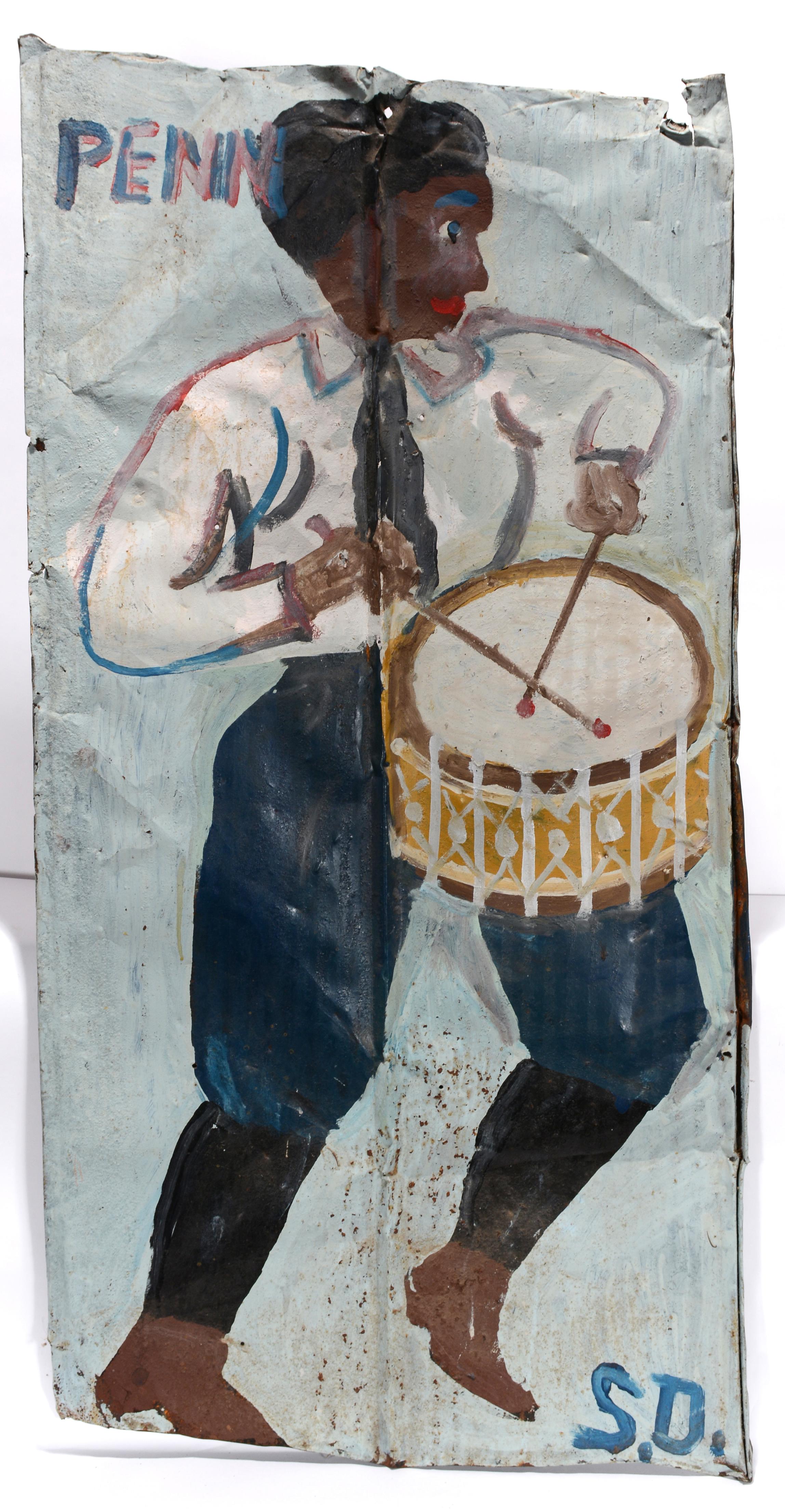
SOLD! Sam Doyle, a Self-Taught African-American Artist, Drums Up $17,000 with Penn Drummer Boy at Slotin Folk Art

Penn Drummer Boy, rendered in house paint on discarded tin roofing material around 1983 by Sam Doyle.

Update: Penn Drummer Boy sold for $17,000.

What you see: Penn Drummer Boy, rendered in house paint on discarded tin roofing material around 1983 by Sam Doyle. Slotin Folk Art estimates it at $15,000 to $20,000.

Who was Sam Doyle? He was an African-American self-taught artist who painted images of people and events in the Gullah community of Saint Helena Island in South Carolina. He made his art with what he could scavenge. Born in 1906, he began painting in 1944 and displayed his works outside his home. Eventually, it evolved into the Saint Helena Out Door Art Gallery. Doyle gained fame after he was included in a groundbreaking 1982 show, Black Folk Art in America: 1930-1980 at the Corcoran Gallery of Art in Washington, D.C. He died in 1985, at the age of 79.

The expert: Steve Slotin of Slotin Folk Art in Buford, Georgia.

How prolific was Sam Doyle? Do we know? There probably is a finite number of works because he was producing for quite a few years and decorating his environment with images. When he got discovered, collectors bought them and he replaced them. There’s at least a thousand works, or it’s in the thousands.

Penn Drummer Boy is undated. Can we narrow down when he might have painted it? The family who owned it bought it directly from his environment. This is 1983 or just right after the Corcoran exhibit. The painting could have been in the yard for a year or two, or he could have just made it.

How often did he paint on metal? The majority of his works are painted on old, used roofing tin. Discarded roofing and discarded house paint was almost free material.

Is Penn Drummer Boy from his Penn series? This image was repeated. That wasn’t uncommon. It’s an image he’d already done, and when it was bought, he made another, and another, and another. When you’re extremely poor and white people come to your community and say, ‘I want one of those,’ you’re going to make one of those. If you wanted a Penn Drummer Boy, he’d make you a Penn Drummer Boy. His paintings reported what went on in his community. He painted people he knew. No one else was documenting what was going on in his community except for him. He would record people of importance, such as the first black butcher. You get a lot of history in his paintings, but you don’t necessarily realize it.

How many Penn Drummer Boy paintings are there? No one knows, but we’ve seen three or four in the last 25 years we’ve been doing this, and we’ve handled two or three.

How similar are they? Pretty much everything is similar to the one before it.  If it’s a midwife holding a baby, it’s the same midwife holding a baby. There’s not a lot of variation.

Sam Doyle attended the Penn school when he was young, and later he became a father. Is there any chance that Penn Drummer Boy is a self-portrait, or maybe a portrait of one of his kids? I would not know that. I’ve studied this guy and what he looks like, and it’s probably not the same person. It could be a very young version of him, but I wouldn’t even go there. There’s no indication. It didn’t occur to me that it would ever be a self-portrait. He may have done one or two self-portraits [in his career].

Was Penn Drummer Boy ever displayed at the outdoor gallery? Everything was displayed in his yard until someone bought it. If you found him and walked onto his property, you could buy it. Nothing was there just for looksies. That was his gallery.

Did Sam Doyle call it a gallery? Who knows what he called it. Everything was nailed to the outside of the walls. It was really an all-outdoor environment. Paintings were leaning against each other. It was not what me and you would say is a gallery.

How rare is it for a Sam Doyle to come to auction? We’ve been really lucky. We get one or two pieces in every sale, which happens every six months. We’ve certainly sold more than anybody else. We have a really good track record of getting the highest prices for our sellers and for the buyers, making sure what we have is correct. We do a really good job of vetting.

Are fakes a problem with Sam Doyle works? There were a few times people tried to pass things off as Sam Doyles, but they’re really quick and easy to spot. We won’t accept those pieces. Anytime money is involved, somebody will try to capitalize and make a quick buck.

So faking a Sam Doyle piece is harder than it looks? Right. A trained artist who mimics folk, self-taught, and outsider art still has training in art. After 25 years of doing this we’re pretty aware of what to look for.

Penn Drummer Boy is fresh to market–it went from Doyle to the consigner to Slotin. Is that rare? For Sam Doyle and for most of the works in the auction, that’s not rare at all. During the period of the 1970s, ’80s, and ’90s, collectors were visiting artists and buying directly from them. The original buyers have started getting older and need to figure out what to do with their art. If the children don’t want it, they sell it. We get a lot of stuff that’s never been sold or offered before.

As of April 6, 2018, about three weeks before the auction, Penn Drummer Boy has been bid up to $3,700. Does that mean anything? What you see online is basically lookie-loos. Most of the action on the piece will be in-house, online, or on the phone. The second that piece hits the auction block, and it’s on the block for 40 seconds to a minute, lots of hands in the auction will bid it up. $3,700 is nothing. It will hit the highest price in-house. That’s where it will go to $15,000, $20,000, $30,000.

What condition is it in? Self-taught artists, especially Sam Doyle, work with found material. This has rust, and holes for nails–that’s expected. You want to see that in a piece. You know it’s real. The colors are strong. It didn’t sit in the environment that long. It’s a pristine piece.

Why will Penn Drummer Boy stick in your memory? This is a really strong piece, in great condition. Those who bought it bought it right from the environment. I like everything it has going on. Everything you want to see in a Sam Doyle is there. It’s got the history. It’s got the colors. It’s easy on the eyes. It’s an all-around nice piece.

How to bid: Sam Doyle’s Penn Drummer Boy is lot 0132 in the Self Taught, Outsider & Folk Art sale on April 28 and 29, 2018 at Slotin Folk Art in Buford, Georgia.

How to subscribe to The Hot BidClick the trio of dots at the upper right of this page.

Image is courtesy of Slotin Folk Art Auction.

Steve Slotin previously spoke to The Hot Bid about a sculpture by Ab the Flag Man which ultimately sold for $1,200.

Would you like to hire Sheila Gibson Stoodley for writing or editing work? Click the word “Menu” at the upper right for contact details.

YES! A Tremendous Mike Japanese Robot Toy Sold for $11,000

A Tremendous Mike robot toy, with original box.

Update: Bertoia Auctions sold the Tremendous Mike robot toy with box for $11,000.

What you see: A Tremendous Mike robot toy, with original box. Bertoia Auctions estimates it at $6,000 to $9,000.

The expert: Auctioneer Michael Bertoia of Bertoia Auctions in Vineland, New Jersey.

Why was this robot toy called Tremendous Mike? Lots of Japanese toys used goofy names. There was Magnificent Mike, a few different Mikes, a few American names. Arguably, it was made for the American market–that’s why the language on the box is in English.

Do we know how many Tremendous Mike robot toys were made, and how many survive? We can’t even take a guess at how many were made. How many are around–that’s easier to take a stab at. I know of at least a dozen in circulation, and that doesn’t include those that are tied up in collections. It’s important to note that what makes the difference between being worth $2,000 or $3,000 versus being worth $10,000, what makes it swing, is its condition, if it has its box, and if the original antenna is still on the top of its head. This guy is fresh, in stellar condition. That’s why it’s so valuable. It might even be old store stock.

And the fact that the original box survives too–does that point to it possibly being old store stock? Exactly. What’s helpful on this box compared to other toy boxes are the graphics. Its a pretty, colorful box. The artwork is not just a sticker on the front of the box. It’s on the sides, too.

How rare is it to see a Tremendous Mike robot toy with its original box? In the last decade, I’ve only seen a few box examples. In general, a robot with its box is harder to come by than a loose example. I know of one Tremendous Mike with box offered through an auction. There was one on eBay a few years ago as well. Those are the only two aside from this one. That said, there’s a little more than a handful of these robot toys without their boxes that have surfaced in the last few years.

What’s the condition of the box? Does its condition matter, given how rare it is for a box to survive at all? In the high-dollar collectors’ market, every scratch matters. The condition of all the pieces and parts are relevant. This box is in really impressive condition. It has a little tear on a flap. The robot is in better shape than the box. The toy doesn’t look like it’s had much play.

How did the Tremendous Mike robot toy and its box survive in such good condition? I often joke that maybe a really bad child had it, because it wasn’t played with often. It’s possible that the robot had several homes throughout its life. It’s hard to believe it would survive years of children playing with it. Maybe the child had a lot of toys and didn’t play with this one much. Often when you see a toy this crisp, and the box is complete, not folded or crushed, that’s an assumption that can be made.

Tremendous Mike is a wind-up toy. What does he do when you turn his key? The wind-up mechanism is pretty cool. Tremendous Mike had action–he was not a simple forward-and-back moving toy. The red glass window in his chest sparkles as he rolls. The satellite dish on his head spins and changes direction after he rolls for a certain distance.

The Tremendous Mike robot toy came in two body colors–red-orange, and grey. Are they equally desirable, or do collectors like one color more than the other? They have the same red accents on both. Red pops a lot more strongly off the grey. It’s a better visual than the red-orange.

How many times has Bertoia handled a Tremendous Mike robot toy? This is the first time in a decade.

What’s the auction record for a Tremendous Mike robot toy with box? It belongs to a red-orange version of the toy sold by Morphy’s in May 2015 that commanded $13,200. (Scroll down to see it.)

Could this Tremendous Mike robot toy with box beat the auction record, do you think? It certainly could. It certainly deserves it. The underbidder [at the Morphy’s 2015 auction] would be satisfied to acquire this example. It’ll take two to make the numbers.

Why will this Tremendous Mike robot toy stick in your memory? Other than my appreciation of the fine name of Mike, it’s very seldom, given the quantity and volumes of toys we handle on a regular basis, that we have to look at one for a long time and research it. If it stumps us, it stands out, because it’s a challenge. I appreciate the challenge. I like to be stumped.

How to bid: The Tremendous Mike with original box is lot 0050 in Bertoia‘s Signature Sale on April 27 and 28, 2018.

How to subscribe to The Hot BidClick the trio of dots at the upper right of this page. You can also follow The Hot Bid on Instagram and follow the author on Twitter.

Image is courtesy of Bertoia Auctions.

Would you like to hire Sheila Gibson Stoodley for writing or editing work? Click the word “Menu” at the upper right for contact details.

SOLD! A Craniometer, Maybe the Only Surviving Example of Its Type, Commands $12,300 at Skinner–More Than Double Its High Estimate

A lacquered brass craniometer, made in the late 19th century by the German company C.F.H. Heineman.

Update: The late 19th century lacquered brass craniometer sold for $12,300–more than double its high estimate.

What you see: A lacquered brass craniometer, made in the late 19th century by the German company C.F.H. Heineman. Skinner estimates it at $4,000 to $6,000.

The expert: Jonathan Dowling, a specialist in the clocks, watches, and scientific instruments department at Skinner.

What’s a craniometer, and how was it used? As it looks, it was to measure skulls. In the 18th and 19th centuries, it was once believed that the shape and size of the skull indicated knowledge. The belief was called craniology. It was a pseudoscience along the lines of phrenology. The craniometer tried to measure each little undulation in a skull. That’s why there’s so many of those spikes. They measure a quarter of an inch to three-quarters of an inch.

Craniology imputed moral character to the size of the skull? That’s a good way of putting it. A bigger skull was considered a better skull.

This tool was made in Germany. Was craniology most popular in Germany? I would not say that. Braunschweig, Germany was a well-known area for producing medical instruments. This might be the only surviving example. Many think there was a very limited run because of the quality.

Are the parts of the craniometer labeled in German? No.

So we don’t know what qualities the craniometer was supposed to measure? It is a mystery. It all depends on where you chose to put the skull.

Why does the craniometer look like this? Why are the pins the length that they are? I think the pins are of this length to accommodate different sizes of skull. And you have to have a skull. You could not put a person in this.

Does the skull rotate or spin within the brass rings? The skull itself does not rotate. But the brass column can be turned manually, 360 degrees.

How were craniometer measurements taken? Around both spheres, there are numerical engravings. Let’s say you’re using the pin through number 17. You measure, you mark, you pull out the pin, and that gives you a measurement for where the pin falls on the skull for number 17. Number 17 is some sort of moral aspect.

Are you auctioning it with or without a skull? The skull is for display. It’s a real skull, a human skull. It is part of the lot.

How many pins are there? I think there are 40 pins. Down below the turned column, on the brass plate mounted in the ebony base, there are holes to hold the pins.

What are the tips of the pins made from? Bone. Turned bone.

Why? That’s not an obvious choice. I think it’s where the quality of the piece surpasses the average piece. The quality of it takes it to a different level.

Have you seen other craniometers? How do they measure up to this one? I haven’t seen others in person, but I have seen them in my research. They’re very crude. They’re less intricate, less detail-oriented. With this one, the tolerances are so tight where the pins go through the uprights–that’s a mark of quality. The castings of the rings are very well done also.

Can we tell if it was made for someone in private practice, or as a teaching model? We cannot tell. In my research, I was not able to find the purpose for this. I don’t know if it’s for a doctor or a teaching tool.

How did the craniometer come to you? This, along with several of the lots in the sale–a few phrenology heads, a medical teaching model–came from a private collector in Massachusetts.

Why will this craniometer stick in your memory? The sculptural quality. That’s how I look at it. As a craftsman myself, the quality of the instrument says something to me. I don’t know if I’ll ever handle another piece like this.

How to bid: The craniometer is lot 560 in the Clocks, Watches & Scientific Instruments sale at Skinner on April 20, 2018.

How to subscribe to The Hot BidClick the trio of dots at the upper right of this page. You can also follow The Hot Bid on Instagram and follow the author on Twitter.

You can follow Skinner on Twitter and Instagram.

Text is copyright Sheila Gibson Stoodley. Image is courtesy of Skinner.

Jonathan Dowling spoke to The Hot Bid in 2017 about a unique mid-century model airplane that ultimately sold for $11,070 at Skinner.

Would you like to hire Sheila Gibson Stoodley for writing or editing work? Click the word “Menu” at the upper right for contact details.

Wow! Pete Townshend Smashed A 1964 Fender Stratocaster On Stage. Its Wreckage Sold for $30,000

A 1964 sonic blue Fender Stratocaster "smasher,"--a guitar played on stage and smashed by Pete Townshend of The Who--on December 1, 1967 at Long Island Arena in Commack, New York.

Update: The 1964 sonic blue Fender Stratocaster smashed on stage by Pete Townshend sold for $30,000.

What you see: A 1964 sonic blue Fender Stratocaster “smasher,”–a guitar played on stage and smashed by Pete Townshend of The Who–on December 1, 1967 at Long Island Arena in Commack, New York. Heritage Auctions estimates it at $15,000 to $20,000.

Who is Pete Townshend? He’s the lead guitarist and lead songwriter for the legendary British rock band, The Who, which played its first concert in 1964. Townshend also first smashed a guitar on stage in that year. The band’s hits include My Generation, Baba O’Riley, Won’t Get Fooled Again, Magic Bus, and Pinball Wizard, a song from the 1969 rock opera, Tommy. Townshend will turn 73 in May 2018.

How rare are genuine stage-played 1960s-era smashed Pete Townshend guitars? “Very rare,” says Garry Shrum, director of entertainment and music memorabilia for Heritage Auctions. “Usually Pete smashed a guitar until it was in shreds. I know a couple of collectors who own multiple stage-played guitars. I know one guy who bought several smashers to make one whole guitar–he Frankensteined it together. But it’s very rare to find one from the 1960s. People didn’t keep them. If it was in the crowd, it was a dive-fest. People wanted a piece of that guitar.”

How many Townshend smashers have you handled? “Two, and I’ve been at Heritage for 14 years,” he says. “Before that, I had a shop for 30 years. People brought in smashers to share with me, but they wouldn’t let me buy them off them.”

Has anyone tried to document how many times Townshend smashed a guitar on stage? “There’s got to be something, somewhere. Someone might have tried to document it, but I have not seen it,” he says. “I wish I had the answer, but I don’t. But he smashed guitars hundreds of times.” [After we spoke, I found a heroic stab at a list on thewho.net. Scroll down for the link.]

I was going to ask if this smasher was worth less because it isn’t complete, but hearing you speak, I get the impression that it’s unusually complete. “Exactly. You have to get the neck and some pickups to make it complete, but you generally don’t get that chance at all,” he says. “It’s a great piece of music history. Over the years, other people have broken guitars on stage, but it was all spawned by Pete in the ’60s.”

Townshend smashed hundreds of guitars on stage? Didn’t that get expensive after a while? “In the early years, he used cheaper guitars, but it got expensive,” he says, noting that Fenders “were imported to the U.K., and the pound versus dollar exchange made it more expensive for him. Probably £400 to £700 for a guitar every time he picked one up.”

This smasher doesn’t have a neck, but it does have its neck plate, which contains the guitar’s serial number. Does that help prove that Townshend played it and smashed it on stage? “In most cases, you don’t see the neck plate. You see half of a guitar. Once he started breaking it, the plate went because of the neck,” he says. “Pete would throw the whole thing into the crowd, and people would rip it to pieces. Somebody got the plate, somebody got the pickups, somebody got the headstock, somebody got the strings. The neck plate helps date it. It’s a stronger provenance of the time period. But there’s no way to trace it back [to Townshend]. After two or three years, music stores threw out their paper receipts. There was no reason for them to keep them. Guitar-collecting didn’t get serious until the mid-1970s.”

Is it rare for a smasher to have accompanying documents, as this one does? [It comes with a ticket stub from the December 1, 1967 show and a two-page handwritten account of how the original owner caught it.] “That’s rare, and that’s so cool, because we can date it,” he says. “A lot of times it’s a hearsay story. When you have other pieces of paper, a paper trail, it’s more exciting to talk about. You can close your eyes and picture the whole thing happening.”

Are Townshend smashers worth more than stage-played guitars that he didn’t smash? “No. An original 1964 Fender Stratocaster is worth money on its own, without a Pete Townshend provenance,” he says. “They sell for $16,000 to $20,000, depending on condition. If Pete played it during that period, it’s easily over $100,000. This is broken. We hope it’s worth $15,000 to $20,000, maybe more. All it takes is two people to push it up.”

What’s the auction record for a Townshend smasher? Is it higher than the record for an intact Townshend-played guitar? The auction record for a smasher as well as an intact guitar appears to belong to a lot sold at Bonhams London, Knightsbridge in December 2015. It contained a pair of Rickenbachers–one whole and one destroyed on stage during The Who’s 25th anniversary tour in 1989, along with a signed November 2014 statement from Townshend about them both. The lot sold for £52,500, or $73,934.

You set the opening bid for this guitar at $10,000. Why? “The consigner hopes to get at least $10,000,” he says. “We wanted it in the auction because it was such a cool, rare piece. You can’t go on eBay and find it. That’s not gonna happen.”

Why will this Townshend smasher stick in your memory? “I have certain bands I admire. I had a shop, and I had the advantage of going backstage to meet people,” he says. “In 1970, I hung out with The Who on the fifth floor of the Hilton San Diego. My wife was 17, and I was 18. It was one of those time periods when I thought, ‘Is this really happening? I’ve spent three hours talking about music with John Entwhistle.’ Keith Moon was doing crazy stuff. Pete and Roger didn’t stick around. They had girls. Anything from The Who that comes in makes me think about the time I spent then. It’s part of my history with music, and with the band itself.”

How to bid: The Pete Townshend Fender Stratocaster smasher is lot #89636 in Heritage Auctions‘s Entertainment & Music Memorabilia Signature Auction on April 15, 2018.

How to subscribe to The Hot BidClick the trio of dots at the upper right of this page. You can also follow The Hot Bid on Instagram and follow the author on Twitter.

Heritage Auctions is on Twitter and Instagram.

Image is courtesy of Heritage Auctions.

By clicking through to the lot, you can also see a photograph of Townsend playing the guitar in classic windmill style on stage, as well as images of the handwritten account of the December 1967 concert.

The folks behind thewho.net have assembled a list of guitars that Pete Townshend smashed over the years. The guitar being auctioned at Heritage is included.

Would you like to hire Sheila Gibson Stoodley for writing or editing work? Click the word “Menu” at the upper right for contact details.

SOLD! A Louis Tavelli Tryptic Sells at Rago for (Scroll Down to See)

2214

Update: The Louis Tavelli tryptic sold for $5,625–a new auction record for the artist.

What you see: Untitled (hunters and bulls), a 1991 tryptic by Louis Tavelli. Rago Auctions estimates it at $4,000 to $6,000.

Who was Louis Tavelli? He was an American musician and abstract expressionist whose art career spanned six decades. Born in Williamstown, Massachusetts, which is home to Williams College and the Clark museum of art, he mostly lived there and in Woodstock, New York throughout his life. Tavelli’s earlier works were influenced by music, but a 1983 trip to Spain with his chamber music group changed him forever. He took a side trip to Altamira, a cave decorated with paintings that are at least 15,000 years old, and after that, his artworks reflected the effect that the ancient, unnamed cave paintings had on him. Tavelli sometimes staged one-man gallery shows and participated in museum shows, but it’s unclear if he ever had steady gallery representation. He died in 2010, at the age of 96.

This Louis Tavelli tryptic is monumental–each of the three panels measures 59 1/2 by 36 inches. Did Tavelli normally work at that scale? “He did like to work big like this,” says Arlen Sam Brown, design specialist at Rago. “He created art his whole life, and it morphed into a graffiti-like style. His earlier works paid homage to music. But there was definitely a switch, a change, and he went a little more Basquiat-like.”

This Louis Tavelli tryptic belongs to his Indigenous Peoples Series of works, which he started after viewing prehistoric cave paintings in Altamira, Spain. Are all of the pieces from the series as large? And how many pieces are in the series? “He did do other pieces that were large, but they’re not all on that scale. He did works on paper as well,” she says, noting that there are at least 60 to 70 works in the series.

It seems like Louis Tavelli didn’t concern himself with promoting or selling his work. The earliest auction result for him is in 2011, a year after his death. Was he only discovered as an artist after he died? “He had local showings, and he did exhibit his work, but he remained regional. It was not shared publicly until he passed away,” she said, noting that his output is still being cataloged. “What’s exciting about this work is it came to market in a strong capacity. We’ve had the good fortune to roll his work out on a stronger scale, and we’ve had good results.”

Rago set the world auction record for Louis Tavelli in June 2017 with an untitled, undated mixed media collage on paper that sold for $4,063 against an estimate of $800 to $1,200. Was that work also part of his Indigenous Peoples Series? And what are the odds that Untitled (hunters and bulls) will set a new auction record for the artist? She says the mixed-media collage is from the same thematic series, and says there’s a “strong likelihood” that the tryptic will break the record.

Untitled (hunters and bulls) is estimated at $4,000 to $6,000. Did its large size have any influence on its estimate? “Its size informs the estimate, but it’s not what made the decision,” she says. “We had a discussion with [the consigner,] whose perception was, ‘It’s three times the size, so it should be three times the estimate.’ That’s not the case… We truly believe in being very grounded in our estimations. We believe in basing them on auction results. While Tavelli is being well-received, we maintain our integrity. He’s a relatively unknown artist. I’m not sure if you’d call him an emerging artist. You don’t need to be young to be emerging.”

Where do you think the market for Louis Tavelli works is going? “I think the notion that it’s still being shaped is very accurate,” she says. “It’s limitless because it’s fresh. I’ve been pleased and surprised by the reactions to each sale. Tavelli is getting more attention with each one, which is cool.”

Why will this Louis Tavelli work stick in your memory? “It stops you in your tracks, no question,” she says. “It’s a pretty intense piece. The people are almost stick figure-like. It’s almost like a cave drawing.”

How to bid: Untitled (hunters and bulls) is lot 2214 in Remix: Contemporary + Classic, a sale taking place at Rago Auctions on April 7, 2018.

How to subscribe to The Hot BidClick the trio of dots at the upper right of this page. You can also follow The Hot Bid on Instagram and follow the author on Twitter.

Rago Auctions is on Twitter and Instagram.

Image is courtesy of Rago Auctions.

Louis Tavelli has a website.

Would you like to hire Sheila Gibson Stoodley for writing or editing work? Click the word “Menu” at the upper right for contact details.

SOLD! A Japanese Poster for Akira Kurosawa’s Seven Samurai Fetched $22,705 at Heritage Auctions

A 1954 Japanese movie poster for Seven Samurai (Shichinin no Samurai). It is the only known example of its type. The kanji on the poster translate to: "The dream awaited by 70 million finally has come true! A massive spectacular samurai drama which is created, for the first time, by the fighting spirit of the Maestro!"

Update: The 1954 Japanese movie poster for Seven Samurai sold for $22,705.

What you see: A 1954 Japanese movie poster for Seven Samurai (Shichinin no Samurai). It is the only known example of its type. Heritage Auctions estimates it at $20,000 to $50,000. The kanji on the poster translate to: “The dream awaited by 70 million finally has come true! A massive spectacular samurai drama which is created, for the first time, by the fighting spirit of the Maestro!”

Do we know how this Japanese movie poster for Seven Samurai was discovered? Grey Smith, director of vintage movie poster auctions at Heritage Auctions, says it came to him via a friend who knew the owner. The poster had been in Japan from 1954 until three or four months ago. “I’d never seen it before,” he says. “I’m not aware of another copy.”

The poster is 21 inches by 58 inches–long and skinny. I’m wondering if this is a standard size for a Japanese movie poster, or if the poster was made at this size to imitate a Japanese scroll or painting. “You would think it might, but it was a commonly used size in Japan,” he says, adding that it’s comprised of two panels that are stacked on top of each other. Look for the samurai dressed in a green top and brown pants at the center of the poster, and you’ll see the join. (The samurai’s left hand doesn’t quite line up with his wrist.)

Is the design of the Seven Samurai poster typical for Japan in 1954? “I’ve always admired Japanese movie posters from the ’40s, ’50s, and ’60s,” he says. “They were ahead of their time in photo montage work, they really were. America just wasn’t as interested in movie posters then, and you can see it. All the interest was in television by then. Compare it [the Seven Samurai poster] to Cat Ballouthat poster is totally lackluster.”

I’m pleasantly surprised that women appear on the Japanese movie poster for Seven Samurai. I was under the impression it was a manly-man type of movie. “It had romantic elements, but it was a male-dominated film about war,” he says, adding that featuring women on posters was not unusual in Japan in 1954: “On Japanese posters from the ’50s and ’60s, 85 percent of the time, there’s a female lead on it.”

What condition is the Japanese movie poster for Seven Samurai in? Heritage Auctions calls it Very Fine – (Minus), which Smith deems “A pretty good grade. It was folded. Most Japanese posters were. It has little nicks and dings in it. But it doesn’t need to be archivally restored. You could frame it like it is.” He also explains that in Japan, theatre owners sometimes stuck a snipe–a piece of paper that listed specific screening dates–to the bottom of a poster. Posters can suffer damage if someone tries to remove the snipe, but it doesn’t look like a snipe was applied to this Seven Samurai example.

We’re talking on March 20, 2018, and this Japanese movie poster for Seven Samurai already has a bid of $10,000 on it. The auction is almost three weeks away. How do you think the poster will do? “I hope it will be north of $25,000 or $30,000, but we just don’t know,” he says. “I think the estimate was $20,000 to $50,000. I’ll be disappointed if it sold for under $20,000.”

Do you know what the auction record is for a Japanese movie poster for a Japanese film? “I don’t know. It’s hard for me to say specifically, but in 2005 at Heritage Auctions, I sold a 1954 Godzilla poster for $21,850,” he says.

What will make this Japanese movie poster for Seven Samurai stick in your memory? “I’m excited about it because it’s never been seen before,” he says. “Personally, I always love to get new items into auction.”

How to bid: The 1954 Japanese movie poster for The Seven Samurai is lot #86137 in the Movie Posters Signature Auction at Heritage Auctions on April 7 and 8, 2018.

How to subscribe to The Hot BidClick the trio of dots at the upper right of this page. You can also follow The Hot Bid on Instagram and follow the author on Twitter.

Heritage Auctions is on Twitter and Instagram.

Image is courtesy of Heritage Auctions.

Would you like to hire Sheila Gibson Stoodley for writing or editing work? Click the word “Menu” at the upper right for contact details.

Thank You For Being a Friend! Rue McClanahan’s Golden Girls Letterman Jacket Could Command $4,500 at Potter & Potter

A circa 1980s wool, leather, and nylon Golden Girls letterman jacket, size L, personalized for Rue McClanahan. It's one of four; the other three went to her co-stars on the beloved sitcom. It comes with a Certificate of Authenticity (COA) from McClanahan's estate.

What you see: A circa 1980s wool, leather, and nylon Golden Girls letterman jacket, size L, personalized for Rue McClanahan. It’s one of four; the other three went to her co-stars on the beloved sitcom. It comes with a Certificate of Authenticity (COA) from McClanahan’s estate. Potter & Potter estimates it at $2,500 to $4,500.

Do we know why this Golden Girls letterman jacket was commissioned? “We don’t,” says Gabe Fajuri, president of Potter & Potter. “But they were generally made as 100th episode gifts, or after a season ended, or to mark an anniversary. We don’t know when she would have gotten this.”

Are there any pictures of McClanahan wearing this jacket, or any pictures of all four Golden Girls leads wearing their jackets? “We weren’t able to find any,” he says. “There are other clothing lots in the auction where we have photos of McClanahan wearing the clothes, but not for this one.”

Have any of the other three Golden Girls letterman jackets appeared at auction? We don’t know, but the consigner bought several McClanahan pieces directly from the estate of the actress, who died in 2010 at the age of 76. The jacket is the marquee item among 27 McClanahan lots in the Potter & Potter auction.

McClanahan’s Golden Girls jacket is described as being in “fine” condition. What does that mean? “Almost unworn. It looks almost new,” he says.

How did you arrive at the estimate of $2,500 to $4,500? “It’s a combination of market expertise and researching similar celebrity costumes and clothes, and looking at demand for the person,” he says.”The consigner thinks it’s worth a lot more. We’ll see on auction day.”

Have you tried it on? He laughs heartily and says, “No!”

Why will this jacket stick in your memory? “We’ve had movie star clothes and costumes, but not a letterman jacket,” he says. “It’s a high-quality thing. They didn’t order it from a cheap catalog. They obviously went to the trouble to make it very attractive.”

How to bid: Rue McClanahan’s Golden Girls letterman jacket is lot 616 in Potter & Potter‘s Entertainment Memorabilia auction, scheduled for April 7, 2018.

How to subscribe to The Hot BidClick the trio of dots at the upper right of this page. You can also follow The Hot Bid on Instagram and follow the author on Twitter.

Follow Potter & Potter on Instagram and Twitter.

Text is copyright Sheila Gibson Stoodley. Image is courtesy of Potter & Potter.

Would you like to hire Sheila Gibson Stoodley for writing or editing work? Click the word “Menu” at the upper right for contact details.

Emperor Jones Prints by Aaron Douglas Could Command $30,000 at Swann

Defiance, one of four prints from the Emperor Jones series by Aaron Douglas. It's from a small group of reprints done with the same wood blocks in 1972, almost 50 years after the originals.

What you see: Defiance, one of four prints from the Emperor Jones series by Aaron Douglas. It’s from a small group of reprints done with the same wood blocks in 1972, almost 50 years after the originals. Swann Auction Galleries estimates the set at $20,000 to $30,000.

Who was Aaron Douglas? He was a Kansas-born African-American painter, graphic artist, and muralist who was at the center of the Harlem Renaissance, a flowering of African-American cultural talent that bloomed in the Harlem section of New York City in the 1920s. His illustrations for Alain Locke’s 1925 book, The New Negro: An Interpretation led to a series of commissions from figures who led the Harlem Renaissance. In 1944, Douglas founded the art department at Fisk University, a university in Nashville, Tennessee, and led it for 22 years. He died in 1979 at the age of 79.

Was Aaron Douglas known as a printmaker, or was this series based on the Eugene O’Neill play Emperor Jones a one-off? “He was not known as a printmaker, and they’re the only wood block prints I’m aware of off the top of my head,” says Nigel Freeman, director of Swann’s African-American fine art department. “It’s from his classic Harlem Renaissance period. It’s unclear when [the prints] were commissioned, but he was published in other magazines at the time. It’s not surprising that he was tapped to do an interpretation of Emperor Jones.”

Best as we can tell, a small but indeterminate number of Emperor Jones prints were made in 1926, and then three more sets of reprints–15, 15, and finally 20–were made in 1972, with Douglas assisted by printmaker Stephanie Pogue. Do we know why the printing was done that way? “The blocks were first carved in 1926. Pogue assisted Douglas at the end of his career. The blocks themselves did not change,” he says. “It’s not unusual for an artist who made prints in the 1920s not to do large numbered editions of prints. It’s not like a contemporary print that’s editioned and sold through a gallery. Later in Douglas’s life, people asked for his works, and he decided to reprint the wood blocks. Why there are three separate reprintings, I don’t know. Maybe they sold out and he did more.”

Are the 1926 prints and the 1972 prints consistent in quality? “If you have your choice, you always want earlier printings. But there are very few examples of Emperor Jones prints done in the 1920s,” he says, noting that the only early set of four that Freeman has seen appeared in a museum exhibition. “There’s not a significant difference in the way they look. They’re printed from the same blocks. There’s not really a significant quality difference. She helped him print a strong impression. They’re more or less the same.”

There might be as many as 100 sets of Emperor Jones prints out there, but the Swann lot notes describe them as scarce. What makes them scarce? Are most of them in museum collections? Were some sets lost? Are collectors just reluctant to let them go? “You just don’t see them coming to auction that often,” he says. “We’ve only had a set once before in my department , and we see a lot of work. They’re things you don’t see very often.”

What’s the auction record for a set of Emperor Jones prints, and what’s the auction record for anything by Aaron Douglas? The Emperor Jones record was set at Swann in October 2008 when a group sold for $22,800. Swann also handled an original 1926 gouache of an Emperor Jones image that sold for $90,000 against an estimate of $35,000 to $50,000 in February 2008. A smallish 1944 painting by Aaron Douglas, Building More Stately Mansions, holds the record for any Douglas work at auction. Swann sold it for $600,000 against an estimate of $100,000 to $150,000 in February 2008.

Why will these Emperor Jones prints stick in your memory? “It’s his classic Harlem Renaissance graphic style. This is the style everyone equates with Aaron Douglas. This is what people think of, what they associate with him the most,” he says. “This is a scarce opportunity to acquire an original work of art in that style. The reason Douglas had such success is he was a very talented graphic artist and designer who was able to synthesize the design ideas and the Art Deco style of the period and infuse it with a strong African-American voice. The black silhouette became about the black figure. He created a depiction of African-Americans that was modern and a celebration of African-American culture, which fit right into the idea of the Harlem Renaissance.”

How to bid: The group of Emperor Jones prints by Aaron Douglas is lot 7 in the African-American Fine Art sale at Swann Auction Galleries on April 5, 2018.

How to subscribe to The Hot BidClick the trio of dots at the upper right of this page. You can also follow The Hot Bid on Instagram and follow the author on Twitter.

Swann Galleries is on Instagram and Twitter.

Image is courtesy of Swann Auction Galleries.

Would you like to hire Sheila Gibson Stoodley for writing or editing work? Click the word “Menu” at the upper right for contact details.
SOLD! Batman’s 1939 Comic Book Debut Sold for Almost $570,000

A May 1939 copy of Detective Comics #27, which featured the debut of Batman. It has a Certified Guaranty Company (CGC) universal grade of 5.0.

Update: The May 1939 copy of Detective Comics #27, featuring the debut of Batman and holding a CGC universal grade of 5.0, sold for $569,273.61.

What you see: A May 1939 copy of Detective Comics #27, which featured the debut of Batman. It has a Certified Guaranty Company (CGC) universal grade of 5.0. Hake’s Americana & Collectibles estimates the comic book’s value in excess of $500,000.

How often do copies of Detective Comics #27 come to auction? “Not often. The caveat is this is universal grade. It’s in its original state–no restoration, no conservation. When you factor that in, it appears even less often,” says Alex Winter, President of Hake’s Americana & Collectibles. “Most copies are not in the original state.”

How many copies of Detective Comics #27 have a CGC grade higher than 5.0? “The CGC census has a total of 67 copies. Only 32 are universal. All the others have restoration,” he says. “Of the universals, there are 16 rated higher and 15 rated lower. 5.0 is mid-grade, but with the universal label, it’s a high grade. 5.0 is very acceptable for a book of this age with no restoration.” He also adds, “Batman is rarer as far as graded universal copies, and Batman is certainly more popular in movies than Superman. I think it’s only a matter of time before Detective Comics #27 eclipses Action Comics #1 [Superman’s debut]. It’s a rarer book.”

But we should say–not every copy of Detective Comics #27 is reflected the CGC census– just those that were sent to CGC for grading. “Yes, but CGC is the top of the mountain,” he says. “It’s the preferred grading company.”

Why are comic books that feature the debut of a major character the most sought-after by collectors? “For the same reason that rookie cards are popular,” he says. “People gravitate to where a star started. Typically, with the debut of a character, they don’t have established track record, so the print run is lower,” he says, noting, “Batman didn’t appear in Detective Comics #1. Whatever worked got its own book. When the popularity was there, Batman got his own title.”

Batman is on the cover of Detective Comics #27, which has a banner announcing that his adventures are “starting this issue.” Would the comic book’s value be affected if Batman was not on the cover? “Not much at all,” he says. “There are character debuts that are not touted on the cover. It certainly helps, but it doesn’t have any bearing. It’d still be the first appearance of Batman even if Batman wasn’t on the cover. And it wasn’t like he was on the cover of the next issue. The issue was created months ahead of its appearance on the newsstand. The creators would see if something worked, and then they’d take the next step.”

How rare is it to have a comic book consigned almost directly from the person who bought it off the rack as a little kid, decades ago? “Pretty rare. It didn’t come directly from that person. There was one middle-man in between. But it’s still fresh to market,” he says. “To have a new discovery like this is a rare opportunity. People are fairly excited about that.”

Is the original owner still alive? How old was he when he bought this comic book? Yes, he is, and we’re not sure. “He certainly was a child when the book came out,” he says. “Maybe he was 10 years old.”

Why does the comic book have a 5.0 rating from CGC? “It has cover blemishes,” he says, pointing out the fact that the original owner wrote “Vol. 3 No. 3” at the top of the cover. “There’s a split on the spine, some dust, some soiling, some age. It’s what you’d expect of a book that’s been read several times. But it wasn’t rolled up, and it wasn’t put in his back pocket. The colors are strong and bold, with no fading.”

How did you arrive at the presale estimate of “in excess of $500,000”? “We have set price ranges,” he says, referring to the Overstreet Comic Book Price Guide. “But it’s very subjective, especially for a comic book that turns up as infrequently as this one. It’s a very, very volatile market when you have something like this, where there’s a lot of people lined up and not enough copies for those people.” This particular copy is the first Detective Comics #27 that Hake’s has handled in its 51 years of existence.

Why will this comic book stick in your memory? “Because it’s so historic,” Winter says. “This is right up there. It’s like a 1952 Topps Mickey Mantle baseball card. It’s an iconic item that transcends collecting. It’s easily identifiable as a piece of pop culture, and you don’t have to be a comic book fan or a Batman fan to appreciate it. It’s rewarding to have a high-caliber piece like this, and it’s exciting that it’s fresh to market.”

How to bid: The copy of Detective Comics #27 is item 1152 in the Hake’s Americana & Collectibles sale that opens on February 20, 2018 and closes on March 15, 2018.

How to subscribe to The Hot BidClick the trio of dots at the upper right of this page. You can also follow The Hot Bid on Instagram and follow the author on Twitter.

Hake’s Americana & Collectibles is on Twitter and Instagram, too.

Image is courtesy of Hake’s.

Would you like to hire Sheila Gibson Stoodley for writing or editing work? Click the word “Menu” at the upper right for contact details.

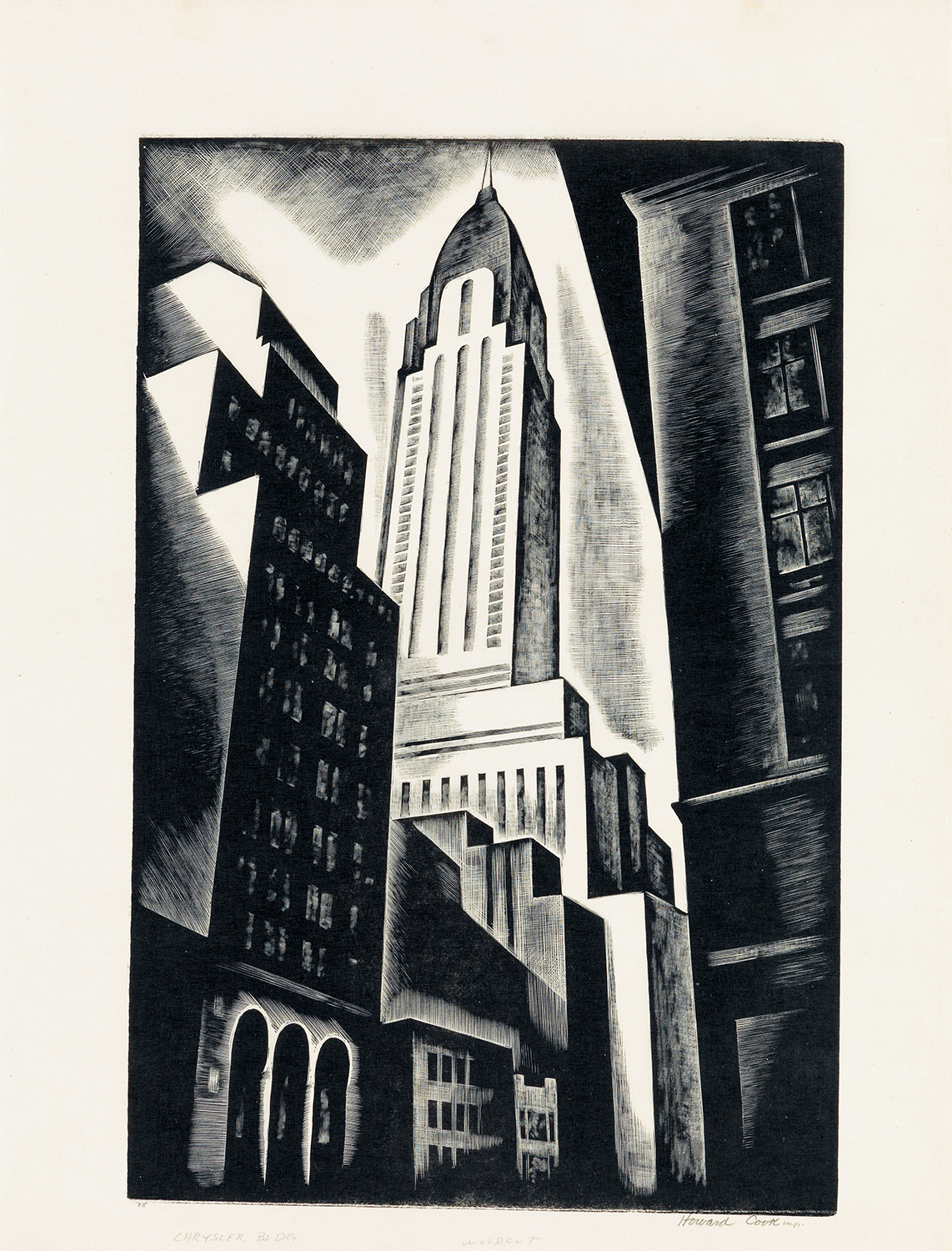
SOLD! A Howard Cook Print of the Chrysler Building Commanded $10,625 at Swann Galleries

Chrysler Building, a 1930 print by Howard Cook.

Update: The Howard Cook print featuring the Chrysler Building sold for $10,625.

What you see: Chrysler Building, a print by Howard Cook. Swann estimates it at $10,000 to $15,000.

Who was Howard Cook? Born in Springfield, Massachusetts, Cook created watercolors and WPA murals but is best known for his prints. He earned Guggenheim Fellowships twice, in 1932 and 1934, and his works are in the collections of the British Museum, the Smithsonian Art Museum, Harvard University, the Whitney, and the Met, among others. Though he was enamored of the American southwest and ultimately settled there, he spent the late 1920s and early 1930s in New York City. He died in 1980 at the age of 78.

How popular is Howard Cook among collectors, and how prolific was he? “He’s very popular. When it comes to those who collect 20th century prints and American views, he’s one of the top artists. That’s been true since American prints began to flourish at auction 25 years ago,” says Todd Weyman, vice president at Swann and director of prints and drawings. “He made over 225 different prints in all media–woodcuts, lithographs, etching. He was prolific compared to Grant Wood, who made 20 lithographs, and Edward Hopper, who made maybe 50 different etchings.”

How sought-after are Howard Cook’s New York images? “Very. They’re the top of his market,” he says. “His views are either panoramic views or singular buildings.”

M37328-1 004

How does Howard Cook’s choice of subject matter–the Chrysler Building–affect the value of this print? “It’s great. It’s an iconic building. The print dates from the year of the completion of the building [1930]. It’s just what collectors want,” he says. “It’s from the Art Deco period, so it’s less static than the Empire State Building.”

Is Howard Cook’s Chrysler Building a stand-alone print, or is it part of a series? “Of the 225 images he printed in his career, he did 30 views of New York,” he says. “All were stand-alone. Cook was not a serial printmaker.”

What would he have based this print upon? Did Howard Cook take a photograph of the Chrysler Building from this angle? Did he stand on the street and make sketches? “We don’t know of him as a photographer,” he says. “My thinking is he sketched it in person, and he knew it from photographs. But he was not known for working from photographs.”

Is this Cook’s only depiction of the Chrysler Building? Yes. “He did other skyscrapers in New York more generally,” he says. “We have another one in the sale, the lot before this one, of Wall Street, and there are skyscrapers in it, but it’s not the sort of grand, isolated building view [like the Chrysler Building].”

How involved was he in the creation of his prints? Did he pull them himself, or did he oversee the work of professional printmakers? “Cook was very much involved in making his prints, from start to finish,” he says, noting that the only time he relied on others was when he created lithographs. “He would come up with the idea for the print, he etched it, and he pulled it on his own press.”

The lot notes for Howard Cook’s Chrysler Building say this was an ‘edition of 50 (from an intended edition of 75),’ and also that it is ‘numbered ’75’ in pencil.’ I’m not sure I understand what’s going on here. Could you explain? “When he worked on editions himself through his gallery, the Weyhe Gallery in New York, he would propose an edition number, and would print them in batches of maybe ten or 20 at a time and deliver them to be sold on his behalf,” he says. “Over a period of a couple of years, he was able to sell only so many. He never reached his printing goal of 75. We know this through the artist’s notes and gallery sales records.”

So what does the number ’75’ actually mean here? “That was what he hoped the edition would be,” he says. “These prints were not numbered in the traditional sense. He would intend for an overall edition at the start of the process and would deliver batches at a time to the gallery. It’s not like they were sequentially numbered. Chrysler Building was going to be an edition of 75 until he couldn’t sell more than 50 or so. We know it wasn’t 75.”

Sometimes, when there’s a large press run of an art print, the early ones look better and crisper than the later ones. Does the batch printing approach that Cook took with Chrysler Building affect the quality of the prints? Is their quality consistently high? “Each was printed more or less identically,” he says. “It’s not like number one is more or lesser than number twenty. Because they’re smaller editions, there’s such attention to detail and quality. He didn’t let anything of lesser quality out to the gallery.”

How often does Howard Cook’s Chrysler Building come to auction? “It’s a scarce one. We’ve seen less than ten at auction in the last 30 years,” he says, noting that the number might not represent ten individual prints–the same print could have gone to auction twice or more in that time. He adds that the auction record for Chrysler Building was set at Swann in November 2015 when one sold for $17,500, and four of Cook’s top ten most-expensive lots at auction have been Chrysler Building prints; first place belongs to a 1930 panoramic New York City scene called Harbor Skyline.

Was Chrysler Building a tricky print to make? “If you look at the imaging, look at the lines, they’re very detailed, almost hairline in the shadows,” he says. “That requires great attention to detail, and it [the ink] would have been hand-applied to the block. To have the blacks as rich as they are in the shadow areas, with no breaks or wear, is stunning. It looks like photographic perfection when you see it.”

What makes this print stick in your memory? “You can see the craft in it,” he says. “It has such a precision to it, on such a small scale–it’s only 10 1/8 inches by 6 3/4 inches–but he’s able to show the grandeur of the city. You really get the sense of a soaring city in such a small format.”

How to bid: Howard Cook’s Chrysler Building is lot 195 in Swann‘s 19th & 20th Century Prints & Drawings auction on March 13, 2018.

How to subscribe to The Hot BidClick the trio of dots at the upper right of this page. You can also follow The Hot Bid on Instagram and follow the author on Twitter.

Swann Galleries is on Instagram and Twitter.

Image is courtesy of Swann Auction Galleries.

Would you like to hire Sheila Gibson Stoodley for writing or editing work? Click the word “Menu” at the upper right for contact details.
SOLD! The 1964 Bride of Frankenstein French Re-release Movie Poster, Estimated at $300 to $500, Commanded $250

A French poster for the 1964 re-release of the 1935 classic horror movie Bride of Frankenstein

Update: The French movie poster for the 1964 re-release of Bride of Frankenstein sold for $250.

What you see: A French poster for the 1964 re-release of the 1935 classic horror movie Bride of Frankenstein. Julien’s Auctions estimates it at $300 to $500.

This Bride of Frankenstein poster was designed for the French market, and for a 1964 re-release of the film, which by then had a long reputation as a cinema classic. How does that affect the poster’s value? “Awareness of international designs is changing, and awareness of how scarce and rare they are is changing,” says consigner Neville Tuli, founder and chairman of the Osian group, which includes the Osianama Archives of world film memorabilia based in New Delhi, India. “I feel sad that the French design has not had its due. France is the home of posters. It’s difficult because the suppliers and distributors [of this re-release poster] didn’t keep archives in a historical manner.”

Some of the most expensive movie posters at auction have advertised 1930s horror movies. The world auction record belongs to a 1931 Dracula poster, sold in 2017 for more than $525,000, and 1930s horror movie posters have consistently fetched six-figure sums at auction. How might these strong sales influence the bidding for this Bride of Frankenstein 1964 French re-release poster? “Obviously, it will have a positive impact,” he says. “First releases of movie posters, you get them once in ten years, and they now sell for in excess of $300,000 and $400,000. Collectors are now looking for re-releases and posters from other countries.”

Why is this Bride of Frankenstein 1964 French re-release poster estimated at $300 to $500? “Everything is estimated very low, the way most auctions like to,” he says. “People like to think they’re getting a bargain. If it passes $3,000 to $4,000, that’s a fair price.”

Why are so many Bride of Frankenstein movie posters so visually strong? “The Bride of Frankenstein, even though she’s barely on the screen, captured the imagination of the world–the hairstyle, the whole look,” he says. “If you see post-1935 posters [for the movie], she’s given as much [visual] importance [as Frankenstein], sometimes even more. She has such a remarkable face. She naturally attracted the public when she appeared on publicity materials,” he says, noting that it was not just common but imperative for movie marketers to redesign and release new posters that capitalized on breakout stars. “If you see the original poster for Marilyn Monroe’s film, Asphalt Jungle,  she’s not there. [There are several poster designs for the 1950 film, and some show Monroe, but none showcase her.–Ed.] In the poster for the 1954 re-release, it’s all her. If the star captures the public’s imagination, they change the publicity material to give the star extra weight.”

Is there more than one version of this Bride of Frankenstein 1964 French re-release poster? “You always have four to six poster designs, but in this case, the main design is the same, and they just changed the color of the background,” he says. “I have another with a green background.”

How rare is this Bride of Frankenstein 1964 French re-release poster? “At auction, it rarely comes up,” he says. “For diehards who go searching [at public auction and in private sales], it comes up every six months. We’re talking about a handful.”

Was this poster on your shopping list for the Osianama Archives, or did it just pop up one day, and you grabbed it? “My shopping list is to build a history of world cinema,” he says. “My reasons for collecting are different from what collectors focus on. I’m building for a larger framework–India and the world, and India’s relationship to the world. I see the iconography [that Indian cultures] have created over 4,000 years, and it’s the greatest sci-fi and horror imagery you could imagine. I try to create understanding and show the links between Indian iconography and 100 years of cinema.”

Unlike earlier posters for the Bride of Frankenstein, Frankenstein and his bride are given the same visual weight here, and she seems to have a determined look on her face. Do you think that’s a deliberate statement by the designers, or is it just a matter of wanting to put a new spin on things? “Probably the story line got clearer by the 1960s,” he says. “Her scream led to his heartbreak, and the destruction of everything. I can’t say how the designers would have thought this up. I don’t know if it’s a feminine power statement or a statement of equality. But on the others, we don’t see the same equality. Here, they are equals on the poster. It’s open to conjecture.”

Why will this poster stick in your memory? “I have many different versions [of posters for the Bride of Frankenstein], and the French version has an austerity about it that’s unique,” he says. “So many versions of the Bride of Frankenstein show him carrying her in his arms, or show her in the laboratory. Here, there’s not much but magenta, black, and white. They pared it down to the essentials of the figures.”

Why are you selling this poster now? “Because I’m trying to become debt-free,” he says, laughing. “For 20 years, I tried to build a cultural network for the country without taking government funds or donations. I wanted to create it on its own terms. Financially, for the last five or six years, I’ve struggled with bank debt. I’m selling 500 pieces out of 200,000. I have to keep the integrity of everything else alive. I want to be debt-free. If I have to sell a few items to do that…”

You own an auction house. Why not use it to sell the 500 pieces? “There’s no interest in these things in India. The finest Indian movie poster can’t sell for $50 or $100,” he says. “We have a great love of cinema in India but not a great culture of cinema in India, and they are two different things.  It takes a long time for a cinematic culture to emerge, and it’s emerging, but there are so many steps and layers to creating it.”

How to bid: The La Fiancée de Frankenstein poster is lot 260 in the Osianama Archives auction scheduled for March 8, 2018 at Julien’s Auctions.

How to subscribe to The Hot BidClick the trio of dots at the upper right of this page. You can also follow The Hot Bid on Instagram and follow the author on Twitter.

Julien’s Auctions is on Twitter and Instagram.

Julien’s is conducting a second, online-only auction from the Osianama Archives that concludes on March 19, 2018.

Image is courtesy of Julien’s Auctions.

Also see the website for Osianama, Tuli’s impressive, ambitious 18-year-old arts endeavor.

Would you like to hire Sheila Gibson Stoodley for writing or editing work? Click the word “Menu” at the upper right for contact details.
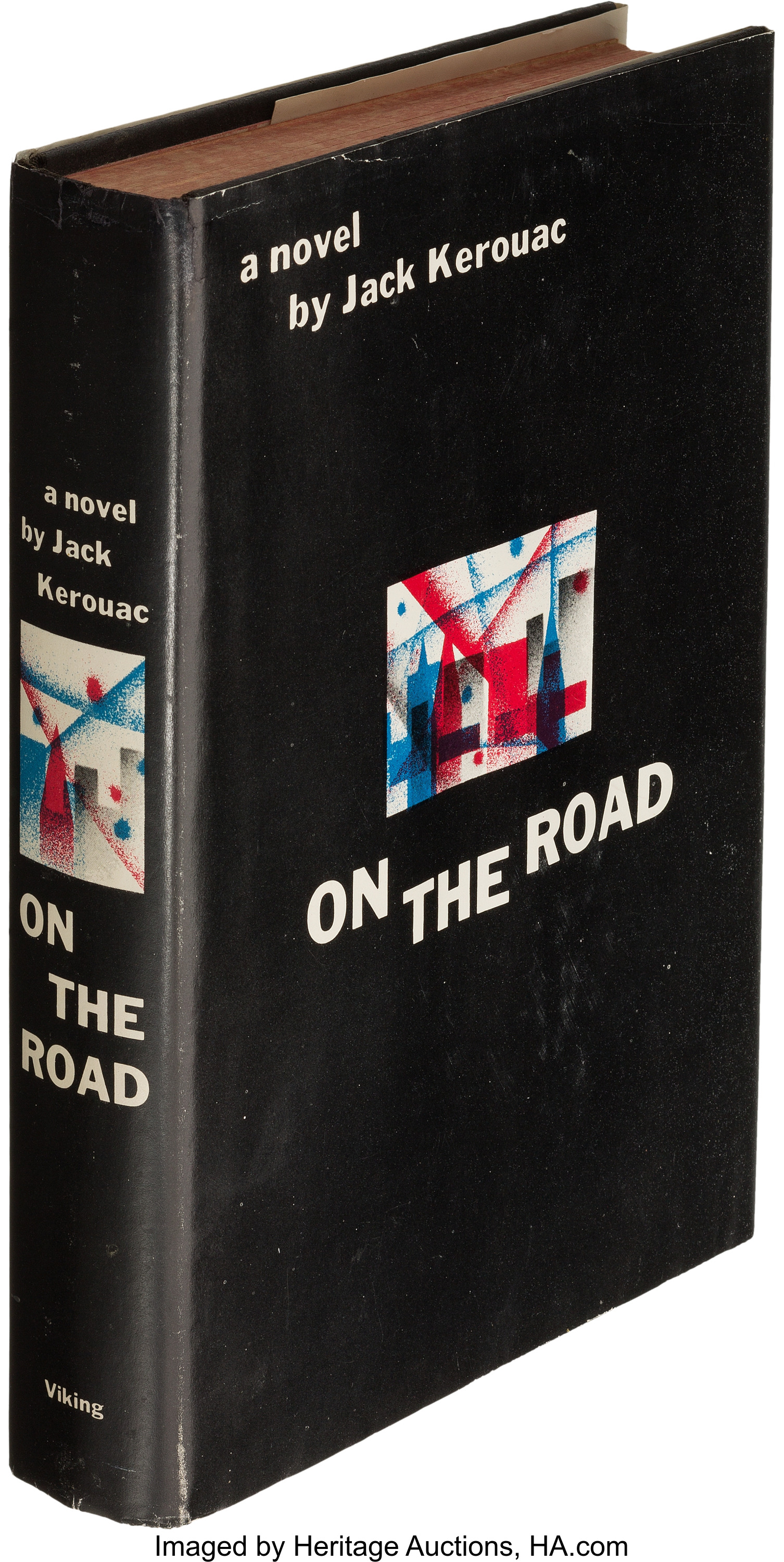
SOLD! A Jack Kerouac-Inscribed Copy of On the Road Fetched $7,500

Jack Kerouac. On the Road. New York The Viking Press, 1957 credit Herita...

Update: The 1957 presentation copy of Jack Kerouac’s On the Road sold for $7,500.

What you see: A 1957 presentation copy of Jack Kerouac’s On the Road. Heritage Auctions anticipates selling it for as much as $8,000.

Who was Jack Kerouac? Born Jean-Louis Kérouac in 1922 in Lowell, Massachusetts, he became a star of the mid-20th century Beat Generation of poets and authors. On the Road, a fictionalized tale of the cross-country travels of himself and his friends, published in 1957, is widely regarded as his greatest, most influential work. Kerouac died in 1969 at the age of 47.

Do we know how big the press run was for the first edition of On the Road? “I can’t find any reliable information about this, just that Viking published an unknown number of hard-cover copies in dust jackets on September 5, 1957,” says James Gannon, director of rare books for Heritage Auctions. “It sold well enough that it required a second printing on September 20 and a third not long after that.” [This copy is from the second printing.]

Did Viking Press have any notion of what they had with On the Road? Was it like Ulysses, where there was some anticipation and awareness that the book might be great? “Some sections of On the Road were published in literary magazines, and were well received so that the publisher announced that the complete first edition book was ‘a publishing event of no small interest.’,” he says. “This was Kerouac’s second novel, but the literary approach was completely fresh and new.”

Do we know how many inscribed presentation copies of On the Road are out there, and how often they come to auction? “Kerouac is known not to have inscribed a lot of copies of this title,” he says. “I only note about eight or 10 copies through the auction rooms in the last 20 years or so, of course getting premium prices.”

The woman to whom this book is inscribed, Mimi, and her daughter, Francesca, are not characters in On the Road, but Lucien Carr, husband to Francesca and son-in-law to Mimi, is in the book [the character based on him is named Damion]. How does that affect this copy’s value? Are inscribed presentation copies of On the Road worth more if they are inscribed to people who appear in the book as fictionalized characters?  “I think this twice-removed relationship limits the importance and desirability of the inscribed copy,” he says. “It is still a great book, but would be a vastly different thing if it was inscribed to Lucien Carr himself.”

What is the auction record for a first edition copy of On the Road? Does it belong to an inscribed presentation copy? If so, to whom did Jack Kerouac sign it?  “Aside from the original scroll of On the Road, the highest price I saw for an inscribed first was to his paramour, Joyce Johnson, and included a drawing,” he says. “Joyce Johnson also inscribed the book. It sold for $185,000 in 2002. The lot also included an autograph letter from Kerouac, and an inscribed copy of Johnson’s book about her relationship with Kerouac.”

What is the estimate on this copy of On the Road, and could you talk about why bidding will open at $4,000?  “The estimate is $8,000, and we open bidding at half of the estimate,” he says. “We hope the estimate is conservative and the book will sell for more than $8,000.”

Could you talk about the condition of the presentation copy of Jack Kerouac’s On the Road and its dust jacket? Does it have the wear that you’d expect of a book that’s about 60 years old? Or is it in better shape?  “The book is fairly nice, without major restoration which would really detract from the value,” he says. “A book like this, with a black dust jacket that shows flaws easily and is popular enough to be read over and over by various readers, typically shows much more wear. This is in better shape than what we see typically, but really nice copies in jacket are out there and get a premium price.”

Do collectors of first-edition Kerouac books, and early copies of On the Road, differ from book collectors in general? “Not in my experience, though sometimes a buyer of On the Road will be specifically a beat literature collector,” he says. “Usually this is included in collections of high-spot literature collectors, who want great books by a variety of modern writers.”

Why will this presentation copy of Jack Kerouac’s On the Road stick in your memory? “The Carr association, though a little removed, being inscribed to his mother-in-law, still adds a layer of interest that might encourage a bidder to go some extra increments, or a retail buyer to pay a little more,” Gannon says. “The ‘pride of ownership’ aspect is enhanced if you can share an interesting story when showing the book to friends and colleagues.”

How to bid: The 1957 presentation copy of Jack Kerouac’s On The Road is lot #45062 in Heritage AuctionsRare Books Signature Auction on March 7, 2018.

How to subscribe to The Hot BidClick the trio of dots at the upper right of this page. You can also follow The Hot Bid on Instagram and follow the author on Twitter.

Heritage Auctions is on Twitter and Instagram.

Image is courtesy of Heritage Auctions.

Would you like to hire Sheila Gibson Stoodley for writing or editing work? Click the word “Menu” at the upper right for contact details.
SOLD! This Trio of Mont Blanc Posters Fetched $13,750 at Swann

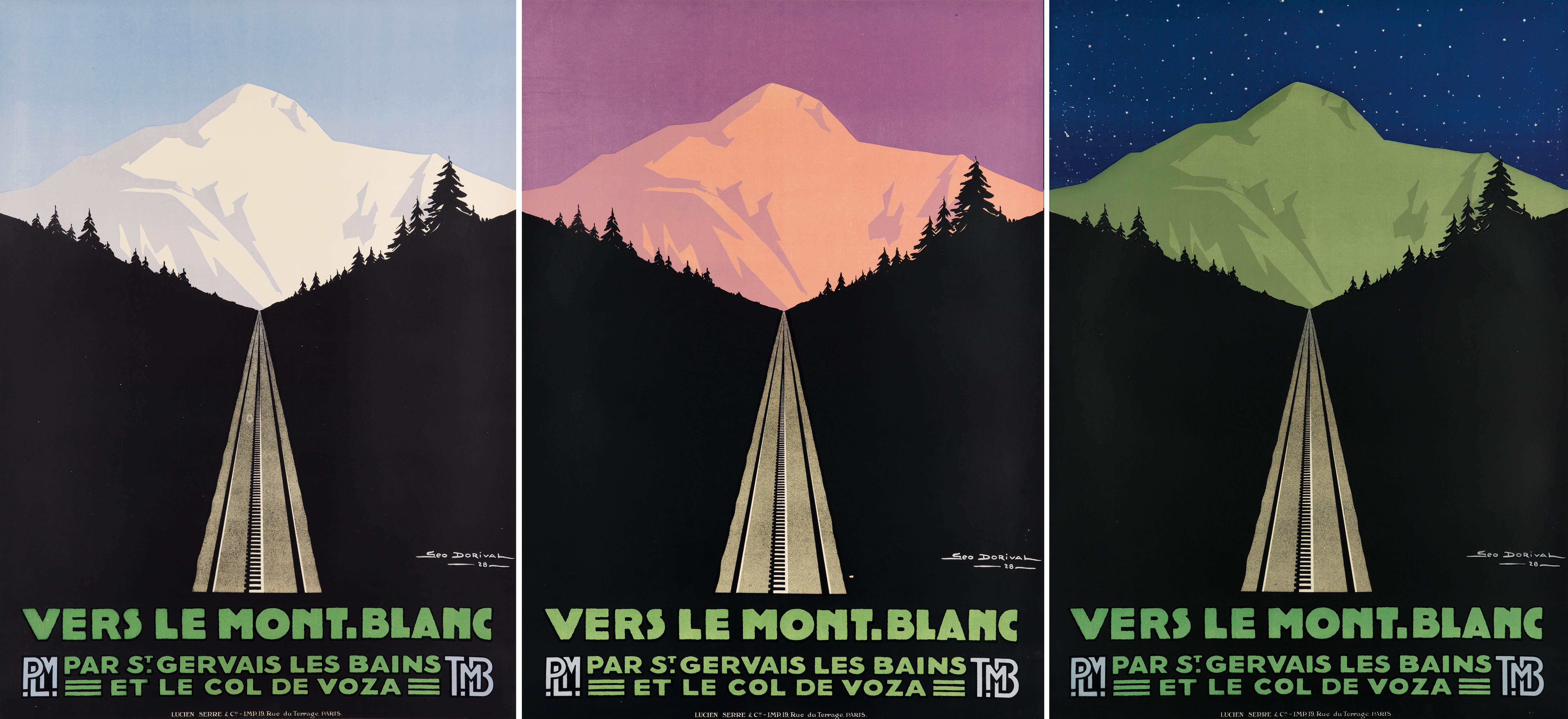
Vers le Mont - Blanc, a group of three posters dating from 1928 and designed by Georges Dorival.

Update: The 1928 trio of Mont Blanc posters sold for $13,750.

What you see: Vers le Mont – Blanc, a group of three posters dating from 1928 and designed by Georges Dorival. Swann Auction Galleries is offering them as a single lot, estimated at $8,000 to $12,000.

Who was Georges Dorival? Justin Marie Georges Dorival was born in Paris in 1879 and died in Louveciennes in 1968 and… that’s about all we know about him. “He was a very prolific artist who wasn’t remembered by history,” says Nicholas Lowry, director of Swann Auction Galleries. “The poster world is littered with artists who don’t amount to much outside their world.”

Was this trio of Mont Blanc posters his crowning achievement? “This is his most famous image,” he says. “If you type Dorival’s name into the search engine on the Swann web site, you’ll see his others are beautiful, but not remarkable in any way. These three are remarkable. What’s special and unique about this is it’s done as a tryptic.”

Do we know why Georges Dorival did Vers le Mont – Blanc as a tryptic? “I just think it was an inspired idea,” he says. “The three separate posters can work individually, or as a tryptic.”

Do I see the mountain depicted in daylight, dusk, and night? “Yes. It’s like a time-lapse, graphic photo,” he says. “One clearly has stars in the sky. Day, dusk, night. Everything below the black V of the mountain is identical. The top third changes.”

How often was this trio of Mont Blanc posters displayed together? “There’s no record of that. I’ve never seen any actual photo documentation of these three up,” he says. “I assume if they could put all three up together, they would, just because it makes a powerful statement.”

Does the trio of Mont Blanc posters tend to come to auction together as well? Generally, yes. Six sets have appeared at auction as a single lot since 2008; this will be the seventh. Sometimes, however, they appear in the same sale as three individual lots. Swann set the auction record for a set of three in November 2010 that sold as one lot for $18,000 against an estimate of $10,000 to $15,000.

What makes the triplicate poster image so strong? “There’s a conceptual reason and an actual reason,” he says. “The actual reason is the way he lays out the art. It’s almost as if someone is unzipping the scene. Your eye is quite literally drawn to the center of the poster. It’s simple and it’s genius. And the concept of the same poster at different times of day–it’s astonishingly simple and had never been done before. In a way, it’s like watching the sun set over the mountains. Each of these is like a color still.”

The trio of Mont Blanc posters come from the estate of Gail Chisholm, a Manhattan poster dealer who died in 2017. Was she a friend? “I’ve known her since 1996. She had a gallery seven blocks away from Swann,” he says. “She was an early adopter in the world of posters, and she had a very European attitude. I knew I had to visit her between noon and three, when she’d be having her three-hour lunch. She became a friend and colleague. It’s a small community. We all know each other. … She was very creative. She knew how to market posters. I think I picked that up from her, too. She lived her life according to her own rules. She unabashedly did what she wanted.”

About 130 posters are in the Chisholm sale, and the proceeds will benefit Planned Parenthood of New York. What’s the total presale estimate? Between $166,000 and $241,000, so as much as a quarter-million dollars could go to Chisholm’s favorite charity thanks to this auction.

What else makes this trio of Georges Dorival posters stand out? “In the world of posters, which are, by definition, a visual medium, these stand out for their unique cinematic quality,” he says. “They’re strong individually and stronger as a tryptic. These are really outliers, so different from the rest of his work.”

How to bid: Dorival’s Vers le Mont – Blanc is lot 29 in the Vintage Posters sale that Swann Auction Galleries will hold on March 1.

How to subscribe to The Hot BidClick the trio of dots at the upper right of this page. You can also follow The Hot Bid on Instagram and follow the author on Twitter.

Swann Auction Galleries is on Instagram and Twitter, and Nicholas Lowry is on Instagram and Twitter as well.

Image is courtesy of Swann Auction Galleries.

Would you like to hire Sheila Gibson Stoodley for writing or editing work? Click the word “Menu” at the upper right for contact details.
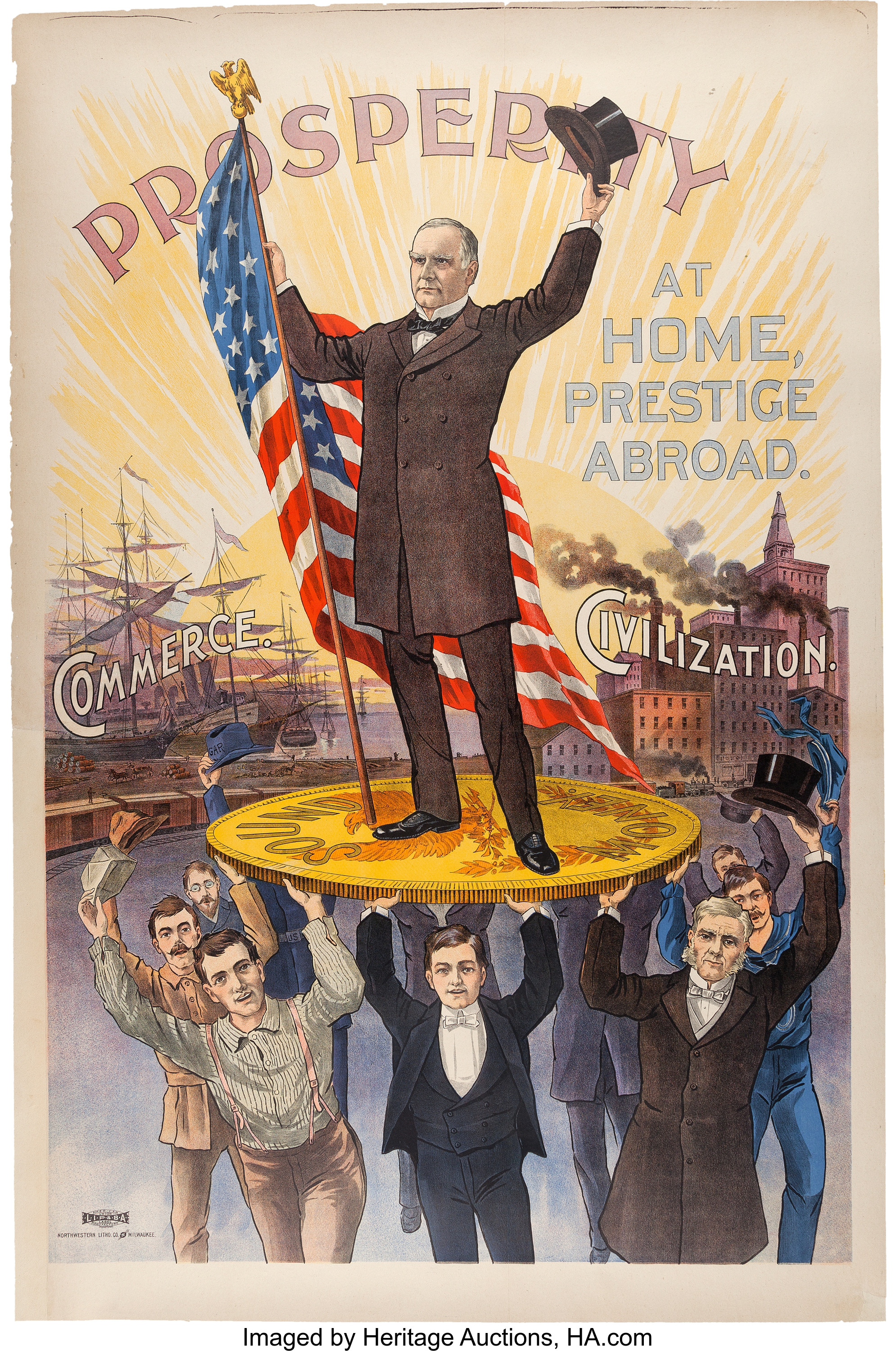
SOLD! A William McKinley Campaign Poster from 1900 Fetched $11,875 at Heritage Auctions

A circa 1900 28-inch-by-42-inch near-mint condition campaign poster for President William McKinley, who was running for a second term.

Update: The William McKinley campaign poster from circa 1900 sold for $11,875.

What you see: A circa 1900 28-inch-by-42-inch near-mint condition campaign poster for President William McKinley, who was running for a second term. Heritage Auctions believes that the poster could sell for $10,000 to $15,000.

Who was William McKinley? He was the 25th president of the United States. He was a Republican and a Civil War veteran who defended the gold standard and led the country through the Spanish-American War, in which America gained Puerto Rico, Guam, and the Philippines (this last eventually became independent). He also annexed Hawaii. His vice president, Theodore Roosevelt, went on to become president in his own right. An assassin shot McKinley in September 1901 and he succumbed to his wounds about a week later. He was 58.

Do we know how this William McKinley campaign poster came to be? And did the campaign know they had a winner on their hands with this image? No, and probably not. “The two times he ran for president, McKinley stayed home in Canton, Ohio, and delegations came to visit him,” says Don Ackerman, consignment director for historical Americana and political material at Heritage Auctions. “Millionaire Mark Hanna financed the entire campaign. Most campaign materials were purchased and used by local Republican clubs and organizations. They didn’t have to be authorized by the national Republican clubs. Posters like this may have been custom-ordered, or may have been produced for Republican clubs.”

What details in this circa 1900 poster might be lost on 21st century viewers? “The word ‘Civilization’ is an unusual usage. It ties in with the expansionism of 1898 and the war with Spain. Republicans supported imperialism and justified that by saying they were bringing civilization to backward peoples,” he says, laughing. “Part of that is you see factories belching smoke. That was considered a higher level of civilization over people who fished and farmed. The large gold coin says ‘Sound Money’ on it, and refers to the gold standard. It was a big issue in 1896 and 1900. McKinley’s opponent, William Jennings Bryan, advocated greater use of silver. Republicans said that would devalue the currency and cause inflation, and if we stuck to the gold standard, it would maintain its value.”

What other details stand out? “The glowing sunrise in the background. Sort of like ‘Morning in America.’ Everything is bright,” he says. “And you have shipping on the left hand side and factories on the right–business is booming, we’re selling overseas, factories are at capacity. McKinley is shown with the flag, in an appeal to patriotism and showing America as a dominant world power. He’s supported by a group of men from all aspects of society. The man in the blue suit is a sailor. One on the left is a soldier, there to appeal to people who served in the armed forces and the Civil War–McKinley served in the Civil War. The man with the silk top hat is a banker or an industrialist. The guy in the center might be a waiter–they usually don’t wear hats. The man in the pale green shirt is a workman. McKinley is appealing to all segments of the voting population.”

I can’t help but notice that everyone shown in the William McKinley campaign poster is a white man. Is that deliberate? “Except for Wyoming and Colorado, women couldn’t vote [in 1900],” he says. “This [poster] is not necessarily a snub of minority voters. There were ‘Colored Republican Clubs’. The Democrats were associated with the south, and with slaveholders. Blacks were loyal Republican voters from the time of Ulysses S. Grant to FDR or later. I think the Republican Party figured that black voters who were permitted to vote were going to vote for them anyway.”

Where were these posters displayed in 1900? “They were in local Republican headquarters or in store windows,” he said. “The owners weren’t afraid to offend their customers. If they liked the Republican candidate, they’d put the Republican poster in the window.”

Maybe ten of these posters exist. How might this one have managed to survive? “If somebody liked it and thought it was nice, they would fold it and put it away,” he says, noting that this example has folding creases in it. “That’s how they got saved. If it’s properly stored and the paper is good, the colors will still be bright. This has a minor chip, but nothing that affects the image.”

The colors on this William McKinley campaign poster really pop, particularly the red and blue of the flag, and the yellow of the coin. How close are they to the colors that the poster would have had when it was fresh off the stone lithographic press? “Pretty close. They’re not faded or anything,” he says. “The ink they used doesn’t fade naturally. As long as it’s not exposed to sunlight, the colors are going to be as vibrant as in 1900.”

How often does this William McKinley campaign poster appear at auction? “We’ve sold three of them in the past, for prices ranging from $10,000 to $17,000,” he says. “The one that sold for $17,925 probably is the record for this poster, but I can’t say definitively.”

Why will this William McKinley campaign poster stick in your memory? “It’s a masterpiece of graphic political Americana, and probably the best McKinley poster, for sure,” Ackerman says. “It’s head and shoulders above most of the stuff we see from the period. This really grabs you. Political posters of this quality were only issued between 1900 and 1904, and of the different designs known, this is the most appealing. It’s got all the great elements you want to see on a poster. It tells a story, it refers to policies that were prominent then, and it reflects the exuberance that people felt for the political process. It was a new century, a new age, and people really felt good about themselves.”

How to bid: The circa 1900 William McKinley campaign poster is lot #43382 in The David and Janice Frent Collection of Political & Presidential Americana, Part 2, taking place at Heritage Auctions on February 24, 2018.

How to subscribe to The Hot BidClick the trio of dots at the upper right of this page. You can also follow The Hot Bid on Instagram and follow the author on Twitter.

Heritage Auctions is on Twitter and Instagram.

Image is courtesy of Heritage Auctions.

Would you like to hire Sheila Gibson Stoodley for writing or editing work? Click the word “Menu” at the upper right for contact details.

TIE! An Original Peanuts Sunday Comic Strip from 1958 Sold for $113,525, Tying the World Auction Record

An original Sunday Peanuts comic strip, drawn by Charles Schulz and dated 12-21-58.

Update: Well, this doesn’t happen often. Heritage sold the original Peanuts Sunday comic strip from 1958 for $113,525–tying the record it set in 2007 for original Sunday Peanuts comic art.

What you see: An original Peanuts Sunday comic strip, drawn by Charles Schulz and dated 12-21-58. Heritage Auctions believes it could sell for $100,000 or more.

Who was Charles Schulz? The Minnesota-born Schulz is one of the most influential cartoonists ever. His comic strip, Peanuts, ran from October 2, 1950 until February 13, 2000 and featured the enduring characters of Charlie Brown and Snoopy, his pet beagle. At its peak, Peanuts appeared in more than 2,500 newspapers and reached more than 350 million readers in 75 countries. The 1965 animated television special A Charlie Brown Christmas became a hit that remains must-see holiday viewing today. Schulz died in 2000, one day before his final Peanuts strip was published. He was 77.

How rare are original Peanuts Sunday comic strips? “There are only so many Sundays between 1950 and when the strip ended,” says Weldon Adams, a comic book cataloging specialist at Heritage Auctions. “Every time we get one, it’s cooler than the last one we saw.”

How does original Peanuts Sunday comic strip art manage to get to the market? Didn’t Schulz keep all his originals at his studio? “Charles Schulz was one of the most gracious and kind souls you could encounter. He was beloved by fans,” he says. “When a fan would write a really nice letter, he would autograph the art and send it to them. A lot were personalized to friends and fans, and he just gave them away.” This particular Sunday strip is not inscribed, however, and not every original strip left his studio as gifts. “Some of these were just sold,” Adams says.

Snoopy isn’t in this Peanuts strip. Does that affect its value? “Not necessarily,” he says. “There are so many recurring favorite themes in Peanuts–Lucy at the psychiatrists’s booth, baseball strips with Charlie Brown at the pitcher’s mound, Snoopy as a World War I flying ace, Charlie Brown with the kite-eating tree, Lucy with the football–running gags that are funny every time you see them. There are so many scenes, and fans go out to look for particular ones.”

This original Peanuts Sunday comic strip has a Christmas theme, but it appeared in 1958, well before the famous Christmas special. How unusual is that? “It’s extremely rare to have a Christmas-themed strip to market before the special in 1965. There are only 15 years predating the special, so there are limited opportunities in the first place,” he says. “It pushes it above and beyond. It’s specifically about a Christmas recital at school, which is an element of the special. Ironically, it has a different outcome from what happens in the TV special. Here, Linus can’t remember his line. In the special, he gives a wonderful, beautiful speech. This is the flip side of that.”

The strip has eight panels, and it shows nine Peanuts characters in each panel. How rare is that? “Very rare. It’s going to be a major driving factor [in its final price],” he says. “This is a huge collection of all the regular cast members at that point. There are only a few who are not there. And it’s unique to have so many characters in every single panel. I haven’t seen another one like it.”

And Schulz would have drawn all eight panels by hand, with no assistance? “This is old school. He drew it all,” he says. He also notes that Sunday strips were printed in color in 1958, but someone in production at United Features Syndicate, which distributed the Peanuts strip, would have handled that task.

As of February 3, bidding on this original Peanuts Sunday comic strip art had reached $26,000, and the auction is still weeks away. Are you surprised it’s risen so high, so fast?The record for an original Sunday Peanuts strip was $113,525. It had a baseball theme, it was from 1955, and it sold in 2007 at Heritage,” he says. “It was similar in that there were several characters in it, but not nearly as many as this one. Given that this has so many characters, and a Christmas theme before the Christmas special, I have a sneaking suspicion it might top the record. This is unique and it has a lot of good things going for it. It will be interesting to see the bidding at the end. I expect it will be fierce and fast.”

The original Peanuts Sunday comic strip art, which is in ink over graphite on Bristol board, is described as being in “excellent condition.” What does that mean? “It indicates that the Bristol board is intact, with no major stains or marks, and no pieces missing,” he says. “There’s a little bit of corner wear, but nothing that would affect the image area. It does allow for a certain amount of toning–discoloration in the paper due to aging. ‘Excellent’ is the highest grade we grant on an artwork. You don’t run into one in pristine condition.”

Why will this original Peanuts Sunday comic strip art stick in your memory?Peanuts is an American icon,” Adams says. “Charles Schulz tapped into something with that strip, a childlike wonder that crosses all boundaries. Having so many characters in the strip is phenomenal. It’s a unique collection of highly beloved characters.”

How to bid: The original 1958 Sunday Peanuts strip is lot #92220 in the Comics & Comic Art Signature Auction on February 22 – 24, 2018, at Heritage Auctions.

How to subscribe to The Hot BidClick the trio of dots at the upper right of this page. You can also follow The Hot Bid on Instagram and follow the author on Twitter.

Heritage Auctions is on Twitter and Instagram.

Image is courtesy of Heritage Auctions.

You can see more original Peanuts comic strip art at the Charles M. Schulz Museum in Santa Rosa, California. The Peanuts strip continues as reruns in newspapers and on the web, too.

Would you like to hire Sheila Gibson Stoodley for writing or editing work? Click the word “Menu” at the upper right for contact details.
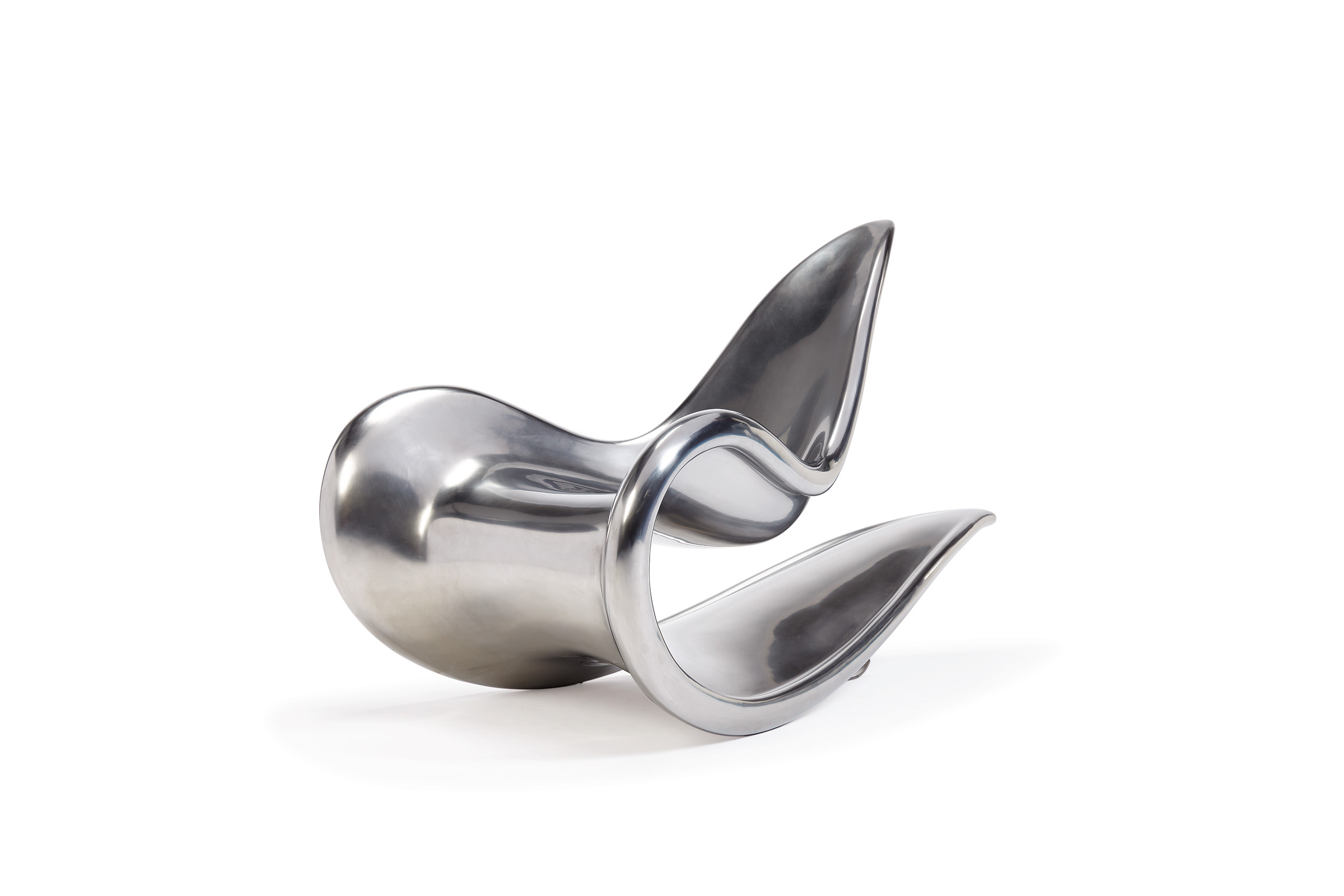
An Alma Thomas Painting Sells for Almost $400,000 (Update November 2019)

Spring Flowers in Washington, D.C., a 1969 oil on canvas by Alma Thomas.

Update: During the November 2019 Postwar and Contemporary Art Evening Sale at Christie’s New York, Alma Thomas’s 1970 canvas A Fantastic Sunset sold for $2.6 million against an estimate of $2.2 million to $2.8 million, setting a new world auction record for the artist.

Update: Thomas’s Spring Flowers in Washington, D.C. sold for $387,500 at Los Angeles Modern Auctions on Sunday, March 5, 2017–well above its $125,000 to $175,000 estimate. It also represents a world record at auction for the artist.

What you see: Spring Flowers in Washington, D.C., a 1969 oil on canvas by Alma Thomas.

Who was Alma Thomas? She was a member of the Washington Color School, a mid-20th century abstract art movement based in Washington, D.C. that also included Gene Davis and Kenneth Noland. Thomas was under-appreciated during her lifetime, but she was not unknown; in 1972, she became the first African-American woman to receive a solo show at the Whitney Museum of American Art. Thomas died in 1978, at the age of 86. Her art gained fresh attention when President Barack Obama and First Lady Michelle Obama displayed her works in the White House. Resurrection, a 1966 Thomas canvas that the Obamas chose for the White House family dining room, shares a mandala-like motif in common with Spring Flowers in Washington, D.C.

Why is the Alma Thomas painting so compelling? “It has an intimacy that you only get when you contemplate a solitary blossom,” says Peter Loughrey, director of modern design and fine art at Los Angeles Modern Auctions (LAMA). “There’s something Zen and eastern about it. The progression of color draws you in to the center of the work. It really lends itself to a one-on-one, personal interaction.”

How does the Alma Thomas painting call to mind Washington, D.C.? “It’s extremely abstracted, but it does reference the cherry blossoms that bloom every spring,” says Loughrey, who grew up in the nation’s capital. “It’s inescapable, that pinkish color in the background. It’s what you remember and walk away with.”

Why is the Alma Thomas painting estimated at $125,000 to $175,000? Thomas wasn’t as prolific as other Washington Color School artists, and today’s collectors are keen to own her works. Spring Flowers in Washington, D.C. has never gone to auction before; the consigner’s father bought it directly from the artist in 1969. He was a medical student at the time, and he paid her in installments. The lot includes a handwritten letter from Thomas to the proud young owner, telling him,”I hope you will love the painting. So many of my friends wanted to buy it.”

How to bid: Spring Flowers in Washington, D.C. is lot 323 in the Modern Art & Design Auction that takes place on March 5, 2017 at LAMA in Van Nuys, Calif.

To subscribe to The Hot Bid: Click the trio of dots at the upper right of this page.

Image is courtesy of Los Angeles Modern Auctions.

Would you like to hire Sheila Gibson Stoodley for writing or editing work? Click the word “Menu” at the upper right for contact details.

A Wendell Castle Rocking Chair Could Fetch $120,000 at LAMA

Castle_LAMA-3

What you see: A limited edition stainless steel Abilene rocking chair, made in 2008 by Wendell Castle. Los Angeles Modern Auctions (LAMA) estimates it at $80,000 to $120,000.

Who was Wendell Castle? The Kansas-born artist was a dean of the American studio furniture movement. He gleefully and deliberately erased the line between sculpture and furniture. He was an artist in residence at the Rochester Institute of Technology and kept a studio near Rochester, N.Y. His pieces are in the collections of the Museum of Modern Art, New York; the Boston Museum of Fine Arts; the Art Institute of Chicago; the Smithsonian Institution; and the White House. Castle died in January 2018 of complications of leukemia. He was 85.

Is the Abilene rocking chair a design that Castle originally made in the 1960s and revisited in 2008? “It’s purely 2008, but you can look at rocking chairs that he made in the 1960s, and you can see the through-line,” says Peter Loughrey, founder of LAMA. “Wendell Castle thought he was part furniture-maker and part artist. The soft curves of this are maternal and embracing, and at the same time, it’s masculine. The 1960s chairs have the same thing–big and bold, yet soft and curvaceous.”

What makes this a Wendell Castle design? What visual signatures mark the Abilene rocking chair as his work? “Wendell Castle emerged when designers and craftspeople were working in a reductionist aesthetic,” he says. “He reacted against the reductionist aesthetic, people who were paring down and reducing forms. He had the capacity to combine masculine and maternal shapes in part by broadening his materials. His work has a thickness that ran contrary to others of the era. Others thought, ‘How can I create with the least amount of material?’ Castle thought, ‘I want to make a leg thicker than normal if it’s closer to my artistic vision.’ This certainly has that. The rails of the rocker that swoop into the warmest are bigger and more massive than you would expect.”

How often did Castle work in stainless steel? Is this the only instance of him using it? “He worked in various materials,” he says. “He’s best known for working in wood, but he worked in metal. I don’t know if he did another stainless steel chair, but he did bronze stools.”

This Wendell Castle rocking chair is number four of the edition of eight. Where are the other seven Abilene rocking chairs? The second from the series sold for $81,250 on an estimate of $50,000 to $80,000 at Christie’s New York in March 2014. Loughrey believes the edition sold out and the rest likely remain in private hands or institutions.

What’s the auction record for a work by Castle? The record-holder is a 1980 ‘Victory’ chair and desk sold at Christie’s New York in December 2015 for $221,000 against an estimate of $120,000 to $180,000. The record for a single stand-alone work belongs to a 1963 rocking chair that sold for $204,000 against a $90,000 to $140,000 estimate at Rago in 2008. The next highest is a 2009 rocking chair that sold for about $180,000 against an estimate of about $134,000 to $201,000 at Tajan in Paris.

Do those results tell us anything about how this Wendell Castle rocking chair might perform at auction? “I would hope so!” he says. “The rocking chair is definitely a form he returns to. All three are completely different, but if you line them all up, you can see the Castle vocabulary flowing through them.”

What is the Wendell Castle rocking chair like to sit in? “It’s incredibly comfortable, and incredibly heavy,” he says, noting that it weighs about 400 pounds. “It takes two strong men to lift it. It’s a sculpture that sits in place. You can’t push it to another part of the room. When it’s set, it’s set.”

I imagine the Abilene rocking chair reflects Castle’s talent–he could make something so heavy look as light as a wisp of smoke and feel as comfortable as any other rocking chair. “Even as an artist, Castle understood the dynamics of the human form and how it interacts with the sculpture,” he says. “All his chairs are created to interact with the human form. It’s not something only to look at. It’s completely functional.”

Wendell Castle died in January 2018. How might that affect how this lot performs at auction on February 25, 2018? “It may affect it to some degree,” Loughrey says. “Typically, works are not dramatically affected when an artist dies. It may get a few more people’s attention. But it’s not easy to answer. It’s an old wives’ tale that if an artist dies, their prices immediately go up. If there’s a dramatic stock market selloff before the auction, that will affect it [the final price of the rocking chair] way more than him passing away.”

Why will this stainless steel Wendell Castle rocking chair stick in your memory? “To me, it’s exciting to see the arc of his career,’ he says. “Very early on, he created rocking chairs, and returned to the form and expanded on it and used his vocabulary in new and different ways. There’s distinct rocking chair progress over a 50-year period. This is instantly recognizable as a chair. At the same time, it’s functional as a piece of modern sculpture,” he says, adding, “And it will be memorable to me because I had a connection to him. I sat on panels with him, I interviewed him, and he was incredibly generous in helping me with cataloging things correctly. Now that he’s gone, it’s going to be a little emotional for me.”

How to bid: The Abilene rocking chair is lot 144 in LAMA‘s Modern Art & Design Auction on February 25, 2018.

How to subscribe to The Hot Bid: Click the trio of dots at the upper right of this page. You can also follow The Hot Bid on Instagram and follow the author on Twitter.

Los Angeles Modern Auctions (LAMA) is on Twitter and Instagram.

Wendell Castle has a website for himself and another for his art-furniture collection.

Image is courtesy of Los Angeles Modern Auctions.

Would you like to hire Sheila Gibson Stoodley for writing or editing work? Click the word “Menu” at the upper right for contact details.
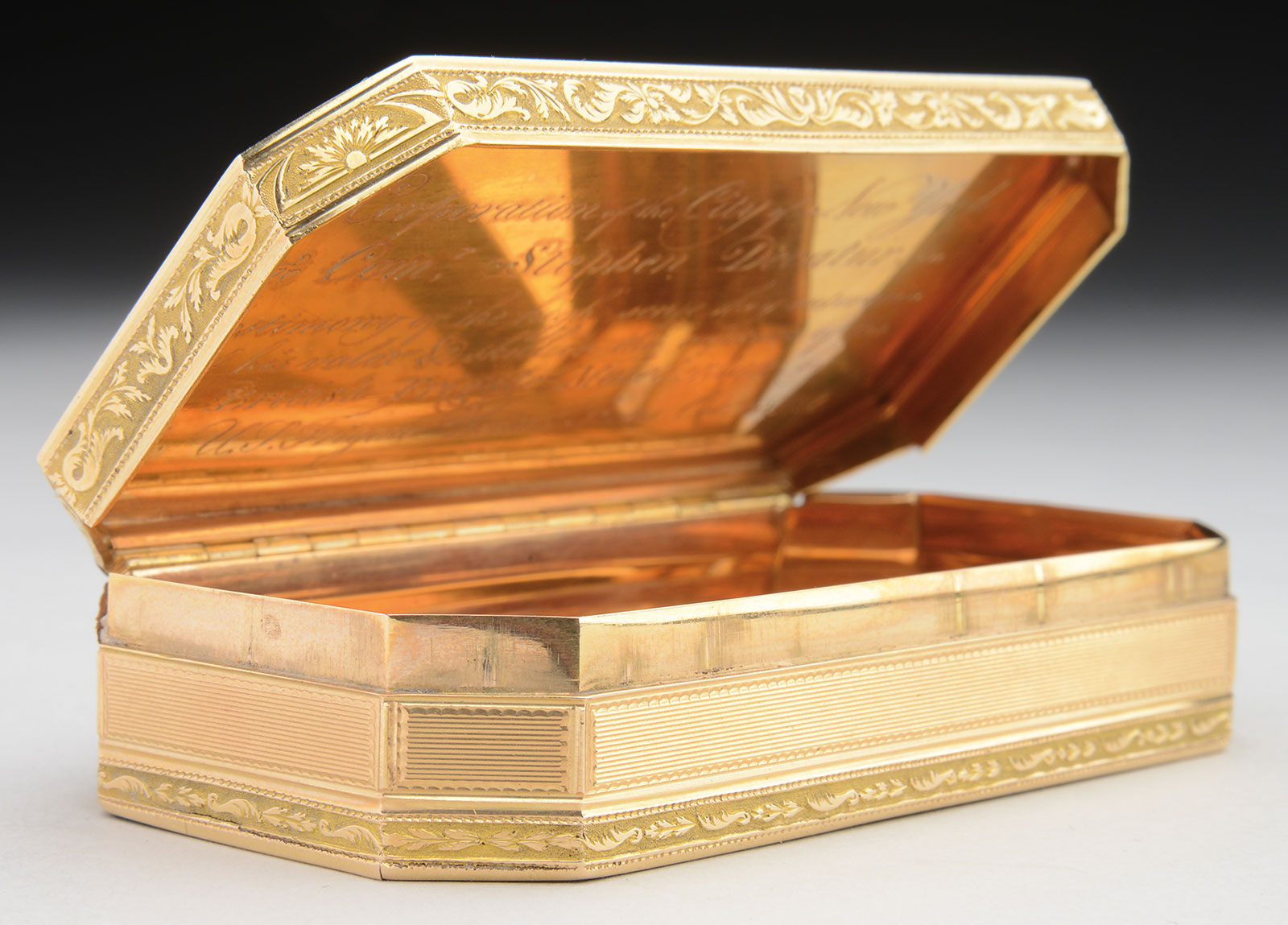
SOLD! Lewis Hine’s Powerhouse Mechanic Fetched $81,250 at Swann Auction Galleries

Lewis Hine's Mechanic at Steam Pump in Electric Power House, aka Power House Mechanic, a photograph printed circa 1921.

Update: Lewis Hine’s Mechanic at Steam Pump in Electric Power House sold for $81,250.

What you see: Lewis Hine’s Mechanic at Steam Pump in Electric Power House, aka Power House Mechanic, a photograph printed circa 1921. Swann Auction Galleries estimates it at $70,000 to $100,000.

Who was Lewis Hine? He was an American photographer who used his camera to document society in hopes of changing it for the better. He captured images of immigrants arriving at Ellis Island; child laborers in Southern cotton mills; and the workers who constructed the Empire State Building. Hine died in 1940 at the age of 66.

Where does Mechanic at Steam Pump in Electric Power House rank among Lewis Hine’s most iconic images? “It’s probably one of his most important, if not his most important. It’s a significant photo,” says Daile Kaplan, vice president of photographs and photobooks at Swann Auction Galleries.

Why is this Lewis Hine photograph such a strong image? “The visual appeal of the photo is rather direct and stunning,” she says. “It has harmony, it has visual balance, and at the same time, he positions the worker in a way that he’s controlling the machine. It reflects a new visual vocabulary that addresses the machine age, but it privileges the person with the machine.”

To what extent did Lewis Hine shape the appearance of this image? “The idea of the photographer arranging the subject is to some extent, to me, a specious issue,” she says. “Hine used a Graflex camera, a handheld camera that predated the 35 mm camera. It had technical aspects that may elude the 21st century viewer. The images are not easy to make. The Graflex is not a cell phone camera. It’s not on a tripod. It’s made of wood. It’s heavy. In all likelihood, flash powder was required for illumination. The image appeared in ground glass, upside down. It takes a bit of mental acuity just to frame the photograph. There were very different handling issues. Capturing an image in an informal manner was extremely difficult with a Graflex camera.”

Hine made several attempts at photographing a laborer using a wrench on a machine. Why did this particular one succeed so well? “The elements of the machine are writ large in this image, and the physicality of the laborer is very beautifully defined. And it shows how prescient Hine was,” she says, noting that he shot the image around 1921, when the phrase “machine age” was yet to be coined. “He was essentially visualizing a cultural idea, and was at the forefront of articulating it in a pictorial fashion. He understood and saw the trend before it was verified or confirmed.”

This Power House Mechanic print was made circa 1921–exceptionally early. Just how rare is it? “This is a very rare, very rare print, a stunning image,” she says, noting that it’s the first she’s handled a Mechanic photograph of this vintage. “In the body of work he produced during this time, it’s uncommon to find a stamp by Lewis Hine [the stamp mark reads ‘Hine’s Interpretive Photography, Hastings-on-Hudson’]. It’s extremely uncommon and rare and it has all the beauty of the finest photographs.”

There was no collectors’ market for photographs in 1921, and there wouldn’t be one for at least 50 years. Why might Lewis Hine have had this Power House Mechanic print made then? “Photographers are always making prints from their negatives,” she says. “Sometimes they give them to their family members or colleagues. He was important in the social welfare community, the progressive community. Undeniably, he would have been proud of this image. This picture is a real winner.”

Are there other prints of this Lewis Hine photograph made at later dates? “I’ve seen others, but nothing as beautiful as this,” she says.

What makes this Power House Mechanic print so beautiful? “The detail, the clarity, the ability to coax out the middle tones of the black and white–I think this print really sings. It stands alone,” she says. “It’s in excellent condition. It’s a stunning representation of the image, and the print itself is gorgeous.”

Why else will this Lewis Hine photograph stick in your memory? “It’s such a privilege to handle a photograph like this. In some ways, it’s a once-in-a-lifetime opportunity,” Kaplan says. “I’ve published two books about Lewis Hine. It’s an extraordinary privilege.”

Is it the finest Lewis Hine photograph you’ve ever handled? “When you work in an auction house, everything you handle is your baby,” she says, laughing. “Let’s say I recognize the integrity and the value of this image.”

How to bid: Lewis Hine’s Mechanic at Steam Pump in Electric Power House is lot 60 in Swann’s Icons & Images: Photographs & Photobooks sale on February 15, 2018.

How to subscribe to The Hot BidClick the trio of dots at the upper right of this page. You can also follow The Hot Bid on Instagram and follow the author on Twitter.

Swann Auction Galleries is on Instagram and Twitter.

Image is courtesy of Swann Auction Galleries.

Would you like to hire Sheila Gibson Stoodley for writing or editing work? Click the word “Menu” at the upper right for contact details.

SOLD! A Gold Freedom Box Given to Commodore Stephen Decatur Fetches $70,000

A 18-karat gold freedom box awarded to Commodore Stephen Decatur by the City of New York in 1812.

Update: The 18-karat gold Commodore Stephen Decatur freedom box sold for $70,000.

What you see: A 18-karat gold freedom box awarded to Commodore Stephen Decatur by the City of New York in 1812. The James D. Julia auction house estimates it at $125,000 to $175,000.

Who was Stephen Decatur? Born to a seagoing American family, Stephen Decatur became the young country’s first great naval hero by fighting the Barbary states–Mediterranean countries whose pirates had a nasty habit of capturing American vessels and ransoming their crews. (Do you remember the line from the U.S. Marines hymn, ‘From the Halls of Montezuma to the shores of Tripoli’? Tripoli is a reference to the Barbary Wars.) Decatur also distinguished himself in the War of 1812. He died in 1820 from a gunshot wound suffered in a duel with Commodore James Barron. Decatur was 41.

How did the custom of giving heroic people a gold freedom box get started? “The way it originated was the gold or silver box held the key to the city,” says John Sexton, senior consultant and sales representative in James D. Julia’s firearms division. “The ‘freedom box’ terminology comes from giving them ‘the freedom of the city.’ By this time [1812], they were just giving them the boxes.”

Why did the City of New York give Commodore Stephen Decatur this gold freedom box? During an October 1812 battle, he captured the HMS Macedonian, a 38-gun British frigate, saved it from sinking, and towed it to New York to be refitted and made part of America’s naval fleet. “It was the most important naval battle ever fought to that point,” he says. “Decatur was a household name in 1812. He was such a hero.”

How often do gold freedom boxes come up at auction? “The last one I could find was one awarded to John Jay and sold at Sotheby’s in 1991,” he says. “They’re beautiful boxes, exceptionally ornate. There’s another one in the sale from the Civil War that’s just as elaborate. They quit using the term ‘freedom box’ in the mid-19th century.”

Were the gold freedom boxes meant to be used to hold anything, such as snuff? Or were they just meant to be beautiful boxes? “It was just the box, but they were snuff box-size,” he says.

The Commodore Stephen Decatur gold freedom box also has its red leather presentation case. Is that unusual? “It’s probably unique,” he says.

And the box is entirely made of gold? “It’s all gold, including the hinge,” he says. “There’s not a part that’s not.”

How does it feel to hold the gold freedom box in your hand? “It’s quite heavy! It weighs 100 grams. It’s a nice, heavy little box,” he says. “Whoever did the engraving had a lot of skill. The engraving style is fantastic, beautiful–a lost art.”

How did you put an estimate on the Commodore Stephen Decatur gold freedom box? “We made a conservative estimate,” he says. “We expect it to bring several hundred thousand dollars. Compared to John Jay, Stephen Decatur is probably more of a household name. But I don’t know what it will bring at auction.”

Decatur’s descendants have passed the box from generation to generation. Why are they consigning it now? “There are about 80 lots from the same family,” Sexton says, noting that the lots include the carnelian and gold signet ring that the Bey of Tunis surrendered to Decatur in 1805. It appears the current owner within the family thought it wiser to consign the material rather than try to split it among seven or eight heirs. “Decatur was a very important person in his day. The treasures he had were phenomenal,” he says. “It’s amazing that the family retained them.”

Why will this gold freedom box stick in your memory? “There are so few objects associated with someone as important as Stephen Decatur. There are 25 states that have cities named after him,” he says. “This is a piece of history. You just know it’s a gem. It’s something so unique and wonderful.”

How to bid: The Commodore Stephen Decatur gold freedom box is lot 2068 in James D. Julia’s Fine Art, Asian, & Antiques Winter 2018 sale, taking place February 8 and 9, 2018.

How to subscribe to The Hot BidClick the trio of dots at the upper right of this page. You can also follow The Hot Bid on Instagram and follow the author on Twitter.

Photograph courtesy of James D. Julia Auctioneers, Fairfield, Maine, USA, www.jamesdjulia.com.

Would you like to hire Sheila Gibson Stoodley for writing or editing work? Click the word “Menu” at the upper right for contact details.

N.C. Wyeth’s Illustration of William Wallace Could Command $150,000 at Skinner

Wallace Draws the King's Sword, an illustration that N.C. Wyeth painted for the 1921 book The Scottish Chiefs.

What you see: Wallace Draws the King’s Sword, an illustration that N.C. Wyeth painted for the 1921 book The Scottish Chiefs. Skinner estimates it at $150,000 to $250,000.

Who was N.C. Wyeth? Newell Convers Wyeth was an American illustrator who brought rousing manly-man adventure tales to life like no other. If you were enamored with pirates as a small child, you have Wyeth’s illustrations for Treasure Island to thank for that. While Wyeth’s commercial illustrations made him immortal, he preferred creating fine art. He was the father of artist Andrew Wyeth and the grandfather of artist Jamie Wyeth. He died in 1945, along with his young namesake grandson, after his car stalled on railroad tracks and was hit by a train. He was 62.

How prolific was N.C. Wyeth?  “He did almost 2,000 illustrations for the Saturday Evening Post alone,” says Elizabeth Haff, specialist in American and European Works of Art for Skinner. “I don’t know how much he did for Scribner’s.”

This painting has a Scribner’s provenance–there’s a Scribner’s Magazine label on the back, and it comes to Skinner directly from the Scribner family. Does that add to its value? “I think it does add value. He did some of his most exciting work for those [Scribner’s Illustrated Classics] novels,” she says, adding, “In 1919, he struck a deal with Scribner’s where he owned his paintings, but they kept the copyright. With this, he either gave it to Scribner’s, or they bought it from him.”

How did author Jane Porter recruit N.C. Wyeth to illustrate her book? “Scribner used him quite a bit,” Haff says, noting his legendary work for the Scribner’s Illustrated Classics series. “The subject matter was his thing, his niche–heroes.” The book must have been a hit; it went through more than one printing.

So what’s going on in this scene? I take it that the unruly Scots are encroaching on their leader, William Wallace, intending to take him prisoner, and he’s drawing his sword and saying, ‘Back off.’ Yes, pretty much. The painting depicts a scene where William Wallace shouts, “He that first makes a stroke at me shall find his death on this Southron steel! This sword I made the arm of the usurper yield to me; and this sword shall defend the regent of Scotland.” As Haff explains, “It’s a distinguished sword. It had belonged to the King of England. In 1297, Wallace turned back the English army and captured the sword.”

Have any original N.C. Wyeth illustrations from The Scottish Chiefs gone to auction before? In October 2016, Dallas Auction Gallery sold Sterling Castle, a 1921 oil on canvas mounted on Masonite that was evidently made as a frontispiece to the book. It fetched $500,000 against an estimate of $100,000 to $150,000.

Why will this N.C. Wyeth painting of William Wallace stick in your memory? “It’s a great painting, and a very exciting painting. The colors are quite rich, very radiant. The tartans and kilts are so painterly and beautiful in person,” Haff says. “And the attackers’ faces are so expressive. The grimaces are so gruesome. He’s caught William Wallace at a moment where he draws his sword–it’s so dramatic, so arresting. It’s jewel-like, and it’s 100 percent N.C. Wyeth.”

How to bid: Wallace Draws the King’s Sword is lot 375 in Skinner‘s American & European Works of Art sale on January 26, 2018.

How to subscribe to The Hot BidClick the trio of dots at the upper right of this page. You can also follow The Hot Bid on Instagram and follow the author on Twitter.

You can follow Skinner on Twitter and Instagram.

Image is courtesy of Skinner.

Would you like to hire Sheila Gibson Stoodley for writing or editing work? Click the word “Menu” at the upper right for contact details.
RECORD: A Frederick Hurten Rhead Tile Panel Commands $637,500 at Rago

A unique, large four-tile panel depicting a peacock, made by Frederick Hurten Rhead in 1910 for a friend, Levi Burgess. Rago Auctions estimated the panel at $35,000 to $45,000 and sold it in October 2012 for $637,500--a then-record for any American work of ceramics at auction.

Editor’s note: With the arrival of the holidays, The Hot Bid shifts its focus to world auction records. Also, after choosing this Frederick Hurten Rhead piece and interviewing David Rago, the world auction record for any American work of ceramics was claimed by Peter Voulkos’s 1958 piece Rondena, which sold for $915,000 at Phillips on December 12, 2017. I expect to devote a post to Rondena in the future.

What you see: A unique, large four-tile panel depicting a peacock, made by Frederick Hurten Rhead in 1910 for a friend, Levi Burgess. Rago Auctions estimated the panel at $35,000 to $45,000 and sold it in October 2012 for $637,500–a then-record for any American work of ceramics at auction.

Who was Frederick Hurten Rhead? Born in England to an artistically talented family, Rhead came to America in 1902 to work in a series of factories that produced art pottery. High points included his tenure at University City, Missouri, where a wealthy patron assembled and bankrolled a dream team of ceramicists (sadly, the patron suffered money troubles in 1911 that killed the project). Rhead moved to California, where he directed a pottery program at a tuberculosis sanatorium and later ran his own pottery studio for a few years. His last major job was as an art director for the Homer Laughlin China Company in West Virginia, where he created the famous Fiesta line of dinnerware. He died in 1942 of cancer at the age of 61 or 62.

Why was Frederick Hurten Rhead an important artist? “I call him the Forrest Gump of American ceramicists,” says David Rago of Rago Arts and Auctions. “It was not so much about where he was and what he did, but how he influenced and mirrored the field. He was an influence on and reflective of American ceramics.”

Are the ceramics he made in America more valuable, generally, than those he made in England? “Yes, but if you look at his University City works, there are some English elements of design in those pieces,” he says. “Rhead would have grown as an artist if he had stayed in England. He just grew differently because he was here. I think the California desert blew his socks off, and Santa Barbara did the same. He was there before the highways, before the sprawl of civilization, in an artist’s colony, with like-minded souls. It had to be deeply influential.”

Why is Frederick Hurten Rhead’s material so rare at auction? “There just isn’t much of it,” Rago says. “Not until he got to University City and had already been here the better part of a decade did he have a chance to make great, one-of-a-kind pieces. One sold at Moran’s in California in April 2014–it was a masterpiece. But it’s pottery. It breaks. I don’t know how many broke over the years. And University City lasted a year, a year and a half. There were not many pieces to begin with. In Santa Barbara, Rhead was a crappy businessman. He could not have been making money. And he wasn’t whipping these out in a day. The best pieces took weeks to do, maybe more.”

When Rago sold a Frederick Hurten Rhead vase in May 2007 for $516,000, was that the first time the artist broke six figures at auction? “Yes, it was the first time something of his sold for six figures, privately or at auction,” he says.

The peacock tile panel was a gift from Frederick Hurten Rhead to a friend, Levi Burgess. Are any of the other Rhead pieces sold at auction as personal as the pieces that he made for Burgess? “I don’t know of any others,” he says, noting that Burgess installed the peacock panel and other Rhead ceramics in his Ohio home. A subsequent owner removed the tiles from the home before selling it 15 to 20 years ago. “A woman walked into the Rago auction gallery in New Jersey with the first set [this peacock panel]. She got one, and her husband got the other. We put them in the [2014] auction for $40,000 to $60,000, and all hell broke loose. The [works Rhead gave to Burgess] were known and talked about. They’re the pinnacle of American prewar [ceramic] design. On a scale of one to ten, this is a ten. He gave Burgess a couple of masterpieces to put in his house–$1 million worth of pottery. He must have liked him.”

How did the tile panel’s connection to University City enhance its value? “The main reason it figures in is University City had the best kilns, the best material, and the best support staff,” he says. “It was state-of-the-art. Rhead didn’t have to worry about money. He didn’t have that at Santa Barbara, and he certainly didn’t have that at Arequipa [the tuberculosis sanatorium].”

Rudy Ciccarello, the collector behind the Two Red Roses Foundation in Palm Harbor, Florida, bought the Rhead vase from Rago in 2007. Did Ciccarello buy the peacock tile, too? And does it pose problems when one collector is so dominant in a particular auction market? Yes, Ciccarello did buy the peacock tile. “He bought a lot of the Rhead pieces that sold for big money at public auction,” he says. As for Ciccarello’s dominance being a problem, he says that auction categories being driven by one or two big bidders “…is true of all these markets. This is American pottery we’re talking about. There aren’t 50 people who will buy once the price is over $100,000. The high-end market is limited. Masterpieces are always in demand.”

What was your role in the sale? “I was the auctioneer,” Rago says. “It was very exciting. Once the bidding hit $100,000, I thought, ‘Wow.’ When it hit $150,000, I thought, ‘Wow.’ But I couldn’t say it. I’ve got to be chill up there. Once it hit $510,00 hammer [the price before standard fees are added], that was it.”

Were you surprised that it sold for $637,500? “Yes, I was really quite surprised,” he says. “I knew it was going to bring good money. I’m known for ceramics, and it was the best of the best. We [he and the keenest bidders] knew what it was, and knew what condition it was in, and we knew where it ranked within the artist’s work, and it was the first time [one of the Burgess tiles] was offered for sale.”

Why will the Frederick Hurten Rhead peacock tile stick in your memory? “I’m a pottery guy. I love great pottery. Those [Burgess tiles] are legendary things–‘Will I get to see them turn up?’ I wouldn’t mind selling them,” he says. “This is my 46th year [in the auction world]. I’ve been chasing these things for a long time. To handle a masterpiece–a legendary masterpiece–it’s what you live for. To have it set the record for American pottery–that’s a singular moment.”

How to subscribe to The Hot BidClick the trio of dots at the upper right of this page. You can also follow The Hot Bid on Instagram and follow the author on Twitter.

Rago Auctions is on Twitter and Instagram.

Image is courtesy of Rago Auctions.

On January 20, 2018, on the second day of a three-day sale, Rago will offer a 1912 vase that Frederick Hurten Rhead made at Arequipa. It is estimated at $75,000 to $100,000.

Would you like to hire Sheila Gibson Stoodley for writing or editing work? Click the word “Menu” at the upper right for contact details.

RECORD: Jesse Owens’s Olympic Gold Medal Sells for $1.46 Million at SCP Auctions

A 1936 Olympic gold medal, one of four earned by Jesse Owens during the Berlin games. SCP Auctions sold it in 2013 for $1.46 million, a world auction record for any piece of Olympic memorabilia.

Editor’s note: With the arrival of the holidays, The Hot Bid shifts its focus to world auction records. 

What you see: A 1936 Olympic gold medal, one of four earned by Jesse Owens during the Berlin games. SCP Auctions sold it in 2013 for $1.46 million, a world auction record for any piece of Olympic memorabilia.

Who was Jesse Owens? He was an African-American athlete who put the lie to Adolf Hitler’s racist Nazi policies when he won four gold medals at the 1936 Olympic Games in Berlin in track and field events: the 100 meters, the 200 meters, the long jump, and the 4 x 100 relay. Sadly, his glory was cut short by American sports officials, who took away his amateur status and killed his career after he accepted endorsement deals. He struggled thereafter, resorting more than once to running against racehorses (and beating them). He died of lung cancer in 1980 at the age of 66.

How did you come up with an estimate for Jesse Owens’s Olympic gold medal? “Estimates are always educated guesses,” says Dan Imler, vice president of SCP Auctions. “Nothing is directly comparable to Jesse Owens’s medal. We had the estimate at half a million and up, and we far exceeded our estimate.”

Do we know when Jesse Owens gave the medal to his friend, Bill “Bojangles” Robinson? “We can’t pinpoint the moment when Owens gave it to him, but their relationship is well-documented,” he says.

What was your role in the auction of Jesse Owens’s Olympic gold medal? “The bidding was all done online,” he says, noting that he dealt with prospective bidders and promoted the lot. “To be honest with you, when we’re in the final stage of bidding, most of our work is done. There’s a tremendous amount of research and marketing leading up to that point.”

When did the online bidding enter crunch time? “On the final day, at 5 pm PST, we went into extended bidding. The hours between 5 pm and 8 pm PST are when people make their moves and really competitive bidding, bidding wars, occur,” he says. “We entered extended bidding on the Owens medal at $447,000. It rose to $1.4 million over a period of three hours. I can’t say exactly how many people were bidding, for privacy reasons, but there were definitely more than two.”

When did you know you had a world auction record? “We weren’t really focused on setting a record,” he says. “We were more focused on getting a result that was worthy of the item. We were very pleased to see it pass the seven-figure mark, but we were not surprised.”

What do you remember most about the auction of the Jesse Owens Olympic gold medal? “The exciting part for us was having the validation of people recognizing the historic significance and value of the item. It was nice to see it go for a figure commensurate with its importance,” he says. “We’ve sold items for more than this sold for, but I’m not sure we’ve sold anything more important from a cultural standpoint. It goes so far beyond the realm of sports memorabilia. Given what it represents, it’s very difficult to put a price on it. In my opinion, it’s worth more today than it was in 2013. If it sold again today, it would bring a higher price.”

Why do you think the Jesse Owens Olympic gold medal would sell for more than $1.4 million if it was consigned again today? “There are several factors,” he says. “The high-end collectible sports memorabilia market has advanced significantly in the last four years. Also, in that time, a major motion picture about Jesse Owens, Race, further raised his profile and raised awareness of what he accomplished. The National Museum of African American History and Culture at the Smithsonian recently opened an African-American sports exhibit. It wasn’t in place at the time the medal sold, but I can’t imagine a greater centerpiece for it. I think the medal’s magnitude has grown for all those reasons.”

Jesse Owens won three other gold medals at the 1936 Olympics, but they appear to be missing. If any of them turned up, along with ironclad documentation that proves they belonged to Owens, how might they do at auction? “If another two or three could be verified, none would be worth less than what we sold ours for, and they could sell for substantially more,” he says.

What was it like to hold Jesse Owens’s Olympic gold medal? “We’re in the business of handling historic artifacts on a daily basis. You can get numb to it. We really felt we were in a privileged position to be handling this,” Imler says. “After 20 years in the business, you don’t get goose bumps that often. This raises goose bumps. It’s very special.”

Why will the Jesse Owens Olympic gold medal stick in your memory? “It’s the ultimate symbol of triumph, and not just in the athletic realm,” he says. “It’s symbolic of civil rights, athletic greatness, courage, fortitude–it’s so far beyond sports, so far beyond anything we’ve handled in our company history. It will stand the test of time and provide inspiration for many generations to come.”

How to subscribe to The Hot BidClick the trio of dots at the upper right of this page. You can also follow The Hot Bid on Instagram and follow the author on Twitter.

SCP Auctions is on Twitter and Instagram as well.

SCP Auctions will offer the Jesse Owens Estate Collection in its 2018 Spring Auction, which takes place between March 7 and March 24, 2018. Lots will include the Presidential Medal of Freedom given to Owens by President Gerald Ford in 1976 (estimated at $250,000-plus); the Congressional Gold Medal posthumously awarded to Owens by President George H.W. Bush in 1990 (estimated at $150,000-plus); and two of the four First Place Olympic Winner Diplomas he received for his performances in the Long Jump and the 200 Meter race at the 1936 Berlin games (estimate pending).

Jesse Owens has an official web site.

Image is courtesy of SCP Auctions.

Would you like to hire Sheila Gibson Stoodley for writing or editing work? Click the word “Menu” at the upper right for contact details.

RECORD: An Ed Ruscha Print Sold for More Than $200,000 in 2014

Double Standard, a 1969 screenprint by Ed Ruscha. Los Angeles Modern Auctions (LAMA) set a record for a print by the artist in October 2014 when it sold for $206,250 against an estimate of $50,000 to $70,000.

Editor’s note: With the arrival of the holidays, The Hot Bid shifts its focus to world auction records. 

What you see: Double Standard, a 1969 screenprint by Ed Ruscha. Los Angeles Modern Auctions (LAMA) set a record for a print by the artist in October 2014 when it sold for $206,250 against an estimate of $50,000 to $70,000.

Who is Ed Ruscha? Edward Joseph Ruscha IV is an Oklahoma-born artist who embraced California and became part of the Pop Art movement. He works in several media–printmaking is just one of them. He might be most famous for his paintings that showcase single words or phrases. He is 79.

Where does Double Standard fit in the pantheon of Ed Ruscha images? “The Standard series is one of his most iconic. Double Standard is a little tongue-in-cheek, as is a lot of his work,” says Peter Loughrey, founder of LAMA. “He infuses humor and irony into a lot of his work, along with pop art sensibilities.”

Is this a depiction of a real Standard gas station, or is it an invention of Ruscha? “I don’t think this is an actual representation. I think it’s a combination of things,” he says. “In 1961, Dennis Hopper took a picture of a station with two Standard signs, like this [print has]. Ruscha would certainly have been aware of that. It’s very similar to Ruscha’s imagery. I can only assume Ed used that as part of his process as well as the stations he saw on his Kerouac-like travels from Oklahoma to get to Los Angeles.”

The print is signed by Ed Ruscha and also Mason Williams. Who is Williams, and what was his contribution to Double Standard? Williams is a musician, writer, and comedian who worked on the Smothers Brothers Comedy Hour and Saturday Night Live. He’s a friend of Ruscha’s, who goes back to his Oklahoma days. “A lot of the humor and wry snarky sensibility had to do with Mason,” he says. “Mason’s ability to satirize a subject is fairly important to this. It was more conceptual. It was more about bringing to Ed’s attention that Standard was too serious, and Double Standard took some air out of it.”

What sort of condition is this Double Standard print in? “It’s in pristine condition, which is why it sold for so much,” he says. “I met an original owner who said they paid $180 for it. When you pay $180 for a print, you don’t go to dramatic lengths to frame it and preserve it and prevent archival issues in the future. The fact that these were not that expensive when new led a lot to be ultimately mishandled in ways that we can identify. It’s clear that this example was treated as a work of art from the beginning. The rarity of a survivor in this condition drove a lot of the interest.”

Double Standard was printed in an edition of 40. How often does it come up at auction? “Mine was the last one, in 2014. About 18 months before that, another sold for $182,500. Before that, one sold in 2008,” he says.

Why did this Double Standard do so well? Was it purely its exceptional condition? “The condition drove a lot of the aggression, but there are a lot of external factors that you can never really quantify,” Loughrey says. “Dennis Hopper came to one of my auctions and bought a piece on his birthday. He paid four or five times what was expected. I said, ‘I can’t believe you paid so much for it.’ Hopper said, ‘It doesn’t matter. It’s my birthday, and I want it.”

What was your role in the sale of the Ed Ruscha print? “I was the auctioneer. It was very exciting,” he says. “The room was aware and burst into applause. They knew the record for his [print] work could be broken. The gasps and sighs of relief are expected and fun in the moment. The [winning] bidder was in the room. You could see determination from the bidder–‘This opportunity is not going to get away from me.’

How long did the auction of the Ed Ruscha print last? “When you start at $50,000 and end at $206,000, it does take a while,” he says. “I don’t remember how long it took. I remember the person on the phone [the eventual underbidder] took time. I saw the anxiety on the face of the person in the room–‘Sell it already!’ It did take a while, but it was probably less than five minutes. That is an extremely long time on an auction block. I usually sell a lot every 45 seconds. Five minutes is an eternity when you’re up there.”

How long do you think this record for an Ed Ruscha print will last? “If someone came along with another [Double Standard print] that’s as good, or a Standard print that’s as good–a Standard print with a bright red sky–it’s ready to fall. I have people who are interested [in both]. I wouldn’t be surprised if it goes over $250,000,” he says, adding, “Consider the perspective of the seller. He agreed to let me sell it for as little as $50,000. If the universe didn’t align, it could have sold as low as $50,000. He was a bit nervous, but he took a leap of faith. He knew the venue [LAMA] attracted Ed Ruscha people more than any other venue. This is an artist we focus on and specialize in.”

Do you think another print will come to market soon? “Believe me, I’m on it,” he says. “I’m conversing with original owners who’ve had it [a Double Standard print] since 1970. I’ve tried to cajole them, but they’re not interested in selling.”

How to subscribe to The Hot Bid: Click the trio of dots at the upper right of this page. You can also follow The Hot Bid on Instagram and follow the author on Twitter.

Los Angeles Modern Auctions (LAMA) is on Twitter and Instagram.

Image is courtesy of Los Angeles Modern Auctions.

Ed Ruscha maintains an online catalogue raisonné.

Would you like to hire Sheila Gibson Stoodley for writing or editing work? Click the word “Menu” at the upper right for contact details.
RECORD! A Faith Ringgold Story Quilt Commissioned by Oprah Winfrey for Dr. Maya Angelou Sold for $461,000 at Swann

Maya's Quilt of Life, a 1989 narrative quilt by artist Faith Ringgold, who Oprah Winfrey commissioned to make it as a birthday gift for Dr. Maya Angelou. At Swann Auction Galleries in 2015, it sold for $461,000--a record for a narrative quilt by the artist.

Editor’s note: With the approach of the holidays, The Hot Bid shifts its focus to world auction records. 

What you see: Maya’s Quilt of Life, a 1989 narrative quilt by artist Faith Ringgold, who Oprah Winfrey commissioned to make it as a birthday gift for Dr. Maya Angelou. At Swann Auction Galleries in 2015, it sold for $461,000–a record for a narrative quilt by the artist.

Who is Faith Ringgold? Born Faith Willi Jones, she is an African-American artist who has worked in several media but is best known for her paintings and textile works of art. She grew up in Harlem during the Harlem Renaissance and is an activist who fights sexism and racism. She began creating narrative quilts in 1980, in part because she had trouble interesting publishers in her autobiography. To date, she has created almost 100 narrative quilts. Ringgold is 87.

What makes Maya’s Quilt of Life a strong example of Ringgold’s work? “It has all the elements she incorporates in her story quilts. They’re called story quilts because they tell a story–they have a narrative,” says Nigel Freeman, director of Swann’s African-American fine art department. “This scene has text taken from Maya Angelou’s writings. It’s an unusual work, but it’s instantly recognizable as Faith Ringgold’s work. It’s a special piece for a special occasion.”

It looks like Ringgold used the Angelou texts like columns that frame the painting. Is that typical of her work? “That’s not the only way she does it. They could be at the top, or the sides. Sometimes they wrap around,” he says. “The important thing is it’s Angelou’s writing. It’s not just the visual creativity of the artist, it’s the voice of the artist and the women involved.”

It strikes me that with Maya’s Quilt of Life, we have an extraordinary black woman, Oprah Winfrey, commissioning a second extraordinary black woman, Faith Ringgold, to commemorate a third extraordinary black woman, Dr. Maya Angelou. Are you aware of any other artwork that’s quite like this? “I thought that was pretty cool,” he says. “It’s a great testament to the fiercely independent spirit of Maya Angelou, and a testament to what she inspires in people, and in artists like Faith Ringgold and cultural figures like Oprah Winfrey. It was an affinity between all three women, a great coming-together. It was a birthday present [for Angelou], and it was the prize piece in her art collection.”

This was the first Faith Ringgold story quilt to come to auction. Why was it consigned? “Because Dr. Angelou died [in 2014], it was consigned as part of a single-owner sale. It came from Dr. Angelou’s estate,” he says. “This is the way the family wanted to distribute a large part of her estate.”

How did you arrive at the estimate of $150,000 to $250,000 for the Faith Ringgold story quilt? “Ringgold narrative quilts are very precious, and owners don’t give them up easily. They’re certainly prized objects,” he says. “Many artists we handle don’t have auction records. We looked at gallery prices and what would be a fair market value. Of course we had to know how to factor in the specialness of the piece, but enough was out there to be able to make a reasonable estimate. Like a lot of contemporary artists, Ringgold’s market is just developing. We had to start somewhere. We were just fortunate to start with a really fantastic one that sets the bar high.”

Were you in the sale room for the auction? “It was a packed room. It was almost the perfect auction. Only one piece didn’t sell,” he says. “It was a moment to savor. I was in the back of the room. People applauded when things went high. And Faith Ringgold was there! She and I posed in front of the quilt. It was quite an event. Everyone left happy.”

Were you surprised that the Faith Ringgold story quilt sold for $461,000? “Yes, because it was uncharted territory,” Freeman says. “We knew we had something really wonderful. She’s an important American artist. Her work is in a lot of museums already. But you never know on a given day how the market will respond. We knew it would do well. We didn’t know how well.”

Do we know who bought Maya’s Quilt of Life? “It ended up going to the Crystal Bridges Museum of Art in Arkansas,” he says. “They made it public shortly after the sale. Faith Ringgold gave a talk there subsequently. That’s always a terrific outcome. It was a win-win-win.”

How long do you think the auction record for a Faith Ringgold story quilt will stand? “It’ll stand for a good while. It was a really great piece, and Faith Ringgold is a great artist,” he says. “If one of her early large canvases–a significant part of her work [came to auction]–that could give this record a run for the money. But you don’t see many at auction. I’m going to enjoy it while it’s a record. It’s a wonderful piece, and the story behind it is great.”

How to subscribe to The Hot BidClick the trio of dots at the upper right of this page. You can also follow The Hot Bid on Instagram and follow the author on Twitter.

Swann Auction Galleries is on Instagram and Twitter.

Nigel Freeman is on Twitter. Faith Ringgold has her own website.

Soul of a Nation: Art in the Age of Black Power, an exhibit that originated at the Tate Modern in London, features the work of 60 black artists, including Ringgold. It will appear at Crystal Bridges from February 3 to April 23, 2018.

Image is courtesy of Swann Auction Galleries.

Would you like to hire Sheila Gibson Stoodley for writing or editing work? Click the word “Menu” at the upper right for contact details.
SOLD! A Chung Ling Soo Magic Poster Commanded $9,225 at Potter & Potter

A 1908 poster touting the talent of magician Chung Ling Soo and His Ten Assistants.

Update: The 1908 Chung Ling Soo magic poster sold for $9,225.

What you see: A 1908 poster touting the talent of magician Chung Ling Soo. Potter & Potter estimates it at $5,000 to $6,000.

Who was Chung Ling Soo? Born William Ellsworth Robinson in Westchester County, New York in 1861, he was a behind-the-scenes designer of magic tricks for headliners Harry Keller and Alexander Herrmann before he struck out on his own. Around 1900, while in Europe, he adopted the Chung Ling Soo persona. He went to great lengths to preserve the illusion, limiting his speech on stage to the occasional bit of broken English and relying on an interpreter to talk to journalists. He died in 1918 at the age of 56.

Are vintage posters featuring Chung Ling Soo rare in general? “Yes, I would say they’re uncommon or scarce,” says Gabe Fajuri, president of Potter & Potter. “The one we’re talking about is a bit harder to find than the others.”

This is one of eight different Chung Ling Soo posters in the auction. Did they all come from the same consigner? One comes from one consigner, and the rest come from a second.

Other famous magic posters of the era show the magician receiving supernatural help. Here, Chung Ling Soo shows what he purports to be the source of his magical talent–his own hands. No supernatural help required. Is this an unusual theme for a vintage magic poster? “There are plenty of portraits [on magic posters],” he says. “We have sold other posters of magicians showing their hands and doing maneuvers, but they’re not as artful as saying ‘My Ten Assistants.’ It got reworked by Ricky Jay into ‘My 52 Assistants.’ It’s not the only example of a magician showing sleight of hand on a poster or referring to sleight of hand, or how they accomplish their tricks.”

Is Robinson, aka Chung Ling Soo, the first person to move from a backstage magic designer role to an on-stage magician role? “He was the great secret weapon for these guys. He was designing and inventing illusions,” he says. “In any professional situation, someone will say, ‘Oh yeah, my boss doesn’t know what he’s doing. I can do a better job.’ He proved he could do as good a job. It took work, and a different persona, but his success is pretty significant.”

Would you talk about how Robinson/Soo died? “He was performing a bullet catch trick in London, England. It was one of the big theatrical showpieces of his performance,” Fajuri says. “I wrote a long time ago that instead of catching the bullet on a plate, he caught the bullet in his chest. They brought the curtain down, and he died not long after.”

Was he the first magician to die doing the bullet catch trick? No. “It wasn’t a new trick. It had been around for decades [by 1918, when Robinson/Soo died], and it had killed people,” he says. “Keller advised Houdini against it in a very famous letter. Robinson did have experience backstage with the trick, and he was familiar with other ways of performing the feat. There’s controversy surrounding what happened. Not thoroughly checking his props led to his demise. It’s a tragic story. He was at the top of his game.”

How rare is the ‘Chung Ling Soo and His Ten Assistants’ poster? “I haven’t had one before in ten years of auctioning magic memorabilia,” he says, adding that he’s aware of at least six copies. “This one was owned by a magician in England. He died years ago, and his family consigned it. It’s in A- condition. Very little was done to it. You’re not going to get much better than this.”

What else makes this Chung Ling Soo magic poster special? “This is more scarce. The image is realistic. The turn of phrase is nice, and the colors are not garish,” he says. “It has a lot going for it by way of aesthetics, the story, and the man it depicts. It has a little bit of everything.”

How to bid: The Chung Ling Soo magic poster is lot 10 in Potter & Potter‘s Winter Magic Auction on December 16.

How to subscribe to The Hot BidClick the trio of dots at the upper right of this page. You can also follow The Hot Bid on Instagram and follow the author on Twitter.

Follow Potter & Potter on Instagram and Twitter.

If you’re intrigued by the story of Chung Ling Soo, you need to read The Glorious Deception: The Double Life of William Robinson, aka Chung Ling Soo, The ‘Marvelous Chinese Conjuror,‘ by Jim Steinmeyer. Really, you ought to read everything Jim Steinmeyer has ever written, but start there, and please buy your copy from an independent bookstore.

Image is courtesy of Potter & Potter.

Would you like to hire Sheila Gibson Stoodley for writing or editing work? Click the word “Menu” at the upper right for contact details.

RECORD! A Patrick Nagel Painting Sells for $200,000 (Updated With New Record November 2020)

Bold, a circa 1980s painting by Patrick Nagel. Heritage Auctions sold it on October 13, 2017, for $200,000--an auction record for the artist.

Update: On October 16, 2020, Heritage Auctions broke the record for a Patrick Nagel artwork. Jeana, painted in 1983, achieved $350,000.

What you see: Bold, a circa 1980s painting by Patrick Nagel. Heritage Auctions sold it on October 13, 2017, for $200,000–an auction record for the artist.

Who was Patrick Nagel? He was an American commercial illustrator who gained fame for his portrayals of beautiful dark-haired women. His best-known works are like Bold–images that focus on the woman’s face. Nagel (pronounced to rhyme with ‘bagel’) did commissions for Playboy and is probably best known for creating the artwork for the cover of Duran Duran’s 1982 album, Rio. He died in 1984 of a heart attack that might have been caused by a congenital heart defect that was first noticed during his autopsy. Nagel was 38.

Did Nagel have a specific woman who he relied on as a model? “He did use models, specific models, but he would alter them so they’re not portraits, they’re idealized,” says Ed Jaster, senior vice president at Heritage Auctions, adding, “In May, we sold a Nagel titled Joan Collins, #411, for $100,000. [If you know its title,] you say, ‘Oh, yeah, I can see it,’ but if you just saw it [without knowing the title], you wouldn’t think it was Joan Collins.”

Why, or for whom, did Nagel make this painting? “In the 1980s, he hooked up with Mirage Studios, and they had him do paintings on spec,” he says. “Bold is from that body of work. He only did them during the last two or three years of his life.”

Why is the Patrick Nagel painting called Bold? “In general, Nagel didn’t title his paintings,” Jaster says. “To the best of my knowledge, there wasn’t a title for this painting. It was [named] by me or the cataloger. If we’re going to coin a title, it’s nice if it’s based on information we have. If we know who the sitter is, it’s obvious.”

How rarely do original works by Nagel come to auction? “Paintings rendered on canvas are a little more rare,” he says. “The untimely nature of his death–he died a young man–means they are very limited, maybe along the lines of 40 to 50 paintings for Mirage Studios. If we’ve sold 20 of them, which is about right, we’ve probably sold half of his body of work from that period.”

When did the secondary market for Patrick Nagel gain momentum? “The earliest Nagel [auction sales] I can find in our records are in 2008,” he says. “From 2008 to 2012, we sold a fair amount of Nagel, but they were all illustrations, not paintings on canvas. We had one in 2012 that brought $56,000 and one in 2013 that brought $158,500. The first on canvas, to the best of my knowledge, was October 2012. From that point on, every one on canvas got [at least] $50,000, but probably the average is more like $125,000.”

Why did this Patrick Nagel painting do so well? Why did it set a new record for Nagel? “She’s got a very alluring, very hypnotic gaze. Very typical Nagel,” he says, adding, “It was a timing thing. If two people want something, it gets a high price. Sometimes it’s predictable, sometimes it’s not.”

How long do you think the Patrick Nagel painting record will stand? “I hope not too long,” says Jaster, laughing. “I’m being a little cheeky, but it’s a strong piece, and it deserves to be the record-holder. It’s quintessential Nagel.”

How to subscribe to The Hot BidClick the trio of dots at the upper right of this page. You can also follow The Hot Bid on Instagram and follow the author on Twitter.

Heritage Auctions is on Twitter and Instagram.

Image is courtesy of Heritage Auctions.

Would you like to hire Sheila Gibson Stoodley for writing or editing work? Click the word “Menu” at the upper right for contact details.

SOLD! A Kem Weber Walt Disney Animation Desk Fetched $13,145 at Heritage

An animation desk designed by Kem Weber for the Walt Disney Company circa 1939 or 1940. It's shown here decorated with the accoutrements of a working animator, but the lot consists solely of the desk, the bulletin board, and a pencil tray that once belonged to Eric Larson.

Update: The Kem Weber Walt Disney animation desk sold for $13,145.

What you see: An animation desk designed by Kem Weber for the Walt Disney Company circa 1939 or 1940. It’s shown here decorated with the accoutrements of a working animator, but the lot consists solely of the desk, the bulletin board, and a pencil tray that once belonged to Eric Larson. Heritage Auctions estimates the desk at $20,000 to $25,000.

Who was Kem Weber? Karl Emanuel Martin Weber was a German designer who moved to the United States during World War I and became a citizen in 1924. He coined a new first name from his initials. Disney chose him as the main architect of his corporate headquarters in Burbank, California. Weber is best known for his airline armchair, a streamlined design that appears in the collections of the Victoria & Albert Museum in London and the Metropolitan Museum of Art in New York. He died in 1963 at the age of 73 or 74.

How did Walt Disney come to hire Kem Weber as the architect and interior designer for his new facility? “Disney traveled in some high-end circles. He wanted the best of the best, a state-of-the-art facility,” says Jim Lentz, director of animation art for Heritage Auctions. “Kem Weber designed nearly every aspect of the studio, even the font types on the building.”

How did Kem Weber design the desk to meet the needs of Disney’s animators? “It’s made for these guys to animate,” he says. “It has all kinds of shelving and places to put paper and pencils.” One thing Weber didn’t include was an ashtray. Animators balanced their cigarettes on one of the metal bars on either side of the drawing surface. The circle you see in the center of the surface is an animation disc, which is lit from underneath and allows the artist to attach a piece of paper and rotate it horizontally or vertically.

Do we know how many animation desks Kem Weber made, and how many survive? And do we know who at the Disney studio used it when it was new? “We don’t know. Only a handful of desks have ever come up for sale. They’re rare,” he says, adding that this is the first Kem Weber Walt Disney animation desk he has handled. As for who used it–Lentz believes that animator Hal Ambro is the likeliest choice, but he takes pains to stress that only the pencil tray belonged to Eric Larson, one of the supervising animators who formed the Disney group dubbed the Nine Old Men.

How did Disney animator David Pruiksma come to own this desk? “He got it for his home studio. Eric Larson was his mentor at Disney, and he gave him the pencil tray,” Lentz says, noting that Pruiksma animated the Disney characters Flounder from The Little Mermaid, Mrs. Potts and Chip from Beauty and the Beast, the Sultan from Aladdin, the gargoyles Victor and Hugo from The Hunchback of Notre Dame, and more.

The Kem Weber Walt Disney animation desk is described as being in “good” condition. What does that mean? “That means it’s not falling apart,” he says, laughing. “Pruiksma used it in his home studio before deciding to sell it. He’s retired now. He did a lot of work at his home studio. It’s a working desk.”

What else makes the Kem Weber Walt Disney animation desk stand out? “It’s a beautiful piece of furniture that has quite a history,” he says. “This desk would have been used to make Peter Pan, Bambi, Alice in Wonderland, and Lady and the Tramp. It’s amazing. It’s a piece of Walt Disney’s studio, it was a significant piece in creating all the films we talk about, and it was designed by one of the most famous furniture designers of the time.”

How to bid: The Kem Weber Walt Disney animation desk is lot #95012 in the Animation Art auction on December 9 – 10 at Heritage Auctions in Beverly Hills.

How to subscribe to The Hot BidClick the trio of dots at the upper right of this page. You can also follow The Hot Bid on Instagram and follow the author on Twitter.

Heritage Auctions is on Twitter and Instagram.

The Animation Art sale includes related lots that might be of interest–a Kem Weber airline armchair; a modern Disney studios television animation desk, which was used when Duck Tales and Goof Troop were in production; and a modern Disney feature film animation desk which was used during the period that spans The Little Mermaid to Tarzan.

Image is courtesy of Heritage Auctions.

Would you like to hire Sheila Gibson Stoodley for writing or editing work? Click the word “Menu” at the upper right for contact details.
SOLD! Hedy Lamarr, Ava Gardner, Jeanette MacDonald, Fay Wray, and Lana Turner All Wore This Simulated Diamond Necklace On Screen. It Fetched $2,025 at Julien’s

A simulated diamond necklace by Joseff of Hollywood, dating to the mid-1930s, and worn by more than half a dozen celebrities on screen.

Update: The simulated diamond necklace made by Joseff of Hollywood and worn by more than half a dozen celebrities on screen sold for $2,025.

What you see: A simulated diamond necklace by Joseff of Hollywood, dating to the mid-1930s. Julien’s Auctions estimates it at $5,000 to $7,000.

Who was Joseff of Hollywood? Eugene Joseff was once a commercial artist for an advertising firm who enjoyed making jewelry as a hobby. He went to Los Angeles on vacation in 1928, just as the Great Depression started to take hold and advertisting work started to drop off. He never found his way back to Chicago. Joseff befriended costume designer Walter Plunkett and railed to him about the historical inaccuracy of the jewelry he paired with his screen clothes. Plunkett challenged him to do better. That challenge gave rise to Joseff of Hollywood, which supplied period-correct, camera-friendly costume jewelry to Golden Age Hollywood. Joseff conjured Shirley Temple’s tiara and scepter for The Little Princess, matched the spark of Vivien Leigh’s Scarlett O’Hara with appropriate jewels for Gone With the Wind, and turned Elizabeth Taylor into an Egyptian queen in the notorious big-budget flop Cleopatra. Joseff died in a plane crash in 1949, when he was in his early forties. His widow, Joan Castle Joseff, took over Joseff of Hollywood until she died in 2010 at the age of 97.

How much of its archives has Joseff of Hollywood consigned for sale? “A good deal of it, but Joseff of Hollywood is still in business, still renting to studios, and still at work,” says Martin Nolan, executive director of Julien’s Auctions. “We were allowed to come in and go through the archive. It was like a treasure hunt, opening drawer after drawer. We’ve been working on the auction since January.”

Eugene Joseff died more than 50 years ago, and his wife, Joan, who ran the business after his death, passed away seven years ago. Why is this trove of vintage costume jewelry being sold now? “In the auction world, there’s something we call ‘the window’–the optimum time to let something go, when there are collectors and fans who know who these people are,” he says. “It’s a good time to let go. These pieces are going to go to homes that appreciate them and museums that will exhibit them, and continue the legacy of the stars who wore them.”

I picked lot 484 because–and I’m going to appropriate a verb here–it’s traveled. Seven different actresses wore the fake diamond necklace in seven different movies between 1934 and 1952, and it appeared on the cover of Life twice to promote two different productions in the mid-1940s. And that’s just counting the rentals that actually carried through–shoots get cancelled, scenes get cut, costume directors decide at the last minute that they need something different. Is this the most ‘traveled’ piece in the auction? “I’d say up to 20 percent of the collection selling now was worn by more than one star in more than one movie,” he says. “With this particular one, we can document that it was worn seven times by various stars. It’s one of the most popular pieces. It was used many times.”

The Joseff of Hollywood simulated diamond necklace first appears around the neck of Fay Wray in the 1934 film The Affairs of Cellini. Joseff was a stickler for historical accuracy in jewelry, so presumably, his workshop made it to look like it belonged in the Italian Renaissance. After that, Jeanette MacDonald wore it in The Firefly (1937); Anita Louise wore it in Marie Antoinette (1938); Hedy Lamarr wore it in Her Highness and The Bellboy (1945); June Haver wore it in I Wonder Who’s Kissing Her Now (1947); Ava Gardner wore it in her hair in The Great Sinner (1949); and Lana Turner wore it in The Bad and the Beautiful (1952). In addition, Ann Sheridan and Lucille Bremer wore it in publicity photos for two other movies, and one of Bremer’s images appeared on the cover of Life. What makes this jewelry design so ludicrously adaptable? “The most important thing is, it’s sort of bland, almost. It’s not jumping out at you,” he says. “You don’t look at it and say, ‘Oh, Fay Wray wore that in The Affairs of Cellini.’ It blended in.”

What did Eugene Joseff and his workshop do to the necklace to make it so adaptable? “I don’t know [what he did to this specific necklace], but all his pieces are able to have parts removed, or be shortened or lengthened,” Nolan says. “He was a man at work in his studio with a team of jewelers who were able to make adjustments easily.”

What else did Joseff do to adapt his pieces to the needs of Hollywood film production? In addition to inventing a formula for a matte gold that was easier for film crews to light, Nolan says Joseff created “a special resin to go in back of a stone to absorb its light, so the camera could get its true color.”

Have you handled the Joseff of Hollywood simulated diamond necklace? Yes. “It’s exquisite, it’s beautiful. It looks like a priceless piece of jewelry,” he says. “It’s a costume piece, but it’s important given that it was worn by so many stars.”

Is it fragile? “The pieces are very robust,” he says. “It speaks to the genius of the jeweler who made the piece. They look exquisite, but they’re quite sturdy.”

When I spoke to people at Sotheby’s about giving an estimate to Vivien Leigh’s personal charm bracelet, they told me they went by the intrinsic value of its gold and gems alone. How did you arrive at an estimate for this Joseff of Hollywood simulated diamond necklace, which does not contain real gold or gems? “What people are buying here is a tangible item that tells a story. It’s a great conversation piece,” he says. “All the stars who wore it–that’s where the value is.”

How to bid: The Joseff of Hollywood simulated diamond necklace is lot 484 in Joseff of Hollywood: Treasures from the Vault, which takes place November 18 at Julien’s Auctions.

How to subscribe to The Hot BidClick the trio of dots at the upper right of this page. You can also follow The Hot Bid on Instagram and follow the author on Twitter.

Julien’s Auctions is on Twitter and Instagram.

Image is courtesy of Julien’s Auctions.

Would you like to hire Sheila Gibson Stoodley for writing or editing work? Click the word “Menu” at the upper right for contact details.

RECORD! A Gus Wilson Duck Decoy Sold for $330,000

A red-breasted merganser drake duck decoy, carved circa 1900 by Augustus "Gus" Wilson. It had been described as the finest Wilson decoy ever offered at auction. Copley Fine Art Auctions sold it in July 2014 for $330,000, achieving an auction record for the artist.

The Hot Bid is on Thanksgiving vacation today. I haven’t got anything turkey-related, so I’m celebrating by reposting a story on a record-breaking duck decoy. 

What you see: A red-breasted merganser drake duck decoy, carved circa 1900 by Augustus “Gus” Wilson. It had been described as the finest Wilson decoy ever offered at auction. Copley Fine Art Auctions sold it in July 2014 for $330,000, achieving an auction record for the artist.

Who was Gus Wilson? He was a Maine native, boat builder, lighthouse keeper, and carver. He took up carving in his teens, probably learning the art from family members, and he remained active for most of his life. He died in 1950 at the age of 85 or 86.

How often do you see a Gus Wilson duck decoy carved with an open bill, as this one is? “It’s very infrequent,” says Stephen B. O’Brien Jr., owner of Copley Fine Art Auctions in Boston, Mass. “There’s less than a handful, and many of those [beaks] are broken off and replaced. The fact that this one is intact makes it a real survivor.”

What makes this Gus Wilson duck decoy exceptional? “It’s a big, bold carving. Wilson regularly produced larger, almost oversize carvings,” he says, alluding to the decoy’s generous measurements: seven inches wide, seven inches high, and more than 16 inches long. “It’s got a wonderful sense of sculpture. Combine that with the open bill, which is almost never seen, and it makes it a pinnacle work.

This is described as a “hunted” or “hunt-used” decoy, which means that a hunter actually put it out on the water to lure ducks. Are most Wilson decoys hunt-used? And do collectors prefer hunt-used decoys? “The vast majority of Gus Wilsons found were actually hunted,” O’Brien says. As for hunt-used versus pristine, he says, “It’s a very personal choice. It almost comes down to, in the art world, how some people are attracted to the real world and some people are attached to abstraction. I’m a hunter. I come at it from that perspective. I love a utility decoy that’s been hunted over, that has some wear that shows it was put to its intended use. But you don’t want it to have too much. With replaced heads, tail chips, and shot scars, it starts to take on some negatives. But you can miss out if all you want is pristine birds. They’re pretty hard to find.”

The decoy was carved around 1900. Where was Wilson in his career then? “It places him at about age 35. What’s nice about this merganser is the artist is at the height of his craft. There are subtleties that take more time to create,” he says, explaining that decoy carvers sometimes go through a period when they feel free to indulge in artistic flourishes that transcend the standard shape of the duck decoy–open beaks, fan tails, slightly extended wings–and abruptly stop when they see how their hand-carved treasures suffer nicks and breaks in the field.

How long do you think this auction record for a Gus Wilson duck decoy will stand? “It’s hard to say. As with any market, if the right piece came up and two people wanted it, the record could easily fall,” O’Brien says. “The decoy market has held up strong over the last 10 years relative to other [categories] in the antiques market. It wouldn’t shock me if it fell. Looking at it from the standpoint of being a great Gus Wilson, it’s probably a bargain price for what it went for.”

Are there any other Gus Wilson duck decoys that rival this one? “For me, I haven’t really seen it,” he says. “That’s why we put a heavy estimate on it. [The presale estimate was $350,000 to $450,000]. “He’s a pretty colorful, proud, bright bird. He had all the bells and whistles that collectors look for–the open bill, the cocked-back head, nice original paint, the paddle tail, and the original rigging [the weight on the bottom that lets the decoy float upright]. I can’t think of a better Gus Wilson decoy. If you asked me to own one Gus Wilson decoy, this would be it.”

How to subscribe to The Hot BidClick the trio of dots at the upper right of this page. You can also follow The Hot Bid on Instagram and follow the author on Twitter.

Copley Fine Art Auctions will hold its 2017 Sporting Sale on July 27 and 28 in Plymouth, Massachusetts.

Image is courtesy of Copley Fine Art Auctions.

Quack!

Would you like to hire Sheila Gibson Stoodley for writing or editing work? Click the word “Menu” at the upper right for contact details.

A Tattooed Man P.T. Barnum Sideshow Poster Sold for $8,610 at Potter & Potter

An 1876 poster advertising the P. T. Barnum attraction, 'Captain Costentenus, The Greek Albanian, Tattooed from Head to Foot.'

Update: The 1876 P.T. Barnum sideshow poster advertising  ‘Captain Costentenus, The Greek Albanian, Tattooed from Head to Foot,’ sold for $8,610.

What you see: An 1876 poster advertising the P. T. Barnum attraction, ‘Captain Costentenus, The Greek Albanian, Tattooed from Head to Foot.’ Potter & Potter estimates it at $4,000 to $5,000.

We live in a world where the barista who takes your coffee order has an amazing sleeve. Just how weird was a tattooed man in the late 19th century? “Well, he was exhibited in a sideshow with Siamese twins, the bearded lady, and midgets. This was not an everyday occurrence,” says Gabe Fajuri, president of Potter & Potter. “I’m not an expert on tattoo history, but I’d say he’s one of the most famous [tattooed men].”

Would women have been allowed to see Captain Costentenus? Would he have appeared under a sideshow tent, or at Barnum’s dime museum, or both? And would he have just sat there and given his spiel, or did he do tricks as well? Yes, both, and his drawing power as a fully tattooed man was strong enough that he’d have only had to sit there, as exposed as decency would allow, and tell his story. “He would have had a little speech that he would give, a short lecture, real or imaginary, on his background, to stir up the imaginations of the people who were viewing him,” he says. “I think he retired wealthy.”

The tattooed man P.T. Barnum sideshow poster says Captain Costentenus’s appearance was changed “…in Chinese tartary as punishment for engaging in rebellion against the king.” That’s crap, right? Not true? “We’ll say he took liberties with the truth,” Fajuri says, adding, “I could see tattoos being used as punishment, certainly if they’re on the face. There might be a grain of truth in there, in the same way that the first person Barnum exhibited was old, but not 175 years old.”

Did Captain Costentenus set the template for what tattooed people in sideshows should look like? “No. They generally did not have their faces done,” he says. “Even today, that’s pretty extreme.”

But if his face is tattooed, why does Captain Costentenus also have a full, bushy beard? “I don’t know!” he says, laughing. “Maybe it’s a cultural thing. He’s Albanian.”

Did P.T. Barnum invent or popularize tattooed people as sideshow attractions? “Barnum had a lot of people working for him, and a lot of people copied him,” Fajuri says. “He set the standard for all these kinds of showmen.”

Just how rare is this tattooed man P.T. Barnum sideshow poster? “Two months ago, Swann sold one. I don’t think it had an imprint [that says ‘P.T. Barnum’] at the top. It got $6,750 on an estimate of $800 to $1,200, Until I saw the one at Swann, I thought this might be the only one. It may be the only one with the Barnum imprint,” he says, adding, “It was custom made for this performer. Stock posters were a thing, but this a portrait of this person, custom made for them.”

Does the P.T. Barnum name add to the poster’s value? “Sure. It’s like the name ‘sterling’ on silver. He’s the guy who’s the godfather of all of this. Let’s hope it adds a premium,” he says. “No one has ever sold one [a Captain Costentenus poster] with the Barnum name on it. I don’t think it’s going to hurt it.”

And it was already bound to do well regardless, because there’s an eager contingent that collects vintage images of tattooed people… “Yes. You assess correctly. Those people are very actively interested in the subject,” he says. “Let’s hope that makes it a cross-collectible.”

What else makes this tattooed man P.T. Barnum sideshow poster memorable? “We’ve sold a lot of weird things over the years, and we’ve never had anything like it,” Fajuri says. “In a business where we sell odd and unusual things, this is in the top twenty, top twenty-five things we’ve offered.”

How to bid: The tattooed man P.T. Barnum sideshow poster is lot 346 in the Circus-Sideshow-Wild West auction at Potter & Potter on November 18.

How to subscribe to The Hot BidClick the trio of dots at the upper right of this page. You can also follow The Hot Bid on Instagram and follow the author on Twitter.

Follow Potter & Potter on Instagram and Twitter.

Image is courtesy of Potter & Potter.

Would you like to hire Sheila Gibson Stoodley for writing or editing work? Click the word “Menu” at the upper right for contact details.

A Billie Holiday Concert Poster Sold For $13,750 At Heritage Auctions

A vintage 1949 concert poster for jazz singer Billie Holiday.

Update: The vintage 1949 Billie Holiday concert poster sold for $13,750.

What you see: A vintage 1949 concert poster for jazz singer Billie Holiday. Heritage Auctions doesn’t explicitly give estimates on vintage concert posters, but officials confirmed it at $10,000, or double its opening bid.

Who was Billie Holiday? Born Eleanora Fagan, Billie Holiday is arguably the best female jazz singer who ever stepped before a microphone. Born to a teenage single mother in Philadelphia, Pennsylvania, Holiday had a hair-raising childhood. By the time she was discovered in a Harlem nightclub at age 18, she had done a stint in reform school, dropped out of school entirely, fought off a rapist, took work as a prostitute, and served time in a workhouse. She sang with the bands of Count Basie and Artie Shaw. She gravitated toward men who beat her and exploited her, and in her later years, she struggled with drug addiction. She died in 1959 at the age of 44, succumbing to cirrhosis of the liver.

How rare was it to show a black woman performer’s photo on a concert poster in 1949? “It was fairly common to see photos on concert posters by 1949, but it was less common for a female artist, and virtually unknown for Billie Holiday,” says Giles Moon, consignment director of entertainment and music memorabilia at Heritage Auctions, adding that the poster shown above is one of two copies that are known.

Where was Billie Holiday in her career by 1949? “She was a big enough star at that point to be a huge draw,” he says. “She didn’t have to have a huge band. She was a star in her own right. She was continuing to have legal problems and continuing to have drug problems, which didn’t help, but she was very successful by this point and would continue [to be] through the 1950s.”

By 1949, she had lost her cabaret license–Harry Anslinger, then the head of the predecessor of the Drug Enforcement Agency, made Holiday a prime target. Might that be why she played the Sacramento Auditorium? She would not have needed a cabaret license for that venue? Moon agrees and points out that the name of the city is spelled incorrectly on the poster. “It’s a common trait with a lot of posters from this period,” he says. “Maybe they didn’t have time to reprint it.”

Last year, Heritage sold the first known example of this poster, which happens to advertise the same show at the same place, for $35,000. Did the owner of this poster come forward as a direct result of that spectacular sale? “Yes, it did come because [of the 2016 auction], and that is often the case,” he says, explaining that it was consigned by the descendants of someone who distributed the poster to record stores and other public places ahead of the 1949 show. “It got a lot of attention when it sold for $35,000. We believe this is only the second.”

What tends to happen at auction when a second copy of a multiple that has only appeared once before goes to the block? “It could go one of two ways. It might not sell for as much because the person who was in the first auction won’t bid for a second copy, because he’s already got one. But it could go the other way,” Moon says. “Those who weren’t in on the bidding at the time, or who were shy [could jump in] and it could reach that level again. Though original concert posters have been around for a while, only in the past two or three years have people started to understand their rarity. Paying $35,000 for a poster–ten or 15 years ago, that would have been unheard of. Many of the lots in this sale are the only known copies, or are extremely rare. People are beginning to realize that if you miss out, the chances are it won’t appear again.”

Are Billie Holiday concert posters rare, whether they show her face or not? Yes. More than once, posters for concerts that featured her didn’t even mention her name, odd as that might seem. Elsewhere in the same lineup, Heritage is offering an original concert poster for the first Newport Jazz Festival, which took place in 1954. It’s the only known copy of the poster. Holiday and Ella Fitzgerald both appeared at the Rhode Island show, but neither woman is named, and nor are any other artists who performed. “It’s very, very hard to find anything related to Billie Holiday,” Moon says, noting that the situation extends to memorabilia, too. “If it has her signature on it, it can get $2,000 to $4,000. Few if any jazz artists can rival that. Maybe Charlie Parker.”

What else makes this Billie Holiday concert poster special? “I’ve seen many original concert posters. I’ve been doing this for nearly 30 years now. This one and the one last year are the first [examples] that I have seen. It’s a really rare and really striking poster,” he says. “It’s interesting. She’s one of the most enduring jazz artists of the period. The market for jazz is still strong for the top artists. But it’s not generally the strongest market. It doesn’t compare to rock ‘n roll or R & B. But because she has such star power, such star quality, this is the most desirable poster in the sale.”

How to bid: The Billie Holiday concert poster is lot #89114 in the Entertainment & Music Memorabilia Signature Auction at Heritage Auctions on November 11.

How to subscribe to The Hot BidClick the trio of dots at the upper right of this page. You can also follow The Hot Bid on Instagram and follow the author on Twitter.

Heritage Auctions is on Twitter and Instagram.

Image is courtesy of Heritage Auctions.

Would you like to hire Sheila Gibson Stoodley for writing or editing work? Click the word “Menu” at the upper right for contact details.
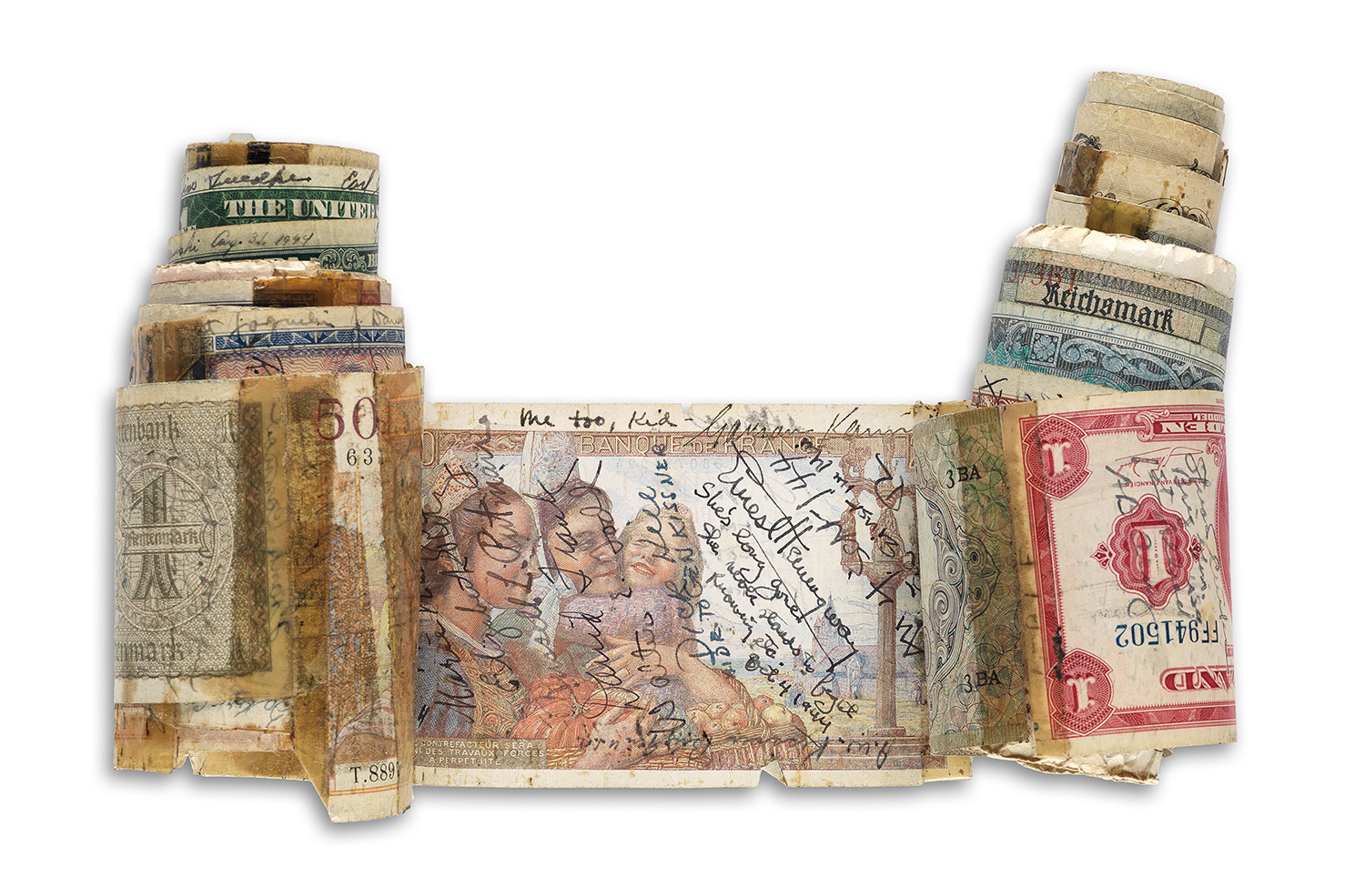
SOLD! A Sarah Stone Watercolor of Parrots Sold For More Than $18,000 at Dreweatts

Four Parrots on a Branch, a watercolor painted by Sarah Stone in 1789 or 1790.

Update: Sarah Stone’s Four Parrots on a Branch sold for £14,000, or about $18,400.

What you see: Four Parrots on a Branch, a watercolor painted by Sarah Stone in 1789 or 1790. Dreweatt’s estimates it at £1,000 to £1,500 ($1,300 to $2,000).

Who was Sarah Stone? She was an English natural history painter and illustrator who was active in the 18th century. Taught by her father, who made his living painting fans, she came to the attention of Sir Ashton Lever, a wealthy Englishman who liked collecting natural history specimens and who displayed his collection to the public. Lever hired Stone before she was out of her teens. She ultimately created around 1,000 artworks based on his collection, and about 900 survive. Many of Stone’s illustrations represent the first depictions of various species, making them significant to science and history. The Royal Academy of Arts invited her to exhibit on three different occasions. After marrying John Langdale Smith in 1789, her output slowed, and she seems to have stopped after 1806, when Lever’s collection was sold. She died in 1844 at the age of 82.

How rare were female natural history artists in the 18th century? Was Sarah Stone pretty much it? “There were good, talented amateur artists, but it was very rare to be a professional artist,” says James Harvey, a salesperson at Mallett Antiques, which consigned the watercolor. “She was rare but not unique.”

What types of parrots are pictured in the Sarah Stone watercolor? At the top is an Australian King parrot; below it is a Black-headed Caique, an Indonesian red-cheeked parrot, and an African grey parrot. Lever’s collection of taxidermied specimens included all four birds. Presumably, Stone looked at them when she created this watercolor.

And this charming little gathering of these four parrots could never happen in the wild, yes? “It was a concept in the sense that the artist enjoyed painting subjects from nature, and she used artistic license to make the painting appealing,” he says. “It’s more about observation, about looking at the forms and the colors and making things look aesthetically pleasing.”

Just how talented did Sarah Stone have to be to look at a group of dead, stuffed birds and turn them into this watercolor? “The birds are very, very vivid, very lively. That’s the difference between a good animal painter and a poor one. These birds are very realistic, but they’ve got character,” he says, adding, “It’s a standout. It’s decorative, but has tremendous presence to it. That’s what makes it so appealing.”

Normally Sarah Stone limited her focus to one subject per artwork. Do we know why she bent her rules here? “Sadly not. It’d be interesting to know why,” he says. While we have no background on the work and why Stone might have made it, Harvey and his colleagues speculate that it might have been meant for presentation: “It has that feel. It’s very well-observed. It might have been an exhibition piece, a presentation piece, perhaps even a piece for teaching purposes.”

Sarah Stone’s works have sold for six-figure sums at auction. How did you arrive at the estimate for Four Parrots on a Branch? “It’s a difficult one in that the market for watercolors is not as strong as it used to be,” he says. “If we get one or two collectors in Australia interested, it could do more.”

What else makes this Sarah Stone watercolor special? “It has all the elements you want–good artist, good condition, nice picture,” he says. “The subject matter is very charming, and from an academic angle, she’s a lady artist who worked in relative obscurity. If there’s any justice in the world, it should do well and create a good price.”

How to bid: Four Parrots on a Branch is lot 167 in Mallett: Taking Stock, an auction scheduled for November 8 at Dreweatts in Berkshire, England.

How to subscribe to The Hot BidClick the trio of dots at the upper right of this page. You can also follow The Hot Bid on Instagram and follow the author on Twitter.

Dreweatts is on Twitter. Mallett Antiques is on Instagram.

Image is courtesy of Mallett Antiques.

*If I can work in a slightly obscure Monty Python reference, why yes, I AM going to do it.

Would you like to hire Sheila Gibson Stoodley for writing or editing work? Click the word “Menu” at the upper right for contact details.

SOLD! A Marlene Dietrich Short Snorter Sells For $5,250 at Swann

A short snorter--a collection of paper money covered with autographs--compiled by Marlene Dietrich during World War II. It comes directly from Dietrich's descendants to Swann Auction Galleries, which estimates it at $3,000 to $5,000.

Update: Marlene Dietrich’s short snorter sold for $5,250.

What you see: A short snorter–a collection of paper money covered with autographs–compiled by Marlene Dietrich during World War II. It comes directly from Dietrich’s descendants to Swann Auction Galleries, which estimates it at $3,000 to $5,000.

Who was Marlene Dietrich? She was a Berlin-born actress and singer who became an international star from her role in the 1930 German film, The Blue Angel. She actively resisted the Nazis, who assumed power in her home country, by funding efforts to help refugees flee Hitler’s regime. She renounced her German citizenship in 1939 and threw herself into the U.S. war effort, touting war bonds and embarking on two long tours in 1944 and 1945 with the United Service Organization (USO). Her war work earned her the Légion d’honneur from the French government and the Medal of Freedom from America. She regarded the latter award as her proudest accomplishment. After the war’s end, she continued to act in films and perform as a cabaret singer. She died in 1992 at the age of 90.

What is the purpose of a short snorter? The tradition seems to have started among aviators in the 1920s. If two flyers met, each would sign a piece of paper money belonging to the other. If they met again, one could challenge the other to produce the signed bill, or else buy the challenger a drink–but a small one, as full-on drunkenness and flying don’t mix. The small drink, known as a short snort, gave its name to the signed roll of bills. At some point the tradition spread beyond aviators to military personnel.

Do we know when Dietrich started her short snorter? “We have the story of how it likely happened, but not how it actually happened,” says Marco Tomaschett, autographs specialist at Swann, explaining that Dietrich’s collection dates to the 1940s, and she might have started it on one of her USO tours. “Someone who was collecting signatures for his short snorter asked her to sign his, and she thought it was a cool idea and decided to start one herself.”

Marlene Dietrich’s short snorter measures 38 feet long. That’s kind of unwieldy. Did she really carry the bill roll on her person during her war travels? “The tradition at the time was you were supposed to have all of them [the signed bills], so if a compatriot asked to see a signature, she could present the signature so she wouldn’t have to buy a drink for them,” he says. “Most short snorters were easier to carry, because most could fit the signatures on a single bill. If you ran out of room, you got a second bill. But not everyone was called to the front repeatedly, and not everyone did as much travel as she was doing.”

Do we know if she was ever challenged to produce a signed bill? “I don’t know. Probably not,” he says, laughing. “But she did use it to demonstrate solidarity with the soldiers.” He adds that seeing Dietrich’s short snorter inspired Army Air Force Captain John L. Gillen to start his own, and his bill roll ultimately grew to contain paper money from 36 countries and measure 100 feet long.

How often do you, as an autograph specialist, handle short snorters? “They don’t come up, mainly because they generally don’t have the value that brings them to auction,” he says. “This is unusual in that it has collectible autographs and it was owned by a celebrated figure.”

Has the short snorter tradition disappeared? “The historical factors that made it exciting at the time have dropped away,” he says. “The drinking game has completely vanished. The last time you get a serious collection of signatures on a bill is in the 1960s, connected with the space race. The analogy of space exploration to aviation made it a natural continuation.”

Who are some of the notable people who signed Marlene Dietrich’s short snorter? Author Ernest Hemingway, whose friendship with the actress predated World War II, wrote, “She’s long gone She never stands to fight knowing etc. Oct 4 1944.” Tomaschett is unsure of what the message might mean, but suspects it’s an inside reference of some sort. Military signers include George S. Patton, Omar Bradley, and Nathan Farragut Twining; entertainers include Danny Thomas and Burgess Meredith.

What is your favorite signature on the Marlene Dietrich short snorter? Tomaschett cited the inscription of Lieutenant Buck Dawson, who wrote, “Even a paratrooper must admire your courage. You volunteer for many things we have to do. Thanks. The 82nd Div.” “The courage he’s referring to is that she performed in these conditions,” he says, referring to the rugged environment of the war’s front lines. “We’re certainly not used to being shot at or bombed, but she did it [staged her USO act] repeatedly, for years.”

How to bid: The Marlene Dietrich short snorter is lot 46 in the November 7 Autographs sale at Swann Auction Galleries.

If you click the link to lot 46, you can see a period black-and-white photo of Dietrich draped in her short snorter.

How to subscribe to The Hot BidClick the trio of dots at the upper right of this page. You can also follow The Hot Bid on Instagram and follow the author on Twitter.

Swann Auction Galleries is on Instagram and Twitter.

Image is courtesy of Swann Auction Galleries.

Would you like to hire Sheila Gibson Stoodley for writing or editing work? Click the word “Menu” at the upper right for contact details.
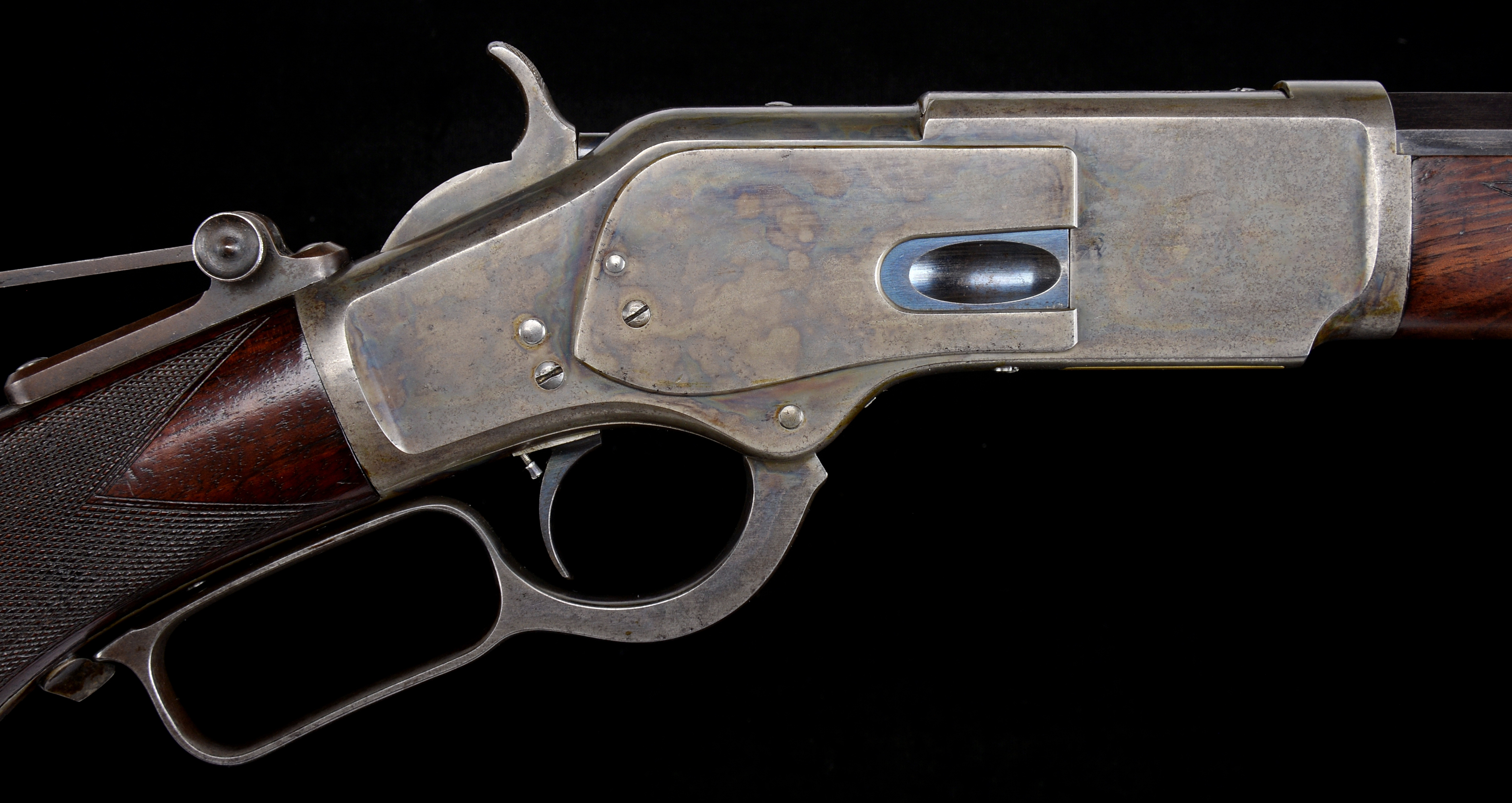
SOLD! A Rocky Balboa Statue Commanded More Than $403,000 At SCP Auctions

A limited edition monumental bronze statue of Rocky Balboa, commissioned from sculptor A. Thomas Schomberg for the 1982 film Rocky III.

Update: SCP Auctions sold the Rocky Balboa statue for $403,657.

What you see: A limited edition monumental bronze statue of Rocky Balboa, commissioned from sculptor A. Thomas Schomberg for the 1982 film Rocky III. SCP Auctions estimates it at $500,000-plus.

Who is Rocky Balboa? He is the fictional star of the Rocky series of films, which are about an Italian-American boxer who climbed from the bottom to the absolute top. The first Rocky appeared in 1976 and propelled its writer-lead, Sylvester Stallone, to Hollywood fame. Stallone has played the Rocky Balboa character in six sequels, including the most recent, Creed, released in 2015. The Rocky films have collectively earned more than $675 million in ticket sales alone.

How did this Rocky Balboa statue come to be? The producers of Rocky III commissioned the statue for the film. It commemorates the famous scene in the original film in which the boxer runs up the steps of the Philadelphia Museum of Art. It was placed at the top of the steps for filming, but now stands at the bottom right of the steps. The statue and the steps rival Independence Hall and the Liberty Bell as the most popular tourist attractions in Philadelphia.

Who is A. Thomas Schomberg, and how was he chosen to sculpt the Rocky statue? By the early 1980s, the Colorado-based sculptor was well-known for his sports-themed works. Stallone owned a few of his boxing-related pieces and called him for the Rocky III job, which took a year. The actor sat for a plaster life mask to assist Schomberg in creating the bronze.

How many Rocky statues are there? Only three of the monumental-size statues exist. Two, including this one, were cast at the same time in the early 1980s, and the third was cast in 2006. The statue consigned to SCP Auctions had been on loan to the San Diego Hall of Champions Sports Museum until recently. The later-cast statue is still with Schomberg.

And this is an exact replica of the Rocky Balboa statue that’s outside the Philadelphia Museum of Art? “Correct, and it was made simultaneously, to the same specifications. They’re virtually identical,” says Dan Imler, vice president of SCP Auctions. “The one on display in Philadelphia and the one we have are twins.”

How often do you have sports-themed art in your auctions? Is it something you seek? “We’ve had our fair share over the years. It’s a take-it-as-it-comes scenario,” he says. “The Rocky statue fits many categories. It’s a monumental piece of art. It’s sports art, but you can see it as movie memorabilia. And it’s an iconic piece of Americana. It transcends categories. It’s many things. It should appeal to a cross-section of bidders.”

This Rocky Balboa statue stands eight feet, six inches tall and weighs 2,000 pounds. What should bidders hold in mind when they consider this piece? “It’s not ideally suited for your average living room. You won’t put it on your mantle or your coffee table. But I think it’s going to appeal to different people,” he says. “It has a lot of commercial value. You could display it at a public venue, or a business, or privately as well. We know from the example in Philadelphia that it was made to be displayed outdoors, or it can be put indoors, as it was in San Diego.”

I’ve never seen the Rocky statue in person. How did it affect you? “It’s breathtaking, first of all, for its sheer size,” Imler says. “Second of all is its sheer artistry. It’s incredibly well done, a beautiful work of art that conveys its ultimate intention, which is inspiration. It’s a very inspiring piece. Anyone who has seen the Rocky movies immediately thinks of the rags-to-riches story. This is an ideal representation of that.”

Why will this lot stick in your memory? “I was always an enormous fan of the Rocky movies,” he says. “If I’m flipping the channels and I happen upon any one of them, it’s hard to turn away. I remember being very moved by the original Rocky film. This statue embodies that story–the overcoming-the-odds, blue-collar, never-give-up mentality. It’s a very inspiring piece. We hope it lands in a place like its brother in Philadelphia, to be appreciated by as many people as possible.”

How to bid: The Rocky Balboa statue is among the lots in SCP Auctions‘ Fall Premier sale, which takes place from October 18 through November 4.

How to subscribe to The Hot BidClick the trio of dots at the upper right of this page. You can also follow The Hot Bid on Instagram and follow the author on Twitter.

SCP Auctions is on Twitter and Instagram as well. A. Thomas Schomberg has a website with a page that is dedicated to the Rocky statue. The statue also has its own website.

Image is courtesy of SCP Auctions.

Would you like to hire Sheila Gibson Stoodley for writing or editing work? Click the word “Menu” at the upper right for contact details.

A Winchester Model 1873 1 of 1000 Rifle Could Sell for $400,000 at James Julia

A closeup of a Winchester 1873 "1 of 1000" rifle, serial number 6594.

What you see: A closeup of a Winchester 1873 “1 of 1000” rifle, serial number 6594. James D. Julia estimates it at $250,000 to $400,000.

What is the Winchester Model 1873 1 of 1000 rifle? It was one of the most popular 19th century firearms from the Winchester Repeating Arms Company, which touted the Model 1873 as “The gun that won the West”. Named for the year in which it debuted, Winchester produced well over 700,000 of them from 1873 until 1923.

What does “1 of 1000” mean? “According to Winchester, they were barrels specially selected for accuracy. It’s estimated that only one of a thousand barrels met those accuracy standards,” says J.R. LaRue, head of James D. Julia’s fine firearms consulting department, noting that 136 Winchester Model 1873s earned the designation, and about 70 to 75 of those still exist.

How often do Winchester Model 1873 “1 of 1000” rifles come to auction? LaRue says he started to see them appear at James D. Julia about eight to 10 years ago, and saw many more come in during the last two to three years. “In this auction, we have three. The other two, I haven’t had time to describe yet,” he says, “But they’re not anything remotely like the quality of the one you read the description on [this one]. This is a really fine, high-condition example.”

This example dates to 1875, the year in which Winchester introduced the “1 of 1000” designation. Does that make the firearm more valuable? “It may add a little bit of prestige to a new owner, but it’s not going to add significantly to the value,” LaRue says.

It’s described as “one of the highest condition Model 1 of 1000 Winchester rifles extant.” What does “high condition” mean here? “It doesn’t show a lot of wear, and it shows a great deal of original finish,” he says. “The likelihood is the owner who purchased the rifle held it in such high regard, he didn’t allow it to be abused or exposed to the elements. Whoever owned it took care of it. It didn’t rattle around in a wagon box or a saddle scabbard.”

In the realm of antique firearms, condition includes functionality. Does this one work? “We don’t fire it at all,” he says. “We only check the functionality of the mechanics to ensure it’s working as intended.”

How unusual is it for an elite 19th century Winchester to have even a partial provenance, as this one does? “Pretty rare. Most of them can only be dated back to 1950, when Universal Studios searched for 1 of 1000 rifles to promote the movie Winchester ’73. We know the history of this one back to 1935,” LaRue says. The first twenty owners who wrote to the studio received a Winchester 184 “Carbie” for their efforts. The person who owned the rifle in 1950 was quick enough on the draw and won a Carbie. That 20th century gun is included in the lot.

This rifle is estimated at $250,000 to $400,000. James D. Julia sold a Winchester 1873 1 of 1000 in fall of 2014 for $258,750. Could this Winchester 1873 1 of 1000 do better? “It certainly has a chance to do so. I absolutely hope it does,” he says.

How to bid: The Winchester Model 1873 1 of 1000 Rifle is among the lots in the Extraordinary Firearms Auction at James D. Julia on October 31, November 1, and November 2, 2017.

How to subscribe to The Hot BidClick the trio of dots at the upper right of this page. You can also follow The Hot Bid on Instagram and follow the author on Twitter.

Text is copyright Sheila Gibson Stoodley. Image is courtesy of James D. Julia.

Would you like to hire Sheila Gibson Stoodley for writing or editing work? Click the word “Menu” at the upper right for contact details.

SOLD! A 1930s German Travel Poster Sold for $6,000

A Pleasant Trip to Germany, a travel poster created circa 1935 by Jupp Wiertz.

Update: The Jupp Wiertz circa 1935 travel poster featuring the Hindenburg sold for $6,000.

What you see: A Pleasant Trip to Germany, a 1930s German travel poster created circa 1935 by Jupp Wiertz. Swann estimates its at $4,000 to $6,000.

Who was Jupp Wiertz? He was a German graphic designer, and unfortunately, we don’t know much more about him. He was based in Berlin, and he created several travel and fashion-themed posters. He died in 1939, when he would have been 57 or 58.

So we have three different forms of transportation (a zeppelin, an airplane, and an ocean liner) and three different destinations (Germany, New York City, and Rio) loaded into this 1930s German travel poster. Why? “This is propaganda–Germany controlling the skies and the seas, flaunting its technology and bragging about its place in the modern world,” says Nicholas Lowry, director of Swann Galleries. “It’s a very effective ad, in that sense.”

How do we know that the zeppelin pictured on the 1930s German travel poster is the Hindenburg? “You can tell by the position of the cockpit,” he says. “On the Graf Zeppelin, it’s all the way forward. On the Hindenburg, its three-quarters of the way down [the body of the airship].”

Do vintage travel posters that feature zeppelins bring a premium? “Zeppelins bring a premium. Swastikas bring whatever is the opposite of a premium,” Lowry says, adding that the most popular zeppelin travel poster was also done by Wiertz. It shows the Hindenburg readying to hitch itself to the docking mast atop the Empire State Building, which is ablaze with golden sunlight. Swann has sold the poster for as much as $15,600.

What else makes this 1930s German travel poster special? “It’s the peak of Art Deco. Though the ship is unrecognizable, the Art Deco style is very recognizable,” he says. “Plus the ghostly outline  of the cityscapes–it’s really a masterful job. It’s fun to have something from the golden age of travel and fun to have something from the very short timespan when zeppelins were operating. They were as captivating to the world’s imagination as the Titanic was in its time.”

How to bid: A Pleasant Trip to Germany is lot 151 in the Rare & Important Travel Posters sale at Swann Auction Galleries on October 26, 2017.

How to subscribe to The Hot BidClick the trio of dots at the upper right of this page. You can also follow The Hot Bid on Instagram and follow the author on Twitter.

Swann Galleries is on Instagram and Twitter, and Nicholas Lowry is on Instagram and Twitter as well.

Text is copyright Sheila Gibson Stoodley. Image is courtesy of Swann Auction Galleries.

Would you like to hire Sheila Gibson Stoodley for writing or editing work? Click the word “Menu” at the upper right for contact details.

SOLD! A Tadanori Yokoo Poster Fetched $4,250

Word Image, a poster designed by Tadanori Yokoo for a 1968 show at the Museum of Modern Art (MoMA).

Update: The Tadanori Yokoo poster sold for $4,250.

What you see: Word Image, a poster designed by Tadanori Yokoo for a 1968 show at the Museum of Modern Art (MoMA). Swann Auction Galleries estimates it at $4,000 to $6,000.

Who is Tadanori Yokoo? He is a Japanese graphic artist and painter who has been compared to Andy Warhol and Peter Max. The 1968 MoMA exhibition poster represents one of his few American commissions. He will turn 81 in June.

What was Word and Image? “This was one of the first really major international poster shows,” says  Nicholas Lowry, director of Swann Galleries. “For us, it was a seminal exhibit, and by us, I mean the poster community.”

Why was Yokoo chosen to create the poster for this MoMA show? While stating that he is unaware of the backstory, Lowry points out, “He was an up-and-coming artist. No one was going to say, ‘Oh, you’re going with the easy standard.’ This was something new. And this was the first mainstream poster he did. In three years, he went from an unknown artist to designing the image for the first major poster retrospective in the U.S.”

What makes this Tadanori Yokoo poster so strong? “It works in the manner that it’s supposed to do–it catches your attention,” Lowry says. “As you walk down the street, it sinks into your head and embeds in your cortex as you pass by. The poster screams at you till you hear it with your eyes. That’s exactly what it does. It’s a great, great poster.”

What other aspects make Word Image work? “What you can’t tell is those are Day-Glo colors–bright pink, bright red, bright blue,” Lowry says. “And he is visually literalizing the name of the show–‘word’ with mouth, and ‘image’ with eye. The message speaks for itself. The only typography is the title at the top and the details at the bottom.”

How rare is this Tadanori Yokoo poster? It’s not rare, but it’s not common, either. Lowry says that Yokoo’s Word Image poster took off at auction only after a 1965 Yokoo poster unexpectedly pulled in $52,800 against an estimate of $6,000 to $9,000 at a Swann sale in 2013, prompting collectors and dealers to comb through their holdings for vintage Yokoos. Since then, a Word Image poster has appeared at auction at least once a year.

How to bid: Yokoo’s Word Image poster is lot 293 in Swann Galleries’s Graphic Design auction on May 25.

How to subscribe to The Hot BidClick the trio of dots at the upper right of this page. You can also follow The Hot Bid on Instagram and follow the author on Twitter.

Swann Auction Galleries is on Instagram and Twitter, and Lowry is on Instagram and Twitter as well.

Image is courtesy of Swann Auction Galleries.

Would you like to hire Sheila Gibson Stoodley for writing or editing work? Click the word “Menu” at the upper right for contact details.

A Matched Set of Bull Mammoth Tusks Could Fetch $250,000

A pair of mammoth tusks from Alaska that date to the Pleistocene era (which spans about 11,700 years ago to 2.6 million years ago).

What you see: A matched set of bull mammoth tusks from Alaska that date to the Pleistocene era (which spans about 11,700 years ago to 2.6 million years ago). Heritage Auctions estimates the pair at $150,000 to $250,000.

These tusks come from a bull, or male, mammoth. Did only bull mammoths grow tusks? And how do we know these are from a bull? “The females have tusks, and the juveniles have them too,” says Craig Kissick, director of nature and science for Heritage Auctions. “The consensus is based on size. This pair of tusks has a pronounced horn, with a big curve. Female tusks are straighter and thinner.”

Were they attached to a skull when they were discovered? “These were probably not found with the bone. They were found together, and you can tell by looking that they’re a matched pair,” he says. “It’s a really nice matched pair, with good color and a nice curve. That’s rare.”

How often do matched pairs of mammoth tusks come to market? “They’re much less common,” Kissick says. “For every tusk you find, a matched pair would be a very small portion of the total take.”

The measurements given in the lot notes for the matched set of bull mammoth tusks–68 inches by 40 inches by 5 inches–are a little hard to understand. What do they describe? The number 68 describes the width of the tusks as they appear in the black display armature, which is visible in the picture. The 40-inch measurement corresponds to height, starting at the bottom of the armature and ending at the top of the tallest tusk. The 5-inch measurement should probably be five feet, because it describes the depth of the display from the front of the armature to the back.

You said that the tusks have “good color.” What does that mean here? “They have smooth whites, tans, and creams. The colors are sublime, not bright and bold like some of the others,” he says. “It’s a nice color palette that’s the result of how the tusks were actually fossilized.”

The lot notes say the matched set of bull mammoth tusks are in excellent condition. What does that mean when we’re talking about fossils? “With fossils, by their very nature, you’re not going to find what you’d call a perfect fossil,” he says, explaining that all fossils need at least some level of “preparation”, a term that covers repairs and restoration. “These tusks appear to have minimal restoration. There’s not a big chunk of the tip that had to be put back on. There are no cracks that had to be filled with putty or paint. These are in really good condition. That’s why they’re important and have a high valuation. They’ve been polished to make them the most presentable [they can be]. No matter how museum-quality it [a great fossil] is, there’s also a decorative quality that makes it amazing to put on display.”

In the foreground of the photo of the mammoth tusks, there’s a fluffy bunny with a carrot in front of it. Why? “It’s for scale,” he says. “Scale doesn’t always translate from your brain to your eyes. We usually put a brass ingot next to minerals, for context. For things that are really big, we’ve used babies, we’ve used kids, we’ve used people, we’ve used dogs.”

But why a fluffy bunny, this time, then? “The tusks are weird with the armature–it’s not easy for an adult or a child [to get in to the space between the tusks in a manner that works for the shot]. It’s easier to plop a bunny down there, and that’s what we did,” he says, explaining that the rabbit is the pet of a junior cataloger at Heritage Auctions. “For further whimsy, we threw the carrot in front of it, because it doesn’t look like a bunny, it looks like a beast. It behaved well enough not to hop off before we took the picture.”

I’d be tempted to tweak the lot notes to add a jokey reference that says the bunny and the carrot don’t come with the tusks. “People can get weird about it [what’s shown in catalog photos versus what’s actually part of the lot]. You’d be surprised,” he says. “We were half thinking of saying, ‘Rabbit not included.'”

How to bid: The matched set of bull mammoth tusks is lot #72194 in Heritage Auctions‘s Nature & Science Signature Auction in Dallas on November 4. As noted above, the rabbit and carrot are not included. Also know that if you live in New York, New Jersey, Hawaii, or California, your state’s laws prevent you from bidding on the tusks. See the lot notes for more.

How to subscribe to The Hot BidClick the trio of dots at the upper right of this page. You can also follow The Hot Bid on Instagram and follow the author on Twitter.

Heritage Auctions is on Twitter and Instagram.

Image is courtesy of Heritage Auctions.

Would you like to hire Sheila Gibson Stoodley for writing or editing work? Click the word “Menu” at the upper right for contact details.

SOLD! Warhol Campbell’s Soup II Prints Sold For Up To $37,500 Each

Update: All ten prints from the Campbell’s Soup II set that Warhol gave to Dr. Rossi sold in the Christie’s auction. Lots 1 through 4 (lot 4 is shown above) and lots 6 through 8 each sold for $37,500. Lot 5 sold for $35,000. Lots 9 and 10, which were more faded, sold for $16,250 and $23,750, respectively.

What you see: A screenprint from Campbell’s Soup II, a limited edition series of 250 that Andy Warhol created in 1969. Warhol also made 26 artist’s proofs–sets reserved for his own use–and marked each with a letter. This print is from the ‘B’ set and it is lot 4 in an upcoming Christie’s sale. The auction house estimates it and seven others from the complete ‘B’ set at $18,000 to $25,000; two more from the same group are estimated at $10,000 to $15,000.

Who was Andy Warhol? Born as Andrew Warhola in Pittsburgh, Pennsylvania, he is one of the most famous and influential artists of the 20th century. Like Picasso, he refused to confine himself to a single medium, taking on painting, printmaking, film,  photography, rock band management, and creating books and magazines. The scene that evolved around his Manhattan studio, which he dubbed The Factory, became famous in its own right. A 1968 exhibition program for his work contained the words, “In the future, everyone will be world-famous for 15 minutes,” a phrase that has become more prophetic over time. On June 3 of that year, Valerie Solanas, an outlier member of The Factory scene, attacked the artist at his studio, shooting him and a visiting art critic. Both survived, but Warhol nearly didn’t, having suffered injuries to several organs. Warhol lived for 19 more years, succumbing in 1987 in Manhattan after gallbladder surgery. He was 58.

Warhol created a lot of iconic images–the Mao portrait, the Brillo box, the Marilyn silkscreen–but his Campbell’s Soup can images might be the best-remembered of his works. Why? “It really gets back to the origin of Pop Art,” says Lindsay Griffith, specialist and head of sale for prints for Christie’s. “He played with the idea of what you already knew. You were so conditioned to see them [the soup cans] in a different context. You did not expect to see them in a gallery. He toggled back and forth between high and low constantly. He changed the nature of image production in the fine-art sense. It’s the purest expression of that.”

I was aware that Warhol had been shot in 1968, and I had seen the photos of him displaying his scar, but I had no idea how badly he was hurt. What happened? “He was actually declared clinically dead. Three bullets entered his chest and stomach. He lost a tremendous amount of blood,” she says. “Dr. Giuseppe Rossi was a chest and thoracic surgeon. He had handled quite a few gunshot victims because of what the neighborhood [of Columbus hospital, whose emergency room received Warhol,] was. He was talented with gunshot surgeries. Every account I have read shows, truly, he saved Warhol’s life. In reading his diaries, that’s how Warhol felt. The damage was incredibly extensive, and he was in pain for the rest of his life.”

It seems that Warhol could have done better with handling the bills that Dr. Giuseppe Rossi sent. The doctor wrote “Pay up you blowhard” on the outside of one of them. And a story that Christie’s wrote on the ten lots includes an image of a check Warhol wrote to the doctor for $1,000, which bounced (scroll down to see it). Did the artist send the Campbell’s Soup II set of prints as payment for his treatment? “Rossi also became Warhol’s doctor for the rest of his life. That bill [the one Dr. Rossi wrote his message on] is potentially related to that,” she says, describing an ongoing relationship between the artist and the family that included Warhol sending Christmas gifts and sitting for an interview with Dr. Rossi’s young son for his middle school newspaper. “A number of people received the prints as gifts. They were really a gift, a gesture of gratitude,” Griffith says, and adds that Warhol asked for Rossi when he entered the hospital in 1987, but the family was vacationing out of the country. Warhol died before they came back. Dr. Rossi died in 2016.

The family consigned the full set of 10 prints to Christie’s, but you are selling them individually. Why? “We felt that was how they would perform best commercially,” she says, explaining that the Rossis stored eight of the prints in a box under a bed and displayed two. If you compare lots 9 and 10 to lots 1 through 8, which stayed in the dark from 1968 to now (scroll down a little to see the 10 lots as a group), you’ll spot the difference that UV light can make. “We wanted to emphasize the condition of those eight. Their colors are in exceptionally wonderful condition.”

Do the estimates for the ten prints reflect the value of the story of Andy Warhol and Dr. Giuseppe Rossi? “We priced them because they are wonderful objects. We did not take the provenance into account at all,” she says. “But provenance is always an interesting X-factor at auction.”

Why will these lots stick in your memory? “This is one of my favorite stories from the last few years of being here at Christie’s,” Griffith says. “Rossi is directly responsible for continuing a tremendous career in 20th century art. It’s a story we’re privileged to be a part of, and we encourage everyone to come and see the prints. They look absolutely amazing in our gallery. They’re meant to be looked at.”

How to bid: The set of Campbell’s Soup II prints given by Warhol to Dr. Rossi are lots 1 through 10 in the Prints and Multiples sale at Christie’s New York on October 24 and 25.

How to subscribe to The Hot BidClick the trio of dots at the upper right of this page. You can also follow The Hot Bid on Instagram and follow the author on Twitter.

Christie’s is on Twitter and Instagram. Christie’s also wrote a story about the lot that contains interviews with Dr. Rossi’s widow, Gemma, and his son, Roberto.

Image is courtesy of Christie’s / © 2017 The Andy Warhol Foundation for the Visual Arts, Inc. / Artists Rights Society (ARS), New York.

Would you like to hire Sheila Gibson Stoodley for writing or editing work? Click the word “Menu” at the upper right for contact details.
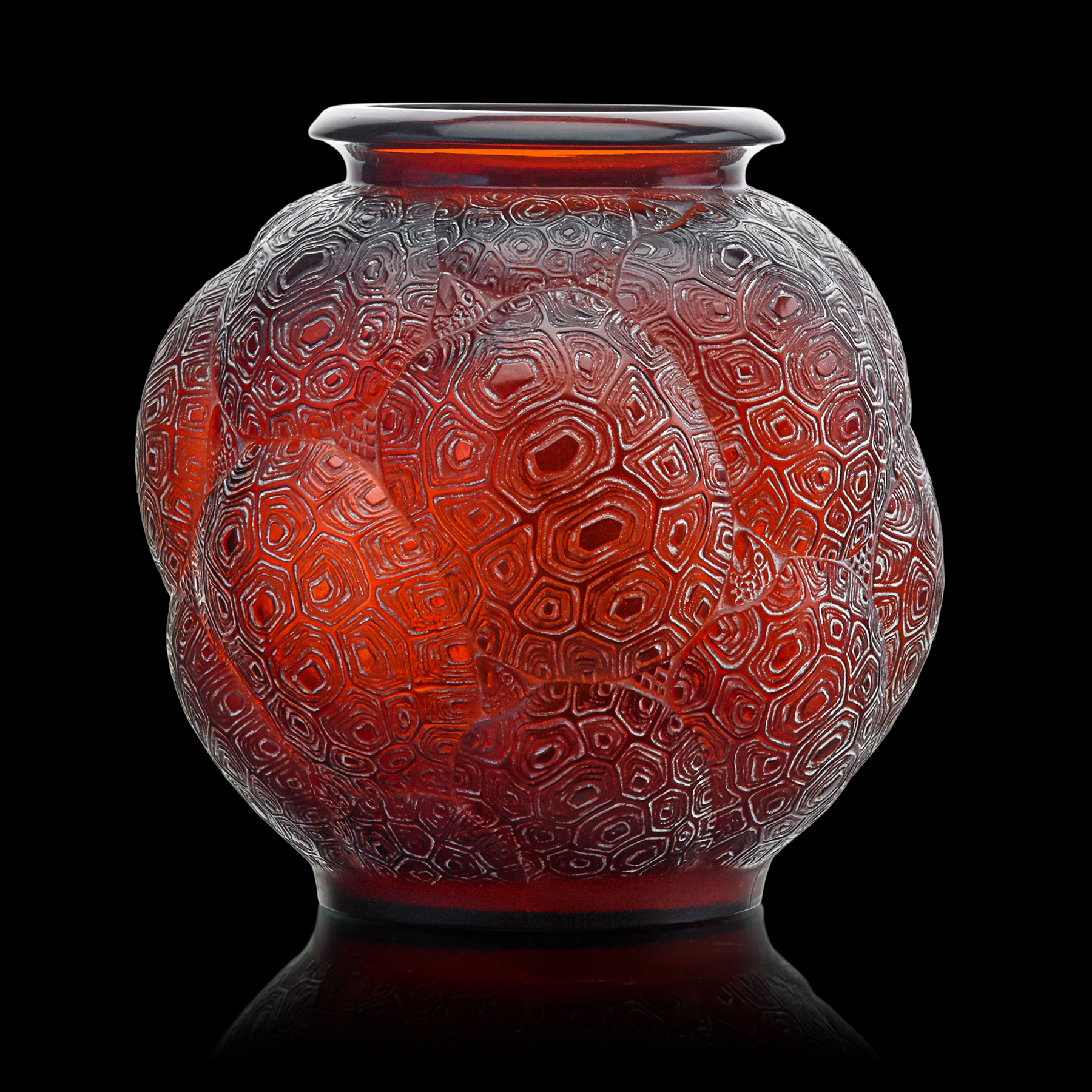
A Bounty Hunter Dune Buggy Sold for $36,250 at LAMA

A Bounty Hunter dune buggy, completed in 1969. It has 45,000 miles on its odometer, and it has a manual transmission.

Update: The dune buggy sold for $36,250.

What you see: A Bounty Hunter dune buggy, completed in 1969. It has 45,000 miles on its odometer, and it has a manual transmission. Los Angeles Modern Auctions estimates it at $30,000 to $50,000.

What is a dune buggy? It’s a recreational off-road vehicle designed for use on beaches, deserts, and dunes, hence the name ‘dune buggy.’ It descends from the VW Beetle, a car with a chassis that was light enough to drive on sand. Dune buggies were primarily kit cars, which means that someone would buy the kit and build the car themselves or have other people do it for them. The cars had their heyday from the late 1950s to the mid-1970s, when lawmakers realized it probably wasn’t a good idea to let drivers tear across delicate shoreline ecosystems with abandon.

Why is this one called a Bounty Hunter dune buggy? The name is a nod to Steve McQueen’s Western show, Wanted: Dead or Alive, which ran in the late 1950s and early 1960s. He played a bounty hunter. Apparently, one of the dune buggy’s designers met McQueen and helped him when the star ran out of gas.

LAMA primarily handles art and design. Why offer a motor vehicle? “We’ve sold a couple of cars, as a matter of fact,” says Peter Loughrey, founder of LAMA, citing, among other things, a supercharged 1963 model 63R2 Avanti Studebaker that belonged to design god Raymond Loewy. The Los Angeles County Museum of Art (LACMA) acquired it.

How do you choose the cars that you auction at LAMA? “We’re looking for something special,” he says. “It’s not necessary to sell it to a car person, but it’s important that a car person looks at it and gets it. It has to do both–it has to excite the design people and a car person can’t look at it and say, ‘Why this one?”

Dune buggies were kit cars, which means the people who bought them built the car or had someone else do it. Why does this example stand out? “The original owner is a figure in the custom car world,” Loughrey says. “When he built it in 1968, he knew what he was doing. This really is the ultimate dune buggy. He custom-built the best example that could be built around this body.”

I also understand that the Bounty Hunter dune buggy is street-legal, while most dune buggies are not? “Because he’s a professional builder and wanted to build the ultimate dune buggy, he wanted to drive it to the dunes and drive it back [instead of towing it],” he says. “He had the headlamps built into the body. The turn signals and rear lamps are from a 1964 Corvette body. He never liked the Jeep-style windshield on other dune buggies, so he took the windshield from a 1964 Renault. He knew every detail was going to make a good, fun vehicle to drive.”

This car is described as being ‘mint.’ What does that mean in this context? “Maybe that’s not the right word. It’s more like a flawless survivor,” he says, explaining that the only parts that aren’t original are the radio and a set of speakers that were installed in the 1980s. “It shows very little wear. The original [fiber] glass body was gel-coated. It has its original gel coat. It has all-original pin-striping that hasn’t been touched since 1968. He [its creator] knew it was a special car, and not a daily driver. It was a work of art, always.”

Is the Bounty Hunter dune buggy drivable? Have you driven it? Yes, and no. “These things have to be usable,” he says. “A Picasso vase–you can use it. I won’t, but I can use it. An Eames chair–you can sit on it. If you say oh, it’s not functional anymore, you cut out a large reason for buying it.” But Loughrey had yet to drive the dune buggy during the week that he did this interview–the brakes were being replaced. “If I sell it to a museum, I’ll be the last one to drive it,” he says.

What else stands out about the Bounty Hunter dune buggy? “Anytime we have a car, it always stands out. The little kid in me loves that we’ve got a dune buggy in our showroom,” he says. “People have asked me for years what our next car will be, and I’d said, ‘maybe a dune buggy.’ I’ve been beating the bushes for several years. When I saw it, it was love at first sight. It was exactly what I wanted–not restored, not repainted. It was 100 percent original.”

How to bid: The Bounty Hunter dune buggy is lot 93 in LAMA‘s 25th anniversary Modern Art & Design Auction on October 22, 2017.

How to subscribe to The Hot Bid: Click the trio of dots at the upper right of this page. You can also follow The Hot Bid on Instagram and follow the author on Twitter.

Los Angeles Modern Auctions (LAMA) is on Twitter and Instagram.

Image is courtesy of Los Angeles Modern Auctions.

Would you like to hire Sheila Gibson Stoodley for writing or editing work? Click the word “Menu” at the upper right for contact details.

SOLD! A Life-Size Artist’s Mannequin Fetched $45,000

A life-size articulated wooden artist's mannequin, made in France, dating to around 1860, and measuring about 60 inches tall.

Update: The 19th century French life-size articulated wooden artist’s mannequin sold for $45,000.

What you see: A life-size articulated wooden artist’s mannequin, made in France, dating to around 1860, and measuring about 60 inches tall. Rago Auctions estimates it at $20,000 to $25,000.

If you were an artist in the 19th century and could afford a life-size articulated wooden mannequin, couldn’t you afford to hire a live model instead? “Possibly, but live models were not always available. And a mannequin can hold a pose forever. It’s almost more posable than a real person,” says Marion Harris, a specialist in antique mannequins and curator of the Curiouser and Curiouser sale for Rago. “Life-size artist’s mannequins were expensive, and they were valued in their own right. They became something of worth in an artist’s inventory. Mannequins were often listed in the estates of artists when they died.”

How many life-size artist’s mannequins have you dealt with? How many are known? Harris says she has handled 15 to 20 over the last quarter-century. She suspects that maybe as many as 100 were made between the 16th and 19th centuries, and as many as half might survive. “They’re just about always androgynous,” she says. “I’ve looked at the same one and seen it as male, then seen it as female.”

Would one artisan have carved the face, and other artisans have carved the rest of the body? “I don’t know how they did it, but it’s likely. Four or five ateliers were known for carving them. Even the bad mannequins are very good. It’s so hard to do,” she says. “This mannequin has a particular sensitivity to the carving. It’s so lifelike.”

Ribs were carved into the mannequin’s torso. Why? “That’s another sign of quality, when the ribs are evident,” she says. “You do want to see the ribs, if you can. It lets the piece look more realistic. Without the ribs, it looks more puppet-like. Anything that gives the mannequin a more realistic human quality to its features makes it more efficient and effective for the artist.”

Does the life-size artist’s mannequin have a patina? “It has a brilliant patina–not just from being handled, but from age. It glows with pride as well as age, I like to say,” she says.

How much does the life-size artist’s mannequin weigh? About 100 pounds. “I could almost carry it. But it would have been on a stand. Once it’s on a stand, it’s completely posable,” she says. “It’s almost like a real person.”

People might know the life-size artist’s mannequin from the Manhattan shop window of Ann-Morris. How did you convince the shop’s owners to consign it? “Everybody wanted to buy it. They would rent it to films, but they would never sell it. Now that the son has taken over the business, I finally got him to part with it,” she says. “It’s a fitting way to part with it. They wanted to give it a rather grand farewell. They’ve had others, but this one was always the queen.” (Harris later confirmed that though the mannequin had appeared in the window since the 1970s, the family never gave it a name, surprising as that might seem.)

What else makes the life-size artist’s mannequin special? “I’ve seen other mannequins. This one almost calls out to you to say, ‘Touch me, love me, hold me, pose me, care for me. I’m here for you and you’re here for me,'” she says. “Even people who’ve never seen it before stop in their tracks. And a number of people would have seen it and looked at it adoringly [when it was in the Ann-Morris window].”

How to bid: The life-size articulated artist’s mannequin is lot 39 in the Curiouser and Curiouser auction on October 22 at Rago Auctions.

How to subscribe to The Hot BidClick the trio of dots at the upper right of this page. You can also follow The Hot Bid on Instagram and follow the author on Twitter.

Rago Auctions is on Twitter and Instagram.

Image is courtesy of Rago Auctions.

Would you like to hire Sheila Gibson Stoodley for writing or editing work? Click the word “Menu” at the upper right for contact details.

SOLD! Rare René Lalique Vase Commands $25,000 at Rago

A Tortues (Turtles) vase by the French glass master and entrepreneur René Lalique, rendered in amber glass with a hand-applied white patina. It was designed in 1926 and produced between 1926 and 1945, when Lalique died.

Update: The Lalique Tortues vase sold for $25,000.

What you see: A Tortues (Turtles) vase by the French glass master and entrepreneur René Lalique, rendered in amber glass with a hand-applied white patina. It was designed in 1926 and produced between 1926 and 1945, when Lalique died. Rago Arts and Auctions estimates it at $10,000 to $15,000.

This Lalique vase was made from amber glass. Why does it look ruby red, then? “It does come across that way. Without light penetrating them, the colors on a Lalique vase can look different, definitely the darker colors,” says David Rago of Rago Arts and Auctions. “My understanding is this is the best of them. You don’t see this color in many pieces to begin with. The patina brings out some of the detailing.”

How rare is this Lalique vase? Rago can only recall handling one other example, which was also a dark amber. His auction house sold it for $34,000 in 2006. While it was in production for almost 20 years, not many were made, probably because of the thickness of the glass and the unusual bulging shape.

How does its relatively large size (10 1/2 inches by 9 1/2 inches) enhance the Lalique vase’s value? “The larger vases were not made in great numbers. It’s not a massive piece, but it’s bigger than a lot of them,” says Rago. “It’s a statement piece of Lalique.”

What else makes this Lalique vase special? “Glass can be feminine by nature. I find this to be a fairly masculine piece in the form, the size, the weight of it, and the design,” says Rago. “It’s not a soft pink. It’s not a particularly pretty color. Instead of being fluid and curvilinear, this is heavy, large, and thick. Most of his vases tend not to have that type of strength. And it’s big, it’s rare, and it’s in perfect condition. If you have a checklist for a major molded piece of Lalique, you have it all.”

How to bid: The Lalique Tortues vase is lot 1000 in the Solana Collection of Lalique Glass auction, taking place May 20, 2017 at Rago.

How to subscribe to The Hot BidClick the trio of dots at the upper right of this page. You can also follow The Hot Bid on Instagram and follow the author on Twitter.

Image is courtesy of Rago Arts and Auctions.

Would you like to hire Sheila Gibson Stoodley for writing or editing work? Click the word “Menu” at the upper right for contact details.
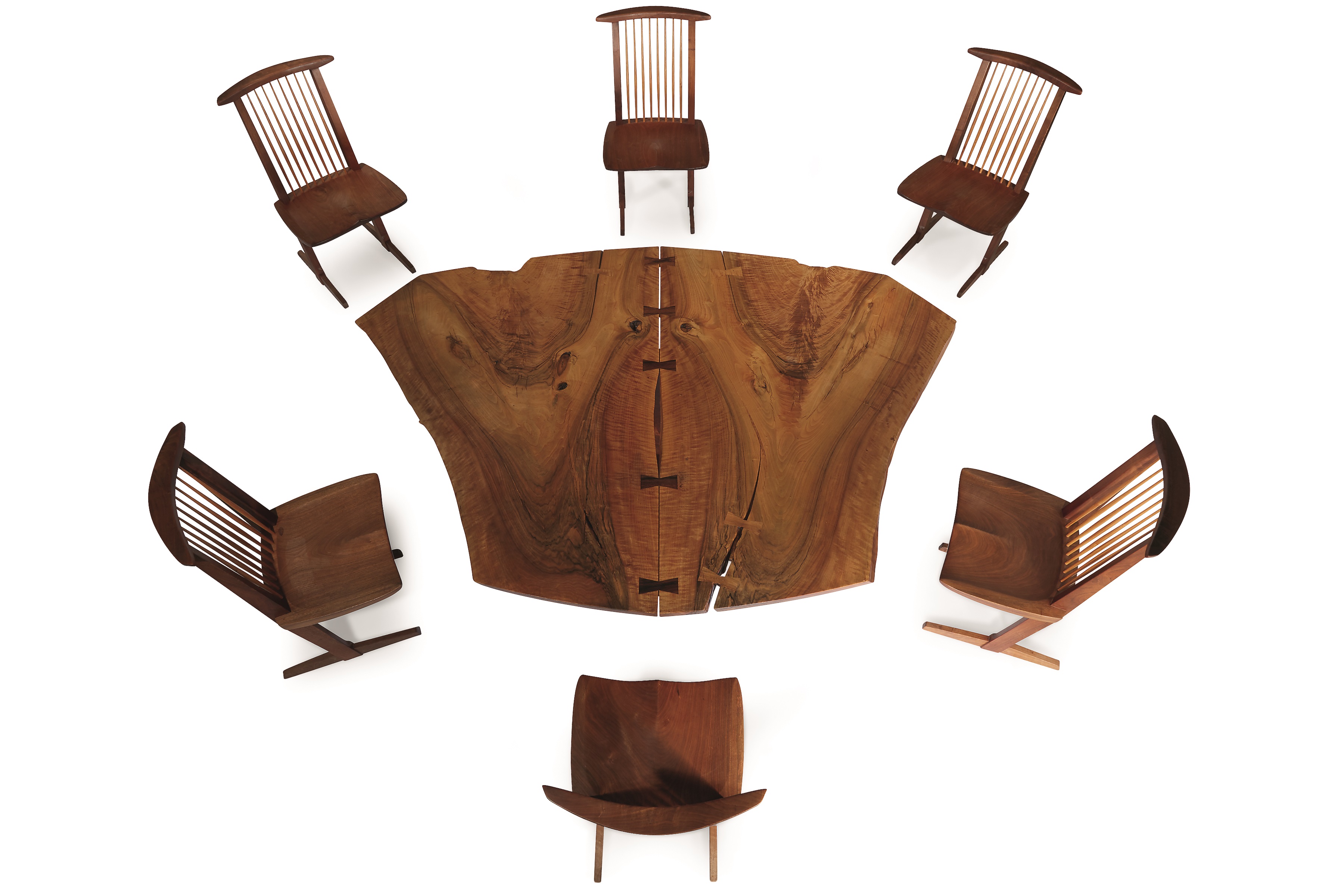
A 1936 Olympic Basketball Gold Medal Could Sell for $150,000

The Olympic gold medal awarded to John Haskell "Tex" Gibbons for his role in propelling the United States basketball team to victory in 1936. Gibbons was 28 at the time. The medal is double-sided and gold-plated and measures just over two inches in diameter.

What you see: The Olympic gold medal awarded to John Haskell “Tex” Gibbons for his role in propelling the United States basketball team to victory in 1936. Gibbons was 28 at the time. The medal is double-sided and gold-plated and measures just over two inches in diameter. It comes with a letter of authenticity from his family and ephemera that he gathered on his Berlin adventure. Grant Zahajko estimates the 1936 Olympic basketball gold medal at $100,000 to $150,000.

Who was John Haskell “Tex” Gibbons? He was a 6’1″ inch guard who played professional basketball years before the NBA arrived. He was on the team at Southwestern College, in Winfield, Kan., and moved on to the Amateur Athletic Union (AAU), playing for the McPherson Globe Oilers. He earned his nickname from the state where he was raised. He died in 1984 at the age of 76.

Why was the 1936 US Olympic basketball team important? “1936 was the first time basketball was an Olympic event,” Zahajko says, adding that more than 20 countries fielded teams and James Naismith, creator of the game, then 74, crowned the winning team with laurels.

What did the Americans have to do to win? “Hitler was not aware of basketball and didn’t give it much recognition. He built gyms, but he didn’t build one for basketball. They played on lawn tennis courts,” he says. “They played [the Olympic final] in a downpour. They couldn’t dribble. They could only pass.  It was a low-scoring game.” The U.S. squelched its way to the gold, defeating Canada 19-8.

Are Olympic medals from 1936 more valuable than those from other years? “1936 medals are very sought-after, even gold medals with no attribution,” he says, referring to those that come to market without related material that proves who earned them. “It’s because of the importance of that Olympics, and how tense and charged it was. Hitler promised not to push his [regime-glorifying] campaign, but he did not hold to that.”

How many other 1936 Olympic basketball gold medals have you handled? “Only three from the 14-man team have ever surfaced, and I’ve had the privilege of touching all three,” he says, alluding to having appraised them. One went to auction at another venue in 2015. It commanded $67,000 despite suffering heavy wear that included having a hole drilled at the top so it could be worn as a necklace. The Gibbons medal is in far better condition. “It’s no longer in its original box, but it’s been well-cared for,” Zahajko says.

How to bid: The 1936 Olympic basketball gold medal is lot 110a in the Sports Cards and Memorabilia, Autographs, Entertainment, Transportation & More! sale offered by Grant Zahajko Auctions on June 24, 2017 in Spokane, Wash.

How to subscribe to The Hot BidClick the trio of dots at the upper right of this page. You can also follow The Hot Bid on Instagram and follow the author on Twitter.

Image is courtesy of Grant Zahajko Auctions.

Would you like to hire Sheila Gibson Stoodley for writing or editing work? Click the word “Menu” at the upper right for contact details.

SOLD! A Russian Silver Rooster Cup Fetched $33,800

A Russian silver and champlevé-enamel cockerel-form (aka rooster-form) covered presentation cup, made in St. Petersburg in the late 19th century.

Update: The Russian silver and champlevé-enamel cockerel-form covered presentation cup sold for $33,800.

What you see: A Russian silver and champlevé-enamel cockerel-form (aka rooster-form) covered presentation cup, made in St. Petersburg in the late 19th century. Freeman’s estimates it at $30,000 to $50,000.

This Russian silver rooster cup is believed to be a wedding gift. Why would a rooster be an appropriate motif for a couple who are getting married? “The rooster symbolizes a new day, and it symbolizes good news. That’s why it’s an appropriate wedding gift,” says Nicholas B.A. Nicholson, who leads the English and Continental furniture and decorative arts department for Freeman’s, which covers silver. He adds, “It’s a tradition of the family [who owned it] that it was a wedding gift. We stop short of saying it was a wedding gift because we don’t have a letter saying that, but we have no reason to disagree.”

Silversmith Alexander Nikolaevich Sokolov designed the Russian silver rooster cup, and the lot notes say it is “likely derived” from an illustration in a popular Russian book from the time, Antiquities of the Russian State. Was Sokolov trying to evoke the medieval-style illustration? “He’s making as realistic a cockerel as he can given the design of medieval Russian works,” he says.

What’s up with the rooster’s tail? It’s a good example of what Nicholson means when he talks about Sokolov balancing realism against the medieval sensibility of the book’s illustrations: “The tail devolves from natural feathers, to braided feathers in a strapwork pattern, to strapwork on the tail–an amazing deconstruction.”

Did Sokolov’s workshop do other rooster-shaped presentation cups? “He did others earlier, but they were not as fully evolved as this one,” Nicholson says. “We don’t know how many he made, but it was clearly a form he liked.”

It’s a presentation cup, so you’re not really supposed to drink from it. But if you wanted to, how would you do it? See the broad band around the top of the rooster’s body? The hinge is in there. The head and neck of the silver bird tilts backwards, and the comb rests on its tail.

This Russian silver rooster cup is fresh to market, directly from the descendants of the people who received it. How unusual is that? “Many things that have been sold were confiscated by the Russian government,” he says. “This was brought over by the family and preserved through the generations to be offered at auction for the first time.”

What else makes the Russian silver rooster cup special? “It’s such an extraordinary piece of silver,” he says. “We have lots of good silver in this sale, and they all have their own stories, but this piece… the story makes it exceptional. So many Russian objects are just stolen. It transferred from an old Russian family [that became] a Russian emigre family and [then became] an American family of Russian descent, who wants it to go to a collector who understands its value.”

How to bid: The Russian silver rooster cup is lot 9 in the Silver & Russian Works of Art auction at Freeman’s on October 17, 2017.

How to subscribe to The Hot BidClick the trio of dots at the upper right of this page. You can also follow The Hot Bid on Instagram and follow the author on Twitter.

Freeman’s is on Twitter and Instagram as well.

Image is courtesy of Freeman’s.

Would you like to hire Sheila Gibson Stoodley for writing or editing work? Click the word “Menu” at the upper right for contact details.

SOLD! The George Nakashima Sanso Table with Conoid Chairs Fetches $187,500

A Sanso "Reception House" table and six Conoid chairs, designed and made by George Nakashima in 1981. The table is 28 inches high, 60 inches wide, and 84 1/2 inches in diameter. All seven pieces are signed with the surname of the client.

Update: The Nakashima Sanso table with Conoid chairs sold for $187,500.

What you see: A Sanso “Reception House” table and six Conoid chairs, designed and made by George Nakashima in 1981. The table is 28 inches high, 60 inches wide, and 84 1/2 inches in diameter. All seven pieces are signed with the surname of the client. Freeman’s estimates the group at $100,000 to $150,000.

Who was George Nakashima? He was an American woodworker who became one of the most influential furniture-makers of the 20th century. Born to Japanese immigrants, Nakashima had traveled extensively in Japan by the time he was forced into an internment camp in Idaho during World War II. There he met an inmate who taught him Japanese carpentry techniques. Architect Antonin Raymond helped free Nakashima in 1943 and invited him to stay in New Hope, Pennsylvania. Nakashima never left. He developed a style that respected and celebrated the rugged, natural aspects of wood, and which turned its flaws into strengths. He died in 1990 at the age of 85.

Why are George Nakashima Sanso tables so rare? Was it difficult for him to find suitable pieces of lumber? “It was tough to get really good slabs of wood at this size,” says Tim Andreadis, department head of 20th century design at Freeman’s, adding that fewer than a dozen Sanso tables exist. “Finding a board that was conducive to this purpose was more difficult and more costly. This one is a really nice English walnut, which is what the client wanted.”

The table comes with six Conoid chairs. Is this the full original set of chairs? Yes. “What’s really nice about them is they’re single slab seats,” he says. “Single slab seats were three times more expensive to purchase. They’re usually better-quality wood, and they’re all very even in color. There’s a nice contrast between the American black walnut chairs and the English walnut Sanso table.”

We know the client for the George Nakashima Sanso table was Stanley Frosh and his family. What do we know about the Froshes? “They [the furniture] were made as a set and originally used in Stanley’s judge’s chambers before moving them to his home as a reception-slash-dining table for the family to use,” Andreadis says. “The Frosh family was extremely close to the Nakashimas. When George passed, the whole [Nakashima] family sat around this table to discuss the future of the George Nakashima studio. It did become a table around which big decisions were made.”

This George Nakashima Sanso table has several butterfly joints in it–bow-tie like fittings that help hold the tabletop together. Did Nakashima invent the butterfly joint, or did he make it his own? “Butterfly joints were used for centuries, but he made them his own,” Andreadis says. “They were used on the undersides of furnishings. You didn’t see butterfly joints. George respected the honesty of the construction process, and he wanted to make it visible. He thought it was something to be celebrated rather than hidden.”

Does the large number of butterfly joints increase the value of the table? “That’s definitely true,” he says. “It shows that George wanted to preserve the piece of lumber. In order to do that, he needed to use more butterfly joints to shore up the piece of wood. He didn’t put them on willy-nilly as a decoration. The joints prevented splits in areas that would have split over time. George worked through all the problems. He didn’t put a Band-Aid on them. He embellished them and drew your eye to them.”

And has the George Nakashima Sanso table held together well? What condition is it in? “It’s in fantastic condition,” he says. “The family always recognized it as a masterpiece, and revered it as such, and treated it as such. George made it later in his career, in the sweet spot between the late 1970s and the early 1980s, when he was catching his stride and reflecting what his design ethos was about. It’s a beautiful thing to behold in person.”

A Paris auction house sold a George Nakashima Sanso table in American black walnut, without chairs, for roughly $207,000 in May. Do you think this suite of Nakashima furniture will do better? “I think it certainly has that potential. It’s one of the most dramatic Sanso tables to come to market. Even if it was just the table, I’d gush about it. It’s absolutely a blue-chip masterwork by George Nakashima,” he says. “To have Mira [George’s daughter, who now leads the studio] and the family’s memory at a pivotal point in the studio’s history speaks even further to the history with the Frosh family, and to why George chose a special table for Stanley Frosh. We have the climax point where George dies, and they talk about the studio’s future [around this table.] It could not only set a record for a Sanso table, it could set a record for any George Nakashima.”

What else makes this George Nakashima Sanso table special? “If you’ve been waiting for a special piece by Nakashima, this is that type of piece. It will transcend market shifts over the years,” he says. “And you can look at it time after time and not get bored. I’ve been looking at it for four months and every time, I find something new. You get chills standing near it. A Nakashima like this belongs in a museum or a private collection. One lucky bidder will get to own this table, and I envy them.”

How to bid: The George Nakashima Frosh family Sanso table and its six Conoid chairs are lot 81 in the Design sale at Freeman’s on October 8, 2017.

How to subscribe to The Hot BidClick the trio of dots at the upper right of this page. You can also follow The Hot Bid on Instagram and follow the author on Twitter.

Freeman’s is on Twitter and Instagram as well. Also, you can read a short article on the Frosh family table and chairs set on the Freeman’s site.

Image is courtesy of Freeman’s.

Would you like to hire Sheila Gibson Stoodley for writing or editing work? Click the word “Menu” at the upper right for contact details.

RECORD! An Elizabeth Catlett Painting Sells for $149,000

War Worker, a 1943 tempera-on-board by Elizabeth Catlett.

Update: Elizabeth Catlett’s War Worker sold for $149,000–a new auction record for a painting by the artist.

What you see: War Worker, a 1943 tempera-on-board by Elizabeth Catlett. Swann Auction Galleries estimates it at $60,000 to $90,000.

Who was Elizabeth Catlett? She was a 20th century African-American artist. She was best known for her sculptures, but she made prints and the occasional painting as well. She devoted herself to creating images that reflected the African-American experience. During the 1960s, she created a series of posters that depicted Malcolm X, Angela Davis, and Harriet Tubman. She also created sculptures of Sojourner Truth and Louis Armstrong. She was active until she died in 2012 at the age of 96.

What makes War Worker so notable? “It’s very scarce. It’s only the second painting of hers to come to auction,” says Nigel Freeman, director of Swann’s African-American fine art department, adding that it dates to a period in the 1940s when the artist lived in New York. Swann offered the first Catlett painting at auction in December 2015. Titled Friends, it sold for $81,250 against an estimate of $30,000 to $40,000.

Why have so few of these Elizabeth Catlett paintings come to auction? Are they in institutions? “The works are just very scarce. They’ve been in people’s collections for a generation or more,” he says, adding that Friends did go to an institutional buyer. “Catlett passed not too long ago. There’s a growing sense of her significance that’s bringing the paintings to market. If you look at Friends, it’s definitely related to War Worker. Both are images of African-American workers.”

War Worker is smaller than 12 inches by 10 inches. Most of the known 1940s Elizabeth Catlett paintings are on the small side, and rendered in tempera. Do we know why? “She didn’t have a studio in the traditional sense. She had to work during the day at her teaching job,” he says, explaining his theory that Catlett may have made War Worker in her apartment, sitting down, perhaps with the paper in her lap. She might have chosen tempera for this reason, too–it doesn’t smell or give off fumes, as oil paints do. “It’s conducive to working in a non-studio environment,” he says. “The small size reinforces the intimacy of these works.”

Does Elizabeth Catlett approach the painting in a sculptural way? Does it hint at her future as a sculptor? “It’s a fascinating glimpse into her work as a modern artist,” he says. “She shows an interest in depicting average working men and women as a social realist. She’s also interested in abstracting the sculptural qualities of his face, flattening the forms. There’s a sculptural quality you see that comes forward in her work, which is interesting in view of her development as an artist.”

War Worker is estimated at $60,000 to $90,000. Do you think it has a chance to top Friends and set a new record for an Elizabeth Catlett painting at auction? “I think this will do very well, and could sell for more,” he says.

What else makes War Worker special? “It’s a really powerful image. These small paintings pack a punch,” Freeman says. “The accumulation of small strokes gives it an intensity. I think it’s going to resonate with the people who see it. We are excited to have it.”

How to bid: War Worker is lot 20 in the African-American Fine Art sale at Swann Auction Galleries on October 5.

How to subscribe to The Hot BidClick the trio of dots at the upper right of this page. You can also follow The Hot Bid on Instagram and follow the author on Twitter.

You can follow Swann Auction Galleries on Twitter and Instagram.

Image is courtesy of Swann Auction Galleries.

Would you like to hire Sheila Gibson Stoodley for writing or editing work? Click the word “Menu” at the upper right for contact details.

SOLD! The First Published Account of a Successful Wright Brothers Flight Commands $5,000 at Swann

The cover of the January 1, 1905 issue of Gleanings in Bee Culture, from an early 20th-century group of 14 issues of the specialist magazine.

What you see: The cover of the January 1, 1905 issue of Gleanings in Bee Culture, from an early 20th-century group of 14 issues of the specialist magazine. Swann estimates the group at $1,500 to $2,500.

What is Gleanings in Bee Culture, and why is it important? It is a specialist magazine, founded in 1869 by Amos Ives Root, a god of the beekeeping world. It published the first eyewitness account of a successful airplane flight by the Wright brothers. Root died in 1923, but his magazine still publishes under the name Bee Culture.

Wait, back up. The first published account of a successful Wright Brothers flight was in a beekeeping journal? Yes. Yes, it was.

How did that happen? Root was a fan of technology, and the Wright brothers’ experiments in aviation represented the cutting edge of technology at the turn of the 20th century. Root befriended the brothers, who were fellow Ohioans, and he witnessed a successful flight in September, 1904 at Huffman Prairie in Ohio (he was not present for the first successful flight, which happened on December 17, 1903). Protective of their invention and stung by a badly garbled press account of a previous test, the brothers did not invite any reporters to watch them work. But they were comfortable with Root writing about the first flight for Our Homes, a column he included in Gleanings in Bee Culture. “They probably recognized Root as a kindred spirit, and felt he wouldn’t leak anything they didn’t want leaked,” says Rick Stattler, director of printed and manuscript Americana for Swann.

How skilled an observer was Root? “He was an extremely curious and interested amateur. He did his best to understand the mechanism and asked a bunch of questions,” says Stattler, who adds that Root was 65 at the time of the September 1904 flight. “He understood about five percent of what they said. My impression is he probably understood it better than I’d have been able to.”

How many times did Root write about the flight that he saw? Twice. The first article ran more than three pages and had no illustrations. The second, which appeared two weeks later, was shorter and included a photograph of a Wright plane without its engine. “I suspect they didn’t want him publishing a picture of the full machine,” Stattler says. “I don’t get the impression that his account was instantly recognized as important around the world. Gleanings in Bee Culture had a very small, specialized readership. I get the impression that it was not taken especially seriously.”

How often do these issues of Gleanings in Bee Culture, which contain the first published account of a successful Wright Brothers flight, come up at auction? This offering at Swann is the first. Stattler reports that Sotheby’s offered a group of issues in 1968, but it did not include the columns that describe the flight.

Why offer 14 issues? Why not offer just the ones with the columns that talk about the flight? Stattler explains that the issues come from a home that had several years’ worth of Gleanings in Bee Culture squirreled away.  “I thought it would be interesting to have a few issues from before the columns and after, as context,” he says. Stattler describes the Our Homes column as being an Andy Rooney-style celebration of the quirks of the world, but Root definitely realized he’d seen something world-changing. “He strongly emphasized it. He realized he was privileged to witness an extremely important event, and he recognized that his platform was not the typical for disseminating that information.”

Do you have any favorite passages from the columns? Stattler cited this paragraph from the January 1, 1905 entry:  ‘Imagine a locomotive that has left its track, and is climbing up in the air right toward you—a locomotive without any wheels, we will say, but with white wings instead, we will further say—a locomotive made of aluminum. Well, now, imagine this white locomotive, with wings that spread 20 feet each way, coming right toward you with a tremendous flap of its propellers, and you will have something like what I saw. The younger brother bade me move to one side for fear it might come down suddenly; but I tell you, friends, the sensation that one feels in such a crisis is something hard to describe.’

These issues have never come to auction before, so they’re guaranteed to set a record when they sell. What do you think will happen? “I’ve got interest from clients already,” he says. “It’s such a quirky publication. It will probably go beyond its estimate, but how far beyond, I don’t know.”

How to bid: The group of issues of Gleanings in Bee Culture is lot 42 in the Printed & Manuscript Americana sale at Swann Auction Galleries on September 28, 2017.

How to subscribe to The Hot BidClick the trio of dots at the upper right of this page. You can also follow The Hot Bid on Instagram and follow the author on Twitter.

You can follow Swann Auction Galleries on Twitter and Instagram. Bee Culture is on Twitter and Instagram as well. Root Candles, another entity founded by Root that survives to this day, devotes a page on its website to Ames Root and the Wright Brothers. And you can read the full text of all of Root’s writings on the Wright brothers’ flight courtesy of the website for the PBS program NOVA.

Image is courtesy of Swann Auction Galleries.

Would you like to hire Sheila Gibson Stoodley for writing or editing work? Click the word “Menu” at the upper right for contact details.

SOLD! M.C. Escher’s Day and Night Fetched $40,000

M. C. Escher's Day and Night, a 1935 print.

Update: The M. C. Escher print of Day and Night sold for $40,000.

What you see: M. C. Escher’s Day and Night, a 1935 print. Swann Galleries estimates it at $20,000 to $30,000.

Who was M.C. Escher? Maurits Cornelis Escher was a Dutch graphic artist and printmaker who gained fame for his complex, precise, mind-boggling, and delightful images. He captured the imaginations of sages such as Martin Gardner and Douglas Hofstader, author of the classic Gödel, Escher, Bach. In 1922, he took trips to Italy and Spain that forever shaped his visions. In particular, he fell under the spell of the tessellations that decorate Alhambra, the fourteenth-century Moorish palace in Granada, Spain. Surprisingly, Escher took no formal mathematical training. He died in 1972 at the age of 73.

Escher made Day and Night in 1935, at the end of an 11-year period when he produced many of his most iconic images. How does Day and Night build on what came before? “When Escher was traveling in Italy, he did tour-de-force topographical works of landscapes. This is more abstracted. It’s not a straightforward view,” says Todd Weyman, vice president at Swann and director of prints and drawings. “In terms of his printmaking techniques and procedures, it’s classical. He’s academically trained. The linear aspects of his woodcuts are very clear.”

How does Escher achieve the exceptionally fine and subtle gradations that we see in Day and Night? “You have to imagine very, very fine cutting of the wood block by hand,” Weyman says. “He was a technical virtuoso.”

Did he work alone? “Yes,” he says. “He often signed and inscribed his prints with the word ‘eigendruk,’ which means ‘printed by myself.’ He’s saying he’s the printer. He oversaw everything at a time when it was not uncommon for an artist to work with a printer, who would handle the technical aspects.”

We should also stress that Escher did all this without the aid of a computer, which would not have been available to him anyway, and he had to carve the image into the wood block backwards to create the print that we see. “Yes. Everything is printed in reverse,” Weyman says. “You can see not just his artistry but his technical virtuosity in the medium.”

This Day and Night has no edition number. Do we know how many were made? And how often does it appear at auction? Unfortunately, we don’t know how many Day and Night prints Escher made, though other prints of his are editioned. This is the only version that he produced. Weyman says it has appeared at auction 40 times in the last 30 years, but some of those might represent the same print being consigned again. The record for an Escher at auction belongs to a 1940 print of Metamorphosis II that sold at Sotheby’s London in October 2008 for more than $246,000. The record for a print of Day and Night was set at Christie’s London in March 2013 when one sold for almost $57,000.

What else makes Day and Night special? “It has all the aspects of a great Escher that you would want,” Weyman says. “The yin and yang qualities, the way the landscape morphs into an aerial view, and the patches of landscape morph into birds, the parallel landscapes [under] day and night, the technical virtuosity, the imagination at play in this image–it’s all Escher.”

How to bid: M.C. Escher’s Day and Night is lot 618 in Swann Galleries’ 19th & 20th Century Prints and Drawings sale on September 19.

How to subscribe to The Hot BidClick the trio of dots at the upper right of this page. You can also follow The Hot Bid on Instagram and follow the author on Twitter.

You can follow Swann Auction Galleries on Twitter and Instagram.

Image is courtesy of Swann Auction Galleries.

Would you like to hire Sheila Gibson Stoodley for writing or editing work? Click the word “Menu” at the upper right for contact details.

SOLD! The Original I Dream of Jeannie Prop Bottle Sells for $34,375

The original prop bottle from the NBC sitcom I Dream of Jeannie (1965-1970). It's hand-painted and stands 14 inches tall.

Update: The original I Dream of Jeannie prop bottle sold for $34,375.

What you see: The original prop bottle from the NBC sitcom I Dream of Jeannie (1965-1970). It’s hand-painted and stands 14 inches tall. Julien’s estimates it at $40,000 to $60,000.

How do we know this is the original prop bottle from I Dream of JeannieIt comes directly to Julien’s from the estate of Gene Nelson, who directed six episodes of the show’s first season, including the pilot, titled The Lady in the Bottle. At some point, Nelson obtained a letter of authenticity from Barbara Eden, who played the title character, Jeannie. Nelson died in 1996. Eden will turn 86 in August.

Did Gene Nelson create the I Dream of Jeannie bottle? Nelson has the strongest claim on its origin story. He was hunting for something that didn’t look like Aladdin’s lamp, spotted a Jim Beam decanter in a liquor store window, snapped it up, and handed it over to the folks in the prop department, who peeled the labels off the glass and decorated it with paint. “There’s something unique in the fact that he saw this,” says Darren Julien, founder and CEO of Julien’s Auctions. “He was scouting around, found the bottle, and had the vision to paint it. He was a good visionary.”

Was it used on the set? Almost certainly, but coming up with a precise photo match is tough, given that the prop bottles were painted to look identical. But according to Julien, the animators would have referenced photos of this bottle when creating the opening credit sequence, and it’s safe to say it was shown in the early episodes that Gene Nelson directed. He left I Dream of Jeannie after repeated clashes with Larry Hagman, who played astronaut Tony Nelson on the show.

How rare is the original I Dream of Jeannie prop bottle? “It’s very rare. We have not handled one before. Not many survive, and nobody back then would have saved anything like that,” says Julien, adding, “It’s the Holy Grail of the series to have. It’s what the show is about. Provenance is king, and it has such a solid history. It’s an iconic piece that’s going to sell for a lot more than our estimate.”

So, does it come with Barbara Eden? No, but it does include the letter of authentication that she wrote for Gene Nelson. The bottle’s interior is also unfurnished and long since emptied of its whiskey. And neither Julien’s nor The Hot Bid is responsible for the I Dream of Jeannie theme song getting stuck in your head.

Damn you! #SorryNotSorry

How to bid: The original I Dream of Jeannie prop bottle is lot 486 in the Property from the Estate of Patrick Swayze and Hollywood Legends 2017 auction on April 28 at Julien’s.

How to subscribe to The Hot BidClick the trio of dots at the upper right of this page. You can also follow The Hot Bid on Instagram and follow the author on Twitter.

Julien’s is also on Twitter and Instagram.

Image is courtesy of Julien’s Auctions.

Da DA dadadadada Da DA dadadadada Da DA dadadadadada. BadadaDA!

Would you like to hire Sheila Gibson Stoodley for writing or editing work? Click the word “Menu” at the upper right for contact details.