Become Technology’s Greatest Visionary! Prop Store Has the Picturephone from Pee-Wee’s Playhouse, Which Could Sell for $15,000

The Picturephone Booth from Pee-Wee's Playhouse.

What you see: The Picturephone Booth from Pee-Wee’s Playhouse. Prop Store estimates it at $10,000 to $15,000.

The expert: James Comisar, president of the Comisar collection. He’s also the consigner.

Let’s start by talking about the place in the culture that Pee-Wee’s Playhouse holds. What makes it a good television show, and why does it endure? It continues to resonate because it was loved by schoolkids, college kids, and adults. It was the perfect mix of everything, and it appealed to everybody. Just as Mr. Rogers is getting his due, I think Paul Reubens [creator of Pee-Wee’s Playhouse and the actor who played the main character, Pee-Wee Herman], in 20 years, will get his due. He created an amazing, organic, joyful world where kids could be kids. He spoke down to nobody, and it was incredibly inclusive. It’s one of the most perfect pieces of television in the last 70 years. I think the secret sauce was its authenticity, and the main character was positive. That never goes out of style.

Why did you want to acquire the Picture Phonebooth? What made it important enough for you to pursue? I should back up. Pee-Wee’s Playhouse is situated in Puppetland. Pee-Wee is sequestered in his own fantasy world. His conduit to the world is this Picturephone Booth. In that way, it’s very special. And in the 80s [the show ran on CBS from 1986 through 1990] the idea of a video phone booth was interesting. Reubens gave it his own spin. He had his own sensibility for everything.

Is the Picturephone Booth well-built? It’s built to look great on camera. As a general rule, pieces look better on camera than they do in person. When a show is in production and a prop is being used, it has an economic value to the production. It’s cared for well. After the show ends production, there’s a mad dash to get it off the stage so a new show can come in and the studio can continue to earn revenue. It’s an indelicate process. When we first received these pieces, they were in studio storage and they had a bit of wear. There was damage to the paint. There were cracks.

Did you have to restore or conserve it? First, we had to stabilize it. It’s a pretty strong and durable piece, but it had been banged around a bit after production [after the show ended]. Once we dealt with the structural issues… No professional archivist wants to take a historic piece and make it look fresh and pretty again. The goal is to get rid of any damaging influences. When pieces live in studio storage, it’s not a climate-controlled facility. It’s on the outskirts of town, 65 cents a foot. It’s 35 degrees in winter and 110 degrees in summer. Bad things happen in studio storage rather quickly. They shove it into a warehouse, and shove stuff around it, and on top of it. [With the Picturephone,] there was nothing catastrophic to be sure, but it still took over a year to accomplish the intake. It required a textile conservator to come in. Then you have wood, and leather, and foam, which is worse than any material, certain to deteriorate. We went slowly and cautiously. Our job was to do the minimum, not the maximum.

I see that only one name is in the provenance, and it’s Paul Reubens. How did you acquire this from him? I believe the initial contact was around 1992, a year after the show had gone off the air. I had numerous conversations with his business manager before I met Paul. The way I found this stuff was I was [in a studio storage warehouse] working for another client, and I found a recognizable puppet for Pee-Wee’s Playhouse. I thought, “No, could it be?” Once Paul’s team was made aware of what was going on, he wanted the pieces to have a more appropriate configuration than studio dead storage.

Did Reubens take some of the Pee-Wee’s Playhouse props back? Absolutely, absolutely. But even if you have a 15,000-square-foot home, you have space limitations. The reality eventually sets in that you cannot keep everything. Paul Rubens kept a lot from the show, and it’s evident that the pieces meant a lot to him. It wasn’t just stuff. It sprung from his brain. It’s still influencing people decades later. It was painful to decide what to save and what to give to another archive.

Well, the Picturephone is furniture, isn’t it? It’s furniture, but it’s an amazing, sculptural piece of artwork. It was created with an almost avant-garde sensibility. It’s almost like folk art in the way it’s put together.

How original is it? It’s two percent restored to 98 percent original. A couple of the dowels that form the eyelashes were broken or missing and had to be replaced. There was paint [the paint required touching up], and surface cleaning. The curtain, which extends across the front for privacy, is original. The textile conservator carefully cleaned it. Even the rings that attach the curtain to the front are original, scrubbed by hand.

Sounds like a lot of work went into it. If this piece sells for $10,000 to $15,000, oh, my dear god in heaven, we spent so much more than that restoring it and caring for it for 25 years. Whoever gets that, if they get it for $10,000, that represents a loss to us. But you can’t keep everything. A piece like that takes up a lot of room on the floor, and you can’t stack anything in it or on it. If you can tell the story of Pee-Wee’s Playhouse with three smaller objects [rather] than one that will take up real estate, you’re going to do it.

It’s amazing it survived so well. I believe the universe put me where I needed to be to advocate for these pieces. The puppet head was poking out, I know, so I could see it and advocate for it. This is much more than a job to me. It’s what I do. I don’t question it. I’m grateful I was there at a time when I could rescue it. [I asked him if he remembered which Pee-Wee’s Playhouse puppet caught his eye that day in the early 1990s; he could not say for sure.]

How did you get what you managed to get from the Pee-Wee’s Playhouse props? When I met Paul at the warehouse, he was very passionate, but a very practical man. There was a Paul pile, a Goodwill pile, with appliances from the set and toys that someone else could use, and a Dump pile. A studio truck was hired to take the discarded pieces to the landfill. That was the end of the road for those things. There was no James pile. My job was to convince him to give me what pieces I could get from the Paul pile and the Dump pile. It was difficult for him to part with any of them, which I respected.

What’s the Picturephone like in person? Monumental. This is a big, hulking piece, but it’s got a joyful character. It’s got eyes, and pouty lips that open up like saloon doors. It’s colorful, joyful, and recognizable. It’s a home run in every way.

How many people can fit inside? One, comfortably. I think it’s meant for one person. We don’t normally sit in the pieces. I think it was made just for him.

So you haven’t sat inside it? Absolutely not. It would be sacrilege, treacherous. It’s a piece of history and art. It’s not for me to degrade it by sitting in it.

Ok, I’ve gotta ask. Where is Chairry? Did Paul Reubens claim Chairry? That falls into the area of client privilege. I’m not able to say what he did and didn’t do. Rest assured the iconic pieces from the show are in his collection or an archival collection. Don’t worry. Chairry is cherished.

How to bid: The Pee-Wee’s Playhouse Picturephone Booth is lot 156 in Prop Store‘s TV Treasures auction on December 1, 2018.

How to subscribe to The Hot BidClick the trio of dots at the upper right of this page. You can also follow The Hot Bid on Instagram and follow the author on Twitter.

Prop Store is on Twitter and Instagram.

Comisar is also the president of the Museum of Television.

The Picturephone appears at three or four points in the background in the opening credits of Pee-Wee’s Playhouse. And that’s an uncredited Cyndi Lauper singing the theme song.

Yes, there is a Pee-Wee Wiki. Here’s the entry for the Picturephone.

Also! Google “Technology’s Greatest Visionary,” on Google Images, and take in the top row of images that the search engine spits back at you.

Image is courtesy of Prop Store.

Would you like to hire Sheila Gibson Stoodley for writing or editing work? Click the word “Menu” at the upper right for contact details.

SOLD! The First TCB Necklace That Elvis Presley Gave Away Sold For… (Scroll Down to See)

A 14k gold necklace with a Taking Care of Business (TCB) logo, given by Elvis Presley to Sonny West circa 1970.

Update: The Taking Care of Business necklace that Elvis Presley gave to Sonny West sold for $38,400.

What you see: A 14k gold necklace with a Taking Care of Business (TCB) logo, given by Elvis Presley to Sonny West circa 1970. Julien’s Auctions estimates it at $30,000 to $50,000.

The expert: Martin Nolan, executive director of Julien’s Auctions.

What was the Memphis Mafia, and how did it serve Elvis Presley? “Memphis Mafia” was the name given to the group of friends and close confidants of Elvis Presley. The media gave them the name “Memphis Mafia” around 1960. Elvis liked the name and it stuck.

Where did the phrase “Taking Care of Business” come from? Elvis’s band was called Taking Care of Business. He always gave away gifts, especially jewelry, and he came up with the idea for an identifying piece of jewelry that he only gave to the Memphis Mafia. There were probably 12 to 20 people [in the group]. Elvis loved Taking Care of Business. It was the logo on his plane. Priscilla was involved with the design of the logo. They were on the plane when a lightning bolt went through it. She got out her sketch pad and came up with Taking Care of Business in a flash.

When did that happen? We don’t know for sure, but we presume it was the late 1950s or early 1960s, probably after he came out of the military.

How was the material and the carat weight chosen? Elvis loved bling, he loved gold. There were some variants on the necklace. The one he gave Doctor Nick [George Nichopoulos, Presley’s personal physician] had diamonds on it. We sold that one for $120,000. The overall look of the 14k gold necklace is probably based on a collaboration with the jeweler in Beverly Hills and what they could do within their budget.

This is believed to be the first Taking Care of Business necklace that Elvis Presley gave out. Does that make it more interesting to collectors? Yes. Collectors love something when it’s original, or the first. TCB went on to be a significant Elvis signature, in a way. Its being the first definitely adds value on auction day.

Why is Sonny West a logical recipient of the first Taking Care of Business necklace? He was Elvis’s bodyguard, responsible for security at his concerts. He was one of the original members of the Memphis Mafia, which was a very close, tight circle. My guess is because he was Elvis’s bodyguard, he was right there when Elvis went to the jewelry shop in Beverly Hills. Because he was right there, and a member of the Memphis Mafia group, he got the first necklace.

Do the Taking Care of Business necklaces always look like this one does, or did the design change over time? They’re not all exactly the same. The TCB logo with the flash remains the same, but the chains change.

How many owners did the necklace have after Sonny West relinquished it? He passed it on to the consigner, who brought it to us. Jeffrey, the consigner, created a video which is on our site of Sonny West taking the necklace off himself and putting it on Jeffrey. The provenance is 100 percent solid. That plays into the value.

How many Taking Care of Business necklaces have you handled, and how many Taking Care of Business necklaces did Elvis give out? Do we know? I think we’ve handled four to sixprobably four, with two coming back to auction again. I don’t know how many there are, but there were somewhere between 12 and 20 people in the Memphis Mafia. Not a huge amount. Maybe 30, max.

Do any period photos exist of Sonny West wearing the TCB necklace and standing alongside Elvis? I presume there would be period photos. He was with Elvis for 16 years, and he was with Elvis a lot. We didn’t license any, but I’m sure there are photos.

How did you arrive at the estimate of $30,000 to $50,000 for the TCB necklace? Obviously we looked at the intrinsic value first. Then we looked at other TCB necklaces we’ve sold. The provenance is so solid because of Sonny West. Then there’s the collectibility of Elvis himself. He has a huge amount of fans out there.

As of October 19, the TCB necklace has its first bid, amounting to $7,500. Does that mean anything? No, it doesn’t mean anything. But we have 55,000 views on this auction already. To have so many so early on, that’s amazing.

What condition is the TCB necklace in? It’s in great condition, given its age and the life it’s had up to now.

Why will this particular TCB necklace stick in your memory? The fact that it was the first one–wow, it was the start of something. The very first one created, for Sonny West, the bodyguard and confidant of Elvis. Within the history of Elvis and the Memphis Mafia, it’s almost like branding, or a tattoo. Taking care of business in a flash was what the Memphis Mafia represented: getting business done. That was what was important to Elvis.

How to bid: The TCB necklace is lot 466 in the Icons and Idols: Rock “N” Roll auction Julien’s will hold in New York on November 9 and 10, 2018.

How to subscribe to The Hot BidClick the trio of dots at the upper right of this page. You can also follow The Hot Bid on Instagram and follow the author on Twitter.

Julien’s Auctions is on Twitter and Instagram.

Image is courtesy of Julien’s Auctions.

Martin Nolan previously spoke to The Hot Bid about a purple Prince-worn tunic that the star donned for a 1998 BET interview, which yielded a famous GIF; a Joseff of Hollywood simulated diamond necklace worn by Hedy Lamarr, Ava Gardner, and several other Hollywood actresses, as well as a once-lost 1962 Gibson acoustic guitar belonging to John Lennon that sold for $2.4 million–a record for any guitar at auction.

Would you like to hire Sheila Gibson Stoodley for writing or editing work? Click the word “Menu” at the upper right for contact details.
SOLD! A Snap Wyatt Sideshow Banner of a Headless Girl Sold For… (Scroll Down)

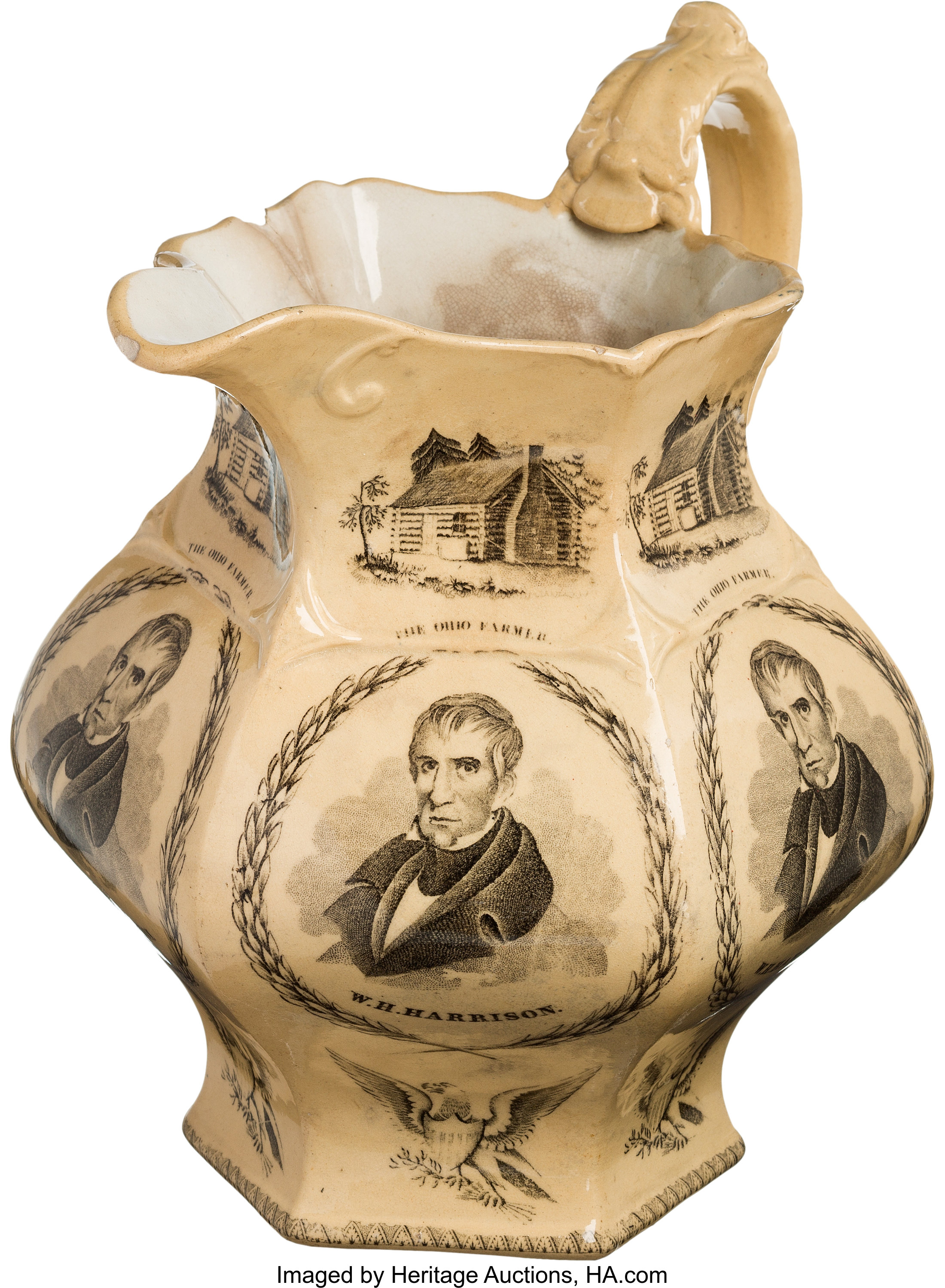
A sideshow banner made by Snap Wyatt circa 1965, advertising a headless girl illusion.

Update: The Snap Wyatt Headless Girl sideshow banner sold for $4,000–double its high estimate. Also, the headless woman illusion apparatus sold for $3,200, well above its $500 to $1,000 estimate.

What you see: A sideshow banner made by Snap Wyatt circa 1965, advertising a headless girl illusion. Potter & Potter estimates it at $1,500 to $2,000.

The expert: Gabe Fajuri, president of Potter & Potter.

How rarely do sideshow banners painted by Snap Wyatt come to auction? I don’t know that it’s unusual. They’re out there. Remember, Wyatt said he could paint one banner per day.

Where does Snap Wyatt rank among the known sideshow banner painters? And is this the largest group of Snap Wyatt banners you’ve offered at the same time? He ranks in the top three, top five. And yes, it is the largest group. Usually we get them one or two at a time, if at all.

How does this Snap Wyatt sideshow banner compare to the other Snap Wyatt banners in the auction? It’s in better condition than some of the others. But it’s so hard to say–tastes vary widely. One banner in there shows a magician, and someone will want that who’s interested in magic. Some might be interested in the Headless Girl because they like a woman in a bikini.

Snap Wyatt signed this sideshow banner. Is that unusual? No, he usually put his stencil signature on them. There are many unsigned examples [of sideshow banners] but I think people like examples by known painters–Sigler, Johnson, Wyatt.

How do you know Snap Wyatt painted this sideshow banner around 1965? It’s an educated guess based on its style and condition. It’s not an earlier banner because it’d be a lot rougher as far as condition. Johnny Meah gave me insight into when and how Wyatt worked.

Do sideshow banner collectors avoid banners that don’t show enough signs of having been on the road? I think something collectors look for are show-used banners–ones you can prove were used in a particular show at a particular time. That is to the good. I don’t know that that’s the case here.

Would people who paid to enter the sideshow in 1965 because this banner caught their eye have seen a headless girl illusion that looks like this? [Laughs] No. They would not have seen it in this way, no. It was the equivalent of a line illustration in the Johnson Smith catalog. The difference between imagination and reality is pretty stark.

How far off would it be from what we see on the sideshow banner? It’d be different in that she wouldn’t be sitting sideways, she wouldn’t be in a bikini, and a thing would be attached to her head in place of her head, like the apparatus we’re selling in lot 646. This is very casual-looking, as if she’ll get up and walk around. In a ten-in-one [a sideshow that offered ten acts in one venue for one price], she’d sit in a chair, and there’d be someone next to her, the demonstrator of the attraction, fiddling with knobs on a blinking control board or pouring fluid into tubes leading to her neck, explaining how she survives. He might hand her things to prove she’s alive and not a robot. Since she’s not getting up out of the chair and can’t talk, she’s going to need some help.

Is the headless girl illusion a standard sideshow attraction? I would say it’s a classic,  a fairly common thing. It was exhibited at Coney Island for years.

Did the headless girl just sit there, or did she do things? She could have done any number of things. She definitely moved around to prove she was not a wax figure or a mannequin. She could have written on a blackboard, anything to prove she was alive.

How similar would the circa 1965 headless girl apparatus have been to the one you’re offering in lot 646? The method is basically unchanged. The way it works now is identical to the way it worked then. There would have been tubes or a metal apparatus coming out of her neck. Perhaps they dressed it up in different ways, with different headpieces, or different sets of tubes and a lot of things on the side to “keep her alive.”

So you can guess where the headless girl’s head is pretty easily. It depends on how careful the exhibitor is. The illusion can be quite good. It’s up to them to set it up correctly. A lot of show operators didn’t care in the sense that they’d gotten your money. You can still buy the workshop plans from Abbott Magic in Michigan, if you want, and build your own. I think the plans are $5. [He remembered correctly. The plans are $5 as of October 2018.]

And the illusion doesn’t look like the sideshow banner. They all have something sticking out of her head. It’s not simply a headless woman.

How much would the headless girl illusion banner be worth if the artist was anonymous? The banner market is not what it used to be, but I don’t think it would change it tremendously. If it’s anonymous, it’s a 20 to 30 percent difference.

What does the Johnny Fox provenance add to the sideshow banner’s value? I think it adds a little bit to it. A lot of people are interested in Johnny Fox. If you look on Facebook, there are memorials to him. He had a lot of friends. He performed for 37 seasons at the Maryland Renaissance Festival. They named a stage after him in tribute to him. A lot of people fondly remember Fox and his museum.

What are the odds that the same bidder buys the Headless Girl sideshow banner and the headless woman apparatus? About 50/50. I think there’s a good chance someone will buy the prop and use it. I think a collector will buy the banner.

How to bid: The Headless Girl sideshow banner is lot 8 in Freakatorium: The Collection of Johnny Fox, a sale that takes place November 10, 2018 at Potter & Potter.

How to subscribe to The Hot BidClick the trio of dots at the upper right of this page. You can also follow The Hot Bid on Instagram and follow the author on Twitter.

Follow Potter & Potter on Instagram and Twitter.

Gabe Fajuri is a favorite on The Hot Bid. He’s talked about a record-setting stage-worn magician’s tuxedo; a genuine 19th century gambler’s case that later sold for $6,765; a scarce 19th century poster of a tattooed man that fetched $8,610; a 1908 poster for the magician Chung Ling Soo that sold for $9,225; a Golden Girls letterman jacket that belonged to actress Rue McClanahan; and a 1912 Houdini poster that set the world record for any magic poster at auction.

Image is courtesy of Potter & Potter.

Would you like to hire Sheila Gibson Stoodley for writing or editing work? Click the word “Menu” at the upper right for contact details.
SOLD! A William Henry Harrison Ceramic Campaign Pitcher from 1840 Sold For… (Scroll Down to See)

A large (almost a foot tall) ceramic pitcher touting Whig candidate William Henry Harrison's 1840 campaign for president.

Update: The William Henry Harrison 1840 campaign pitcher sold for $18,750.

What you see: A large (almost a foot tall) ceramic pitcher touting Whig candidate William Henry Harrison’s 1840 campaign for president. Heritage Auctions estimates it at $30,000.

The expert: Don Ackerman, consignment director for Heritage Auctions’s historical Americana & political department.

Who would have bought this pitcher in 1840? Or did William Henry Harrison make them to give away to his most ardent supporters? A lot of the campaign items from that period were utilitarian objects. In contrast to campaign buttons or ribbons that you wore to a rally, you’d display the pitcher in your home, and you could use it. I don’t think he gave it away. It was not cheap to produce. If you were a diehard supporter, you’d buy it and put it in your house. After the election, you didn’t throw it out. It had long-term value.

Was the ceramic pitcher a common form for campaign memorabilia in 1840? It was a fairly common form. Pitchers made of soft paste porcelain and china have a history. Before America became independent, there was a 1766 teapot that said ‘No Stamp Act’. That’s certainly one of the earliest political items. After the Revolutionary War, you’d often see Liverpool jugs, which were imported from England. America had very little in the way of pottery. Though England lost the war, they produced patriotic pitchers and tankards for the U.S. because there was demand for them.

William Henry Harrison died barely a month after taking office, so there’s little to collect from his time as president. I imagine there’s much more material from his days as a candidate? You get a lot of stuff for William Henry Harrison and practically nothing for his opponent, Martin Van Buren. Harrison had a highly organized campaign and it caught the public’s attention more than any other campaign before that time. 1840 stands out for a flourishing of political items and material, and probably 95 percent of it was for William Henry Harrison.

Why was that? Was Harrison a marketing and branding wizard, or was the demand for Harrison stuff that strong? I think there was demand for it. His was the first campaign with an icon–the log cabin and the hard cider barrel. Previously, you didn’t have symbols representing the candidates. Harrison came up with the log cabin and the hard cider barrel, and it caught fire.

We think that four or five of these ceramic pitchers survive, but do we have any idea how many might have been made? They probably made very few of them. It was made by an American pottery company.

So you get cross-competition for this pitcher from collectors of American ceramics? Yes. Pottery people really like it. This is the pinnacle of political pottery from 1840. There’s probably fewer than ten examples in existence. When these come up for auction, they consistently sell for a lot of money.

How do the decorations on the pitcher reflect William Henry Harrison’s campaign imagery? It’s got the log cabin and the hard cider barrel.

Where is the hard cider barrel? Below the window of the log cabin. It was a popular image because Harrison was meant to be a man of the people. Contrast that with Martin Van Buren, who was considered a New York elitist who’d sit in the White House and sip Champagne from a silver goblet. The hard cider barrel was originally a criticism of Harrison–that he was a country bumpkin, and if he was given a pension he’d be content to sit in a log cabin and sip hard cider. Of course by that time he was living in a mansion, but he presented himself as born in and lived in a log cabin, and an Ohio farmer, like Cincinnatus, going back to his farm after the war.

Does the pitcher have every element that a William Henry Harrison collector would want? No, it doesn’t, but it’s got the essentials. It doesn’t say “The Hero of Tippecanoe,” and it doesn’t show a canoe. [Yes, Harrison was the ‘Tippecanoe’ in ‘Tippecanoe and Tyler Too,’ and that slogan is not on the pitcher, either.] He was sometimes called the “Farmer of North Bend.” Here he’s the “Ohio Farmer.” It lacks the symbol of the Whig party, which was the raccoon–

Wait, wait, wait. The symbol of the Whig party was the raccoon? What is it with American political parties choosing non-heroic animals to represent them? The raccoon goes with the rustic Daniel Boone, Davy Crockett type of thing. These guys were trappers. They trapped animals, sold the hides, and made stew out of the meat.

This pitcher was a functional object. Does it show any signs of use? Not really. It’s in pretty good shape. It’s got some discoloration on the inside, and it’s got a crack and a chip [which you can see on the spout of the pitcher]. Obviously, it was used. The crack and the chip can be restored, and the stains can be bleached out. Even with the defects, it’s probably the nicest one [of the surviving pitchers] I’ve seen. A lot of them have cracks and tend to be highly discolored.

Another example of the William Henry Harrison pitcher went to auction at Heritage in December 2016, selling for $37,500. But do you remember if and when one of these pitchers went to auction before then? This one and the one sold in 2016 are the only two I remember in political memorabilia auctions. I know of five examples, and I’ve been collecting for 54 years. They’re highly prized. I don’t think I’ve seen one sold for under $20,000, even going way, way back. This is the Cadillac. It’s got four portraits. It was made in Jersey City, New Jersey. It’s big. It’s got great graphics. It’s rare. If you can afford it, it’s a great item to have.

How to bid: The William Henry Harrison ceramic pitcher is lot #43039 in the David and Janice Frent Collection of Presidential & Political Americana, Part IV sale, which takes place on November 10 and 11 at Heritage Auctions.

How to subscribe to The Hot BidClick the trio of dots at the upper right of this page. You can also follow The Hot Bid on Instagram and follow the author on Twitter.

Heritage Auctions is on Twitter and Instagram.

Earlier in 2018, Don Ackerman spoke to The Hot Bid about a William McKinley campaign poster, also from the David and Janice Frent Collection, which sold for $11,875.

Did you just realize that “William Henry Harrison” scans just like “Alexander Hamilton”? No need to write a Hamilton parody. Actor Jason Kravitz beat you to it.

Image is courtesy of Heritage Auctions.

Would you like to hire Sheila Gibson Stoodley for writing or editing work? Click the word “Menu” at the upper right for contact details.

A 1903 World Series Program Could Command $250,000

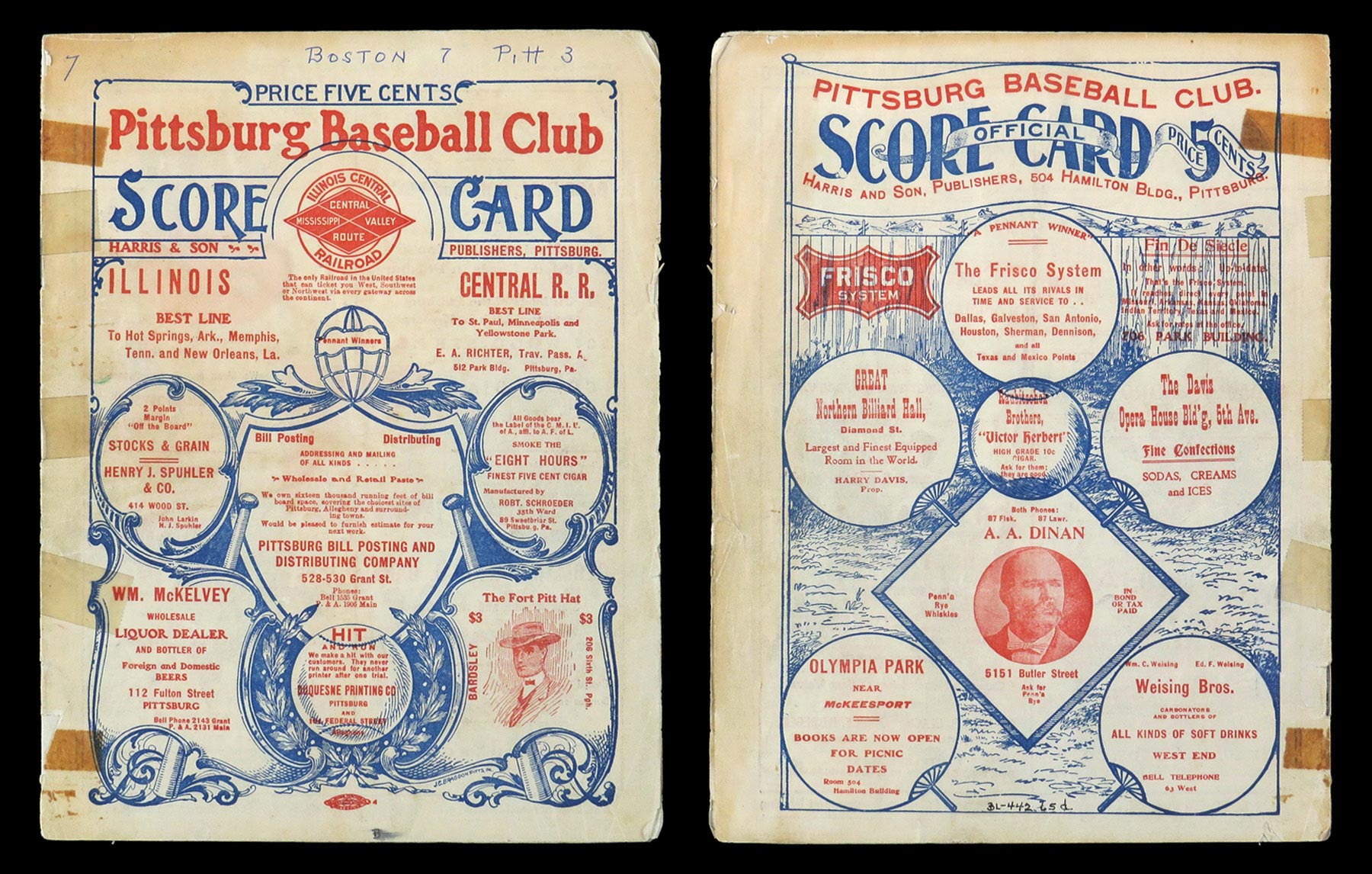
The front and back cover of a 12-page 1903 World Series program, printed for and sold during the championship games held in Pittsburgh.

What you see: The front and back cover of a 12-page 1903 World Series program, printed for and sold during the championship games held in Pittsburgh. Huggins and Scott estimates it at $150,000 to $250,000.

The expert: Bill Huggins of Huggins and Scott.

Why do so few of these inaugural World Series programs survive? They were actually sold only at Pittsburgh games. Boston won the series, five games to three. [It was a best of nine.] I think only four of those games were played in Pittsburgh. Twenty to 30 copies of the Boston version of the program have surfaced over the years. Only three have surfaced for the Pittsburgh games. One is in Cooperstown, and one is in a private collection. This one here was purchased by the consigner in the 1970s and has been in a safe deposit box ever since.

Why should there be fewer surviving Pittsburgh programs than Boston programs? Was the Pittsburgh park smaller, or the program less interesting than the Boston one? Being that it was the first World Series, I’m not sure they were expecting a huge turnout. They didn’t know if if would even catch on.

To stay on that point about the Pittsburgh program maybe being less interesting–the cover does not show any players… It’s mostly ads. As you open it up, there are lots and lots of ads, 90 percent advertising.

Maybe that explains why so few of these 1903 World Series programs survive? People didn’t buy the Pittsburgh program because it was so full of ads? Possibly. In and among a page of ads is a picture of [Pittsburgh Pirate] Honus Wagner, who was the star of the series. [The images of the players] are only silhouettes, two by two inch black and white head shots, in a bunch of ads. They had the player’s last name underneath. The players are in business suits with ties. They’re not even in uniform.

What condition is the 1903 World Series program in? I see pieces of tape on the cover… It must have been coming apart a little, because it has three pieces of tape on it. I don’t know if that was done in 1903, but it was done a very, very long time ago. And it’s got some wear on the corners, and things like that. When I get an old publication, I pick it up and smell it. It smells like old paper. That’s a telltale sign it’s not a reproduction. The pages are very. very thin compared to today’s programs. But there are no pages missing, no tears, no rips, no excessive writing.

Have you personally seen the other two known copies of the 1903 World Series program from Pittsburgh? I have not, but I can only imagine, barring the tape, I couldn’t find one nicer than this.

Do we know who the program’s first owner was–the person who made the notations on the cover and the scorecard inside? And do we know any of its subsequent owners, aside from the consigner? We don’t. However, the style of the scoring is very much of the period. Today, scorecards are much more elaborate.

And those handmade notations–that’s how we know it’s a World Series program from Game 7, yes? Yes. The World Series is the only time the American League met the National League in 1903. They didn’t play each other during the year.

The printers used three colors on this 1903 World Series program: blue, red, and black. Does that mean the people who commissioned the program splashed out on it? Actually, this is a bit more primitive. Some scorecards produced in the late 1800s were more elaborate. They might have four or five or more colors on some of them.

The words “World Series” don’t appear anywhere on the front or back cover of this 1903 World Series program. Do they appear anywhere inside it? No. Actually, it looks very similar to programs that the Pittsburgh ball club put out for regular games, if not identical. The defining part is the center page scorecard. I’d imagine the center page is a thing that could be a separate insert on its own, changed on a day to day basis. [FWIW, the cover of the counterpart Boston program doesn’t say “World Series”, but it does say “World’s Championship Games.” To learn more about how the contest got its modern name, follow this link and scroll down to the section called The Origin of the Name ‘the World Series’,]

What else marks this as ephemera from 1903? Are there ads in the program that would never appear in a World Series program today? There are whiskey ads, and one for cigars, three for five cents. Another says ‘Drink Crystal Water and live for 200 years.’

The Federal Trade Commission would not be cool with an ad like that today. No. There’s an ad for OK beer. Another cigar ad–almost everybody smoked. There’s literally page after page of advertising.

Why will this piece stick in your memory? Knowing what it is and knowing the significance of it, it’s very cool. In our industry, rookie cards are very, very hot. This is sort of the rookie card of World Series programs. The rarity of it is key, the firstness of it is key, and only three have surfaced. But there could be some in attics, basements, or drawers that haven’t come out.

How to bid: The 1903 World Series program from Pittsburgh is lot 2 in Huggins and Scott‘s November Auction, which runs from November 2 to November 15, 2018.

How to subscribe to The Hot BidClick the trio of dots at the upper right of this page. You can also follow The Hot Bid on Instagram and follow the author on Twitter.

Image is courtesy of Huggins and Scott.

Would you like to hire Sheila Gibson Stoodley for writing or editing work? Click the word “Menu” at the upper right for contact details.

Chirp! A Jess Blackstone Robin Carving Sold for… (Scroll Down and See)

A miniature robin, carved and painted by Jess Blackstone circa 1968 or 1969.

Update: The Jess Blackstone robin sold for $584.

What you see: A miniature robin, carved and painted by Jess Blackstone circa 1968 or 1969. Skinner estimates it at $300 to $500.

The expert: Chris Barber, deputy director of American furniture and decorative arts at Skinner.

So, who was Jess Blackstone, and how did he come to carve and paint miniatures of birds? Born 1909, died 1988, a resident of Melrose, Massachusetts, and moved to New Hampshire in the late 1930s, when he became a member of the League of New Hampshire Craftsmen. His dad carved mini-songbirds, and he learned to paint and carve from him. That seemed to shape where Blackstone went. He and his dad would have good-natured competitions to paint the smallest bird, or the most elaborate bird. He definitely eclipsed his dad in quality and production, but it [carving and painting bird sculptures] was a family business at one point.

Did Jess Blackstone live out his life in New Hampshire, or did he travel? He stayed there the rest of his life, in a simple house with a lot of land. He was able to support a wife and an adopted daughter with his carvings. When he was in the military in 1944 and 1945, he listed 58 birds that he encountered or identified in Germany, some of which he actually carved once he got home.

I take it he chose that place so he could look out his window and see birds? He had a lot of land, and he was a feeder type of guy. The birds were much more plentiful to see [in the mid-20th century], particularly warblers and tanagers and certain sparrows, which only come during the spring and fall migrations. He carved 92 different species of songbirds, based on an analysis of records at the New Hampshire Historical Society.

How prolific was Jess Blackstone? He’s estimated to have carved 8,500 birds. More than 2,500 were chickadees. Since 2005, as far back as our digital records go, we’ve sold 132 Jess Blackstone carvings.

Did he carve duck decoys? Decoys, no, but there’s a distinction to be made between these decorative carvings and decoys. Blackstone birds were never meant to attract a member of its own species. He carved ducks, yes, but there aren’t many among his output. They’re all decorative, and the overwhelming majority are songbirds.

What do we know about how Jess Blackstone worked? We think he observed birds a great deal. We think he bird-watched the way we bird-watch. He’d put out a feeder, or hike, and see them. There’s a story that if a bird hit his window, he would study it. He was so good at capturing the personality of a bird that he had to have watched them. Once he had a template for the shape and colors of a bird, it was almost paint-by-number. He would follow his template after producing one bird.

And what do we know about his approach to carving? We know he used white pine. In 2012 we sold a trade sign, a tabletop display mounted on a wood base, with a robin perched on it, that said ‘All birds are made of white pine.’ White pine is easy to carve, light, and plentiful. As far as I can tell, he never deviated from carving white pine.

What characteristics mark a Jess Blackstone bird carving? He was an inveterate record-keeper. He always signed his birds the same way, with an intertwined ‘JB’. There’s also a nice detail–he called it ‘feathering the bird’–a very subtle textured effect [of] parallel lines that run the length of the body. It prevents the bird from being completely flat. And the birds always stand on a grey stone-like base.

Jess Blackstone bird carvings are not photo-realistic, but they’re not folk art, either. Yes. They have a liveliness, a personality. They have a great presence. They straddle the line between realism and charm. Because they make you feel so good, they appeal to people who are not folk art collectors and not bird collectors, necessarily. The man who runs this department has a Jess Blackstone bluebird at his house. It speaks to how universal their appeal is. Though Blackstone created 8,500 of them, and 2,500 chickadees, he was never bored by them. It takes love to carve that many.

Why did he make so many chickadees? We don’t know, exactly. Maybe it dovetails with how he marketed and sold his work. He’d do shows at the League of New Hampshire Craftsmen and developed a following. I think the majority of his business was from craft shows. He knew his carvings were good, and he sought sophisticated audiences for them. People would ask him to carve a certain bird. He painted five times as many chickadees as any other bird. They’re great-looking, and they’re the state bird of Massachusetts. Maybe he carved so many because it was like playing the hits–certain bands out there have to play the one. He carved 267 robins, and this is number 240. Bluebirds and goldfinches, he did more than 500 each. He did 454 mallards, the biggest non-songbird. It looks like the robin is his tenth most popular songbird.

He signed his birds, but did he date them? He didn’t typically date them, no. There are numbers on the bottom, but there’s disagreement about what the numbers mean. He started numbering each bird by species. There may not be a number one chickadee, but there is a number 1,150 chickadee. He carved about 30 to 40 birds in a typical month, and up to 60 in a really productive month. The higher the number, the closer to his death [it was made]. He stopped around 1980 because he wasn’t well enough to carve in the last eight years of his life. Some of the ones from the late 1970s are not as high-quality as this robin.

Does his having made about 2,500 chickadees mean that chickadees were his favorite bird? Or does that just reflect what the market wanted? I wish I knew the answer to that question. I couldn’t find if he made observations about the birds themselves, other than his output. There’s no indication of if he weighted one bird more than another in his mind.

Where do collectors put Jess Blackstone bird carvings? Any flat surface. Mantelpieces, bookshelves, custom-made cabinets. They’re easy to amass. People who have one tend to have more than one.

What was Jess Blackstone’s golden age? It depends on how you define it. His output seems to have been regular. Toward the end of his career, he was better-known. In 1947, he asked $2 for a bluebird. By the early 1980s [after he had stopped working, but presumably had a stock of finished works], he charged up to $100 per bird. He had good days and he had bad days, but I don’t think his quality dipped very far, if at all. Because he was prolific, well-known, and consistent, [collectors judge based on] the condition of the bird, and the earlier the number, the better it does.

What’s the auction record for a Jess Blackstone bird carving? We’ve had one sell for $2,600–a a pair of purple finches mounted on driftwood. It’s rare for him to have two birds in one piece. [For individual birds,] in 2012, we sold a European bird for more than $2,100. It was a crowd-pleasing bird that was odd for him. If you turned it one way, it looked like a yellow wagtail, and if you turned it another way, it looked like a pied wagtail. It appears to be unique, and it was carved from a drawing he gathered overseas, when he was in the service. Rarer birds are the ones that tend to bring the most.

What is this Blackstone robin like in person? Is it actual size? It’s been on my desk all day. It’s tentative, it has an inquisitive stance, but it’s confident in its own way. It’s looking for its next worm. It’s probably an eighth of the size of a real robin, maybe a tenth of the size. The bigger it is, the harder it is to collect and display. One of the appeals of Jess Blackstone birds is they’re so easy to collect. Four look fine, and 30 doesn’t look overwhelming. They display nicely together. With 30 birds at full size, you have to commit. You don’t have to commit as readily to 30 miniature birds.

How to bid: The Jess Blackstone robin is lot 1576 in Skinner‘s Americana Online auction, which opened on October 25, 2018 and closes on November 4, 2018.

How to subscribe to The Hot BidClick the trio of dots at the upper right of this page. You can also follow The Hot Bid on Instagram and follow the author on Twitter.

You can follow Skinner on Twitter and Instagram.

Image is courtesy of Skinner.

Chris Barber spoke to The Hot Bid in February 2017 for a piece on an unusually charming double folk portrait that ultimately sold for $9,840.

Would you like to hire Sheila Gibson Stoodley for writing or editing work? Click the word “Menu” at the upper right for contact details.

A William Henry Harrison Campaign Pitcher Could Sell for $30,000

A large (almost a foot tall) ceramic pitcher touting Whig candidate William Henry Harrison's 1840 campaign for president.

What you see: A large (almost a foot tall) ceramic pitcher touting Whig candidate William Henry Harrison’s 1840 campaign for president. Heritage Auctions estimates it at $30,000.

The expert: Don Ackerman, consignment director for Heritage Auctions’s historical Americana & political department.

Who would have bought this pitcher in 1840? Or did Harrison make them to give away to his most ardent supporters? A lot of the campaign items from that period were utilitarian objects. In contrast to campaign buttons or ribbons that you wore to a rally, you’d display the pitcher in your home, and you could use it. I don’t think he gave it away. It was not cheap to produce. If you were a diehard supporter, you’d buy it and put it in your house. After the election, you didn’t throw it out. It had long-term value.

Was the ceramic pitcher a common form for campaign memorabilia in 1840? It was a fairly common form. Pitchers made of soft paste porcelain and china have a history. Before America became independent, there was a 1766 teapot that said ‘No Stamp Act’. That’s certainly one of the earliest political items. After the Revolutionary War, you’d often see Liverpool jugs, which were imported from England. America had very little in the way of pottery. Though England lost the war, they produced patriotic pitchers and tankards for the U.S. because there was demand for them.

William Henry Harrison died barely a month after taking office, so there’s little to collect from his time as president. I imagine there’s much more material from his days as a candidate? You get a lot of stuff for William Henry Harrison and practically nothing for his opponent, Martin Van Buren. Harrison had a highly organized campaign and it caught the public’s attention more than any other campaign before that time. 1840 stands out for a flourishing of political items and material, and probably 95 percent of it was for William Henry Harrison.

Why was that? Was Harrison a marketing and branding wizard, or was the demand for Harrison stuff that strong? I think there was demand for it. His was the first campaign with an icon–the log cabin and the hard cider barrel. Previously, you didn’t have symbols representing the candidates. Harrison came up with the log cabin and the hard cider barrel, and it caught fire.

We think that four or five of these ceramic pitchers survive, but do we have any idea how many might have been made? They probably made very few of them. It was made by an American pottery company.

So you get cross-competition for this pitcher from collectors of American ceramics? Yes. Pottery people really like it. This is the pinnacle of political pottery from 1840. There’s probably fewer than ten examples in existence. When these come up for auction, they consistently sell for a lot of money.

How do the decorations on the pitcher reflect William Henry Harrison’s campaign imagery? It’s got the log cabin and the hard cider barrel.

Where is the hard cider barrel? Below the window of the log cabin. It was a popular image because Harrison was meant to be a man of the people. Contrast that with Martin Van Buren, who was considered a New York elitist who’d sit in the White House and sip Champagne from a silver goblet. The hard cider barrel was originally a criticism of Harrison–that he was a country bumpkin, and if he was given a pension he’d be content to sit in a log cabin and sip hard cider. Of course by that time he was living in a mansion, but he presented himself as born in and lived in a log cabin, and an Ohio farmer, like Cincinnatus, going back to his farm after the war.

Does the pitcher have every element that a William Henry Harrison collector would want? No, it doesn’t, but it’s got the essentials. It doesn’t say “The Hero of Tippecanoe,” and it doesn’t show a canoe. [Yes, Harrison was the ‘Tippecanoe’ in ‘Tippecanoe and Tyler Too,’ and that slogan is not on the pitcher, either.] He was sometimes called the “Farmer of North Bend.” Here he’s the “Ohio Farmer.” It lacks the symbol of the Whig party, which was the raccoon–

Wait, wait, wait. The symbol of the Whig party was the raccoon? What is it with American political parties choosing non-heroic animals to represent them? The raccoon goes with the rustic Daniel Boone, Davy Crockett type of thing. These guys were trappers. They trapped animals, sold the hides, and made stew out of the meat.

This pitcher was a functional object. Does it show any signs of use? Not really. It’s in pretty good shape. It’s got some discoloration on the inside, and it’s got a crack and a chip [which you can see on the spout of the pitcher]. Obviously, it was used. The crack and the chip can be restored, and the stains can be bleached out. Even with the defects, it’s probably the nicest one [of the surviving pitchers] I’ve seen. A lot of them have cracks and tend to be highly discolored.

Another example of the William Henry Harrison pitcher went to auction at Heritage in December 2016, selling for $37,500. But do you remember if and when one of these pitchers went to auction before then? This one and the one sold in 2016 are the only two I remember in political memorabilia auctions. I know of five examples, and I’ve been collecting for 54 years. They’re highly prized. I don’t think I’ve seen one sold for under $20,000, even going way, way back. This is the Cadillac. It’s got four portraits. It was made in Jersey City, New Jersey. It’s big. It’s got great graphics. It’s rare. If you can afford it, it’s a great item to have.

How to bid: The William Henry Harrison ceramic pitcher is lot #43039 in the David and Janice Frent Collection of Presidential & Political Americana, Part IV sale, which takes place on November 10 and 11 at Heritage Auctions.

How to subscribe to The Hot BidClick the trio of dots at the upper right of this page. You can also follow The Hot Bid on Instagram and follow the author on Twitter.

Heritage Auctions is on Twitter and Instagram.

Earlier in 2018, Don Ackerman spoke to The Hot Bid about a William McKinley campaign poster, also from the David and Janice Frent Collection, which sold for $11,875.

Did you just realize that “William Henry Harrison” scans just like “Alexander Hamilton”? No need to write a Hamilton parody. Actor Jason Kravitz beat you to it.

Image is courtesy of Heritage Auctions.

Would you like to hire Sheila Gibson Stoodley for writing or editing work? Click the word “Menu” at the upper right for contact details.
Chirp! Skinner Has a Flock of Jess Blackstone Bird Carvings, Including a Robin That Could Fly Away With $500

1576Miniature birds “Hand Carved and Painted by Blackstone”

What you see: A miniature robin, carved and painted by Jess Blackstone circa 1968 or 1969. Skinner estimates it at $300 to $500.

The expert: Chris Barber, deputy director of American furniture and decorative arts at Skinner.

So, who was Jess Blackstone, and how did he come to carve and paint miniatures of birds? Born 1909, died 1988, a resident of Melrose, Massachusetts, and moved to New Hampshire in the late 1930s, when he became a member of the League of New Hampshire Craftsmen. His dad carved mini-songbirds, and he learned to paint and carve from him. That seemed to shape where Blackstone went. He and his dad would have good-natured competitions to paint the smallest bird, or the most elaborate bird. He definitely eclipsed his dad in quality and production, but it [carving and painting bird sculptures] was a family business at one point.

Did Jess Blackstone live out his life in New Hampshire, or did he travel? He stayed there the rest of his life, in a simple house with a lot of land. He was able to support a wife and an adopted daughter with his carvings. When he was in the military in 1944 and 1945, he listed 58 birds that he encountered or identified in Germany, some of which he actually carved once he got home.

I take it he chose that place so he could look out his window and see birds? He had a lot of land, and he was a feeder type of guy. The birds were much more plentiful to see [in the mid-20th century], particularly warblers and tanagers and certain sparrows, which only come during the spring and fall migrations. He carved 92 different species of songbirds, based on an analysis of records at the New Hampshire Historical Society.

How prolific was Jess Blackstone? He’s estimated to have carved 8,500 birds. More than 2,500 were chickadees. Since 2005, as far back as our digital records go, we’ve sold 132 Jess Blackstone carvings.

Did he carve duck decoys? Decoys, no, but there’s a distinction to be made between these decorative carvings and decoys. Blackstone birds were never meant to attract a member of its own species. He carved ducks, yes, but there aren’t many among his output. They’re all decorative, and the overwhelming majority are songbirds.

What do we know about how Jess Blackstone worked? We think he observed birds a great deal. We think he bird-watched the way we bird-watch. He’d put out a feeder, or hike, and see them. There’s a story that if a bird hit his window, he would study it. He was so good at capturing the personality of a bird that he had to have watched them. Once he had a template for the shape and colors of a bird, it was almost paint-by-number. He would follow his template after producing one bird.

And what do we know about his approach to carving? We know he used white pine. In 2012 we sold a trade sign, a tabletop display mounted on a wood base, with a robin perched on it, that said ‘All birds are made of white pine.’ White pine is easy to carve, light, and plentiful. As far as I can tell, he never deviated from carving white pine.

What characteristics mark a Jess Blackstone bird carving? He was an inveterate record-keeper. He always signed his birds the same way, with an intertwined ‘JB’. There’s also a nice detail–he called it ‘feathering the bird’–a very subtle textured effect [of] parallel lines that run the length of the body. It prevents the bird from being completely flat. And the birds always stand on a grey stone-like base.

Jess Blackstone bird carvings are not photo-realistic, but they’re not folk art, either. Yes. They have a liveliness, a personality. They have a great presence. They straddle the line between realism and charm. Because they make you feel so good, they appeal to people who are not folk art collectors and not bird collectors, necessarily. The man who runs this department has a Jess Blackstone bluebird at his house. It speaks to how universal their appeal is. Though Blackstone created 8,500 of them, and 2,500 chickadees, he was never bored by them. It takes love to carve that many.

Why did he make so many chickadees? We don’t know, exactly. Maybe it dovetails with how he marketed and sold his work. He’d do shows at the League of New Hampshire Craftsmen and developed a following. I think the majority of his business was from craft shows. He knew his carvings were good, and he sought sophisticated audiences for them. People would ask him to carve a certain bird. He painted five times as many chickadees as any other bird. They’re great-looking, and they’re the state bird of Massachusetts. Maybe he carved so many because it was like playing the hits–certain bands out there have to play the one. He carved 267 robins, and this is number 240. Bluebirds and goldfinches, he did more than 500 each. He did 454 mallards, the biggest non-songbird. It looks like the robin is his tenth most popular songbird.

He signed his birds, but did he date them? He didn’t typically date them, no. There are numbers on the bottom, but there’s disagreement about what the numbers mean. He started numbering each bird by species. There may not be a number one chickadee, but there is a number 1,150 chickadee. He carved about 30 to 40 birds in a typical month, and up to 60 in a really productive month. The higher the number, the closer to his death [it was made]. He stopped around 1980 because he wasn’t well enough to carve in the last eight years of his life. Some of the ones from the late 1970s are not as high-quality as this robin.

Does his having made about 2,500 chickadees mean that chickadees were his favorite bird? Or does that just reflect what the market wanted? I wish I knew the answer to that question. I couldn’t find if he made observations about the birds themselves, other than his output. There’s no indication of if he weighted one bird more than another in his mind.

Where do collectors put Jess Blackstone bird carvings? Any flat surface. Mantelpieces, bookshelves, custom-made cabinets. They’re easy to amass. People who have one tend to have more than one.

What was Jess Blackstone’s golden age? It depends on how you define it. His output seems to have been regular. Toward the end of his career, he was better-known. In 1947, he asked $2 for a bluebird. By the early 1980s [after he had stopped working, but presumably had a stock of finished works], he charged up to $100 per bird. He had good days and he had bad days, but I don’t think his quality dipped very far, if at all. Because he was prolific, well-known, and consistent, [collectors judge based on] the condition of the bird, and the earlier the number, the better it does.

What’s the auction record for a Jess Blackstone bird carving? We’ve had one sell for $2,600–a a pair of purple finches mounted on driftwood. It’s rare for him to have two birds in one piece. [For individual birds,] in 2012, we sold a European bird for more than $2,100. It was a crowd-pleasing bird that was odd for him. If you turned it one way, it looked like a yellow wagtail, and if you turned it another way, it looked like a pied wagtail. It appears to be unique, and it was carved from a drawing he gathered overseas, when he was in the service. Rarer birds are the ones that tend to bring the most.

What is this Jess Blackstone robin like in person? Is it actual size? It’s been on my desk all day. It’s tentative, it has an inquisitive stance, but it’s confident in its own way. It’s looking for its next worm. It’s probably an eighth of the size of a real robin, maybe a tenth of the size. The bigger it is, the harder it is to collect and display. One of the appeals of Jess Blackstone birds is they’re so easy to collect. Four look fine, and 30 doesn’t look overwhelming. They display nicely together. With 30 birds at full size, you have to commit. You don’t have to commit as readily to 30 miniature birds.

How to bid: The Jess Blackstone robin is lot 1576 in Skinner‘s Americana Online auction, which opened on October 25, 2018 and closes on November 4, 2018.

How to subscribe to The Hot BidClick the trio of dots at the upper right of this page. You can also follow The Hot Bid on Instagram and follow the author on Twitter.

You can follow Skinner on Twitter and Instagram.

Image is courtesy of Skinner.

Chris Barber spoke to The Hot Bid in February 2017 for a piece on an unusually charming double folk portrait that ultimately sold for $9,840.

Would you like to hire Sheila Gibson Stoodley for writing or editing work? Click the word “Menu” at the upper right for contact details.

Sold! The 1869 Red Stockings Sheet Music Fetched $1,320

An 1869 copy of The Red Stockings sheet music, lauding a Cincinnati team of that name.

Update: The 1869 Cincinnati Red Stockings sheet music sold for $1,320.

What you see: An 1869 copy of The Red Stockings sheet music, lauding a Cincinnati team of that name. Robert Edward Auctions estimates it at $2,000 to $3,000.

The expert: Tom D’Alonzo, vintage memorabilia specialist at Robert Edward Auctions.

How was sheet music of this sort used in the mid-19th century? Also, is this sheet music for the piano, for voice, or both? It might be a little hard, but try to imagine living in a time with no radio, no records, no televisions. If you wanted to hear music, you had to go to a concert or play an instrument. A lot of homes had a piano, so sheet music like this was sold to be played for entertainment. This sheet music is for exactly that – a piano – with no lyrics included.

How many songs are in this 1869 Cincinnati Red Stockings sheet music? Would we recognize any of the songs today, or are all of them unknown to modern audiences? Only one song appears in this sheet music, and I would think it’s safe to say that it wouldn’t be recognized today if the tune came on the radio.

How was the sort of music in the 1869 Cincinnati Red Stockings sheet music important to baseball and baseball fandom? Did clubs that were similar to the Royal Rooters in Boston exist in 1869? Would they have used sheet music such as this? I don’t know how important it was to the fan base, but other prominent teams and players had songs dedicated to them – it was considered a great honor. I’d imagine that some of these songs were popular in their day, but it’s hard to say for sure – we have no way of seeing how many pieces of sheet music were sold. The Red Stockings had a strong local following, of course, but nothing to the extent of the Royal Rooters.

Why are the 1869 Cincinnati Red Stockings ‘one of the most celebrated teams in baseball history’, according to the lot notes? What is the demand like for that club’s material today, and how does it remain strong? This team is generally considered to be the first professional team. That, coupled with the fact that they won all their games in 1869 against some of the best teams in the country, has made them pretty famous today. That contributes to a strong demand for items related to the team, but there aren’t a ton of items to go around. We’ve seen some, including CDVs [cartes de visite] and sheet music like this, and they’re always in demand.

Are the Cincinnati Red Stockings an antecedent to the Cincinnati Reds? Does the club have any connection to the Boston Red Sox? You’d think they would, but they don’t. Four players from the 1869 Cincinnati team joined up with the Boston Red Stockings in 1871 as part of the National Association, which was baseball’s first professional league, after the Cincinnati club disbanded. That Boston team is actually today’s Atlanta Braves – stick with me here – and the Boston Red Sox didn’t come along until 1901. The Cincinnati Reds that we know today weren’t a thing until 1882.

Is this cover design for the 1869 Cincinnati Red Stockings sheet music unusually elaborate? What can we infer from the fact that the publisher thought they could pay to show all nine players in this level of detail on the cover and make a profit? This cover was obviously designed to catch the eye, and that’s true of most early baseball sheet music. They’re phenomenal display pieces and very attractive. The players on the 1869 team were all well known, so it’s likely the manufacturer saw them as great selling points and included them all.

How does this copy compare to the other four that you’ve handled? Without being able to hold them side by side, I’d estimate that this example is middle of the pack – not the best, but not the worst. It’s really a solid example.

How did it manage to survive so well? Much of the early sheet music was bound together in an album, and that’s true of this example. Having it preserved tightly and free of exposure to the elements contributed to its survival.

The lot notes mention the sheet music’s ‘extremely fragile nature’–what makes it fragile? Was it printed on lower-quality paper? And does it require any sort of special handling, such as gloves? It’s printed on thin paper – not low quality by any means, but thin and susceptible to tearing or damage. Gloves aren’t needed to handle it, but common cautions should be taken to ensure it lives another 100+ years.

How did this 1869 Cincinnati Red Stockings sheet music come to you? How many owners has it had? Have you sold it before? This piece has a typical story – it was collected by a sheet music collector who enjoyed it for many years before deciding it was time to sell his collection. I don’t know where he acquired it or how many owners it had, but it’s the first time we’ve ever offered it.

What is the world auction record for this particular piece of sheet music? The highest price we’re aware of at public auction is $4,025 in 1999.

Why will this item stick in your memory? It’s just a classic piece from the early days of baseball. When we think sheet music, it’s hard not to have the 1869 Red Stockings sheet music come to mind.

How to bid: The 1869 Red Stockings sheet music is lot 2054 in the REA Fall Auction, which opened online on October 8, 2018 and closes on October 28, 2018.

How to subscribe to The Hot BidClick the trio of dots at the upper right of this page. You can also follow The Hot Bid on Instagram and follow the author on Twitter.

Robert Edward Auctions is on Twitter and Instagram.

Image is courtesy of Robert Edward Auctions.

Would you like to hire Sheila Gibson Stoodley for writing or editing work? Click the word “Menu” at the upper right for contact details.

A Snap Wyatt Sideshow Banner of a Headless Girl Could Sell for $2,000

A sideshow banner made by Snap Wyatt circa 1965, advertising a headless girl illusion.

What you see: A sideshow banner made by Snap Wyatt circa 1965, advertising a headless girl illusion. Potter & Potter estimates it at $1,500 to $2,000.

The expert: Gabe Fajuri, president of Potter & Potter.

How rarely do sideshow banners painted by Snap Wyatt come to auction? I don’t know that it’s unusual. They’re out there. Remember, Wyatt said he could paint one banner per day.

Where does Snap Wyatt rank among the known sideshow banner painters? And is this the largest group of Snap Wyatt banners you’ve offered at the same time? He ranks in the top three, top five. And yes, it is the largest group. Usually we get them one or two at a time, if at all.

How does this Snap Wyatt banner compare to the other Snap Wyatt banners in the auction? It’s in better condition than some of the others. But it’s so hard to say–tastes vary widely. One banner in there shows a magician, and someone will want that who’s interested in magic. Some might be interested in the Headless Girl because they like a woman in a bikini.

Snap Wyatt signed this banner. Is that unusual? No, he usually put his stencil signature on them. There are many unsigned examples [of sideshow banners] but I think people like examples by known painters–Sigler, Johnson, Wyatt.

How do you know Wyatt painted this banner around 1965? It’s an educated guess based on its style and condition. It’s not an earlier banner because it’d be a lot rougher as far as condition. Johnny Meah gave me insight into when and how Wyatt worked.

Do sideshow banner collectors avoid banners that don’t show enough signs of having been on the road? I think something collectors look for are show-used banners–ones you can prove were used in a particular show at a particular time. That is to the good. I don’t know that that’s the case here.

Would people who paid to enter the sideshow in 1965 because this banner caught their eye have seen a headless girl illusion that looks like this? [Laughs] No. They would not have seen it in this way, no. It was the equivalent of a line illustration in the Johnson Smith catalog. The difference between imagination and reality is pretty stark.

How far off would it be from what we see on the banner? It’d be different in that she wouldn’t be sitting sideways, she wouldn’t be in a bikini, and a thing would be attached to her head in place of her head, like the apparatus we’re selling in lot 646. This is very casual-looking, as if she’ll get up and walk around. In a ten-in-one [a sideshow that offered ten acts in one venue for one price], she’d sit in a chair, and there’d be someone next to her, the demonstrator of the attraction, fiddling with knobs on a blinking control board or pouring fluid into tubes leading to her neck, explaining how she survives. He might hand her things to prove she’s alive and not a robot. Since she’s not getting up out of the chair and can’t talk, she’s going to need some help.

Is the headless girl illusion a standard sideshow attraction? I would say it’s a classic,  a fairly common thing. It was exhibited at Coney Island for years.

Did the headless girl just sit there, or did she do things? She could have done any number of things. She definitely moved around to prove she was not a wax figure or a mannequin. She could have written on a blackboard, anything to prove she was alive.

How similar would the circa 1965 headless girl apparatus have been to the one you’re offering in lot 646? The method is basically unchanged. The way it works now is identical to the way it worked then. There would have been tubes or a metal apparatus coming out of her neck. Perhaps they dressed it up in different ways, with different headpieces, or different sets of tubes and a lot of things on the side to “keep her alive.”

So you can guess where the headless girl’s head is pretty easily. It depends on how careful the exhibitor is. The illusion can be quite good. It’s up to them to set it up correctly. A lot of show operators didn’t care in the sense that they’d gotten your money. You can still buy the workshop plans from Abbott Magic in Michigan, if you want, and build your own. I think the plans are $5. [He remembered correctly. The plans are $5 as of October 2018.]

And the illusion doesn’t look like the banner. They all have something sticking out of her head. It’s not simply a headless woman.

How much would the banner be worth if the artist was anonymous? The banner market is not what it used to be, but I don’t think it would change it tremendously. If it’s anonymous, it’s a 20 to 30 percent difference.

What does the Johnny Fox provenance add to the banner’s value? I think it adds a little bit to it. A lot of people are interested in Johnny Fox. If you look on Facebook, there are memorials to him. He had a lot of friends. He performed for 37 seasons at the Maryland Renaissance Festival. They named a stage after him in tribute to him. A lot of people fondly remember Fox and his museum.

What are the odds that the same bidder buys the Headless Girl banner and the headless woman apparatus? About 50/50. I think there’s a good chance someone will buy the prop and use it. I think a collector will buy the banner.

How to bid: The Headless Girl sideshow banner is lot 8 in Freakatorium: The Collection of Johnny Fox, a sale that takes place November 10, 2018 at Potter & Potter.

How to subscribe to The Hot BidClick the trio of dots at the upper right of this page. You can also follow The Hot Bid on Instagram and follow the author on Twitter.

Follow Potter & Potter on Instagram and Twitter.

Gabe Fajuri is a favorite on The Hot Bid. He’s talked about a record-setting stage-worn magician’s tuxedo; a genuine 19th century gambler’s case that later sold for $6,765; a scarce 19th century poster of a tattooed man that fetched $8,610; a 1908 poster for the magician Chung Ling Soo that sold for $9,225; a Golden Girls letterman jacket that belonged to actress Rue McClanahan; and a 1912 Houdini poster that set the world record for any magic poster at auction.

Image is courtesy of Potter & Potter.

Would you like to hire Sheila Gibson Stoodley for writing or editing work? Click the word “Menu” at the upper right for contact details.
Sold! A 1928 Roger Broders Corsica Travel Poster Commanded $7,500

La Place de Calvi. Corse, a 1928 poster by Roger Broders, touting Calvi Beach on the Mediterranean island of Corsica.

Update: The 1928 Roger Broders poster featuring Calvi Beach in Corsica sold for $7,500.

What you see: La Place de Calvi. Corse, a 1928 poster by Roger Broders, touting Calvi Beach on the Mediterranean island of Corsica. Swann Auction Galleries estimates it at $8,000 to $12,000.

The expert: Nicholas Lowry, director of Swann Galleries.

Where was Roger Broders in his career in 1928? Let me give you a little background first. In 2011, we were very lucky at Swann to hold a sale called The Complete Poster Works of Roger Broders–every poster he ever designed. We have handled all his material at the same time. We’re in a good position to have an overview. We arranged the catalog in chronological order, first to last, and we had 100 lots in the auction. This poster was number 49, so, midway in his output, if not his actual career. He was at a stage when his figures take on a lithe, elongated look.

Was this his first poster for this client? Oh, no. PLM was his major client, his primary client. Between two-thirds and three-quarters of his posters were done for them.

A railway company commissioned this Corsica poster from Roger Broders, but there’s no train in it. Why would a railroad want a travel poster that didn’t show a railroad? The railway teamed up with ferry services. You would have booked the ferry through the train company–it was a PLM ticket. PLM was like a travel agency, in that way. This [Corsica] was along their extended route.

M38476-1 004

What makes this Roger Broders image a strong poster design? I see a bright patch of orange in the middle–a beautiful, brightly colored, artistically decorated wrap. If I was passing by this, I would stop because I saw a flash of orange. Then I’d see the pretty lady. The composition is fantastic. The curve of the shore is a Broders design motif. Her body cuts right through it. It’s very eye-catching. And at the time, people wouldn’t have thought this, but it’s an incredible Art Deco image. This is archetypal Art Deco. The coastline is sweeping, the cape is moving, the waves are lapping at the shore.

Was it unusual for Broders to place a woman front-and-center, as he does here? Lot 72 is the same woman seen from the back. There are a handful of other posters where he has figures taking the central place.

I went back and forth between those two posters, lot 71 and lot 72, and settled on this one because I recognized the woman’s feet and legs. They look like the feet and legs of Venus in Botticelli’s Birth of Venus. It’s almost as if he traced them. I don’t see anything mentioned in the lot notes, though. Is Broders quoting that painting?  The tilt of her head is similar, and the elongated neck is similar. There’s no way it’s a coincidence. It’s too accurate. 100 percent, this is a nod to Birth of Venus.

And the Birth of Venus is, technically, a beach scene… It gets better and better. If you look at the bottom of the poster, there are two figures on the left of the woman and one on the right. That’s also like the painting. The figure on the right in the painting is about to shroud Venus with a cloak. In the poster, the woman has a wrap. There’s not a lot of info on Broders, but the Birth of Venus is in Florence, and he did a poster for Florence in 1921. And that’s his style–the elongated style appears in other posters.

Was it typical for him to quote paintings in his posters? Off the top of my head, I’ve never seen a pose in his posters that made me think he was copying an Old Master.

How many of these 1928 Roger Broders Corsica posters have you handled, and what is the auction record? It’s not rare, but it’s not common. At least 23 have been auctioned since 1988. We have had it three times. The first time was in 2011. The auction record is $16,800, set at Poster Auctions International in February 2018.

M38476-1 004

Where does this rank among Broders’s poster designs? Certainly in the top 10 and probably in the top five. Now I’m biased, knowing it was based on the Birth of Venus. I thought it was a great poster before you said that. Now it’s like, wow. It’s because of the composition, the color, the style, and the attitude it broadcasts–summer laziness, aristocratic decadence. It’s certainly how high society lives. There’s no question this is an elegant lady.

What else do you like about this Roger Broders Corsica poster? He has made the landscape realistic. It’s Calvi Beach in Corsica, and it wraps around Corsica. That sweep is not an exaggeration. He has accurately represented the surroundings. It’s a tribute to the level of detail he put into his work. Some posters are really supposed to represent an attitude. This is about a destination, too. Lot 72, the woman with her arms to the sun–that doesn’t tell you anything about where you’re going. There’s a beach, but it’s not the same level as this.

How to bid: The Roger Broders Corsica poster is lot 71 in the Rare & Important Travel Posters sale at Swann Auction Galleries on October 25, 2018.

How to subscribe to The Hot BidClick the trio of dots at the upper right of this page. You can also follow The Hot Bid on Instagram and follow the author on Twitter.

Swann Galleries is on Instagram and Twitter, and Nicholas Lowry is on Instagram and Twitter as well.

Nicholas Lowry has appeared several times on The Hot Bid. Read past entries in which he  talks about Swann setting the world auction record for any travel postera 1938 London Transport poster by Man Ray that ultimately sold for $149,000a trio of Mont Blanc posters from 1928, a mid-1930s German travel poster featuring the Hindenburg, a 1968 MoMA poster by Japanese artist Tadanori Yokoo, an I Want You 1917 World War I recruiting poster that introduced the modern concept of Uncle Sam, and an Alphonse Mucha poster featuring Sarah Bernhardt.

Are you a professional art historian? Here’s the full Swann Auction Galleries catalogue for The Complete Poster Works of Roger Broders. Can you find more instances of Broders quoting a work of art? If you do, tweet it to @SGSwritereditor, @SwannGalleries, and @NichoLowry, along with a WikiCommons image of the work the poster is emulating.

Text is copyright Sheila Gibson Stoodley. Image is courtesy of Swann Auction Galleries.

Would you like to hire Sheila Gibson Stoodley for writing or editing work? Click the word “Menu” at the upper right for contact details.

The First TCB Necklace That Elvis Presley Gave Away Could Sell for $50,000 at Julien’s

A 14k gold necklace with a Taking Care of Business (TCB) logo, given by Elvis Presley to Sonny West circa 1970.

What you see: A 14k gold necklace with a Taking Care of Business (TCB) logo, given by Elvis Presley to Sonny West circa 1970. Julien’s Auctions estimates it at $30,000 to $50,000.

The expert: Martin Nolan, executive director of Julien’s Auctions.

What was the Memphis Mafia, and how did it serve Elvis Presley? “Memphis Mafia” was the name given to the group of friends and close confidants of Elvis Presley. The media gave them the name “Memphis Mafia” around 1960. Elvis liked the name and it stuck.

Where did the phrase “Taking Care of Business” come from? Elvis’s band was called Taking Care of Business. He always gave away gifts, especially jewelry, and he came up with the idea for an identifying piece of jewelry that he only gave to the Memphis Mafia. There were probably 12 to 20 people [in the group]. Elvis loved Taking Care of Business. It was the logo on his plane. Priscilla was involved with the design of the logo. They were on the plane when a lightning bolt went through it. She got out her sketch pad and came up with Taking Care of Business in a flash.

When did that happen? We don’t know for sure, but we presume it was the late 1950s or early 1960s, probably after he came out of the military.

How was the material and the carat weight chosen? Elvis loved bling, he loved gold. There were some variants on the necklace. The one he gave Doctor Nick [George Nichopoulos, Presley’s personal physician] had diamonds on it. We sold that one for $120,000. The overall look of the 14k gold necklace is probably based on a collaboration with the jeweler in Beverly Hills and what they could do within their budget.

This is believed to be the first TCB necklace that Elvis Presley gave out. Does that make it more interesting to collectors? Yes. Collectors love something when it’s original, or the first. TCB went on to be a significant Elvis signature, in a way. Its being the first definitely adds value on auction day.

Why is Sonny West a logical recipient of the first TCB necklace? He was Elvis’s bodyguard, responsible for security at his concerts. He was one of the original members of the Memphis Mafia, which was a very close, tight circle. My guess is because he was Elvis’s bodyguard, he was right there when Elvis went to the jewelry shop in Beverly Hills. Because he was right there, and a member of the Memphis Mafia group, he got the first necklace.

Do the TCB necklaces always look like this one does, or did the design change over time? They’re not all exactly the same. The TCB logo with the flash remains the same, but the chains change.

How many owners did the necklace have after Sonny West relinquished it? He passed it on to the consigner, who brought it to us. Jeffrey, the consigner, created a video which is on our site of Sonny West taking the necklace off himself and putting it on Jeffrey. The provenance is 100 percent solid. That plays into the value.

How many TCB necklaces have you handled, and how many TCB necklaces did Elvis give out? Do we know? I think we’ve handled four to sixprobably four, with two coming back to auction again. I don’t know how many there are, but there were somewhere between 12 and 20 people in the Memphis Mafia. Not a huge amount. Maybe 30, max.

Do any period photos exist of Sonny West wearing the TCB necklace and standing alongside Elvis? I presume there would be period photos. He was with Elvis for 16 years, and he was with Elvis a lot. We didn’t license any, but I’m sure there are photos.

How did you arrive at the estimate of $30,000 to $50,000? Obviously we looked at the intrinsic value first. Then we looked at other TCB necklaces we’ve sold. The provenance is so solid because of Sonny West. Then there’s the collectibility of Elvis himself. He has a huge amount of fans out there.

As of October 19, the necklace has its first bid, amounting to $7,500. Does that mean anything? No, it doesn’t mean anything. But we have 55,000 views on this auction already. To have so many so early on, that’s amazing.

What condition is the necklace in? It’s in great condition, given its age and the life it’s had up to now.

Why will this particular TCB necklace stick in your memory? The fact that it was the first one–wow, it was the start of something. The very first one created, for Sonny West, the bodyguard and confidant of Elvis. Within the history of Elvis and the Memphis Mafia, it’s almost like branding, or a tattoo. Taking care of business in a flash was what the Memphis Mafia represented: getting business done. That was what was important to Elvis.

How to bid: The TCB necklace is lot 466 in the Icons and Idols: Rock “N” Roll auction Julien’s will hold in New York on November 9 and 10, 2018.

How to subscribe to The Hot BidClick the trio of dots at the upper right of this page. You can also follow The Hot Bid on Instagram and follow the author on Twitter.

Julien’s Auctions is on Twitter and Instagram.

Image is courtesy of Julien’s Auctions.

Martin Nolan previously spoke to The Hot Bid about a purple Prince-worn tunic that the star donned for a 1998 BET interview, which yielded a famous GIF; a Joseff of Hollywood simulated diamond necklace worn by Hedy Lamarr, Ava Gardner, and several other Hollywood actresses, as well as a once-lost 1962 Gibson acoustic guitar belonging to John Lennon that sold for $2.4 million–a record for any guitar at auction.

Would you like to hire Sheila Gibson Stoodley for writing or editing work? Click the word “Menu” at the upper right for contact details.

SOLD! African-American Outsider Artist William Edmondson’s The Crucifixion Commanded $175,000 at Rago

The Crucifixion, a 1930s sculpture by the outsider artist William Edmondson, who was the first African-American to have a solo show at the Museum of Modern Art in Manhattan.

Update: African-American outsider artist William Edmondson’s circa 1930s sculpture, The Crucifixion, sold for $175,000.

What you see: The Crucifixion, a 1930s sculpture by the outsider artist William Edmondson, who was the first African-American to have a solo show at the Museum of Modern Art in Manhattan. Rago Auctions estimates it at $30,000 to $50,000.

The expert: Sebastian Clarke, director of estate services for Rago.

Did African-American outsider artist William Edmondson use a railroad spike as a chisel for most of his artistic career? He did, though to the best of my knowledge, he used smaller, finer chiseling tools as well. He was very much self-taught. I can send you a discovery–the original press release from the 1937 MoMA show, which includes an interview with him. The list of pieces to be shown includes a version of The Crucifixion. He did three or four different versions of The Crucifixion, and we don’t know if this is the one that was in the show, or another example. Of the three or four, one is in the Smithsonian, at least one other is in a private collection, but was exhibited in 2005, one is unknown [its whereabouts are unknown], and one is ours.

How does this version of The Crucifixion compare to the others? The others have more fully formed figures, with pierced areas between the arms and the cross [the arms are separate]. This is more of a relief, with a flat face. What I love about it is it really conveys Edmondson’s work. It’s impossible to identify it as male or female. Of the others, two ore three are male figures wearing loincloths or underpants. This one is completely plain.

William Edmondson preferred limestone. How difficult is it to carve limestone? It’s very, very difficult to carve. What’s fabulous about this is its condition is so good. You can really see the strike marks where he worked the stone. This is almost smooth to the touch in so many areas.

The sculpture measures 15 and a quarter inches high by 10 and a half inches wide by five inches deep. Is that relatively small for an Edmondson? It’s a hair on the smaller side. His animals seem to be a little smaller. His figures got to be 23, 24 inches. Of his Crucifixions, one is 20 inches and another is 26 inches. So it’s definitely smaller for a Crucifixion, but squarely on the average side for pieces he worked.

Earlier you told me, “This work is as close to Edmondson’s original intent as they get.” Could you elaborate? Edmondson’s pieces are extremely symbolic. The scenes are often drawn from his religious beliefs. This Crucifixion is part of that body of work. The surface is just so fantastic. It’s clearly a crucifixion, but it’s up to the viewer to interpret the rest of the thing.

This is William Edmondson’s only crucifixion sculpture to come to auction. How did you put an estimate on it? We’re aware the world auction record for an Edmondson is nearly $1 million, for a wholly different work. The nature of this is cruder and more simplistic. And a crucifixion, in my experience in the art world, sometimes places limitations on value. We want to take that into account.

But it’s not a gory, gruesome crucifixion scene. It’s pretty stylized. And people who collect folk art and outsider art, they know they’re going to encounter pieces with intensely religious themes. True. But the value will be determined by the marketplace. We’ll have to wait and see what happens. I’ve been in the business for 20 years. I’ve never handled an Edmondson before. Whenever they come up for sale, they always far exceed the estimate. We’ll try to replicate that success.

Edmondsons rarely go to auction. Is that because most of them are in institutions, or is it because collectors are reluctant to give them up, or both? Several examples are in institutions, and the ones in collectors’ hands are often promised to institutions. Folk art and outsider art collectors take a lot of pride in their collections. Edmondsons come up so rarely, everybody pays attention.

What’s the world auction record for a work by African-American outsider artist William Edmondson? The Boxer, a circa 1936 piece that sold at Christie’s in January 2016. It had an estimate of $150,000 to $250,000 and it hammered at $785,000. I’d love to see it [The Crucifixion] beat its estimate but I’d be surprised to see it go beyond-beyond. Artnet only has 24 records. It’s a very shallow pool, and none are a crucifixion. They don’t come from a similar period or style, where the features are not very well-defined. What will that do to it? Will it make it more desirable, or less? We’ll have to wait and see.

What is the William Edmondson sculpture like in person? It’s fabulous. It’s so bright and crisp. There’s something magnetic–you’re drawn to it, and the color and the surface are lovely. It looks like it’s never seen the light of day. The chisel marks are so well-defined on the back. There’s something really exceptional about it.

What does it feel like to hold it in your hands? It’s heavy, probably around 40 pounds. It is surprisingly smooth. You can really feel the weight of the piece, the way the figure is defined on the cross. You want to turn it over and look at the back, which is not easy to do, because it weighs so much.

Is that something that collectors look for in a work by African-American outsider artist William Edmondson–chisel marks? Or are they so rare that they can’t afford to quibble if they’re missing? The whole idea behind outsider and folk art is really feeling a connection with the individual who made it, to feel them reflected in the piece. In the chisel marks, you can really see him working on it.

Why will this piece stick in your memory? Probably because I’ll never handle one again. [Laughs.] Edmondsons are something you only hear about, but don’t get to see. For me, personally, my training is in European furniture and decorative art. This is something I’ve grown to appreciate and love. I’ve always been a high-style person. I’ve come to appreciate pieces that are naive in so many ways, but are spectacular. It’s so magnificent.

How to bid: The Crucifixion will be offered in Autobiography of a Hoarder: The Collection of Martin Cohen, Part I, which takes place October 21, 2018 at Rago.

How to subscribe to The Hot BidClick the trio of dots at the upper right of this page. You can also follow The Hot Bid on Instagram and follow the author on Twitter.

Rago Auctions is on Twitter and Instagram.

Text is copyright Sheila Gibson Stoodley. Image is courtesy of Rago Auctions.

Would you like to hire Sheila Gibson Stoodley for writing or editing work? Click the word “Menu” at the upper right for contact details.

Cincinnati Red Stockings Sheet Music from 1869 Could Sell for $3,000 or More

An 1869 copy of The Red Stockings sheet music, lauding a Cincinnati team of that name.

What you see: An 1869 copy of The Red Stockings sheet music, lauding a Cincinnati team of that name. Robert Edward Auctions estimates it at $2,000 to $3,000.

The expert: Tom D’Alonzo, vintage memorabilia specialist at Robert Edward Auctions.

How was sheet music of this sort used in the mid-19th century? Also, is this sheet music for the piano, for voice, or both? It might be a little hard, but try to imagine living in a time with no radio, no records, no televisions. If you wanted to hear music, you had to go to a concert or play an instrument. A lot of homes had a piano, so sheet music like this was sold to be played for entertainment. This sheet music is for exactly that – a piano – with no lyrics included.

How many songs are in this 1869 Cincinnati Red Stockings sheet music? Would we recognize any of the songs today, or are all of them unknown to modern audiences? Only one song appears in this sheet music, and I would think it’s safe to say that it wouldn’t be recognized today if the tune came on the radio.

How was music of this sort important to baseball and baseball fandom? Did clubs that were similar to the Royal Rooters in Boston exist in 1869? Would they have used sheet music such as this? I don’t know how important it was to the fan base, but other prominent teams and players had songs dedicated to them – it was considered a great honor. I’d imagine that some of these songs were popular in their day, but it’s hard to say for sure – we have no way of seeing how many pieces of sheet music were sold. The Red Stockings had a strong local following, of course, but nothing to the extent of the Royal Rooters.

Why are the 1869 Cincinnati Red Stockings ‘one of the most celebrated teams in baseball history’, according to the lot notes? What is the demand like for that club’s material today, and how does it remain strong? This team is generally considered to be the first professional team. That, coupled with the fact that they won all their games in 1869 against some of the best teams in the country, has made them pretty famous today. That contributes to a strong demand for items related to the team, but there aren’t a ton of items to go around. We’ve seen some, including CDVs [cartes de visite] and sheet music like this, and they’re always in demand.

Are the Cincinnati Red Stockings an antecedent to the Cincinnati Reds? Does the club have any connection to the Boston Red Sox? You’d think they would, but they don’t. Four players from the 1869 Cincinnati team joined up with the Boston Red Stockings in 1871 as part of the National Association, which was baseball’s first professional league, after the Cincinnati club disbanded. That Boston team is actually today’s Atlanta Braves – stick with me here – and the Boston Red Sox didn’t come along until 1901. The Cincinnati Reds that we know today weren’t a thing until 1882.

Is this cover design for the 1869 Cincinnati Red Stockings sheet music unusually elaborate? What can we infer from the fact that the publisher thought they could pay to show all nine players in this level of detail on the cover and make a profit? This cover was obviously designed to catch the eye, and that’s true of most early baseball sheet music. They’re phenomenal display pieces and very attractive. The players on the 1869 team were all well known, so it’s likely the manufacturer saw them as great selling points and included them all.

How does this 1869 Cincinnati Red Stockings sheet music compare to the other four that you’ve handled? Without being able to hold them side by side, I’d estimate that this example is middle of the pack – not the best, but not the worst. It’s really a solid example.

How did this 1869 Cincinnati Red Stockings sheet music manage to survive so well? Much of the early sheet music was bound together in an album, and that’s true of this example. Having it preserved tightly and free of exposure to the elements contributed to its survival.

The lot notes mention the sheet music’s ‘extremely fragile nature’–what makes it fragile? Was it printed on lower-quality paper? And does it require any sort of special handling, such as gloves? It’s printed on thin paper – not low quality by any means, but thin and susceptible to tearing or damage. Gloves aren’t needed to handle it, but common cautions should be taken to ensure it lives another 100+ years.

How did this item come to you? How many owners has it had? Have you sold it before? This piece has a typical story – it was collected by a sheet music collector who enjoyed it for many years before deciding it was time to sell his collection. I don’t know where he acquired it or how many owners it had, but it’s the first time we’ve ever offered it.

What is the world auction record for this particular piece of sheet music? The highest price we’re aware of at public auction is $4,025 in 1999.

Why will this item stick in your memory? It’s just a classic piece from the early days of baseball. When we think sheet music, it’s hard not to have the 1869 Red Stockings sheet music come to mind.

How to bid: The 1869 Red Stockings sheet music is lot 2054 in the REA Fall Auction, which opened online on October 8, 2018 and closes on October 28, 2018.

How to subscribe to The Hot BidClick the trio of dots at the upper right of this page. You can also follow The Hot Bid on Instagram and follow the author on Twitter.

Robert Edward Auctions is on Twitter and Instagram.

Image is courtesy of Robert Edward Auctions.

Would you like to hire Sheila Gibson Stoodley for writing or editing work? Click the word “Menu” at the upper right for contact details.

Sold! That Glorious Portfolio of Nudes from the Roaring 20s Fetched $2,860 at Swann

An image from The Model, Series No. 1, a 1925 portfolio of 15 photographs of nude women shot by Albert Arthur Allen.

Update: The 1925 Albert Arthur Allen portfolio of nudes sold for $2,860.

What you see: An image from The Model, Series No. 1, a 1925 portfolio of 15 photographs shot by Albert Arthur Allen. Swann Auction Galleries estimates the glorious portfolio of nudes at $4,000 to $6,000.

The expert: Daile Kaplan, vice president and director of photographs and photobooks at Swann Auction Galleries.

What do we know about the photographer, Albert Arthur Allen? He was born in Grafton, Mass., in 1886, and his family moved to California in the early 20th century. Apparently, his father was a businessman in the maritime industry and a man of means. Allen was an artistic figure who relied on his family’s financial resources. As far as I know, he was fairly isolated and had no associations with other Bay Area artists. As a young man, Allen became interested in art and, by the late 1910s, was producing Pictorialist images—lovely photographs of young women in natural settings. Many were hand-colored, and the long-haired subjects have a fresh, natural appearance. By about 1919, he started photographing nude models in the studio, against a black backdrop. With the rise of the Roaring 20s, Allen’s aesthetic changed, and he began to shoot in residential and studio settings and also create fanciful tableaux, such as the ones we see in The Model. An entrepreneur, he sold his pictures via ads in newspapers and art publications. But sending nude studies through the mails, especially those in which women’s pubic hair was clearly visible, was illegal. Allen was the target of numerous suits and, by the end of the 1920s, went bankrupt.

The photo I’m using to illustrate the glorious portfolio of nudes is the group of seven women in profile, six with their left hands on the shoulder of the woman in front of her. What, specifically, would a 1925 audience have found scandalous about this photo? What details that don’t jump out at us now would have scandalized viewers then? Sadly, we’re now living in a social and political period that illustrates the ways in which women are considered second-class citizens. In 1925, there was a more relaxed atmosphere in the U.S., one that fostered new cultural and artistic expressions. But the appearance of a nude female form was considered quite scandalous. In this picture, Allen has softly airbrushed the models’ pubic areas, but did not eliminate this “pornographic” feature. And the notion of women touching one another was certainly perceived as a Sapphic-like expression.

Sapphic-like? What made it Sapphic-like? Is it that the women are nude and touching each other–is that enough? Exactly, exactly. We have to look at the pictures from American social history–Puritan influences, Comstock influences. [Anthony Comstock was a U.S. postal inspector who championed a namesake law that made sending “obscene” material through the mail a crime.] These pictures, as innocent as they are to us, are very loaded.

How does this glorious portfolio of nudes exemplify 1920s beauty and style? The models’ shorter, more androgynous hairdos are the most visible sign of a 1920s liberated woman. And the slimmer body types also epitomize the “new woman.”

What jumped out at me was how normal these women look–not the super-thin models who predominate today. You’re right. They’re not the emaciated women of the last 10 to 15 years. They are curvaceous, and they have breasts. They’re active and healthy. Victorian women [by contrast] wore corsets and had full hips.

All of the women have short hair. Would all of their hairstyles have been described as “bobs” then? Are these women flappers? Yes and yes. My understanding is that “flapper” relates to a dance or performance, and these models are definitely active.

Was it legal for Albert Arthur Allen to shoot this glorious portfolio of nudes in California in 1925? It was legal for Allen to shoot these photographs, but it was illegal for him to utilize the U.S. Postal Service to convey them to clients.

How did he find seven young women who would agree to be photographed nude? Allen paid his models for their time and effort. I was told by a dealer of nude studies that, in some instances, some of these young women were pregnant. Finding work was challenging and modeling was an available occupation.

Do we know who any of the women are? None of the women are identified by name. Allen was more focused on representing “types,” and his other portfolios include loopy quasi-scientific texts in which he unsuccessfully attempts to articulate complex ideas associated with gender.

Beneath each woman in the photo there’s a letter, from A through G. Do we know what the letters mean? Does it reflect Albert Arthur Allen’s attempt to represent “types” of women? I believe the letters may correspond to text information that’s not included in this particular portfolio.

Can we assume that the women had no input in the composition of any of the images in this glorious portfolio of nudes—this is all Albert Arthur Allen’s vision? My sense is that Allen was responsible for composing these marvelous tableaux. But given that he worked in California, it’s not unlikely that some of these models had experience in Hollywood or with dance troupes, and contributed ideas.

Did he shoot the images for Model, Series No. 1 in his Oakland, California studio prior to it burning down in 1925? There’s very little biographical information about Allen that has survived. When I was working on my book, I consulted with a number of Allen collectors, one of whom hired a detective to try to learn more about this colorful and mysterious figure. But I imagine he rented a theatre–note the size of the stage and the large backdrop.

Does the title Model, Series No. 1 imply that he intended to produce sequel portfolios, but never managed to do so? Allen was a grandiose figure with larger-than-life ambitions who innocently–and inadvertently–took on the conservative, political establishment. The legal actions were costly and time consuming. He did not manage the production of these portfolios with any business acumen or organizational skills. I imagine he intended to develop other versions of The Model, but as far as I know, he didn’t.

I understand Albert Arthur Allen was indicted for sending obscene materials through interstate mail—would a copy of this portfolio have triggered those charges? Allen was drawing the ire and attention of federal authorities before this particular portfolio was photographed. Remember Comstock’s chastity law and America’s Puritan origins? Well, despite the cultural shift and appearance of free women in the 1920s, these repressive precepts continued to dictate social mores.

Some suggest that Albert Arthur Allen’s work is seen as campy now. Do you agree? What makes it campy? Some of the pictures may conform to the idea of camp, which is seen as bad taste. But my perspective is that Allen was positing interesting forms of photographic representation that are still valid. Allen’s artistic program falls apart in his so-called scientific analysis, introducing terms like “sexine,” and attempting to formulate correspondences between body types and personality traits. He wasn’t an Edward Weston, but his sensibility certainly corresponds to someone like William Mortensen, the most popular photographer of the 1930s.

“Sexine”? Erm, what does “sexine” mean? It’s a word he invented. It seems to be some obscure concept he had to characterize a woman who was not a virgin, but had not had children. Was it a sense of purity? I don’t know. But it was something odd.

Do we know how many of these portfolios were made, and how many survive? Unfortunately, Allen did not edition his portfolios or maintain records of the number of portfolios he sold.

How often does The Model, Series No. 1 come up with all 15 photos in place?  How many have you handled? This portfolio is offered every few years; it’s rare to find a suite with the entire 15 photographs. The last time Swann offered a complete set was in 2009, when it sold for $3,600. Swann has handled four copies, one of which contained 10 prints, since 2001.

What is the auction record for The Model, Series No. 1? $8,400, which was realized on October 15, 2007.

What condition is this copy in? Excellent. Clearly, the images were respected and well-taken-care-of. They weren’t handled a lot. But I want to back up and give you background on the folio. It was consigned by a woman whose great-grandfather collected this material. When family members come to us after discovering nude photos, there’s a kind of shock that they readily, openly convey to us that grandfather had this in the attic. There was no Playboy magazine in 1925. There weren’t any magazines that depicted male and female nudes except nudist magazines. Where did collectors get them? Allen advertised in the printed matter you’d see in barber shops or mens’ clubs.

Might that explain why we don’t know how many copies Allen made of The Model, Series No. 1? Maybe it wasn’t in his best interest to keep accurate records of how many he printed? Perhaps at a certain point he was advised to destroy his records. The legal battle went on and on. It’s possible he intentionally didn’t keep records.

Why will this portfolio stick in your memory? Of Allen’s various projects, I would deem this particular portfolio the most successful. These particular images are fun and celebratory and epitomize the spirit of the Roaring 20s. The photographs depict women who are comfortable in their bodies, have an athletic verve, and are enjoying one another. There’s also the obvious correspondence between photography and cinema, an interdisciplinary dialog that’s culturally rich.

How to bidThe Model, Series No. 1 portfolio is lot 68 in Artists & Amateurs: Photographs & Photobooks, which takes place at Swann on October 18, 2018.

How to subscribe to The Hot BidClick the trio of dots at the upper right of this page. You can also follow The Hot Bid on Instagram and follow the author on Twitter.

Swann Auction Galleries is on Instagram and Twitter.

Daile Kaplan previously spoke to The Hot Bid about an exceptional circa 1921 print of Lewis Hine’s Powerhouse Mechanic, a record-setting Edward Curtis portrait of the Oglala Lakota leader, Red Cloud, and a print of Harold Edgerton’s Milk Drop Coronet.

Kaplan’s 2001 book on Albert Arthur Allen’s nudes, Premiere Nudes, is available at the Strand book store and other independent booksellers.

Image is courtesy of Swann Auction Galleries.

Would you like to hire Sheila Gibson Stoodley for writing or editing work? Click the word “Menu” at the upper right for contact details.
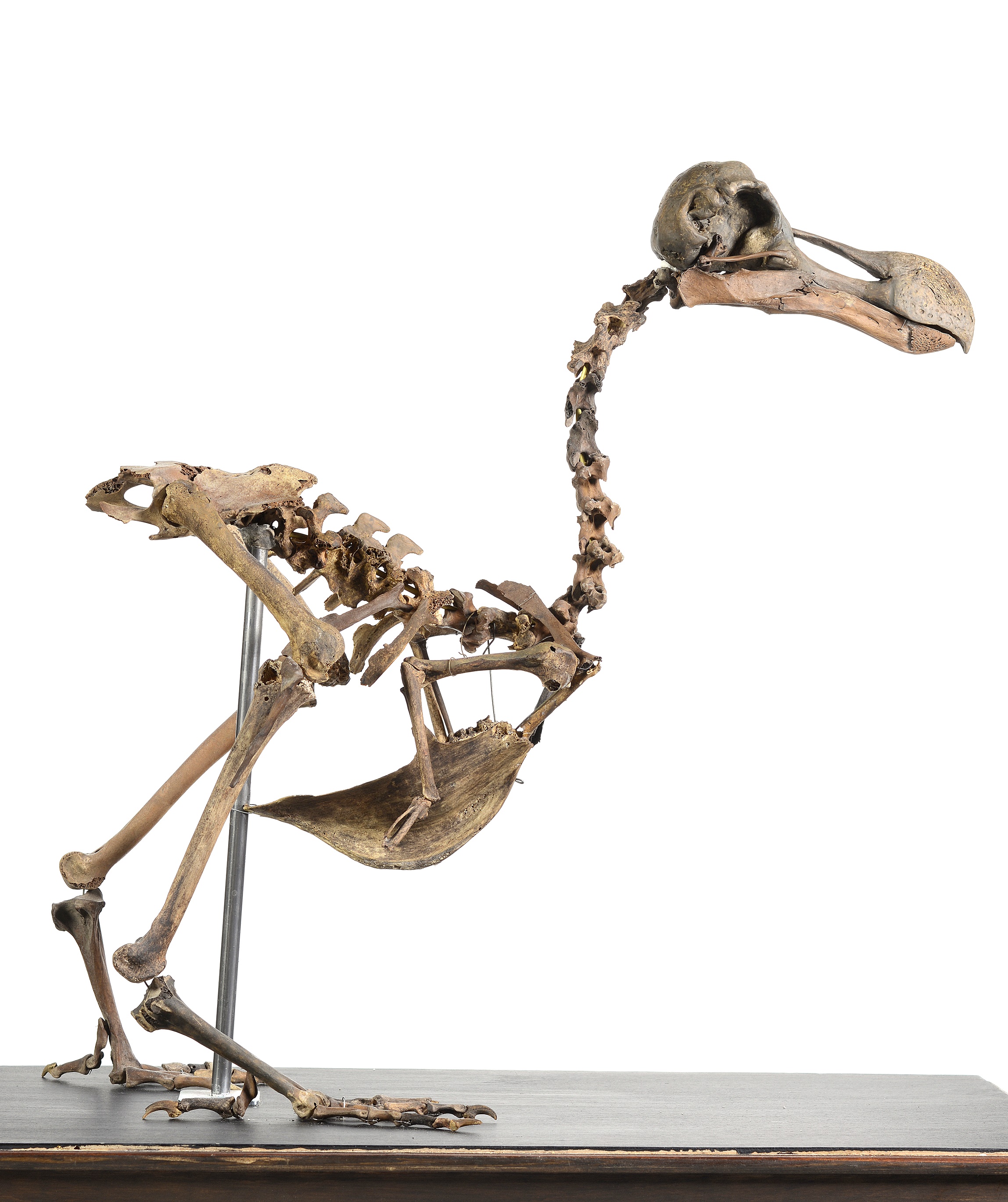
A Roger Broders Corsica Travel Poster Could Sell for $12,000

La Place de Calvi. Corse, a 1928 poster by Roger Broders, touting Calvi Beach on the Mediterranean island of Corsica.

What you see: La Place de Calvi. Corse, a 1928 poster by Roger Broders, touting Calvi Beach on the Mediterranean island of Corsica. Swann Auction Galleries estimates it at $8,000 to $12,000.

The expert: Nicholas Lowry, director of Swann Galleries.

Where was Roger Broders in his career in 1928? Let me give you a little background first. In 2011, we were very lucky at Swann to hold a sale called The Complete Poster Works of Roger Broders–every poster he ever designed. We have handled all his material at the same time. We’re in a good position to have an overview. We arranged the catalog in chronological order, first to last, and we had 100 lots in the auction. This poster was number 49, so, midway in his output, if not his actual career. He was at a stage when his figures take on a lithe, elongated look.

Was this his first poster for this client? Oh, no. PLM was his major client, his primary client. Between two-thirds and three-quarters of his posters were done for them.

A railway company commissioned this poster from Roger Broders, but there’s no train in it. Why would a railroad want a travel poster that didn’t show a railroad? The railway teamed up with ferry services. You would have booked the ferry through the train company–it was a PLM ticket. PLM was like a travel agency, in that way. This [Corsica] was along their extended route.

M38476-1 004

What makes this Roger Broders Corsica image a strong poster design? I see a bright patch of orange in the middle–a beautiful, brightly colored, artistically decorated wrap. If I was passing by this, I would stop because I saw a flash of orange. Then I’d see the pretty lady. The composition is fantastic. The curve of the shore is a Broders design motif. Her body cuts right through it. It’s very eye-catching. And at the time, people wouldn’t have thought this, but it’s an incredible Art Deco image. This is archetypal Art Deco. The coastline is sweeping, the cape is moving, the waves are lapping at the shore.

Was it unusual for Roger Broders to place a woman front-and-center, as he does here? Lot 72 is the same woman seen from the back. There are a handful of other posters where he has figures taking the central place.

I went back and forth between those two Roger Broders posters, lot 71 and lot 72, and settled on this one because I recognized the woman’s feet and legs. They look like the feet and legs of Venus in Botticelli’s Birth of Venus. It’s almost as if he traced them. I don’t see anything mentioned in the lot notes, though. Is Broders quoting that painting?  The tilt of her head is similar, and the elongated neck is similar. There’s no way it’s a coincidence. It’s too accurate. 100 percent, this is a nod to Birth of Venus.

And the Birth of Venus is, technically, a beach scene… It gets better and better. If you look at the bottom of the poster, there are two figures on the left of the woman and one on the right. That’s also like the painting. The figure on the right in the painting is about to shroud Venus with a cloak. In the poster, the woman has a wrap. There’s not a lot of info on Broders, but the Birth of Venus is in Florence, and he did a poster for Florence in 1921. And that’s his style–the elongated style appears in other posters.

Was it typical for Roger Broders to quote paintings in his posters? Off the top of my head, I’ve never seen a pose in his posters that made me think he was copying an Old Master.

How many of these 1928 Roger Broders Corsica posters have you handled, and what is the auction record? It’s not rare, but it’s not common. At least 23 have been auctioned since 1988. We have had it three times. The first time was in 2011. The auction record is $16,800, set at Poster Auctions International in February 2018.

M38476-1 004

Where does this Corsica poster rank among Broders’s poster designs? Certainly in the top 10 and probably in the top five. Now I’m biased, knowing it was based on the Birth of Venus. I thought it was a great poster before you said that. Now it’s like, wow. It’s because of the composition, the color, the style, and the attitude it broadcasts–summer laziness, aristocratic decadence. It’s certainly how high society lives. There’s no question this is an elegant lady.

What else do you like about this Roger Broders Corsica poster? He has made the landscape realistic. It’s Calvi Beach in Corsica, and it wraps around Corsica. That sweep is not an exaggeration. He has accurately represented the surroundings. It’s a tribute to the level of detail he put into his work. Some posters are really supposed to represent an attitude. This is about a destination, too. Lot 72, the woman with her arms to the sun–that doesn’t tell you anything about where you’re going. There’s a beach, but it’s not the same level as this.

How to bid: The Roger Broders 1928 Calvi Beach poster is lot 71 in the Rare & Important Travel Posters sale at Swann Auction Galleries on October 25, 2018.

How to subscribe to The Hot BidClick the trio of dots at the upper right of this page. You can also follow The Hot Bid on Instagram and follow the author on Twitter.

Swann Galleries is on Instagram and Twitter, and Nicholas Lowry is on Instagram and Twitter as well.

Nicholas Lowry has appeared several times on The Hot Bid. Read past entries in which he  talks about Swann setting the world auction record for any travel postera 1938 London Transport poster by Man Ray that ultimately sold for $149,000a trio of Mont Blanc posters from 1928, a mid-1930s German travel poster featuring the Hindenburg, a 1968 MoMA poster by Japanese artist Tadanori Yokoo, an I Want You 1917 World War I recruiting poster that introduced the modern concept of Uncle Sam, and an Alphonse Mucha poster featuring Sarah Bernhardt.

Are you a professional art historian? Here’s the full Swann Auction Galleries catalogue for The Complete Poster Works of Roger Broders. Can you find more instances of Broders quoting a work of art? If you do, tweet it to @SGSwritereditor, @SwannGalleries, and @NichoLowry, along with a WikiCommons image of the work the poster is emulating.

Image is courtesy of Swann Auction Galleries.

Would you like to hire Sheila Gibson Stoodley for writing or editing work? Click the word “Menu” at the upper right for contact details.

Contemporary Artist Pae White’s Widow of a King Could Command $25,000 at Heritage Auctions

Widow of a King, a 2006 work by artist Pae White

What you see: Widow of a King, a 2006 work by artist Pae White. Heritage Auctions estimates it at $15,000 to $25,000.

The expert: Brent Lewis, director of design at Heritage Auctions.

Is this piece unique, or part of a limited edition? From what we understand, three versions were made, and each of those is unique.

How do the other two differ? From a few images I’ve seen, they’re very similar, but slightly different in the design of the faux carving.

Do we know why Pae White named this piece Widow of a King? I don’t know the story on that. I think she uses an evocative title to suggest a background for it that could not be immediately obvious. This is very atypical of her oeuvre. Pae White is an artist in the true sense of the word. She is not a designer. She typically does not make functional objects.

Do we know why Pae White made Widow of a King predominantly white? The material she used, Corian, is produced in various colors, but its primary color is white. She’s been quoted as saying she wanted to source blue Corian, but it wasn’t available, so she used white. She worked up the conceptual side of the piece in white, and she has said, “I wanted the “look” of something that might have been carved in the Black Forest but by an albino alien and I think we came pretty darn close.” If you look at it from a distance, it looks like it may be a traditional four-poster bed that’s carved and may be painted white. As you approach, you see the way it’s carved is different. The carving itself is off and almost degraded. You can tell there’s something else going on with the piece once you begin to examine it.

Why is one of the headboard posts taller than the other? It’s part of what I described of her intentionality. It [the work] is an object that has an inherent unbalance. She talked about wanting to subvert the viewers’ relationship with everyday objects.

Do the symbols on the footboard have any particular meaning? Not to my knowledge.

Do we know why Pae White used Corian? And how involved was she in its creation–did she do the physical work of producing the bed, or did she delegate it? I didn’t see anything [that explained why she used Corian]. She’s a mixed-media artist who doesn’t typically work in this manner. I’m not aware of other works in Corian. Everything was done under her watchful eye. It was made with the assistance of sophisticated machinery.

Widow of a King is an actual bed, but what size is it? And did the consigner use it as a bed? I think it’s a king-size. And yeah, the owner did use it as a bed.

Widow of a King has signs of use. Will that matter? No. I think that any of that can be conserved quite easily.

Is Widow of a King among the earlier pieces by Pae White to reach the secondary market? Not a great deal of her work has come to auction. I count 25 auction records on Artnet, with the record being $20,000 in 2013, sold at Christie’s, and titled Skygazing #6: Blue Nebula. It’s a large cotton and polyester work.

Is that record work anything like Widow of a King? No. Nothing like this by Pae White has sold at auction.

What is Widow of a King like in person? It’s incredible. It’s extraordinary, it’s complex, it’s multi-layered, and it has extraordinary physical presence.

We’re seeing the work as an incomplete bed frame, with no mattresses or sheets. Does the artist have any recommendations for finishing it? I don’t think there are any, but it was created to be a functional bed. Its impact would be complete when it’s installed in a domestic setting.

Are there details that don’t show up well in the photo? The fine carving on the posts. I think there is an intangible quality to the carving on the headboard and the footboard.

How does the carving hold your attention? It’s beguiling. It’s beautiful, but in an unexpected way. As I explained earlier, when you first come upon it, it’s traditional. As you approach it, you look for the carving techniques you’re accustomed to. When you get up close, the carving may be sharper and more asymmetrical where you would expect a more balanced pattern. It throws you off balance, but allows you to enjoy the object itself.

Widow of a King is a work of contemporary art, but you decided to put it in a design sale. Was that a tough call? There was debate, but in the end we felt it was pretty clear-cut where this piece should be positioned. Pae White is an artist who doesn’t make design objects and is not known for making functional objects. Because of the functionality, it may have a stronger market in design than in contemporary art, where you normally see her work. From time to time, contemporary artists make works that have a functional aspect, like this bed. Sometimes they’re successful from a design standpoint, and sometimes they’re less successful. I think this is very successful. The quality of the material used and its production is very high, but the intentionality that’s prevalent in it clearly comes from the place of the artist. It’s what makes this piece stand apart. It’s an accomplished piece of furniture, but you can look at it as a work of art.

How to bid: Pae White’s Widow of a King is lot 79038 in the Design Signature Auction at Heritage Auctions on October 21, 2018.

How to subscribe to The Hot BidClick the trio of dots at the upper right of this page. You can also follow The Hot Bid on Instagram and follow the author on Twitter.

Heritage Auctions is on Twitter and Instagram.

Image is courtesy of Heritage Auctions.

Would you like to hire Sheila Gibson Stoodley for writing or editing work? Click the word “Menu” at the upper right for contact details.
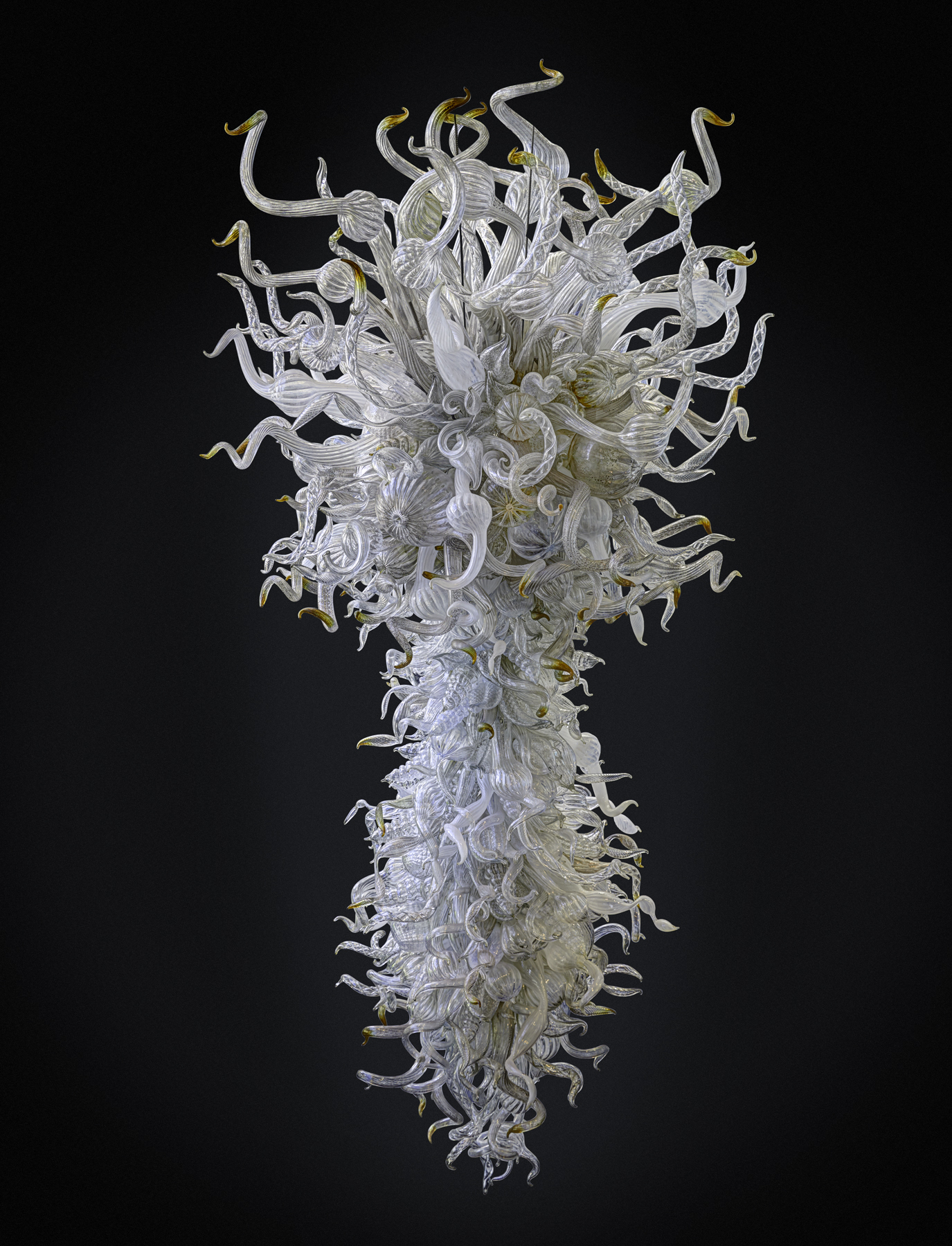
A Glorious Portfolio of Nudes from the Roaring 20s Could Command $6,000 at Swann

An image from The Model, Series No. 1, a 1925 portfolio of 15 photographs of nude women shot by Albert Arthur Allen.

What you see: An image from The Model, Series No. 1, a 1925 portfolio of 15 photographs shot by Albert Arthur Allen. Swann Auction Galleries estimates the glorious portfolio of nudes it at $4,000 to $6,000.

The expert: Daile Kaplan, vice president and director of photographs and photobooks at Swann Auction Galleries.

What do we know about the photographer, Albert Arthur Allen? He was born in Grafton, Mass., in 1886, and his family moved to California in the early 20th century. Apparently, his father was a businessman in the maritime industry and a man of means. Allen was an artistic figure who relied on his family’s financial resources. As far as I know, he was fairly isolated and had no associations with other Bay Area artists. As a young man, Allen became interested in art and, by the late 1910s, was producing Pictorialist images—lovely photographs of young women in natural settings. Many were hand-colored, and the long-haired subjects have a fresh, natural appearance. By about 1919, he started photographing nude models in the studio, against a black backdrop. With the rise of the Roaring 20s, Allen’s aesthetic changed, and he began to shoot in residential and studio settings and also create fanciful tableaux, such as the ones we see in The Model. An entrepreneur, he sold his pictures via ads in newspapers and art publications. But sending nude studies through the mails, especially those in which women’s pubic hair was clearly visible, was illegal. Allen was the target of numerous suits and, by the end of the 1920s, went bankrupt.

The photo I’m using to illustrate the glorious portfolio of nudes is the group of seven women in profile, six with their left hands on the shoulder of the woman in front of her. What, specifically, would a 1925 audience have found scandalous about this photo? What details that don’t jump out at us now would have scandalized viewers then? Sadly, we’re now living in a social and political period that illustrates the ways in which women are considered second-class citizens. In 1925, there was a more relaxed atmosphere in the U.S., one that fostered new cultural and artistic expressions. But the appearance of a nude female form was considered quite scandalous. In this picture, Allen has softly airbrushed the models’ pubic areas, but did not eliminate this “pornographic” feature. And the notion of women touching one another was certainly perceived as a Sapphic-like expression.

Sapphic-like? What made it Sapphic-like? Is it that the women are nude and touching each other–is that enough? Exactly, exactly. We have to look at the pictures from American social history–Puritan influences, Comstock influences. [Anthony Comstock was a U.S. postal inspector who championed a namesake law that made sending “obscene” material through the mail a crime.] These pictures, as innocent as they are to us, are very loaded.

How do these images in this glorious portfolio of nudes exemplify 1920s beauty and style? The models’ shorter, more androgynous hairdos are the most visible sign of a 1920s liberated woman. And the slimmer body types also epitomize the “new woman.”

What jumped out at me was how normal these women look–not the super-thin models who predominate today. You’re right. They’re not the emaciated women of the last 10 to 15 years. They are curvaceous, and they have breasts. They’re active and healthy. Victorian women [by contrast] wore corsets and had full hips.

All of the women have short hair. Would all of their hairstyles have been described as “bobs” then? Are these women flappers? Yes and yes. My understanding is that “flapper” relates to a dance or performance, and these models are definitely active.

Was it legal for Albert Arthur Allen to shoot this glorious portfolio of nudes in California in 1925? It was legal for Allen to shoot these photographs, but it was illegal for him to utilize the U.S. Postal Service to convey them to clients.

How did he find seven young women who would agree to be photographed for this glorious portfolio of nudes? Allen paid his models for their time and effort. I was told by a dealer of nude studies that, in some instances, some of these young women were pregnant. Finding work was challenging and modeling was an available occupation.

Do we know who any of the women are? None of the women are identified by name. Allen was more focused on representing “types,” and his other portfolios include loopy quasi-scientific texts in which he unsuccessfully attempts to articulate complex ideas associated with gender.

Beneath each woman in the photo there’s a letter, from A through G. Do we know what the letters mean? Does it reflect Albert Arthur Allen’s attempt to represent “types” of women? I believe the letters may correspond to text information that’s not included in this particular portfolio.

Can we assume that the women had no input in the composition of any of the images—this is all Allen’s vision? My sense is that Allen was responsible for composing these marvelous tableaux. But given that he worked in California, it’s not unlikely that some of these models had experience in Hollywood or with dance troupes, and contributed ideas.

Did he shoot the images for Model, Series No. 1 in his Oakland, California studio prior to it burning down in 1925? There’s very little biographical information about Allen that has survived. When I was working on my book, I consulted with a number of Allen collectors, one of whom hired a detective to try to learn more about this colorful and mysterious figure. But I imagine he rented a theatre–note the size of the stage and the large backdrop.

Does the title Model, Series No. 1 imply that he intended to produce sequel portfolios, but never managed to do so? Allen was a grandiose figure with larger-than-life ambitions who innocently–and inadvertently–took on the conservative, political establishment. The legal actions were costly and time consuming. He did not manage the production of these portfolios with any business acumen or organizational skills. I imagine he intended to develop other versions of The Model, but as far as I know, he didn’t.

I understand Albert Arthur Allen was indicted for sending obscene materials through interstate mail—would a copy of this glorious portfolio of nudes have triggered those charges? Allen was drawing the ire and attention of federal authorities before this particular portfolio was photographed. Remember Comstock’s chastity law and America’s Puritan origins? Well, despite the cultural shift and appearance of free women in the 1920s, these repressive precepts continued to dictate social mores.

Some suggest that Albert Arthur Allen’s work is seen as campy now. Do you agree? What makes it campy? Some of the pictures may conform to the idea of camp, which is seen as bad taste. But my perspective is that Allen was positing interesting forms of photographic representation that are still valid. Allen’s artistic program falls apart in his so-called scientific analysis, introducing terms like “sexine,” and attempting to formulate correspondences between body types and personality traits. He wasn’t an Edward Weston, but his sensibility certainly corresponds to someone like William Mortensen, the most popular photographer of the 1930s.

“Sexine”? Erm, what does “sexine” mean? It’s a word he invented. It seems to be some obscure concept he had to characterize a woman who was not a virgin, but had not had children. Was it a sense of purity? I don’t know. But it was something odd.

Do we know how many of these portfolios were made, and how many survive? Unfortunately, Allen did not edition his portfolios or maintain records of the number of portfolios he sold.

How often does The Model, Series No. 1 come up with all 15 photos in place?  How many have you handled? This portfolio is offered every few years; it’s rare to find a suite with the entire 15 photographs. The last time Swann offered a complete set was in 2009, when it sold for $3,600. Swann has handled four copies, one of which contained 10 prints, since 2001.

What is the auction record for The Model, Series No. 1? $8,400, which was realized on October 15, 2007.

What condition is this copy in? Excellent. Clearly, the images were respected and well-taken-care-of. They weren’t handled a lot. But I want to back up and give you background on the folio. It was consigned by a woman whose great-grandfather collected this material. When family members come to us after discovering nude photos, there’s a kind of shock that they readily, openly convey to us that grandfather had this in the attic. There was no Playboy magazine in 1925. There weren’t any magazines that depicted male and female nudes except nudist magazines. Where did collectors get them? Allen advertised in the printed matter you’d see in barber shops or mens’ clubs.

Might that explain why we don’t know how many copies Albert Arthur Allen made of The Model, Series No. 1? Maybe it wasn’t in his best interest to keep accurate records of how many he printed? Perhaps at a certain point he was advised to destroy his records. The legal battle went on and on. It’s possible he intentionally didn’t keep records.

Why will this portfolio stick in your memory? Of Allen’s various projects, I would deem this particular portfolio the most successful. These particular images are fun and celebratory and epitomize the spirit of the Roaring 20s. The photographs depict women who are comfortable in their bodies, have an athletic verve, and are enjoying one another. There’s also the obvious correspondence between photography and cinema, an interdisciplinary dialog that’s culturally rich.

How to bidThe Model, Series No. 1 portfolio is lot 68 in Artists & Amateurs: Photographs & Photobooks, which takes place at Swann on October 18, 2018.

How to subscribe to The Hot BidClick the trio of dots at the upper right of this page. You can also follow The Hot Bid on Instagram and follow the author on Twitter.

Swann Auction Galleries is on Instagram and Twitter.

Daile Kaplan previously spoke to The Hot Bid about an exceptional circa 1921 print of Lewis Hine’s Powerhouse Mechanic, a record-setting Edward Curtis portrait of the Oglala Lakota leader, Red Cloud, and a print of Harold Edgerton’s Milk Drop Coronet.

Kaplan’s 2001 book on Albert Arthur Allen’s nudes, Premiere Nudes, is available at the Strand book store and other independent booksellers.

Image is courtesy of Swann Auction Galleries.

Would you like to hire Sheila Gibson Stoodley for writing or editing work? Click the word “Menu” at the upper right for contact details.

RECORD! A Walker Percy-signed First Edition of A Confederacy of Dunces Sold for $5,000

A 1980 first edition copy of A Confederacy of Dunces by John Kennedy Toole, in its dust jacket.

Update: Freeman’s sold the first edition Walker Percy-signed copy of A Confederacy of Dunces for $5,000, setting a new record for the novel at auction.

What you see: A 1980 first edition copy of A Confederacy of Dunces by John Kennedy Toole, in its dust jacket. signed by Walker Percy. Freeman’s estimates it at $3,000 to $5,000.

The expert: Darren Winston, head of the books, maps, and manuscripts department at Freeman’s.

How rare is it to find a first edition of A Confederacy of Dunces in its dust jacket, and how rare is it to find one that’s also signed by Walker Percy, who helped see the book into print and wrote its foreword? It was published in 1980. Since that time, 21 copies have come to auction. Of the 21, only two were signed by Walker Percy. They came up in 2002 and 2009. You could argue that only two copies have come up like ours in the last 38 years. Another interesting fact is the very first copy to come up at auction was in 1986.

Is that unusually quick, to see a book published in 1980 debut on the secondary market six years later? It is unusually quick. It has such an interesting history, and it’s so different from other books like it. It became an instant cult classic. Now it’s even more of a big deal. It sat around from 1969, when Toole killed himself and his mom [Thelma Toole] found the manuscript. She went around trying to get it published. Walker Percy, at the time, was at Loyola [Loyola University of New Orleans]. Toole’s mom got him to read the manuscript, and he made it his duty to get it published. LSU Press published it in 1980.

Yes, let’s hit the point squarely–why is it impossible to find a first-edition of A Confederacy of Dunces signed by the author? Because he died before it was published. He wrote it in 1963 and committed suicide in 1969. 1969 to 1980 was the period in which his mom set about finding a publisher for it.

So, Walker Percy’s signature is the closest thing to an author’s signature that we can get on a first edition of A Confederacy of Dunces? Exactly right. He was sort of the midwife. In the world of book-collecting, the next-best thing is the mom’s signature. Two copies she signed were at auction in 2011 and 2012. Either [signature] is as charming as the other. If she hadn’t picked up the baton, the manuscript wouldn’t have gotten to Walker Percy, and he wouldn’t have done what he did.

Are there any first-edition copies signed by both Thelma Toole and Walker Percy? There are no recorded copies at auction. They might be in the world, but not at auction.

Who is shown on the dust jacket? It’s the protagonist, Ignatius J. Reilly.

If A Confederacy of Dunces came up today as the debut novel of an unknown, dead author, I just can’t picture a modern publishing house green-lighting dust jacket art featuring a fat guy in a deerstalker holding a hot dog in one hand and a sword in the other, even if he is the lead character and he dresses that way. Was this a risky choice, even for a university press in 1980? You could argue that the title, which is from a Jonathan Swift poem, is a mouthful. It’s completely wacky. But maybe part of it was the publisher being a university press. Maybe it had more leeway.

How was the book received in 1980? The initial press run was 2,500. That’s part of its rarity–only 2,500 copies in the first edition, versus 50,000 for The Old Man and the Sea, which was printed 30 years before. Within three years, the unknown, dead author won the 1981 Pulitzer prize for fiction and sold 650,000 copies.

Why does A Confederacy of Dunces hold up almost 40 years after its publication? Certain books–The Catcher in the Rye, To Kill a Mockingbird–come along and upend everything that came before. The Catcher in the Rye was 1951. To Kill a Mockingbird was about 10 years later, and A Confederacy of Dunces was 20 years after that. It was a book that became a touchstone. As a teen, you carried it with you. When you look at it as a collector, young people turn into adults, and when they have money, they want a talisman [of their youth]. When many people want the same talisman, it goes up and up.

This first edition of A Confederacy of Dunces is described as “fine.” What does that mean? “Fine” is a tricky word because any wear marks it as less than fine. This copy looks like it’s unread, which leads to questions about the box. It was made early in the book’s life, and the book has lived in this box. There’s a relief image of Ignatius on the [box’s] cover. Someone went to some trouble to have it made. Thought went into it.

How many different groups of collectors will compete for this first edition of A Confederacy of Dunces? There are many, but people who go after high spots–the biggest and best book by any author–will be interested. People who collect an author’s first book will be interested, as will people who just love the book. If you’re going to splash out, this is the copy you want. Another reason people will go after this book is to trade up to a better copy. Maybe someone has a gorgeous copy with no Walker Percy signature, or a gorgeous copy with no dust jacket–they trade up.

What’s the world auction record for a first edition of A Confederacy of Dunces in its dust jacket? What are the odds of this copy meeting or exceeding that record? The most it’s brought at auction was $4,000, in 2002. I believe that copy was also signed by Walker Percy. That’s a good sign in our case.

Why will this book stick in your memory? Because of the story. There’s a poignancy, a sadness, and a lot of irony to the fact that Toole never saw it published. It was his life’s work, literally and figuratively. Father Time came through for it. It’s on its third generation of readers. Toole published one book, and he’s in the pantheon. That’s cool.

How to bid: The Walker Percy-signed first edition of A Confederacy of Dunces is lot 176 in Freeman’s September 27 Books & Manuscripts auction.

How to subscribe to The Hot BidClick the trio of dots at the upper right of this page. You can also follow The Hot Bid on Instagram and follow the author on Twitter.

Freeman’s is on Twitter and Instagram as well.

Image is courtesy of Freeman’s.

Would you like to hire Sheila Gibson Stoodley for writing or editing work? Click the word “Menu” at the upper right for contact details.

RECORD! Carole Feuerman’s Bibi on the Ball Sold for $118,750–a New Record for the Artist

Bibi on the Ball, a 2015 oil on resin sculpture by Carole Feuerman. It's the first of an edition of six.

Update: Bibi on the Ball sold for $118,750–a new auction record for the artist.

What you see: Bibi on the Ball, a 2015 oil on resin sculpture by Carole Feuerman. It’s the first of an edition of six. Los Angeles Modern Auctions (LAMA) estimates it at $60,000 to $80,000.

Who is Carole Feuerman? She is a contemporary sculptor who explores hyperrealism, an approach that strives for life-like qualities in a work of art. Her sculptures have appeared at the Venice Biennale, the National Portrait Gallery at the Smithsonian Institution, and the State Hermitage Museum in St. Petersburg, Russia. She lives in New York City and just turned 78.

The expert: Peter Loughrey, founder of LAMA.

Is this the first sculpture of the limited edition of six to go to auction? It is that I’m aware of. I searched the auction databases, and I haven’t seen this one come up before.

Are the six Bibi on the Ball sculptures identical, or do the colors of the ball change? The colors of the ball don’t change, but the swimsuit color and other parts of the sculpture can vary.

Is Bibi on the Ball a stand-alone limited edition, or is it part of a larger group of associated works? There are two other very similar editions which the artist commonly calls “variants.” One edition has a mirror-like reflective surface on the ball, and another variant has the subject’s eyes open. Each of these variants are different editions. There is a group of Feuerman works people generally refer to as “bathing beauties” or “swimmers.” They’ve been the focus of a good part of her career for the last 30 years. They’re typically female subjects in swimsuits or bathing suits, shown in a supreme state of relaxation or satisfaction, with closed eyes in a state of bliss. That theme has continued for much of her career. 

How does Carole Feuerman create the hyperrealistic effects of wet skin and fabric on her sculptures? With her resin sculptures, the artist first creates a plaster or resin maquette. Then she makes a mold of the maquette that is filled with epoxy resin to form the edition. She creates the water droplets by mixing epoxy and placing each drop in strategic locations with a toothpick. In addition, the artist hand-applies lifelike qualities such as veins, sunspots, and freckles, so no two examples will be exactly alike.

Is Bibi a real person? Does Carole Feuerman feature her in other works? Most of the pieces are not created from any live model, but rather are based on the artist’s creative vision. Bibi is simply a character.

Bibi on the Ball is pretty colorful, maybe a bit more colorful than most Feuerman sculptures. Does that matter? If so, how does that matter? Do the more colorful sculptures of hers do better at auction? All of her works featuring beach balls are colorful, but the colors themselves have no particular meaning. From a market perspective, her more colorful works do tend to be more consistently desirable than the less colorful examples. It fits with the subject matter, too. The beach ball and the swimsuit lend themselves to bright, sunny color schemes.

What’s the world auction record for a Carole Feuerman artwork? It’s $104,500, set in 2016 by Innertube variant II, a 2013 sculpture.

What’s the likelihood that Bibi on the Ball could meet or exceed the record? Bibi on the Ball is in fairly pristine condition, and condition drives the market. When a sculpture has natural or synthetic hair loose under the bathing cap, as Bibi does, it’s easily damaged. Feuerman has had to restore and replace the hair on older models. [The hair peeking out from under Bibi‘s cap is hard to see in the photo, but it is there. The figure in Innertube variant II has a bit of hair coming out from under its bathing cap as well.] Bibi is extremely well-kept and well-cared-for. We could get double our estimate.

Los Angeles Modern Auctions (LAMA), September 30, 2018 Modern Art and Design auction

What is Bibi on the Ball like in person? It’s life-size and a full figure where a lot of Feuerman’s other works don’t necessarily show a full figure. This is not just part of a scene–it’s a scene of a figure and what it’s interacting with. Bibi is fairly exquisite, with painted fingernails and toenails and strands of hair escaping the bathing cap, and there’s a hyperreal feeling of water on the skin and the bathing suit. It’s technically more difficult to get an entire figure correct and doing what you’d expect a figure to do when it sits on a beach ball. The figure has to be rendered perfectly lifelike. There’s a completeness to Bibi, and thus there is complexity.

Is Bibi on the Ball a single sculpture, or is it comprised of several parts? It is technically multiple pieces. I don’t know if the swimsuit or the cap can be removed, but you can pick the figure up separately from the beach ball. It’s perfectly balanced. It can’t be visually lopsided or physically lopsided.

There are hollows in the ball that are designed to receive the figure? Yes. There are impressions that are equal to the shape of the figure. The hands, the calves–it fits perfectly.

How to bid: Bibi on the Ball is lot 239 in LAMA‘s Modern Art & Design Auction, which takes place on September 30, 2018.

How to subscribe to The Hot Bid: Click the trio of dots at the upper right of this page. You can also follow The Hot Bid on Instagram and follow the author on Twitter.

Los Angeles Modern Auctions (LAMA) is on Twitter and Instagram.

Peter Loughrey has appeared on The Hot Bid since the beginning–literally. The blog’s first post was on an Alma Thomas painting that LAMA ultimately sold for a world auction record. He has also discussed works by Jonathan Borofsky and Wendell Castle, as well as an exceptional 1969 dune buggy. Prior to this entry, he spoke about an Ed Ruscha print that set a world auction record at LAMA.

Carole Feuerman has a website and a namesake foundation.

This post for The Hot Bid debuted on the LAMA Blog on September 14, 2018.

Image is courtesy of Los Angeles Modern Auctions.

Would you like to hire Sheila Gibson Stoodley for writing or editing work? Click the word “Menu” at the upper right for contact details.
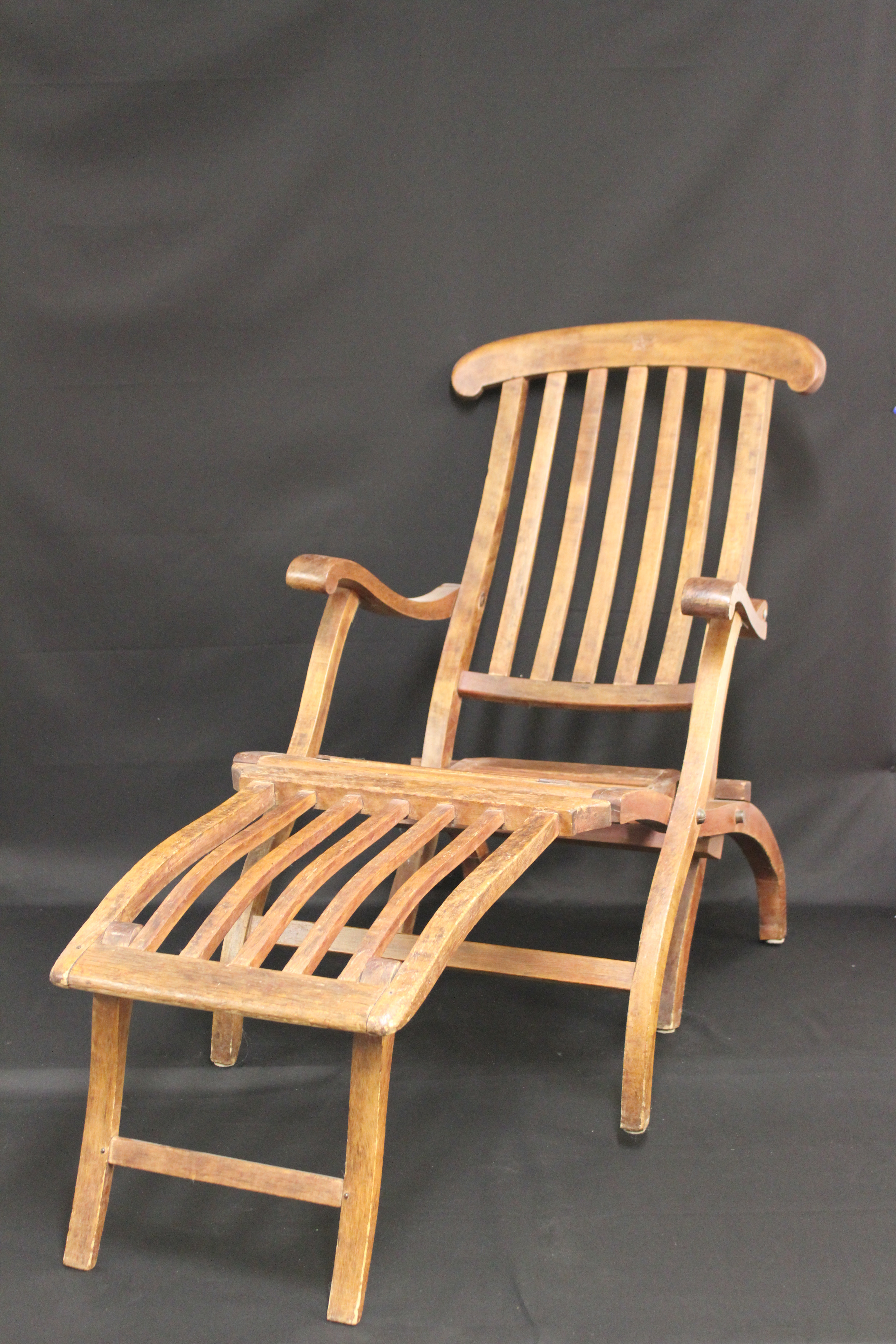
African-American Outsider Artist William Edmondson’s Sculpture, The Crucifixion, Could Command $50,000

The Crucifixion, a 1930s sculpture by the outsider artist William Edmondson, who was the first African-American to have a solo show at the Museum of Modern Art in Manhattan.

What you see: The Crucifixion, a 1930s sculpture by the outsider artist William Edmondson, who was the first African-American to have a solo show at the Museum of Modern Art in Manhattan. Rago Auctions estimates it at $30,000 to $50,000.

The expert: Sebastian Clarke, director of estate services for Rago.

Did African-American outsider artist William Edmondson use a railroad spike as a chisel for most of his artistic career? He did, though to the best of my knowledge, he used smaller, finer chiseling tools as well. He was very much self-taught. I can send you a discovery–the original press release from the 1937 MoMA show, which includes an interview with him. The list of pieces to be shown includes a version of The Crucifixion. He did three or four different versions of The Crucifixion, and we don’t know if this is the one that was in the show, or another example. Of the three or four, one is in the Smithsonian, at least one other is in a private collection, but was exhibited in 2005, one is unknown [its whereabouts are unknown], and one is ours.

How does this version of The Crucifixion compare to the others? The others have more fully formed figures, with pierced areas between the arms and the cross [the arms are separate]. This is more of a relief, with a flat face. What I love about it is it really conveys Edmondson’s work. It’s impossible to identify it as male or female. Of the others, two ore three are male figures wearing loincloths or underpants. This one is completely plain.

African-American outsider artist William Edmondson preferred limestone. How difficult is it to carve limestone? It’s very, very difficult to carve. What’s fabulous about this is its condition is so good. You can really see the strike marks where he worked the stone. This is almost smooth to the touch in so many areas.

The sculpture measures 15 and a quarter inches high by 10 and a half inches wide by five inches deep. Is that relatively small for an Edmondson? It’s a hair on the smaller side. His animals seem to be a little smaller. His figures got to be 23, 24 inches. Of his Crucifixions, one is 20 inches and another is 26 inches. So it’s definitely smaller for a Crucifixion, but squarely on the average side for pieces he worked.

Earlier you told me, “This work is as close to Edmondson’s original intent as they get.” Could you elaborate? Edmondson’s pieces are extremely symbolic. The scenes are often drawn from his religious beliefs. This Crucifixion is part of that body of work. The surface is just so fantastic. It’s clearly a crucifixion, but it’s up to the viewer to interpret the rest of the thing.

This is William Edmondson’s only crucifixion sculpture to come to auction. How did you put an estimate on it? We’re aware the world auction record for an Edmondson is nearly $1 million, for a wholly different work. The nature of this is cruder and more simplistic. And a crucifixion, in my experience in the art world, sometimes places limitations on value. We want to take that into account.

But it’s not a gory, gruesome crucifixion scene. It’s pretty stylized. And people who collect folk art and outsider art, they know they’re going to encounter pieces with intensely religious themes. True. But the value will be determined by the marketplace. We’ll have to wait and see what happens. I’ve been in the business for 20 years. I’ve never handled an Edmondson before. Whenever they come up for sale, they always far exceed the estimate. We’ll try to replicate that success.

Edmondsons rarely go to auction. Is that because most of them are in institutions, or is it because collectors are reluctant to give them up, or both? Several examples are in institutions, and the ones in collectors’ hands are often promised to institutions. Folk art and outsider art collectors take a lot of pride in their collections. Edmondsons come up so rarely, everybody pays attention.

What’s the world auction record for a work by African-American outsider artist William Edmondson? The Boxer, a circa 1936 piece that sold at Christie’s in January 2016. It had an estimate of $150,000 to $250,000 and it hammered at $785,000. I’d love to see it [The Crucifixion] beat its estimate but I’d be surprised to see it go beyond-beyond. Artnet only has 24 records. It’s a very shallow pool, and none are a crucifixion. They don’t come from a similar period or style, where the features are not very well-defined. What will that do to it? Will it make it more desirable, or less? We’ll have to wait and see.

What is the sculpture like in person? It’s fabulous. It’s so bright and crisp. There’s something magnetic–you’re drawn to it, and the color and the surface are lovely. It looks like it’s never seen the light of day. The chisel marks are so well-defined on the back. There’s something really exceptional about it.

What does it feel like to hold it in your hands? It’s heavy, probably around 40 pounds. It is surprisingly smooth. You can really feel the weight of the piece, the way the figure is defined on the cross. You want to turn it over and look at the back, which is not easy to do, because it weighs so much.

Is that something that collectors look for in a sculpture by African-American outsider artist William Edmondson–chisel marks? Or are they so rare that they can’t afford to quibble if they’re missing? The whole idea behind outsider and folk art is really feeling a connection with the individual who made it, to feel them reflected in the piece. In the chisel marks, you can really see him working on it.

Why will this piece stick in your memory? Probably because I’ll never handle one again. [Laughs.] Edmondsons are something you only hear about, but don’t get to see. For me, personally, my training is in European furniture and decorative art. This is something I’ve grown to appreciate and love. I’ve always been a high-style person. I’ve come to appreciate pieces that are naive in so many ways, but are spectacular. It’s so magnificent.

How to bid: The Crucifixion will be offered in Autobiography of a Hoarder: The Collection of Martin Cohen, Part I, which takes place October 21, 2018 at Rago.

How to subscribe to The Hot BidClick the trio of dots at the upper right of this page. You can also follow The Hot Bid on Instagram and follow the author on Twitter.

Rago Auctions is on Twitter and Instagram.

Image is courtesy of Rago Auctions.

Would you like to hire Sheila Gibson Stoodley for writing or editing work? Click the word “Menu” at the upper right for contact details.

SOLD! A Memorial Lincoln Lithograph Fetched $4,000 at Swann

In Memory of Abraham Lincoln, the Reward of the Just, a hand-colored lithograph by D.T. Wiest, printed circa 1865.

Update: The hand-colored circa 1865 memorial Lincoln lithograph sold for $4,000.

What you see: In Memory of Abraham Lincoln, the Reward of the Just, a hand-colored lithograph by D.T. Wiest, printed circa 1865. Swann Auction Galleries estimates the memorial Lincoln lithograph at $2,000 to $3,000.

The expert: Rick Stattler, director of printed and manuscript Americana for Swann Auction Galleries.

Do we know how many of these memorial Lincoln lithographs were made, and how many survive? There’s likely no way to know how many were produced. I imagine at least a couple of hundred were made. I’ve tracked down three in institutions and two at auction.

The memorial Lincoln lithograph’s date is given as circa 1865, but is it fair to assume it would have been done very soon after Lincoln’s assassination in April of that year? Absolutely. It’s fairly laborious work to make a lithograph like this. It wasn’t made the day after, but it was made in response to the assassination, I’m pretty confident. The engraver, Wiest, is largely unknown. He didn’t have a long career as a lithographer. He was only active in 1865.

The memorial Lincoln lithograph is closely modeled after an 1801 image by John James Barralet known as The Apotheosis of Washington [scroll down to see the image]. How would D.T. Wiest have made his Lincoln-centric version? Would he have looked at the John James Barralet print and copied most of it onto a new lithographic stone? Right. The copy, I would say, is semi-pirated, but it’s got enough changes in style and composition. I don’t know what the copyright laws were then.

How well-known was the John James Barralet image in 1865? It was an image that might have been familiar to some people, but by 1865, I don’t expect it was probably terribly well-known.

So the John James Barralet image of Washington was not part of popular culture in 1865? Yes, and probably the creative process here was not all that sophisticated. The printer wanted something dramatic, something that would catch the eye and stir the emotions, and he wanted to get it in the hands of the public as quickly as possible. The printer probably showed the Barralet to Wiest and said, “Do something like this, but with Lincoln.” When Washington died, there would have been a small audience for the Barralet print, and it would have been a luxury item. The audience would have been sophisticated, and would have picked up on its classical analogies. By 1865, print-making was a much more mass-market endeavor. The audience didn’t care much about symbolism.

Is the Lincoln print as colorful as most lithographs of its era, or is it more colorful? For its period, it’s certainly one of the more eye-catching ones. The color is quite nice and rich. It definitely tilts toward the colorful end of the spectrum.

So it’s the sort of thing that a print shop would put in its shop window to draw in customers? That’s a likely way to advertise it, sure.

D.T. Wiest changed the face of Washington to the face of Lincoln, and he changed the inscription on the tomb, but he didn’t change several details that he could have changed and probably should have changed… The goal, when the print was produced, was to get it into the hands of the public quickly. I don’t know if we can say that some of those details should have been changed. It may not have been profitable for them to spend a week on changing them. If it was produced as fine art, then or now, they might have reconsidered the symbolism. The mourning Indian was a symbol of America in 1800, but clearly, for someone mourning Lincoln’s loss, it should have been changed to a freed slave. They probably should have taken the extra two days to do that, particularly if their main sales were in Philadelphia, an abolitionist city. But they didn’t.

Would the average American print-buyer in 1865 have cared that the American flag-decorated shield on the left has 15 stars in in its canton and not the 35 it should have had by then? Not necessarily. If you’re looking to buy a print for 50 cents–and I don’t know if that was its 1865 price, but that seems reasonable–you might not count the stars. Also, we grew up with a flag with 50 stars. We think of it as a fixed thing. In the 1800s, the stars changed with each new state.

So these Washington-centric details that D.T. Wiest copied over–the badges on the tomb that represent the Society of Cincinnati and the Freemasons, the out-of-date canton, the mourning Native American where a freed slave would be more appropriate–would an 1865 audience have seen them as errors? Errors on whose part? Wiest was given an assignment and he fulfilled it faithfully, with Lincoln’s face [in place of Washington’s]. They’re not exactly errors, but they’re things that could have been improved on if more thought had been given to it. But it gives us more to chew on. We can ponder the evolution.

And because the Washington print wasn’t part of pop culture in 1865, we can’t assume that D.T. Wiest was being clever by tying the legacy of Lincoln directly to Washington by deliberately borrowing the visuals of the 1801 Barralet print? Yeah, but if it did happen, it would have been an additional selling point. Some might say, ‘Hey, it’s that old Washington print. That’s how we mourn our heroes.’ In Henry Holzer’s [the consigner’s] scholarship, this is the moment when Lincoln joined the pantheon. For 80 years, it was Washington, the founder of the country. Now we start to see Lincoln as his peer or equal. It’s hard to imagine that happening today. I can’t imagine such a print featuring Obama or Trump in place of Lincoln.

Do these details that look like errors make the print appealing to modern collectors? The first point of appeal to modern buyers is the same point that appealed to buyers in 1865. It’s patriotic, it’s colorful, Lincoln is in the center, and it’s an eye-catching print. From there, it’s a historical curiosity, designed for Washington but with Lincoln’s head awkwardly glued in where Washington’s head had been. It not only looks great on the wall, it’s something to chew on and discuss with friends. And it’s a tribute to Lincoln, who people still admire.

How to bid: The lithograph is lot 141 in Printed & Manuscript Americana Featuring the Holzer Collection of Lincolniana, taking place September 27, 2018 at Swann Auction Galleries.

How to subscribe to The Hot BidClick the trio of dots at the upper right of this page. You can also follow The Hot Bid on Instagram and follow the author on Twitter.

You can follow Swann Auction Galleries on Twitter and Instagram.

Rick Sattler spoke to The Hot Bid before about a lot of early 20th century copies of Gleanings in Bee Culture which included the issue that contained the first published account of the Wright brothers’ first successful flight. The lot sold for $5,000, double its high estimate.

Image is courtesy of Swann Auction Galleries.

Would you like to hire Sheila Gibson Stoodley for writing or editing work? Click the word “Menu” at the upper right for contact details.

Carole Feuerman’s Hyperrealistic Sculpture Bibi on the Ball Could Sell for $80,000

Bibi on the Ball, a 2015 oil on resin sculpture by Carole Feuerman. It's the first of an edition of six.

What you see: Bibi on the Ball, a 2015 oil on resin sculpture by Carole Feuerman. It’s the first of an edition of six. Los Angeles Modern Auctions (LAMA) estimates it at $60,000 to $80,000.

Who is Carole Feuerman? She is a contemporary sculptor who explores hyperrealism, an approach that strives for life-like qualities in a work of art. Her sculptures have appeared at the Venice Biennale, the National Portrait Gallery at the Smithsonian Institution, and the State Hermitage Museum in St. Petersburg, Russia. She lives in New York City and just turned 78.

The expert: Peter Loughrey, founder of LAMA.

Is this the first sculpture of the limited edition of six to go to auction? It is that I’m aware of. I searched the auction databases, and I haven’t seen this one come up before.

Are the six Bibi on the Ball sculptures identical, or do the colors of the ball change? The colors of the ball don’t change, but the swimsuit color and other parts of the sculpture can vary.

Is Bibi on the Ball a stand-alone limited edition, or is it part of a larger group of associated works? There are two other very similar editions which the artist commonly calls “variants.” One edition has a mirror-like reflective surface on the ball, and another variant has the subject’s eyes open. Each of these variants are different editions. There is a group of Feuerman works people generally refer to as “bathing beauties” or “swimmers.” They’ve been the focus of a good part of her career for the last 30 years. They’re typically female subjects in swimsuits or bathing suits, shown in a supreme state of relaxation or satisfaction, with closed eyes in a state of bliss. That theme has continued for much of her career. 

How does Carole Feuerman create the hyperrealistic effects of wet skin and fabric on her sculptures? With her resin sculptures, the artist first creates a plaster or resin maquette. Then she makes a mold of the maquette that is filled with epoxy resin to form the edition. She creates the water droplets by mixing epoxy and placing each drop in strategic locations with a toothpick. In addition, the artist hand-applies lifelike qualities such as veins, sunspots, and freckles, so no two examples will be exactly alike.

Is Bibi a real person? Does Carole Feuerman feature her in other works? Most of the pieces are not created from any live model, but rather are based on the artist’s creative vision. Bibi is simply a character.

Bibi on the Ball is pretty colorful, maybe a bit more colorful than most Feuerman sculptures. Does that matter? If so, how does that matter? Do the more colorful sculptures of hers do better at auction? All of her works featuring beach balls are colorful, but the colors themselves have no particular meaning. From a market perspective, her more colorful works do tend to be more consistently desirable than the less colorful examples. It fits with the subject matter, too. The beach ball and the swimsuit lend themselves to bright, sunny color schemes.

What’s the world auction record for a Carole Feuerman artwork? It’s $104,500, set in 2016 by Innertube variant II, a 2013 sculpture.

What’s the likelihood that Bibi on the Ball could meet or exceed the record? Bibi on the Ball is in fairly pristine condition, and condition drives the market. When a sculpture has natural or synthetic hair loose under the bathing cap, as Bibi does, it’s easily damaged. Feuerman has had to restore and replace the hair on older models. [The hair peeking out from under Bibi‘s cap is hard to see in the photo, but it is there. The figure in Innertube variant II has a bit of hair coming out from under its bathing cap as well.] Bibi is extremely well-kept and well-cared-for. We could get double our estimate.

What is Bibi on the Ball like in person? It’s life-size and a full figure where a lot of Feuerman’s other works don’t necessarily show a full figure. This is not just part of a scene–it’s a scene of a figure and what it’s interacting with. Bibi is fairly exquisite, with painted fingernails and toenails and strands of hair escaping the bathing cap, and there’s a hyperreal feeling of water on the skin and the bathing suit. It’s technically more difficult to get an entire figure correct and doing what you’d expect a figure to do when it sits on a beach ball. The figure has to be rendered perfectly lifelike. There’s a completeness to Bibi, and thus there is complexity.

Is Bibi on the Ball a single sculpture, or is it comprised of several parts? It is technically multiple pieces. I don’t know if the swimsuit or the cap can be removed, but you can pick the figure up separately from the beach ball. It’s perfectly balanced. It can’t be visually lopsided or physically lopsided.

There are hollows in the ball that are designed to receive the figure? Yes. There are impressions that are equal to the shape of the figure. The hands, the calves–it fits perfectly.

How to bid: Bibi on the Ball is lot 239 in LAMA‘s Modern Art & Design Auction, which takes place on September 30, 2018.

How to subscribe to The Hot Bid: Click the trio of dots at the upper right of this page. You can also follow The Hot Bid on Instagram and follow the author on Twitter.

Los Angeles Modern Auctions (LAMA) is on Twitter and Instagram.

Peter Loughrey has appeared on The Hot Bid since the beginning–literally. The blog’s first post was on an Alma Thomas painting that LAMA ultimately sold for a world auction record. He has also discussed works by Jonathan Borofsky and Wendell Castle, as well as an exceptional 1969 dune buggy. Prior to this entry, he spoke about an Ed Ruscha print that set a world auction record at LAMA.

Carole Feuerman has a website and a namesake foundation.

This post for The Hot Bid debuted on the LAMA Blog on September 14, 2018.

Image is courtesy of Los Angeles Modern Auctions.

Would you like to hire Sheila Gibson Stoodley for writing or editing work? Click the word “Menu” at the upper right for contact details.

SOLD! A Piano-playing Automaton Commanded $11,000 at Bertoia

A piano-playing automaton, created by Gustave Vichy between 1890 and 1910.

Update: The Gustave Vichy piano-playing automaton sold for $11,000.

What you see: A piano-playing automaton, created by Gustave Vichy between 1890 and 1910. Bertoia Auctions estimates it at $15,000 to $25,000.

What is an automaton? It’s a form of robot or proto-computer that’s designed to entertain. The machine executes a series of movements or acts in a specific order, such as performing a magic trick or riding a bicycle. Clock- and watchmakers naturally gravitate to building automata because many of them run on clockwork. If you have a cuckoo clock in your house, you own an automaton.

The expert: Jeanne Bertoia, proprietor of Bertoia Auctions.

This is described as a “Vichy” automaton because it was made by Gustave Vichy, a French designer from the late 19th and early 20th centuries. But why is it called a “Vichy Piano Watteau Automaton”? Is the “Watteau” a reference to the painter? The company catalog [which is in French] calls it “piano Watteau.” I suspect it probably has to do with the pastoral type of paintings Watteau was known for. If you look at the painting on the piano, the gold, it has a very Watteau feel.

And the figure kind of looks like a woman from a Watteau painting Yes, exactly. She’s very elaborate, with silk and lace and pearl jewelry. She has heeled shoes and stockings on. [Unfortunately, none of the photos of the lot show this.] She’s very elegant.

To when does the piano-playing automaton date? Probably 1890 to 1910, the turn of the last century. It was probably the later part of the 19th century. The peak of automata production was the mid-1800s into the 1900s. Automata were luxurious items. They had moving parts that were powered by clockwork, and they played only for about a minute.

How rarely do you find automata that have porcelain parts? It’s rarer, though it was done. There are others with porcelain parts, but most of them were papier-mâché. Some automata makers used parts from doll companies. You actually get a doll. This has a Jumeau porcelain head. Jumeau usually made French fashion dolls. The doll head is the most important part of the doll. The hands and the head are made of bisque porcelain.

Do we know how many other Vichy Watteau piano-playing automatons survive? Unfortunately, we don’t know. This is the first we’ve had the opportunity to handle, and we go back to 1986. There may be a few in some of the grander collections.

Does the piano-playing automaton have all the details and fittings it had when it was new? Can we know? We believe it’s all-original. It’s very well-taken-care-of and in generally excellent condition. It still works beautifully. The mechanism and the music functions well. In the [Vichy] catalog, it’s just a drawing. It looks the same. It has a different costume, but that doesn’t mean it was dressed differently. There was no mass-production clothing line then. A dress as elaborate as this would have been individually handmade.

Who would have been the audience for this piano-playing automaton? I’m guessing it wasn’t intended as a toy. It was probably for the newly rich. Again, it’s an elaborate, luxurious piece to own. It was not treated as a toy. It was treated as a piece of moving art.

What instrument is the figure playing? It’s a piano harp. I don’t know if it’s a real instrument. It looks pretty fanciful to me. I think those are original harp strings.

The lot notes for the automaton describe its condition as “excellent to pristine”. What does that mean in this context? It means that it’s all-original, the mechanism works, the music plays fine. Maybe there’s a little restoration to the clothing, which is very accepted.

Has it been restored, beyond touching up the dress? Not that we saw, no.

Will you post audio and video of the automaton playing the piano? Good question. We’ve been discussing it. We probably will put something on the website. We have at least a dozen different automata in the sale that are so unique.

The lot notes say that the music that the automaton plays “consists of four different ‘airs’,” which repeat. What are ‘airs’? And are any of the four pieces of music familiar to modern listeners? It’s a song, a tune, a piece of music. It’s French, it’s what they call it in the [Vichy] catalog. I don’t recognize the music. I can’t put a name to any of them.

How does the automaton move? Oh! The mechanism is fabulous! She has multiple movements. The hands gracefully move across the piano keys. Her chest breathes. The papier-mâché shoulder plate allows her to look like she’s breathing. She plays the piano, turns her head, puts her head up, and breathes in as if she’s breathing in beauty. Then she puts her head down and continues to play. That is her movement.

Have you seen other automata that simulate breathing? I haven’t, but I wouldn’t be surprised if there are others. We haven’t had such an elegant doll figure as the main part of an automaton. We have had automata with lots of movement–this is just a different style. It almost falls into the doll world. It’s a beautiful doll, gracefully playing the piano.

Was this automaton intended for girls and women? I don’t think so. It’s just an elegant piece for the times. In today’s marketplace, doll collectors are very excited to get an automaton that has such a great doll. It stands on its own as an elegant, beautiful piece. If you had a daughter who plays the piano, it’d be a fabulous gift.

How to bid: The Vichy piano Watteau automaton is lot 272 in Bertoia Auctions’s Signature Sale on September 22, 2018.

How to subscribe to The Hot BidClick the trio of dots at the upper right of this page. You can also follow The Hot Bid on Instagram and follow the author on Twitter.

Image is courtesy of Bertoia Auctions.

Would you like to hire Sheila Gibson Stoodley for writing or editing work? Click the word “Menu” at the upper right for contact details.
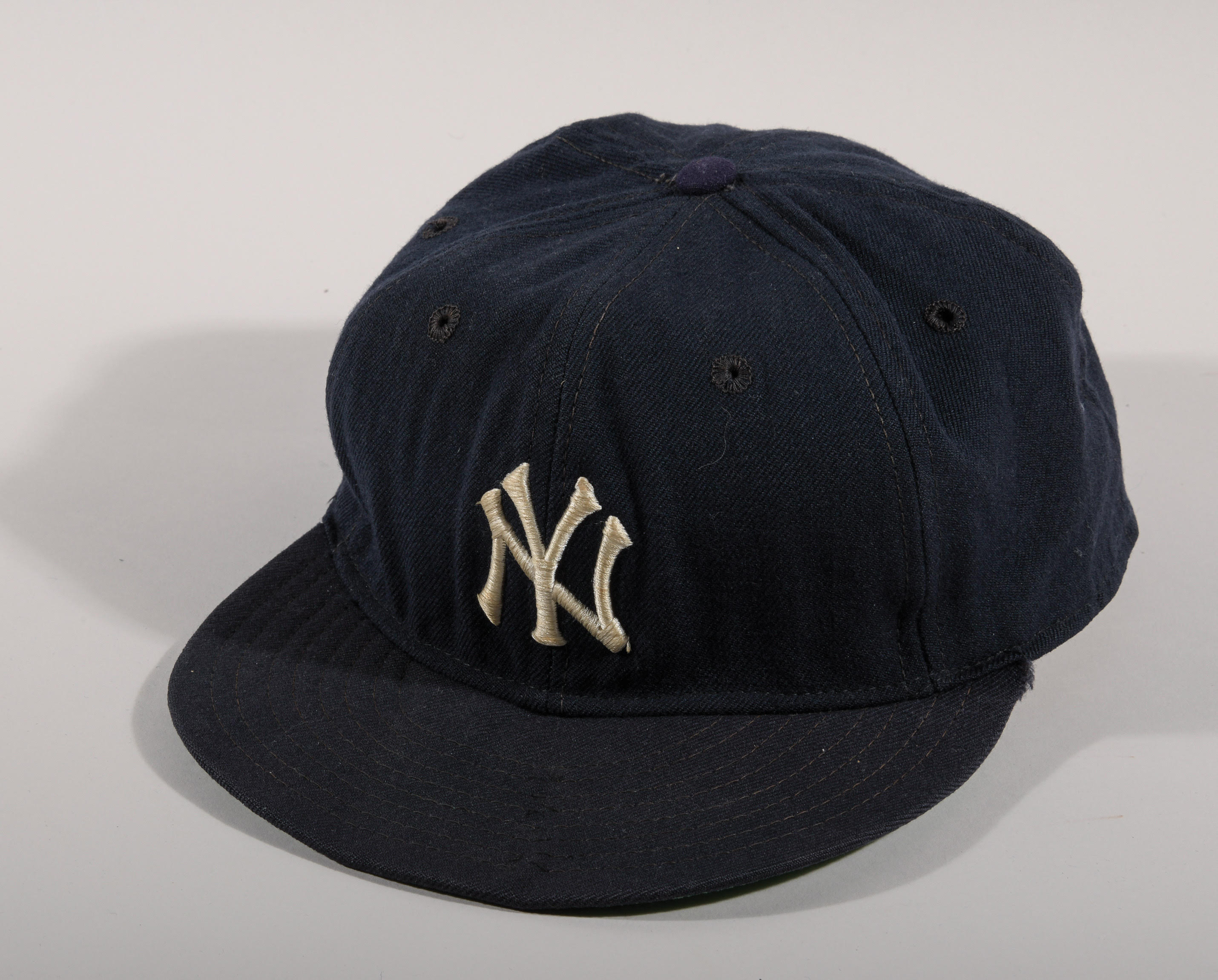
A Walker Percy-signed First Edition of A Confederacy of Dunces Could Sell for $5,000

A 1980 first edition copy of A Confederacy of Dunces by John Kennedy Toole, in its dust jacket.

What you see: A 1980 first edition copy of A Confederacy of Dunces by John Kennedy Toole, in its dust jacket. Freeman’s estimates it at $3,000 to $5,000.

The expert: Darren Winston, head of the books, maps, and manuscripts department at Freeman’s.

How rare is it to find a first edition of A Confederacy of Dunces in its dust jacket, and how rare is it to find one that’s also signed by Walker Percy, who helped see the book into print and wrote its foreword? It was published in 1980. Since that time, 21 copies have come to auction. Of the 21, only two were signed by Walker Percy. They came up in 2002 and 2009. You could argue that only two copies have come up like ours in the last 38 years. Another interesting fact is the very first copy to come up at auction was in 1986.

Is that unusually quick, to see a book published in 1980 debut on the secondary market six years later? It is unusually quick. It has such an interesting history, and it’s so different from other books like it. It became an instant cult classic. Now it’s even more of a big deal. It sat around from 1969, when Toole killed himself and his mom [Thelma Toole] found the manuscript. She went around trying to get it published. Walker Percy, at the time, was at Loyola [Loyola University of New Orleans]. Toole’s mom got him to read the manuscript, and he made it his duty to get it published. LSU Press published it in 1980.

Yes, let’s hit the point squarely–why is it impossible to find a first-edition of A Confederacy of Dunces signed by the author? Because he died before it was published. He wrote it in 1963 and committed suicide in 1969. 1969 to 1980 was the period in which his mom set about finding a publisher for it.

So, Walker Percy’s signature is the closest thing to an author’s signature that we can get on a first edition of A Confederacy of Dunces? Exactly right. He was sort of the midwife. In the world of book-collecting, the next-best thing is the mom’s signature. Two copies she signed were at auction in 2011 and 2012. Either [signature] is as charming as the other. If she hadn’t picked up the baton, the manuscript wouldn’t have gotten to Walker Percy, and he wouldn’t have done what he did.

Are there any first-edition copies signed by both Thelma Toole and Walker Percy? There are no recorded copies at auction. They might be in the world, but not at auction.

Who is shown on the dust jacket? It’s the protagonist, Ignatius J. Reilly.

If A Confederacy of Dunces came up today as the debut novel of an unknown, dead author, I just can’t picture a modern publishing house green-lighting dust jacket art featuring a fat guy in a deerstalker holding a hot dog in one hand and a sword in the other, even if he is the lead character and he dresses that way. Was this a risky choice, even for a university press in 1980? You could argue that the title, which is from a Jonathan Swift poem, is a mouthful. It’s completely wacky. But maybe part of it was the publisher being a university press. Maybe it had more leeway.

How was the book received in 1980? The initial press run was 2,500. That’s part of its rarity–only 2,500 copies in the first edition, versus 50,000 for The Old Man and the Sea, which was printed 30 years before. Within three years, the unknown, dead author won the 1981 Pulitzer prize for fiction and sold 650,000 copies.

Why does A Confederacy of Dunces hold up almost 40 years after its publication? Certain books–The Catcher in the Rye, To Kill a Mockingbird–come along and upend everything that came before. The Catcher in the Rye was 1951. To Kill a Mockingbird was about 10 years later, and A Confederacy of Dunces was 20 years after that. It was a book that became a touchstone. As a teen, you carried it with you. When you look at it as a collector, young people turn into adults, and when they have money, they want a talisman [of their youth]. When many people want the same talisman, it goes up and up.

This first edition of A Confederacy of Dunces is described as “fine.” What does that mean? “Fine” is a tricky word because any wear marks it as less than fine. This copy looks like it’s unread, which leads to questions about the box. It was made early in the book’s life, and the book has lived in this box. There’s a relief image of Ignatius on the [box’s] cover. Someone went to some trouble to have it made. Thought went into it.

How many different groups of collectors will compete for this first edition of A Confederacy of Dunces? There are many, but people who go after high spots–the biggest and best book by any author–will be interested. People who collect an author’s first book will be interested, as will people who just love the book. If you’re going to splash out, this is the copy you want. Another reason people will go after this book is to trade up to a better copy. Maybe someone has a gorgeous copy with no Walker Percy signature, or a gorgeous copy with no dust jacket–they trade up.

What’s the world auction record for a first-edition of A Confederacy of Dunces in its dust jacket? What are the odds of this copy meeting or exceeding that record? The most it’s brought at auction was $4,000, in 2002. I believe that copy was also signed by Walker Percy. That’s a good sign in our case.

Why will this book stick in your memory? Because of the story. There’s a poignancy, a sadness, and a lot of irony to the fact that Toole never saw it published. It was his life’s work, literally and figuratively. Father Time came through for it. It’s on its third generation of readers. Toole published one book, and he’s in the pantheon. That’s cool.

How to bid: The Walker Percy-signed first edition of A Confederacy of Dunces is lot 176 in Freeman’s September 27 Books & Manuscripts auction.

How to subscribe to The Hot BidClick the trio of dots at the upper right of this page. You can also follow The Hot Bid on Instagram and follow the author on Twitter.

Freeman’s is on Twitter and Instagram as well.

Image is courtesy of Freeman’s.

Would you like to hire Sheila Gibson Stoodley for writing or editing work? Click the word “Menu” at the upper right for contact details.

WHOA! That 1834 Ornithological Book Sold for $100,000

An 1834 first edition of Oiseaux brillans du Brésil by Jean Théodore Descourtilz. Pictured is the Red Curlew plate from the book.

Update: The 1834 first edition of Oiseaux brillans du Brésil by Jean Théodore Descourtilz sold for $100,000–about five times what Heritage Auctions expected, and a record for this book at auction.

What you see: An 1834 first edition of Oiseaux brillans du Brésil by Jean Théodore Descourtilz. Heritage Auctions estimates it around $20,000. Featured above is the Red Curlew plate from the book.

The expert: James Gannon, director of rare books for Heritage Auctions.

I see the quote in the lot notes from Rubens Borba de Moraes, the former director of the United Nations library in New York, saying, “This book is so rare that I had begun to doubt its existence,” but how many copies are there? Do we know? From what we can tell, we think this is the fifth known copy.

Can you talk about how the book came to be? Was Descourtilz the illustrator? He did illustrate it. It was toward the end of the color plate period, which ran from 1790 to 1830. It was fairly early for a hand-colored ornithological [bird] book. Audubon was contemporaneous in the 1830s. This book was never published. It was issued, and someone made lithographs that were then hand-colored, but it was never published, and never had a table of contents or text. The lithographic plates were put together in a book. I don’t know much about Descourtilz. I’d never heard of him before the book crossed my path. His dad was a botanist and a physician who did a book on the flora of the Antilles. Descourtilz did the illustrations for his father’s book. It’s better known because it was published.

The book is described as a first edition, but it was not published. Why might it have been made? It was probably a mockup, made to engender interest from publishers and get the money to be able to produce the book.

Was it intended to be sold by subscription, as Audubon’s Birds of America was?Maybe the [60] plates were issued in five groups of 12. That was the style then. Audubon published in parts. The reason they did it was so they could start reaping profits against their costs sooner.

The lot notes say the ornithological book has 60 plates. Does that mean it’s complete? I don’t know, but there’s no reason to think there were more. We call it complete. Other copies might have a similar number or a lesser number. Whether he envisioned an epic work like Audubon, we don’t know.

Are all the plates in the ornithological book as vibrant as the Red Curlew plate, shown above? Pretty much. I think it’s just a matter of [the book] being closed. We don’t know much about where it came from beyond being in the same family for decades. It probably was not handled very much over the almost 200 years since it was made.

The lot notes say the ornithological books illustrations are “heightened with gum arabic.” How did that detailing enhance the plates? Gum arabic is a clear sheen, almost a clear varnish. Lots of color plate books use it. You’d put it over the color in certain places so it created a sheen when you looked at it. It makes the plates look more vibrant, and it catches the light in different places. It would help make the plates stand out. [The effect is not visible in the photo shown.]

The book is French, but it has no text. Does that make it more appealing to American collectors, or does it not matter? It doesn’t matter in this case, because it wasn’t issued with text. The collector for this is someone who collects bird books or hand-colored plate books. Anyone sophisticated enough to spend tens of thousands on a book understands why it has no text.

And we don’t know why it wasn’t published? Descourtilz may never have found the backing. Maybe there were other reasons why it was never published. It was certainly publishable if the right circumstances existed. If there was a similar kind of thing for Audubon [Birds of America], where Audubon made lithographs and had them hand-colored to get the backing, get the money [to make it]–if that existed, it’d really be worth a lot, because it predated the book.

How did this ornithological book come to you? It came through another person on staff. She told me the family had had it for a long time, decades. The consigner had a connection to one of the people listed in the front of the book, which is why I think it sat for 80 to 100 years on a shelf. It didn’t get looked at by book fairs and dealers. They [the family] probably didn’t think about it for a long time.

How did you arrive at a value for this ornithological book? It hasn’t come on the auction market. There are so few copies around. Probably, other collectors and dealers have never seen it. There may be more copies we don’t know about that have never become public. If it sold for mid-five figures, we’d be satisfied.

What was it like to look at it for the first time? I didn’t see it until it had been researched by [Heritage Auctions] staff. We knew it was special, and we knew we wanted to use it in the advertising campaign [for the auction].

What is it like to leaf through it, and how does that experience compare to handling Audubon’s Birds of America? I’ve seen Audubon many times. Here, everything is a surprise, everything is new. Many of the plates are stunningly beautiful.

Why will it stick in your memory? How rare it is to see this book. There aren’t many around. Many more people have seen our catalog cover with the Red Curlew on it than have actually seen the book.

How to bidOiseaux brillans du Brésil is lot #45090 in the Rare Books & Maps Signature Auction at Heritage Auctions on September 13, 2018.

How to subscribe to The Hot BidClick the trio of dots at the upper right of this page. You can also follow The Hot Bid on Instagram and follow the author on Twitter.

Heritage Auctions is on Twitter and Instagram.

Image is courtesy of Heritage Auctions.

James Gannon has appeared three other times on The Hot Bid, speaking about the typewriters Larry McMurtry used to write Lonesome Dove; a British first edition of Harry Potter and the Philosopher’s Stone that ultimately sold for a world auction record; and an inscribed presentation copy of Jack Keroauc’s On the Road.

Would you like to hire Sheila Gibson Stoodley for writing or editing work? Click the word “Menu” at the upper right for contact details.

A Rare Bird! An 1834 Ornithological Book Could Sell for $20,000

An 1834 first edition of Oiseaux brillans du Brésil by Jean Théodore Descourtilz. Pictured is the Red Curlew plate from the book.

What you see: An 1834 first edition of Oiseaux brillans du Brésil by Jean Théodore Descourtilz. Heritage Auctions estimates it around $20,000. Featured above is the Red Curlew plate from the book.

The expert: James Gannon, director of rare books for Heritage Auctions.

I see the quote in the lot notes from Rubens Borba de Moraes, the former director of the United Nations library in New York, saying, “This book is so rare that I had begun to doubt its existence,” but how many copies are there? Do we know? From what we can tell, we think this is the fifth known copy.

Can you talk about how the ornithological book came to be? Was Descourtilz the illustrator? He did illustrate it. It was toward the end of the color plate period, which ran from 1790 to 1830. It was fairly early for a hand-colored ornithological [bird] book. Audubon was contemporaneous in the 1830s. This book was never published. It was issued, and someone made lithographs that were then hand-colored, but it was never published, and never had a table of contents or text. The lithographic plates were put together in a book. I don’t know much about Descourtilz. I’d never heard of him before the book crossed my path. His dad was a botanist and a physician who did a book on the flora of the Antilles. Descourtilz did the illustrations for his father’s book. It’s better known because it was published.

The ornithological book is described as a first edition, but it was not published. Why might it have been made? It was probably a mockup, made to engender interest from publishers and get the money to be able to produce the book.

Was it intended to be sold by subscription, as Audubon’s Birds of America was? Maybe the [60] plates were issued in five groups of 12. That was the style then. Audubon published in parts. The reason they did it was so they could start reaping profits against their costs sooner.

The lot notes say the ornithological book has 60 plates. Does that mean it’s complete? I don’t know, but there’s no reason to think there were more. We call it complete. Other copies might have a similar number or a lesser number. Whether he envisioned an epic work like Audubon, we don’t know.

Are all the plates in the ornithological book as vibrant as the Red Curlew plate, shown above? Pretty much. I think it’s just a matter of [the book] being closed. We don’t know much about where it came from beyond being in the same family for decades. It probably was not handled very much over the almost 200 years since it was made.

The lot notes say the ornithological book’s illustrations are “heightened with gum arabic.” How did that detailing enhance the plates? Gum arabic is a clear sheen, almost a clear varnish. Lots of color plate books use it. You’d put it over the color in certain places so it created a sheen when you looked at it. It makes the plates look more vibrant, and it catches the light in different places. It would help make the plates stand out. [The effect is not visible in the photo shown.]

The book is French, but it has no text. Does that make it more appealing to American collectors, or does it not matter? It doesn’t matter in this case, because it wasn’t issued with text. The collector for this is someone who collects bird books or hand-colored plate books. Anyone sophisticated enough to spend tens of thousands on a book understands why it has no text.

And we don’t know why it wasn’t published? Descourtilz may never have found the backing. Maybe there were other reasons why it was never published. It was certainly publishable if the right circumstances existed. If there was a similar kind of thing for Audubon [Birds of America], where Audubon made lithographs and had them hand-colored to get the backing, get the money [to make it]–if that existed, it’d really be worth a lot, because it predated the book.

How did this ornithological book come to you? It came through another person on staff. She told me the family had had it for a long time, decades. The consigner had a connection to one of the people listed in the front of the book, which is why I think it sat for 80 to 100 years on a shelf. It didn’t get looked at by book fairs and dealers. They [the family] probably didn’t think about it for a long time.

How did you arrive at a value for this book? It hasn’t come on the auction market. There are so few copies around. Probably, other collectors and dealers have never seen it. There may be more copies we don’t know about that have never become public. If it sold for mid-five figures, we’d be satisfied.

What was it like to look at it for the first time? I didn’t see it until it had been researched by [Heritage Auctions] staff. We knew it was special, and we knew we wanted to use it in the advertising campaign [for the auction].

What is it like to leaf through it, and how does that experience compare to handling Audubon’s Birds of America? I’ve seen Audubon many times. Here, everything is a surprise, everything is new. Many of the plates are stunningly beautiful.

Why will it stick in your memory? How rare it is to see this book. There aren’t many around. Many more people have seen our catalog cover with the Red Curlew on it than have actually seen the book.

How to bidOiseaux brillans du Brésil is lot #45090 in the Rare Books & Maps Signature Auction at Heritage Auctions on September 13, 2018.

How to subscribe to The Hot BidClick the trio of dots at the upper right of this page. You can also follow The Hot Bid on Instagram and follow the author on Twitter.

Heritage Auctions is on Twitter and Instagram.

Image is courtesy of Heritage Auctions.

James Gannon has appeared three other times on The Hot Bid, speaking about the typewriters Larry McMurtry used to write Lonesome Dove; a British first edition of Harry Potter and the Philosopher’s Stone that ultimately sold for a world auction record; and an inscribed presentation copy of Jack Keroauc’s On the Road.

Would you like to hire Sheila Gibson Stoodley for writing or editing work? Click the word “Menu” at the upper right for contact details.

RECORD! A Near-complete Dodo Skeleton Sold for $430,000 in 2016

A nearly complete (95 percent) Dodo skeleton, assembled by a collector over the course of four decades. Maybe a dozen similarly complete Dodo skeletons exist, and all of them are in museums. In November 2016, Summers Place Auctions sold it for £280,000, or about $430,000, a world auction record for a Dodo skeleton.

What you see: A nearly complete (95 percent) Dodo skeleton, assembled by a collector over the course of four decades. Maybe a dozen similarly complete Dodo skeletons exist, and all of them are in museums. In November 2016, Summers Place Auctions sold it for £280,000, or about $430,000, a world auction record for a Dodo skeleton.

The expert: Rupert van der Werff, director of Summers Place Auctions.

How abundant are Dodo bones, generally? Are some harder to get than others, making it difficult to piece together a fuller skeleton? The way bones are found are by people walking through the swamp [on Mauritius]. Given that they come from one small swamp on one small island from one small species, they’ve never been particularly abundant.

When did Mauritius ban the export of Dodo bones? It became illegal in 2016, but it was generally considered unacceptable post-World War II.

Did the collector who consigned the skeleton set out to piece one together, or did he realize after several years that he had a nearly complete Dodo skeleton? He was a passionate collector of all things Dodo-related. He’d been acquiring bones as they popped up. He came to the realization that he may well have a skeleton, started piecing it together, and realized he did indeed have a skeleton.

How did the nearly complete Dodo skeleton come to you? We’ve sold a diplodocus, a mammoth, and an allosaurus–we’ve had some pretty fabulous star lots. The publicity and the prices we managed to achieve certainly alerted the person to us. In a way, it was natural for him to come to us.

But how did you learn of the Dodo skeleton’s existence and come to receive it? I got a call. He said what he had. It was so unlikely, but there was a chance it could actually be true. He was a few hours away. I popped in my car and went as soon as it was practicable. It was in his shed. He had mounted it. Even I, who wouldn’t pretend to be an expert, could see it was the real deal. I took pictures, talked to the owner, picked it up, and drove very carefully back to work to start the publicity rolling.

What do you do in a moment like that? I mean, he may as well have shown you a unicorn skeleton. Did you try to maintain a poker face? It is something of a Holy Grail in terms of natural history. If I’d tried to remain straight-faced, it wouldn’t have worked. It was quite extraordinary, not something I ever dreamed would happen.

How did you put an estimate on the nearly complete Dodo skeleton? There aren’t really Dodo comparables other than the skeleton that sold in 1914. I tried to negotiate with the owner for the lowest estimate he would consider acceptable and use the auction for what auctions can do–establish what something is worth on any one day.

What was your role in the auction? I was on the phone with a a pretty serious collector we’ve done a lot of business with in the past.

Were you surprised by the result? I was pleased it sold, of course. But when you find something as rare as this, as iconic as this, as exciting as this, you can’t help but getting a little carried away in your imagination and think it can go on and on.

In the material that Summers Place assembled to promote the Dodo, you noted that the last time a Dodo skeleton sold was in 1914. The Cardiff Museum paid £350 for it, but you estimate that because Britain was on the gold standard back then, the sum is equivalent to £5 million, or $6.5 million. Does this mean that the 2016 bidder got a bargain? I think so. As far as anyone knows, there’s only one in private hands. Any future discoveries belong to Mauritius. It’s unique. That word is used a lot in the art world, but it’s rarely true. In this case, it actually is. Frankly, it could have made anything [sold for anything].

And the only way this record will be beaten is if this particular Dodo skeleton returns to auction? Yes. There are no others unless a museum deaccessions, which isn’t going to happen. If it’s back to market, that’s the only chance there is.

Why are we still so fascinated by the Dodo, a bird that went extinct centuries ago? It’s clearly quite an unusual animal, and it does look a bit unfortunate. To think it existed on one little island in the Indian Ocean 300 years ago and man wiped it out, it’s incredibly sad. If it were a better-looking animal, it wouldn’t figure in the public consciousness. But it’s got a great name and an unfortunate look. Like a T-Rex, everyone has heard of one. And there are more relatively complete T-Rex skeletons than Dodo skeletons, which puts it into perspective, and shows you how special it is.

Why does this Dodo skeleton stick in your memory? Because I never considered… when I got the opportunity to include a diplodocus, I couldn’t believe it. Never in 100 years would I dream of handling a diplodocus skeleton. It’s right up there, one of the icons of natural history. If I handle a T-Rex, that’d also be incredible, and there’s probably more of a chance of getting a T-Rex than a Dodo. If anything, things like this almost transcend monetary value. It’s surprising that a private individual was able to secure it.

How to subscribe to The Hot BidClick the trio of dots at the upper right of this page. You can also follow The Hot Bid on Instagram and follow the author on Twitter.

Summers Place Auctions is on Twitter and Instagram.

Image is courtesy of Summers Place Auctions.

Would you like to hire Sheila Gibson Stoodley for writing or editing work? Click the word “Menu” at the upper right for contact details.

RECORD! The Preakness Trophy Given to Alfred Vanderbilt, Jr., Owner of Native Dancer, Sells for $100,000

A sterling silver Preakness Trophy, won in 1953 by Alfred Gwynne Vanderbilt, Jr., owner of the thoroughbred Native Dancer. Doyle sold it in May 2018 for $100,000 against an estimate of $20,000 to $30,000, which is a world auction record for a Preakness Trophy.

What you see: A sterling silver Preakness Trophy, won in 1953 by Alfred Gwynne Vanderbilt, Jr., owner of the thoroughbred Native Dancer. Doyle sold it in May 2018 for $100,000 against an estimate of $20,000 to $30,000, which is a world auction record for a Preakness Trophy.

The expert: Peter Costanzo, senior vice president at Doyle as well as its executive director for books, autographs, and photographs; coins, bank notes, and postage stamps; and estate and appraisal services.

How often do Triple Crown trophies come to auction? Infrequently, and for the Preakness, it’s even less frequently. What you normally see are Kentucky Derby Trophies. They’re highly prized by the families who win them. Kentucky Derby Trophies tend to be valuable. The race has name recognition and the trophy is made out of high-karat gold. The Preakness Trophy is made of silver. A Preakness trophy sold at Christie’s on January 17, 2008, won in 1970 by Personality, which was owned by Ethel D.Jacobs, a very notable horse owner, sort of on a par with Vanderbilt. [He later provided a link to a story that mentioned a third sale of a Preakness Trophy at SCP Auctions in November 2017. Scroll down for the mention.]

How much is this trophy worth simply as a Preakness Trophy, without factoring in the names of Vanderbilt and Native Dancer? Any winner of the Preakness would be a notable horse, bred and raised and trained by notable owners. You’ve got to go back a ways to find a no-name. The Preakness trophy was not available before 1953. The original trophy was the Woodlawn Vase, a pre-Civil War trophy made by Tiffany & Co. for a racecourse in Kentucky called Woodlawn. Not until the late 19th or the early 20th century did Pimlico host the Preakness–the vase was not made for Pimlico. It passed to the next winner until 1953, when Native Dancer won. Vanderbilt decided that the original trophy was too valuable, and should be safely held in the Baltimore Art Museum. 1953 was the first time a replica trophy was issued, and that’s what we sold. It’s notable in that it was the first one you could get. I think that helped its price in the end.

How did the Vanderbilt name affect the value of the 1953 Preakness trophy? Lots of people collect things related to prominent Vanderbilts. The cross-current of competition [with collectors of horse-racing memorabilia] helped drive the price up. This trophy belonged to Alfred Gwynne Vanderbilt, Jr., and was sold [consigned] by Alfred Gwynne Vanderbilt III. Vanderbilt Jr., was very influential in the history of American racing and particularly in Maryland.

And how did the Native Dancer name affect the value of the trophy? Native Dancer is one of a small group of horses that lost the Kentucky Derby but won the Preakness. That’s the only mar on his record. He was a big favorite going into the Kentucky Derby and the Preakness. In 1953, the Preakness was shown on live television and got huge national attention. The country fell in love with Native Dancer.

How did you arrive at the estimate of $20,000 to $30,000? We matched the estimate on the trophy sold at Christie’s in 2008. That sold for $32,200. Ours really took off.

What is the 1953 Preakness trophy like in person? It wasn’t huge, but it was imposing, though. It had a very nice look to it, and it was in good condition. I think it was two-thirds the size of the original Woodlawn Vase. It’s a good, presentable size.

What was your role in the auction? Were you in the room? I acted as a specialist. I wrote the essay about the horse and its owner. The silver specialist cataloged it. And I was there, watching it sell. The whole thing took maybe two minutes. There was a pretty big pool of bidders that dropped down to two once it was over $60,000.

How long do you think the record will stand? I think this Preakness record should stand for a while. Probably none of the owners of horses that won the Preakness have the name recognition of the Vanderbilt family. It would probably have to belong to a horse that won the Triple Crown.

Why will this piece stick in your memory? It’s a major sports collectible, probably the highest-ranking sports collectible I’ve ever sold. It’s a case of a fantastic owner, Vanderbilt, with a fantastic horse, Native Dancer, and the Preakness. It’s hard to get trophies for major horses. That’s why it’s special. The trophy clearly spoke to a lot of people.

How to subscribe to The Hot BidClick the trio of dots at the upper right of this page. You can also follow The Hot Bid on Instagram and follow the author on Twitter.

Image is courtesy of Doyle.

Doyle is on Twitter and Instagram.

Would you like to hire Sheila Gibson Stoodley for writing or editing work? Click the word “Menu” at the upper right for contact details.

RECORD! A Dale Chihuly Chandelier Sold for $200,000 in 2015

A white, clear, and amber chandelier, measuring ten feet tall, five feet wide, and four feet, eight inches deep, made by Dale Chihuly in 2004.

What you see: A white, clear, and amber chandelier, measuring ten feet tall, five feet wide, and four feet, eight inches deep, made by Dale Chihuly in 2004. Rago Auctions sold it in June 2015 for $200,000 against an estimate of $60,000 to $80,000.

The expert: Suzanne Perrault, partner and co-director of Rago’s 20th and 21st century design department.

How did this Dale Chihuly chandelier come to be? Was it a commission? Is it unique? It is a commission, and it is unique. The chandeliers usually are. These weigh hundreds of pounds, and they’re not technically chandeliers–they’re glass sculptures. Each is unique, but Chihuly has made quite a few of them.

Where was it displayed originally? It was for a residence in New York City. I came to have it because a gentleman who bought the house with the piece in it had a three-year-old son who was terrified of it. He contacted us about selling it.

How did you sell this huge, fragile Dale Chihuly chandelier? Did you bring it to the sale room? We didn’t put it up in the auction house. It’s pretty much the only thing we’ve sold by a photo only. It was available to be seen in situ in New York. We had a banner of it made to scale to hang in the gallery.

Was it tricky to sell it largely on the basis of a photo? Yes and no. There are so many items people buy without seeing in person. A lot of people seem to be comfortable with that. I always encourage people to see things in person, but of the four who saw the chandelier in person, none bought.

Just how fragile is this Dale Chihuly chandelier? The glass in these is considerably thicker than other Chihuly glass. It’s definitely sturdier.

The colors of this chandelier are white, clear, and amber. How did that affect its value? It’s actually white, clear, and gold. It has done considerably better than multicolor ones that have sold subsequently. It’s pretty fancy. It may look a little plainer in the photo than in reality.

Have other Dale Chihuly chandeliers gone to auction? How did they do? Chandeliers are the pieces by Dale Chihuly that bring the most. The closest price was $158,500 at Heritage in Texas in May 2013. Another at Wright didn’t sell.

What condition was this one in? It’s hard to tell, and it’s kind of irrelevant. When the chandelier is designed, it’s always an organic process. There’s no finite number of elements going in. The person putting it up for the original purchaser asks them if they have enough elements, or if they want it fuller.  If the client insists, elements can be replaced by the Chihuly studio.

How many elements does the Dale Chihuly chandelier have? About 700 pieces, and it took about a week to install [in the home of the winning bidder].

What was your role in the auction? I was calling the auction. There was tremendous interest in the lot.

What stands out about the experience of selling it? When the underbidder asked me to go for a half-bid, and I said no.

What’s a half-bid? Bids go up by increments that are codified in the catalog. They go up by a certain amount until we hit a cap. Maybe we’d gotten to $150,000, and maybe he said give me a half-bid when it should have been $10,000. It could have been that. The people who bought the chandelier were very grateful, and it cemented our friendship after that. I hate half-bids. These are lovely items. No one really needs them. They’re luxuries. I don’t think half-bids are fair to other bidders who are willing to go to the full increment. There were many underbidders.

How many bidders were in the hunt? We started with ten, which is a lot for piece at that level. And you should know about the chandelier–it is quite large. There are not a lot of places that can afford [to set aside] that kind of space, and it’s expensive to put up. There’s one company Chihuly recommends and will stand behind [to install his works], and it’s done a ton of them. The company needs to be there many days. It’s a big job, and it’s costly. This is not like buying a sculpture that’s ready to put on a center table. It’s a lot more complicated.

How long do you think the record will stand? I have no idea. There’s quite a few of these Chihuly chandeliers. There’s a spectacular red chandelier in a home in Philadelphia that overlooks the city. It’s right there in the middle of the room, and it goes from the ceiling almost all the way to the floor. It looks like an upside-down Christmas tree. It’s magical. How much would that do? I don’t know. That’s the magic of auctions.

What is this chandelier like in person? It’s lovely. It’s so wonderful because of how they [the winning bidders] set it up. It’s in a four-story house which is industrial and modern, all glass and steel. You walk up the stairs, which curl around this piece. It’s a real show-stopper. It couldn’t look any better. It was meant to be there.

How to subscribe to The Hot BidClick the trio of dots at the upper right of this page. You can also follow The Hot Bid on Instagram and follow the author on Twitter.

Rago Auctions is on Twitter and Instagram.

Image is courtesy of Rago Auctions.

Would you like to hire Sheila Gibson Stoodley for writing or editing work? Click the word “Menu” at the upper right for contact details.

RECORD! Louis Eliasberg’s 1913 Liberty Head Nickel Sold for $4.5 Million

This Eliasberg 1913 Liberty Head nickel sold for $4.5 million, a world auction record for a coin made from a non-precious metal.

Update: The Eliasberg 1913 Liberty Head nickel sold for $4.5 million, a world auction record for a coin made from a non-precious metal.

What you see: A 1913 Liberty Head nickel, one of five produced. Stack’s Bowers Galleries estimates it at $3 million to $5 million.

The expert: Brian Kendrella, president of Stack’s Bowers Galleries.

I see here that five 1913 Liberty Head nickels were made–not that five survive. What do we know about how the nickels came to be? The history of the 1913 Liberty Head nickel is a little murky and there’s a lot of lore to it. That’s one of the intriguing aspects of this coin. There’s no confirmed story, and there’s no U.S. Mint records surrounding the 1913 Liberty Head nickel. But there are a couple of theories. One is they were struck and exchanged with collectors for coins that were missing from the Mint’s collection. Another is they were privately struck at the Mint and they found their way onto the market, or they were struck for wealthy collectors. 1913 was the first year of the buffalo nickel. Because the buffalo design was not approved until late February of 1913, there was a two-month period in 1913 when the nickels could have been made.

And the Liberty Head design on the 1913 nickel is the same design that was on the nickel from 1883 to 1912? Yes, it’s the same. In 1913, the Mint switched to the buffalo nickel that everyone is so familiar with.

How many of the five 1913 Liberty Head nickels are in private hands? Two are permanently housed in museums–one is in the Smithsonian, and the other is in the American Numismatic Association (ANA) Museum in Colorado Springs, Colorado. That leaves three in private hands.

Copyright StacksBowers Galleries

When was the last time a 1913 Liberty Head nickel went to auction? Two nickels were offered in 2014. They were two different specimens, and one of the two was previously offered in 2010. Prior to that, the last auction appearance was our coin in 1996. They do not come around very often.

When was this nickel graded? Was it encapsulated? It is encapsulated, and I do not have the date when it was graded. Our collector acquired it in 2007. I’m guessing it was around then.

Are the other two in private hands graded and encapsulated? And is it a tough call to seal the coin in plastic? You bring up a good point. There are a lot of benefits to certification and getting it sealed in a plastic holder. One, the coin is guaranteed to be authentic. If you’re spending a couple of million on something, an authenticity guarantee is important. Two, it’s protected. And most important of all, having it third party-graded and encapsulated is really the way the market accepts rare coins today. Everything we sell is encapsulated. It does feel a little more bit more distant because it’s in a plastic holder, but it’s really not a hard decision to have them graded.

Copyright StacksBowers Galleries

How does this Eliasberg 1913 Liberty Head nickel stand out from its four siblings? It’s pretty universally recognized that this is the finest of the five pieces. Ours is mirror-like, and very sharply struck. All the design shows up in the coin. It’s a 66 on a scale of 70. It’s nearly flawless. The other two in private hands have grades of 63 and 64. The others have more of a satiny finish, and other coins do show some signs of handling. The one in the ANA museum was owned by someone who carried it in his pocket, unprotected, with keys and change, and it shows significant signs of wear.

This nickel once belonged to Louis Eliasberg, a prominent American coin collector. Why was he such a big deal in the numismatic world? He was probably the most accomplished numismatist ever. Not only did he get examples of every [American] coin ever created, he got great pieces. Today, everything with an Eliasberg provenance trades at a premium.

How many of the five 1913 Liberty Head nickels has Stack’s Bowers Galleries handled? We’ve handled four of the five. The one in the ANA museum never made it through our hands at any point.

What’s the world auction record for a 1913 Liberty Head nickel? What’s the likelihood that the Eliasberg 1913 Liberty Head nickel will meet or beat that sum? In 2010, the nickel with the 64 grade sold for $3.7 million. It’s pretty likely to meet or beat the record. I’ll take the over if we’re betting. (Laughs.)

What has changed in the numismatic market between 2010 and now? The market is very strong right now. Given the fact that the coin has not been offered publicly since 1996 and may not be offered again in our lifetime, depending on who buys it, we expect a lot of competition for the coin and we expect it to do well.

Copyright StacksBowers Galleries

Why will this Eliasberg 1913 Liberty Head nickel stick in your memory? It’s far and away the finest example of one of the greatest American rarities. It’s a piece of American history. It’s museum-worthy.

How to bid: The Eliasberg 1913 Liberty Head nickel is lot 1096 in Stack’s Bowers Galleries‘s official auction at the American Numismatic Association’s World’s Fair of Money, taking place from August 14 through August 18, 2018.

How to subscribe to The Hot BidClick the trio of dots at the upper right of this page. You can also follow The Hot Bid on Instagram and follow the author on Twitter.

Stack’s Bowers Galleries is on Twitter and Instagram.

Image is courtesy of Stack’s Bowers.

Would you like to hire Sheila Gibson Stoodley for writing or editing work? Click the word “Menu” at the upper right for contact details.

RECORD! A Walter Dorwin Teague Nocturne Radio Sold for $149,000

A Nocturne radio, model 1186, designed by Walter Dorwin Teague for the Sparton Corporation in 1935.

What you see: A Nocturne radio, model 1186, designed by Walter Dorwin Teague for the Sparton Corporation in 1935. Wright sold it in November 2015 for $149,000 against an estimate of $70,000 to $90,000–a record for any work by Teague.

The expert: Richard Wright, president of Wright auction house.

Sparton unveiled the Nocturne radio in 1935, during the Great Depression. It was priced at $350 to $375, which means it almost cost as much as a car. Who would have been the market for this high-end radio? It was always a Cadillac premium item, not intended for the masses. They didn’t sell a lot of them, but it was marketed to high-end posh interiors–hotels and similar venues. They did it as futuristic branding of the company as opposed to selling a lot of these.

I look at the Nocturne radio and to me, sitting here in the 21st century, it still seems futuristic. Do we know how the public reacted to the radio at the time? People looked at it and felt optimistic about the future. The fact that it came out at the depths of the Great Depression spoke to the idea that there was real hope and promise in technology. Things are different today, but the promise is out there that technology can make the world better. We still do that. Computers and technology products tend to be futuristic in design.

This represents an auction record for a work by Walter Dorwin Teague, but is it also an auction record for any radio? It seems to be, but I can’t verify that. There are auction databases, but you can’t just search on radios. Enigma machines have a radio component, but that’s a different category. For a straightforward radio, I do think it’s a record.

Could you explain what the yellow dial at the top does? I think it’s the frequency tuner. This radio works but we were very reluctant to plug it in. I didn’t play around with all the things it could do.

And the black box at the bottom is the speaker? Yes.

And the ladder structure and the blue glass–is it decorative or functional? Does the glass help amplify the sound? It’s purely aesthetic. There’s no functional aspect to that.

About two dozen Nocturne radios survive, and they pop up at auction every now and again. How does this one compare to the other examples? This was a particularly good one. It had been incredibly restored, and there had been a carefully documented restoration of it. There’s a relatively small number of buyers for these today. The best buyers for us for these have been museums.

What is the Nocturne radio like in person? It’s impressive. I think the reason it’s collected today is it’s a visually iconic symbol of industrial design and American Art Deco. To your point, it still looks very modern today and very pared down and pure in its expression. And it’s big, physically big. It was meant to be a real show-stopper. There was a tabletop version. I think it was called a Bluebird. There are many more of those, but it doesn’t at all have the presence of the Nocturne. This is bigger, and you can see yourself in it. It’s a pretty interesting experience to stand in front of it.

What does it sound like? I did hear it on. I didn’t play with it, didn’t tune it to different bands. It’s hard to gauge the sound quality. We’re pretty spoiled now [as far as expectations of sound quality]. It has a pretty big sound, but a mono speaker.

What drove the price of this Nocturne radio so high? There were five active bidders, which is significant at that level. I think it was a fantastic example, historically documented, we did a good job telling its story, and it had the nice element that part of the proceeds went to charity. If you were waiting to buy one, this was the one to buy, and people recognized that.

How did you arrive at the estimate of $70,000 to $90,000? It was based on comparables that existed. We’d handled Nocturnes before, and we knew this was a great one. The estimate was fairly aggressive. We did sell one in 2003 to the Dallas Museum of Art for over $100,000 on an estimate of $50,000 to $70,000. The consigner was the widow of the radio enthusiast, but she had a good sense of the market. She also played a part [in the estimate]. She wanted to honor her husband’s legacy and wanted a significant price, for sure.

What was your role in the auction? I was the auctioneer. I don’t remember much. Auctioneering is very much a flow activity. You’re very concentrated. You try to respond with energy and try not to make a mistake and then you go to the next lot.

When did you know you had a record? Records are nice, but it wasn’t first and foremost in my mind. I didn’t go into it hoping to break a record, but I know the benchmarks. I handled the consignment myself.  It was her husband’s legacy, his favorite radio. I felt proud that I had told the story of the radio, put it online, linked to her husband’s blog, and got a great result. That’s the best of my work. I helped myself, I helped somebody, and I preserved history. I feel super-proud of that. And I want it [the lot listing] to be out there as a resource for people who find it.

What else is out there by Walter Dorwin Teague that could challenge this record? Teague designed a wide range of things. Nothing else would touch it in his oeuvre. It’d be another Nocturne. That’s the only thing that would get back up there.

How to subscribe to The Hot BidClick the trio of dots at the upper right of this page. You can also follow The Hot Bid on Instagram and follow the author on Twitter.

Wright is on Twitter and Instagram.

The Nocturne’s previous owner, the late Roger E. Dillon, created a website about the exquisite radio and how he restored it.

Image is courtesy of Wright.

Would you like to hire Sheila Gibson Stoodley for writing or editing work? Click the word “Menu” at the upper right for contact details.

RECORD! A Deck Chair from the Titanic Sold for Almost $150,000

IMG_0162

What you see: A deck chair recovered from the ocean debris field of the Titanic after it sank in 1912. Henry Aldridge & Son sold it in April 2015 for just over £100,000, or about $150,000, setting a world auction record for a Titanic deck chair, and presumably any deck chair.

The expert: Andrew Aldridge, auctioneer.

I’m surprised that any deck chairs survived the wreck of the Titanic. How did it happen? It’s very straightforward. When any ship sinks, especially one that’s 46,000 tons and 883 feet long, there’s a lot of debris. The two main recovery ships were cable-layers that were redirected to pick up bodies. They also picked up a lot of flotsam and jetsam, not for souvenirs, but for recycling. The ship carpenter on the Mackay-Bennett would fashion something out of it [salvaged wood]. The Titanic would have had thousands of deck chairs, and they washed off the deck. They [the rescue ships] probably picked up 20 to 30 deck chairs. That small number narrows down to a handful today.

The Titanic did not have its own specific, distinctive deck chair. How do we know that this particular one was used on the Titanic and not another White Star Line vessel? They are generic deck chairs. What makes it is the provenance. [Period records show that the chair originally belonged to a French cable ship captain who was on board the Mackay-Bennett when it was diverted.] That’s one reason this chair is so desirable. To give you an example, the provenance package for this deck chair included a folder that stood an inch and a half high. You’re talking no more than a few deck chairs that could pass muster, in our opinion.

How many Titanic deck chairs have you handled? One. That shows you how rare they are.

Does the Titanic deck chair show evidence of having been in the water? There was some discoloration of the wood and oxidation of the fittings. Things like the fittings going green–you want to keep that. You don’t want to polish them to new. The conservator walked a tight line between keeping the patination and the age of it, but preserving it as well.

You’ve sold this Titanic deck chair twice, in 2001 and again in 2015. How do the two sales show how things have changed over time? In 2001 it sold for £33,500, which was then a record for a Titanic deck chair. It illustrates the difference in the market between 2001 and 2015. The one percent, the best of the best, the blue chip pieces have gone up.

When did the phrase ‘Shuffling the deck chairs on the Titanic‘ enter pop culture? Certainly not right after the sinking? Possibly in the 1950s. She sank in 1912 and by 1913, 1914, she was old news. People were not interested in her for decades and decades. Only in the 1950s, with A Night to Remember, did people get interested in her again. I guess it entered pop culture after that.

Did you sit on the Titanic deck chair? No. I’m 16 stone [224 pounds]. It’s not sensible. But if you’re lighter than me, yes, you could. If I was 8 stone [112 pounds] I’d happily sit on it.

What do you remember of the auction? It was 25,000 lots ago, but there was a hell of a lot of interest in it. It got to £50,000 to £60,000 quick. We opened bidding with a new record for a Titanic deck chair.

Why does the Titanic deck chair stick in your memory? We were talking before about moving the deck chairs on the Titanic–that’s your answer, really. You don’t see an object like that every day.

There were so many spectacular ocean liners, but material from the Titanic is far and away the most collectible. Why are we still fascinated with that ship? Most people don’t care how long the Titanic was or how many tons she weighed. People care about people. There were 2,200 people on that ship and every man, woman, and child had a story to tell. That’s why we still talk about it.

How to subscribe to The Hot BidClick the trio of dots at the upper right of this page. You can also follow The Hot Bid on Instagram and follow the author on Twitter.

Henry Aldridge & Son is on Instagram.

Henry Aldridge & Son‘s October 22, 2018 auction will include a Titanic travel poster touting a return voyage that never had a chance to happen.

Image is courtesy of Henry Aldridge & Son.

Would you like to hire Sheila Gibson Stoodley for writing or editing work? Click the word “Menu” at the upper right for contact details.

RECORD! A Harold Dunbar Cape Cod Scene Sold for $78,000

A Young Woman and a Captain on an Evening Stroll, Likely Chatham, Massachusetts, an undated but probably circa 1920s oil on board by Harold Dunbar. Eldred's sold it in August 2017 for $78,000 against an estimate of $3,000 to $5,000--stomping the artist's previous auction record several times over.

What you see: A Young Woman and a Captain on an Evening Stroll, Likely Chatham, Massachusetts, an undated but probably circa 1920s oil on board by Harold Dunbar. Eldred’s sold it in August 2017 for $78,000 against an estimate of $3,000 to $5,000–stomping the artist’s previous auction record several times over.

The expert: Joshua Eldred, president of Eldred’s and head of its fine arts department.

First, let’s talk about the artist who made this work, Harold Dunbar. What can you tell me about him? There are two distinct parts of his career. When he was younger he lived in Canton, Massachusetts. He was a gifted Impressionist painter, and if he stayed that course, he might be better regarded than he is today. In the 1910s, he moved to Chatham, Massachusetts, and he started to work for the tourist trade. He could paint local scenes of Chatham fairly quickly, and he sold them to tourists and locals for a tidy sum. Lore says he had quite the alcohol issue. We see a real variety of quality in his later era–some paintings where he didn’t give his all, and others that are much better.

Did this work have a name when it came to you? No, it did not have a name. We applied the name.

This has been described as Harold Dunbar’s best work. What makes it so? Obviously it’s a very subjective thing to say. In my opinion it’s in the top five. It’s certainly the best we’ve ever handled. The thing that really grabs people is the woman. She’s looking right at you and she’s almost talking to you, like she’s trying to draw you into the painting. Her pose, the way her head is cocked, the way she’s looking toward the viewer, it’s really dramatic.

How do we know the landscape shows the Cape Cod town of Chatham? There’s a bit of debate about that now. Some feel it might be Truro instead. We can’t say it’s an exact point in Chatham. There’s a bit of a debate about exactly where it is on the Cape, but we’re fairly sure it’s Truro now.

Do we know if Harold Dunbar used models for this, and if so, do we know who the models were? I don’t know. I suspect he did. He didn’t do an awful lot of figurative work.

What makes this painting stand out among Harold Dunbar’s works? The prominent figures, the work is a fairly large size for him, and the quality is outstanding. He obviously puts a lot of time and effort into it. On the quality scale of his Cape Cod works, it’s a 10.

How many Dunbars have you handled? How have you seen his market change over time? We’ve handled probably 500 Dunbars. The market for him has been pretty steady. There’s always been pretty solid demand, particularly on the cape. They’re bright, cheerful, and fairly easy and popular sells.

How did the Harold Dunbar painting find its way to you? It came in to an art dealer in a shop in Denver, Colorado last summer. The dealer called us to refer the consigner, and shipped the painting out. It was not where you expect to find a Dunbar. My suspicion is someone who was probably here originally left the area. We didn’t see a public record of it being sold. None of the local dealers and collectors recalled seeing it on the market before.

Did that prompt a concern that it might be fake? Are fakes a problem with Dunbar’s work? That didn’t concern us at all. There actually have been a few fakes out there, but they’re pretty easy to spot. A lot of the “fakes” that we see are not intentionally faked, but people thinking, “If I put a signature on it, I can make a couple hundred bucks.”

© Robert C. Eldred Co., Inc.

What was it like to see the Harold Dunbar painting show up? It was exciting. We looked at it and said, “Wow, this is the best Dunbar we’ve ever seen.” It was a nice moment to unpack it. I put it on the cover of the catalog not thinking it would bring that kind of money, but because I thought it was a powerful image.

How did you arrive at the estimate of $3,000 to $5,000 for the Harold Dunbar painting? Estimates are always a tricky thing. As an auctioneer, you want the estimate to be fair but conservative. In this case, the Dunbar auction record up to that point was $5,000. It was a very nice harbor painting that we sold about 10 years before. Only about five percent of his works had broken the $3,000 barrier. Conservative estimates are better, but a lot of people get caught up in the moment and bid what they want to bid. I thought if they got caught up, on a great day, the Dunbar might sell for $10,000 to $15,000.

When did you get a notion that the Harold Dunbar painting might do better than $5,000? We had a preview two weeks before the sale, and it was very, very well-received. Dunbar collectors loved it. Even those who didn’t care about Dunbar loved it.

What was your role in the auction? I am one of the principal auctioneers, but I did not auction the Dunbar. I was a bystander.

What do you remember of the sale? I think it started around $5,000. There were two very active people in the room, and it quickly got around $15,000. After $15,000, there was one bidder on the phone and one in the room who bid it up to the final price. The person who bought it was in the room, and the underbidder was on the phone.

What was your reaction when you saw the Harold Dunbar painting glide past $15,000? I would have been pleased with $15,000. Once it got to $20,000, I was shocked. It was a surprise to everybody. Two people desperately had to have it, and it became a battle.

© Robert C. Eldred Co., Inc.

Why do you think they fought so hard for it? I think the painting just spoke to them. This is just my analysis of it–I haven’t spoken to either of them. This is a wonderful Cape Cod painting. Everyone was taken in by the female figure. It’s a pleasing painting, a relaxing painting. You can picture yourself walking on a Cape Cod evening and passing her. It was one of those moments. And there’s mystery around the painting, too. The man is much older. Is it her father? Her husband? People had fun figuring out what the story was. At one point, I thought it might be a commissioned work or an illustration for a story, but there’s no proof. That’s complete conjecture on my part.

How long do you think this record will stand? Could any other Harold Dunbar painting challenge it? I know of nothing out there that would be available for sale at any point that could challenge it. I know of some Dunbars in private hands, but they wouldn’t achieve close to this level. In my opinion, it will stand for a long time, potentially our lifetimes. It was lightning in a bottle.

Well, this painting pretty much appeared out of nowhere. Maybe lightning will strike twice? It certainly can. I’m not a gambler, and I wouldn’t bet on it, but part of the fun of what we do is we never know. Last summer, we sold a scrimshaw tooth that shattered the record, and it was bought at a gun show. There’s always that next wonderful thing out there. That’s part of what keeps us going.

How to subscribe to The Hot BidClick the trio of dots at the upper right of this page. You can also follow The Hot Bid on Instagram and follow the author on Twitter.

Eldred’s is also on Twitter and Instagram.

Image is courtesy of Eldred’s.

Would you like to hire Sheila Gibson Stoodley for writing or editing work? Click the word “Menu” at the upper right for contact details.

WHOA! That Elmer Crowell Preening Black Duck Decoy Flew Away With $600,000 at Copley Fine Art Auctions–Double Its High Estimate

A Phillips rig preening black duck decoy, carved circa 1912 by A. Elmer Crowell for his patron, Dr. John C. Phillips.

Update: The circa 1912 A. Elmer Crowell Phillips rig preening black duck decoy sold for $600,000—double its high estimate.

What you see: A Phillips rig preening black duck decoy, carved circa 1912 by A. Elmer Crowell for his patron, Dr. John C. Phillips. Copley Fine Art Auctions estimates it at $200,000 to $300,000.

Who was A. Elmer Crowell? Born in 1862 in East Harwich, Massachusetts, he’s the king of American duck decoy carvers. Initially, he carved in the course of his work at duck-hunting camps, but over time, his magnificent wooden birds won fans who loved them as decorative objects. His decoys have sold at auction for six-figure sums, and two sold privately for more than $1 million each. Crowell died in 1952, at the age of 89.

The expert: Colin McNair, decoy specialist for Copley Fine Art Auctions.

Forgive me if this is a stupid question, but is this Crowell preening black duck decoy a hen or a drake? Black ducks get a pass on being hens or drakes. 99 percent of the time, they’re just black ducks. This is just a black duck, with no clear designation on being one or the other.

The Crowell preening black duck decoy is also described as being a “rig mate” to other duck decoys that belonged to the late Dr. Phillips. What does it mean for a decoy to be a rig mate? A rig is a group of birds [decoys] owned by and hunted over by one person. It doesn’t always mean the decoys are exactly alike, or made side by side. There can be a lot of variation, depending on how they were made and used. In the context of the Phillips rig, a decoy can be anything out of that group of rig mates. There are Phillips rig mates that look nothing like Crowell’s work.

Crowell carved and painted hundreds of decoys that depicted black ducks. Where does this one rank among his lifetime output? It’s among his very finest. As you mention, he did hundreds of them. This bird is as good as they come, in my personal opinion.

Did he carve the decoy from a single piece of wood? The bird is made of two pieces, one for the body and one for the head. One thing that makes the bird so strong is the masterful sculpture of the duck in a preening position. It’s not easy to capture well, and Crowell did it nearly perfectly. The finer details of the carving show Crowell’s tremendous effort to do his best work for his best patron. We see him coming into a sweet spot in his career–he was as good a carver as he would be, and this was on the early side of showing his command of his wet-on-wet painting technique, which gives a natural, soft look to the feathers.

This Crowell duck decoy looks gorgeous enough to have been destined for a mantle, but the lot notes say it shows evidence of being used on a hunt… It’s a working decoy, and at the same time, it represents one of the best carved decoys in a decorative sense. The bird was hardly used. It was probably retired early because of an appreciation of its aesthetic qualities. I suspect the patron deemed it too precious to hunt over. What’s interesting about the Phillips rig is Crowell didn’t just make this decoy for Phillips, he was his stand manager. He created the decoys, and decided where they would be hunted, and how they would be hunted over. Crowell knew he was going to be involved with handling the decoy after it left his workshop. He wasn’t handing it over to a hunter who might break it. It’s unknowable, but it’s possible because of the relationship Crowell and Phillips had.

Do we know when Crowell made this decoy? He used a hot brand [on his decoys]. We can date his birds to some extent on the quality of the brand. Every time a brand is heated, it corrodes a little. Over the years, a brand can be seen burning out, leaving a softer and softer impression. It’s a great dating tool that Crowell inadvertently left behind. This has a perfectly crisp oval brand, which suggests it was 1912.

Carving the duck’s head to make it hover in a natural-looking way over the body seems difficult. Is it harder to carve a preening duck? You can think of a preener as the decoy maker’s deluxe model. It’s harder to carve and harder to paint. But it adds variety to the rig, making it look more lifelike as a group. An additional benefit is they’re less breakable because the body can protect the head. We have a 200-year-old decoy in the sale with an intact bill because it’s protected by the body in the preening pose.

What is your favorite detail on this Crowell duck decoy? When I look at this bird, the first thing it does is hold together as a phenomenal piece of sculpture. You can go from tip to tail picking out fine details that were expertly executed, but the bird is better than any one single detail.

What is it like to hold the Crowell duck decoy? [Laughs] Being in the presence of the decoy before handling it is a real pleasure. It’s excellent from every angle. And it feels just right in the hand. It’s full, robust, and you can feel the finer subtleties in the carving details. I wouldn’t change a thing.

To explain what a big deal it is to auction Donal C. O’Brien, Jr.’s collection of decoys and sporting art, can you draw an analogy to other notable auctions of lots consigned by great collectors? It would be somewhat like the Rockefeller collection or the Yves St. Laurent collection in its breadth and quality, and that’s been reflected in the market response to the birds so far.

Why will this Crowell preening black duck decoy stick in your memory? Crowell is a quintessential representative of great American bird carving. He was self-taught. He started making decoys because he needed to, and his working decoys led to the birth of American decorative bird carving. This bird is at the nexus of his carving career, where his working decoys became so good, they’re indistinguishable from decorative carving. He’s one of the best makers, making his best effort, carving one of his favorite species for his most important client. It fires on all cylinders from a historic standpoint and an aesthetic standpoint.

How to bid: The Crowell preening black duck decoy is lot 14 in the Donal C. O’Brien, Jr. Collection of Important American Sporting Art and Decoys, Session III, taking place July 19, 2018 at Copley Fine Art Auctions.

How to subscribe to The Hot BidClick the trio of dots at the upper right of this page. You can also follow The Hot Bid on Instagram and follow the author on Twitter.

Image is courtesy of Copley Fine Art Auctions.

Copley Fine Art Auctions appeared on The Hot Bid last summer in a post about a record-setting Gus Wilson duck decoy.

Quack!

Would you like to hire Sheila Gibson Stoodley for writing or editing work? Click the word “Menu” at the upper right for contact details.

RECORD! An A.M. Cassandre Poster Sold for $162,500–A Record for Any Travel Poster

L.M.S./Best Way, a 1928 poster by Adolphe Mouron (A.M.) Cassandre. Swann Galleries sold it in November 2012 for $162,500, an auction record for any travel poster.

What you see: L.M.S./Best Way, a 1928 poster by Adolphe Mouron (A.M.) Cassandre. Swann Galleries sold it in November 2012 for $162,500, an auction record for any travel poster.

The expert: Nicholas Lowry, director of Swann Galleries.

Cassandre did so many great travel poster designs. Why is this Cassandre poster so sought-after? The easiest way to sum it up is it’s the only poster of his that had a limited edition run. The fewer there are, the more collectors want it.

Cassandre did designs along these lines for two different train company clients, both of whom rejected them. Why did they say no? The story is a little bit murky. In 1927, he did a painting for a French railway that was similar. It was not accepted, and there’s no record as to why. The British railway line [L.M.S] didn’t want it either, so Cassandre printed it in a small run.

That’s quite a move for a poster artist, to print the thing himself. Why did he do it? Because the poster is great. I think he was very, very proud of it.

Why might the train companies have hesitated to go ahead with this design? We’re looking at it with 20/20 historical hindsight, but what we love about it now is it’s a unique view of a train. The train companies might have asked, ‘Dude, where is the train going?’ It could have been too abstract for them.

Why does the Cassandre poster take this unusual square-ish shape? This is the standard size British poster format for the hoardings [billboards] at a British train station. Had the British railway accepted the poster design, they had to be able to use it in their system. The French version, which I’ve only seen as a photo in a book, is quite close to this. You look at them and you could base a game on picking out how they’re different from each other. It’s not at all obvious.

Cassandre printed 50 of these posters. Do we know how many survive? No one has done a census of them, but I’d have to imagine there’s probably ten to 25. Some are in institutions, which will never sell them. There can’t be more than 25 in private hands.

How many of these Cassandre posters have you seen or handled? We’ve only handled one. I have seen three others. A different organization has offered it for sale four times. Twice, it was the same piece.

How did you arrive at the estimate of $70,000 to $100,000 for the Cassandre poster? It came from the fact that in 1990, it sold at auction for $60,500, and in 1997, one sold for $57,500. In the decade and a half since the 1997 sale, there had been more poster auctions. His name was more known, his stock was rising, and his talent was known more.

Cassandre numbered these posters like you would a limited edition print. Was that an unusual practice for 1928? Posters are never numbered. It’s more than unusual, it’s singular. For his Normandie ship, no one knows how many were done, but it was probably in the thousands. This one, because it was privately printed, signed, and numbered, it was more like a Picasso lithograph.

You were the auctioneer that night. What do you remember about selling the Cassandre poster? Without looking anything up, I remember it was not bought by someone who I thought would buy it. We know who the big collectors are, and the big dealers who feed the big collectors. We know whose toes to tickle, and it went to someone else. It was such a rarity that people outside the expected circle were participating. It was bought over the Internet and remains our largest purchase online to date.

Do you remember when you knew you had a record? It’s too long ago to say, but it was clearly a groundbreaking moment both for the artist and for the poster market as a whole. $162,500 is real money. I don’t think I thought this at the time, but it really showed that posters had come of age. It showed how deep the market was.

What factors drove the Cassandre poster to its record price? Rarity, but you can have something that’s rare and ugly. This is rare, and it’s extraordinary, and it’s by Cassandre. It’s a trifecta. Cassandre is still the gold standard for machine age Art Deco design, and this poster is incredibly attractive. It’s great.

How long do you think the record will stand? I don’t think anything else is out there that could challenge it. What you haven’t asked me is what its estimate would be if it came up today. Since 2012, everything has changed. That sale was after the crash in 2008. Now the economy is booming. If the poster came up again, I think the estimate would be $100,000 to $150,000, and I have to think it would sell for substantially more. I’m almost certain that it would set the record again, depending on its condition. The one we sold was not in great condition. It had a grade of B+/ B– not a proud condition grade. If it were in better shape, the estimate might be $120,000 to $180,000.

How to subscribe to The Hot BidClick the trio of dots at the upper right of this page. You can also follow The Hot Bid on Instagram and follow the author on Twitter.

Swann Galleries is on Instagram and Twitter, and Nicholas Lowry is on Instagram and Twitter as well.

Image is courtesy of Swann Auction Galleries.

Nicholas Lowry has appeared several times on The Hot Bid. Read past entries in which he  talks about a 1938 London Transport poster by Man Ray that ultimately sold for $149,000a trio of Mont Blanc posters from 1928, a mid-1930s German travel poster featuring the Hindenburg, a 1968 MoMA poster by Japanese artist Tadanori Yokoo, an I Want You 1917 World War I recruiting poster that introduced the modern concept of Uncle Sam, and an Alphonse Mucha poster featuring Sarah Bernhardt.

Would you like to hire Sheila Gibson Stoodley for writing or editing work? Click the word “Menu” at the upper right for contact details.

SOLD! A Mickey Mantle Game-worn Yankees Cap Sold for $58,750

A game-worn Mickey Mantle Yankees baseball cap, circa 1968, size 7 3/4, inscribed by Mantle to his teammate, Tom Tresh. It also comes with a letter of provenance from Tresh, who died in 2008. Hunt Auctions estimates the cap at $50,000 to $100,000.

Update: The circa 1968 Mickey Mantle game-worn Yankees cap sold for $58,750.

What you see: A Mickey Mantle game-worn Yankees cap, circa 1968, size 7 3/4, inscribed by Mantle to his teammate, Tom Tresh. It also comes with a letter of provenance from Tresh, who died in 2008. Hunt Auctions estimates the cap at $50,000 to $100,000.

The expert: Dave Hunt of Hunt Auctions.

How rare is it to see any authentic game-worn garments from Mickey Mantle at auction, hats or otherwise? Game-used, game-worn, there’s different terminology used in our industry. Jerseys and uniforms come first, and that’s understandable, because [prior to the 1970s or so] there were a few sets issued per year [players got a home uniform and a road uniform each season], and few are in private hands. Then there’s hats and bats and the like. Hats are rare specifically because [provenance] is so hard. If you take a magic marker and write ‘7’ inside the hat, it could be attributed to Mantle. Here, the provenance is buttoned up. It’s so special. I’ve had two or three Mantle hats of any type over the last 26 years, and this is clearly the best one I’ve offered.

What makes this Mickey Mantle game-worn Yankees cap the best one you’ve offered? In today’s [Major League Baseball] world, everything is formally witnessed. It’s just different from the 1960s. You’ve got to get as close to the primary source as you can. To the degree that you can, this cap has every attribute that can be corroborated. You have “Mick 7” written underneath the bill with the inscription, “To Tom My Best Wishes, Your Friend Mickey Mantle.” You have a letter of provenance from Tom Tresh, his teammate.

Is it rare to have an inscribed game-worn hat from any well-known baseball player? I would say it’s unusual. You do see them.

How hard is it to document a period game-worn baseball cap? Fewer hats are documentable to the degree that meets [accepted third-party graders’] guidelines. We’ve had plenty of hats that could well be significant, but don’t have the documentation to prove it. We have one in the auction, a game-worn Brooklyn Dodgers hat with insertion plates [which were needed] because teams were beaning Jackie Robinson. A Brooklyn Dodgers employee gave it to his neighbor–we locked that up [that aspect of the provenance]. But there’s no 42 in it, and the size is off from Jackie Robinson’s hat size. [The lot notes state that the cap is 6 3/4, while Robinson’s documented hat size is 7.] It’s a beautiful hat, a rare hat with insertion plates. It may sell for $3,000 to $4,000, but if it had a 42 in it, it could be a quarter million plus. We clearly point out the inconsistencies that say that its not [not necessarily worn by Robinson]. That’s how to represent it.

How generous was Mantle with his game-worn hats? Did he give them away often? I don’t know. You do see, with a player of Mantle’s caliber, Hank Aaron, Willie Mays–they were the most popular people in the world. People sought them out and had access to the players and the field that we don’t have today. You could wait by their cars. Hats weren’t worth a lot then. It was a different world.

And Mantle gave this hat to Tresh because they were teammates? As far as we can tell. They clearly were teammates, they played during the same era, and they had a lot of chances to interact. What’s nice is there’s a personal letter from Tom [explaining how and when Mantle gave him the hat].

How do you know the Mickey Mantle game-worn Yankees cap dates to circa 1968? Yankee hats still are so stylistically similar to what they wear [now] that you go by tagging [period tags sewn inside the hat]. We had the advantage here of Tresh himself noting in the letter of provenance when he recalled getting it. The 1968 date is consistent with the tagging, model, and style. With the Tresh attribution, we feel comfortable in saying it’s circa 1968.

Game-worn clothes present a weird situation to collectors: you want them to show some wear, but not too much. What condition is the Mickey Mantle game-worn Yankees cap in? It’s very fine. It’s excellent. It’s not abused in any way, shape, or form. It does have cracking to the bill, which is normal. It has perspiration wear, but not abusively so. The top of the hat is navy blue in color, but muted. Why? Because of the sun. It’s a nice mix of honest use and the wear you want to see, but not with the condition issues that might hold the value down.

How did you arrive at the estimate of $50,000 to $100,000 for the Mickey Mantle game-worn Yankees cap? It was actually a bit difficult. Mantle game-worn jerseys bring from a quarter of a million to $750,000. There are so few hats at this level that this hat–it’s tough. You could argue it’s $20,000 to $30,000. You could argue it’s $100,000 to $150,000. If it was a jersey, it would be one of the better jerseys.

Have you tried on the cap? No. Nope. (Laughs.) People have asked me that before with jerseys and hats, and I can honestly say in 26 years I don’t think I ever wore one. Not once.

How have you avoided the temptation? I don’t know. There’s nothing wrong with wearing them, but I don’t know. Maybe it’s baseball superstition. Maybe it’s reverence. Maybe it’s coincidence. But I don’t know.

As of July 6, 2018, bids on the Mantle cap have passed $15,000, with the close of the auction more than a week away. Does that mean anything? It really doesn’t. You can go through the auction and see things that are three times higher than the estimate already. It could sell for past that, or not any further. I wouldn’t say it’s completely irrelevant. It can be. But it’s by no means indicative of how it will end up.

Why will this Mantle cap stick in your memory? I’m a fan of the pieces of professional model equipment that have incredible provenance. When you have something so well-sourced, it not only does better at auction, you can go to the client and stand behind it and say this is the one to go for. On this piece, it’s the combination–it’s not just the “Mick 7,” or the inscription, or the size and the style being consistent with other Mantle hats, or the letter–it’s all of those things. It has all those boxes checked to make it one of the better pieces.

How to bid: The inscribed Mickey Mantle game-worn Yankees cap is lot 895 in Hunt Auctions‘s 2018 Live Auction at the MLB All-Star FanFest on July 16 and 17, 2018.

How to subscribe to The Hot BidClick the trio of dots at the upper right of this page. You can also follow The Hot Bid on Instagram and follow the author on Twitter.

You can follow Hunt Auctions on Twitter.

Image is courtesy of Hunt Auctions.

Would you like to hire Sheila Gibson Stoodley for writing or editing work? Click the word “Menu” at the upper right for contact details.

RECORD! Astronaut Dave Scott’s Apollo 17 Space-flown Robbins Medal Sells for $68,750 (Updated November 2019)

A space-flown Apollo 17 Robbins medal owned by Dave Scott, commander of Apollo 15 and the seventh man to walk on the moon. RR Auction sold it in September 2016 for $68,750--a record for a Robbins medal.

Update: In July 2019, Neil Armstrong’s 14k gold Apollo 11-flown Robbins medal was offered at Heritage Auctions. It sold for just over $2 million, setting a new record for a Robbins medal.

What you see: A space-flown Apollo 17 Robbins medal owned by Dave Scott, commander of Apollo 15 and the seventh man to walk on the moon. RR Auction sold it in September 2016 for $68,750–a record for a Robbins medal.

The expert: Bobby Livingston, executive vice president at RR Auction.

How did Scott get this Apollo 17 Robbins medal? All astronauts had the opportunity to buy them. Dave Scott bought one for every Apollo mission, starting with Apollo 7. They’re a neat crossover between coin collecting and space flight memorabilia. These were meant for the astronauts–the general public couldn’t buy them. They had the mission logo on the front and their names [the names of the three crew members] struck on the back. They were great commemoratives.

Unlike stamps or flags, which are flat and light, silver medals have heft and weight. How did the Robbins company convince NASA to make room for several dozen medals on its Apollo spacecraft? I’m not familiar with the history of the decision. I do know it was a tradition of NASA to allow certain artifacts to be flown in space. NASA flew Robbins medals into the 1990s. It was a long tradition with the government and the astronauts.

What makes a Robbins medal valuable? Aside from being flown in space, having a letter of authenticity from an astronaut makes them extremely valuable. When Buzz Aldrin writes a letter saying, “I took this Robbins medal to the moon,” that adds value. The chain of custody matters.

If a space-flown Robbins medal lacks a letter of authenticity from an astronaut, is it still valuable? Yes. Each coin has a number stamped on its edge. We know which numbers flew [in space] and which did not. If it flew, it has value. With Dave, when he was on Apollo 15, he requested his to be number 15. Not only did he take a coin, he took a specific number because it related to the mission. I can’t imagine one more valuable.

How did Dave Scott snag the number 15 Robbins medal from the Apollo 17 series? Because he asked for it. Dave is a collector, so he understood what was neat and what made sense. These guys are engineers, they’re numbers guys.

That’s what I mean. There were two other guys on Apollo 15. How did Dave Scott claim the number 15 Apollo 17 Robbins medal for himself? Did he arm-wrestle them for it? Wrong. He was the mission commander. He outranked them. (Laughs)

How often do space-flown Robbins medals come up at auction? They appear at auction consistently, but the supply is limited and the price is going up. They’re becoming more commodified.

I understand the Robbins company struck 14-karat gold Robbins medals. How do they fit in here? They’re rarer and more desirable. They struck three to seven for each mission. All have serial numbers on them, and they were only available to the flight crew. They were made specifically to give to their wives.

Have any of the gold ones come to auction? One from Apollo 13 sold recently. We had one with a diamond in it from Apollo 11. They’re not giant coins–they’re smaller than a silver dollar, maybe a bit smaller. They’re beautiful.

Why are space-flown Apollo 17 medallions considered the most sought-after and difficult to obtain? Is it because of their limited numbers, or is it more than that? Only 80 Apollo 17 Robbins medals were flown. You can’t have a complete set of flown medals without Apollo 17. It was the last mission, and it’s rare. They come up once every couple of years, and we’re actively seeking them out. People are not willing to sell them.

This space-flown Robbins medal has a third-party grade of MS67. Did the high grade drive the medal’s record price? It was in great condition, but I don’t know if the grade made a difference to the person who bought it. He needed it for his collection.

Dave Scott is still alive. Could you talk about what prompted him to consign back in September 2016? Why did he sell the space-flown Robbins medal then? Most of the astronauts donated lots of material to universities, and a lot gave things to their children and grandchildren. There’s stuff left over that their families don’t want, and they want to get it into the hands of people who would want them. Dave Scott cares a lot. He’s got things that went to the moon, he’s in his eighties, and he’s a collector. He will write a whole dissertation about what it [a given piece he owned during his NASA career] meant. These things will be lost unless they’re documented and put in the hands of people. On a side note, Alan Shepard lived in Derry, New Hampshire. His family had a garage sale. Someone bought a bureau for $50, and in it was a letter he wrote to his parents, talking about being considered for the Mercury 7 selection program. We sold it for $106,000. These astronauts–if things are not documented and curated, they’ll be put on the curb, like [those countless mothers who infamously threw out their kids’] baseball cards. It happens! (Laughs)

What was the previous record for a space-flown Robbins medal? Was it an Apollo 11? We sold an Apollo 11 for $56,000. It was an interesting one, owned by a nephew of Neil Armstrong, but it wasn’t the previous record. In May 2013, we sold Gene Cernan’s Apollo 17 Robbins medal for $61,000. The Apollo 17, because it’s rarest, sold for more.

The September 2016 auction took place entirely online. When did you know you had a record for a space-flown Robbins medal? We realized it that night, and we put a press release out right away. We’re very proud every time we set a record.

How long do you think the record for a space-flown Robbins medal will stand? I don’t know, but records are made to be broken. With the 50th anniversary of Apollo 11 coming up, we may see a lot of excitement in the space collectibles market. The attention is going to be intense. I wouldn’t be surprised if we break the record in a year or two.

What else could challenge it? Maybe Neil Armstrong’s 14-karat gold Robbins medal?  I don’t know if that’s ever going to come to market. If it did, it would have a pretty high estimate. It would be incredibly valuable, and it would break the record.

How to subscribe to The Hot Bid: Click the trio of dots at the upper right of this page. You can also follow The Hot Bid on Instagram and follow the author on Twitter.

Image is courtesy of RR Auction.

Livingston spoke to The Hot Bid in 2017 about a ring that Clyde Barrow made in prison to give to his girlfriend, Bonnie Parker.

Would you like to hire Sheila Gibson Stoodley for writing or editing work? Click the word “Menu” at the upper right for contact details.

RECORD! Frank Frazetta’s Death Dealer 6 Sold for $1.7 Million — a Record for Any Piece of Comic Art (Updated)

Death Dealer 6, an original painting done in 1990 by the late Frank Frazetta. Heritage Auctions sold it in May 2018 for $1.7 million, an auction record for the artist, and for any piece of comic art.

Update: Since this story went live in July 2018, a different Frank Frazetta work broke the record for the artist and for any piece of comic art: Egyptian Queen, created in 1969 for the cover of Eerie. It sold at Heritage Auctions in May 2019 for $5.4 million.

What you see: Death Dealer 6, an original painting done in 1990 by the late Frank Frazetta. Heritage Auctions sold it in May 2018 for $1.7 million, an auction record for the artist, and for any piece of comic art. (Also, scroll all the way down for a link to a Frazetta painting in an August 2 to August 4, 2018 auction at Heritage that could command $600,000 or more.)

The expert: Joe Mannarino, director of comics and comic art for Heritage Auctions. Mannarino and his wife, Nadia, were longtime personal friends of Frazetta’s, who died in 2010 at the age of 82.

So, for those who don’t know, can you give an introduction to the work of the Frank Frazetta, and explain why he’s such a big deal? He came to fame because he was originally an illustrator of popular culture. He grew up as a fan of Edgar Rice Burroughs’s Tarzan series, and he happened to get in a situation where he helped an artist who was doing the illustrated covers for reprints of Burroughs’s work in the early 1960s. One out of every three paperbacks sold [then] was an Edgar Rice Burroughs paperback, and many people bought them because of their covers. Later, Frazetta did the cover illustrations for Conan the Barbarian, and he revitalized the entire franchise. Then he was in demand, doing paperback covers, magazine covers, movie posters. Warren Publishing, a magazine publisher, said to him, “You come up with any image you want, and we’ll get a writer to write a story around it.” I can’t tell you how many people from so many different walks of life grew up with a Frank Frazetta poster on their walls. They spark the imagination. Every picture tells a story.

What do collectors look for in a Frazetta painting? Frank is known for the Four Bs. The first is beautiful babes–he has an eye for the beautiful. There are people who love his barbarians. There are people who love Burroughs and the sci-fi fantasy realm. And there are people who love the way Frank does beasts.

How did Frazetta hit upon the idea of the Death Dealer character? In the 1960s, he decided for himself–it wasn’t an assignment–to do a depiction of what he felt Death would look like.  No sooner does Frank do it than people think of ways to use the image. It was on the cover of a magazine, and on the cover of a record album. Frank was always surprised by this. The last thing he thought would be licensed was Death Dealer. It’s a feeling, it’s a mood.

How many Death Dealer images did he paint? He was always looking for licensing deals. He was asked if he could do more images with the same character. He did six, five of which were published as paperback covers [of Death Dealer novels]. The last one, number six, never came out. It was cancelled after five issues.

How does Death Dealer 6 compare to the other five? The first Death Dealer is very intense. It’s motionless. It has great gravitas. You feel the intensity there. The others depicted scenes in a novel. He is a character almost like a barbarian. Death Dealer 6 captures a lot of what Frank is known for. He hated art that was stiff. Look at the horse, and look at the guy’s arm. Nothing there looks overworked or stiff. It has tremendous visual appeal. That’s what his art is about.

And Death Dealer 6 is the only Death Dealer painting to go to auction? Yes. The family has the other five.

How often do Frazetta paintings come to auction? He was fanatical about keeping his original art. He felt his art was going to be more valuable. He kept 80 to 90 percent of what he produced. None of the [other] Death Dealers have been sold. His key paintings were always in his museum. Then he passed away. His wishes were that his museum continue, but his kids had other ideas.

So Frazetta paintings started to come to market after he died? He would agree to sell things sporadically [while he was alive]. The first time he sold a lot of material, it was the mid 1990s. He sold eight or nine paintings.

How prolific was Frazetta? He wasn’t. That’s a misconception. He worked in any medium that you can imagine, but he considered himself to have 150 finished oil paintings, with maybe another 25 unfinished. Maybe he sold 30 prior to his death. He sold very infrequently.

What drove Death Dealer 6 to such a high price at auction? How much of that was because it was a Death Dealer image? A Death Dealer painting had never come on the market before, and Death Dealer is an original character created by Frank Frazetta [unlike Tarzan and Conan the Barbarian]. That was most of it. And the market has been escalating. With each painting we put up, we get more and more, and as comparables are rising, people are comfortable going up to the next stage. But if he had ever agreed to sell Death Dealer 1 in the 1990s, I could have gotten $1 million for it then. Frank just refused to sell his paintings. The only thing that ever held back the Frazetta market before was because nothing great came up for sale. If it had, the market would have gone up much quicker. But he wanted to keep them.

When did you know you had a new world auction record for a Frank Frazetta painting? When it passed $1.1 million. It was very exciting, on many levels. First of all, you know you’re helping a consigner, and you see them get a lot of money–that means a lot to them. And knowing the artist, and knowing what it would have meant to him [to see a work of his cross the seven-figure threshold], means even more.

How long do you think this record for a Frazetta painting will stand? What else could challenge it? If any of his more iconic paintings come to market, the market will be pushed, that’s for sure. We have yet to see some of the greatest Frazetta paintings come up for sale. I don’t know what will happen if they do.

What’s the likelihood that another painting from the Death Dealer series will come up? Impossible to say. It depends on the family’s needs and wishes going forward.

How to subscribe to The Hot BidClick the trio of dots at the upper right of this page. You can also follow The Hot Bid on Instagram and follow the author on Twitter.

Heritage Auctions is on Twitter and Instagram.

In its Comics & Comic Art Signature Auction, taking place from August 2 to August 4, 2018, Heritage is offering Escape on Venus, a 1972 Frazetta painting for the cover of an Edgar Rice Burroughs novel. It could command $600,000 or more.

The Frank Frazetta Museum has a website. The original Death Dealer image is its logo.

Image is courtesy of Heritage Auctions.

Would you like to hire Sheila Gibson Stoodley for writing or editing work? Click the word “Menu” at the upper right for contact details.

RECORD! Cardini’s Stage-worn Tux Sold for $72,000, a Record for Any Magician’s Costume

A tuxedo outfit worn on stage by Cardini, including spats, bow tie, vest, white dress shirt, pocket handkerchief, fake flower, and top hat. It sold at Potter & Potter in April 2013 for $72,000 [with premium], a world auction record for a magician's costume at auction.

What you see: A tuxedo outfit worn on stage by Cardini, including spats, bow tie, vest, white dress shirt, pocket handkerchief, fake flower, and top hat. It sold at Potter & Potter in April 2013 for $72,000 [with premium], a world auction record for a magician’s costume at auction.

Who was Cardini? Born Richard Valentine Pitchford in 1895 in Swansea, England, he was a magician who patterned his stage name after Harry Houdini. He practiced card tricks in the trenches while serving in World War I, and the harsh conditions forced him to master the sleights with his gloves on. After the war he traveled the world performing his magic act and ultimately rose to the top of his profession. His wife, Swan Walker, joined him onstage as his assistant. Pitchford died in 1973 at the age of 77.

The expert: Gabe Fajuri, president of Potter & Potter.

How often do you receive stage-worn costumes from any prominent magician, period? We have not had many. Cardini wore many tuxedos over his life. We’ve never had anything Houdini wore before, except for a straitjacket. We sold a Harry Blackstone Sr. tuxedo last year for a lot of money [$45,600 with buyer’s premium]. They’re not like magic books or tricks, which we get on a daily basis.

How many tuxedos would Cardini have traveled with? He had to have had more than one, yes? He had at least two. He’d need to have fresh clothes because he’d do multiple shows a day. He came up in vaudeville, doing five to seven shows a day at its peak. Then he transitioned to nightclubs and hotels. He was working.

Do you know when he would have worn and used this tuxedo? What span of time? We don’t know, but I’d guess later. It came directly from his daughter, and she got it from her mother [Swan Walker, Cardini’s wife and stage assistant].

The lot notes say the tuxedo is “custom-tailored”. Did Cardini have anything done to the suit to help him with his act? There might have been one or two things. Most of the things he added to the tux are literally added to the tux, not sewn in. There’s folklore that Cardini’s extra-long tails inspired Fred Astaire to add long tails [to his tuxedo coat] for his dance moves, but there’s no proof. But they [Cardini and Astaire] certainly came up through the ranks at the same time.

The lot notes say this outfit is “perhaps the most iconic costume of the most imitated magic act of the twentieth century”. Could you elaborate? Cardini and his wife did a 12-minute act for four decades. He became the archetype of nightclub and vaudeville magic. He didn’t invent the card trick, but he was what everyone aspired to because his technique was perfect and he did it wearing gloves. He had a character, a slightly tipsy gentleman, who people could recognize. He had a monocle, a top hat, a cigarette holder–he had a brand, essentially. You look at Cardini and think, ‘Isn’t that how magicians dress?’ Yes, and it’s because of this guy.

He didn’t wear the outfit to look like a magician–he wore it to look like a gentleman arriving at his club. Or leaving his club. Watch the video. His character is not exactly surefooted. He’s using the monocle as a way to register surprise. He had a little story to tell within the span of the act. It was all part of the story.

Just how badass is it that Cardini did his card tricks while wearing gloves? It’s really hard. I’ve tried it. It’s hard enough to do what he’s doing without wearing gloves. That’s the thing–his technique is flawless.

Have any other magicians tried to perform card tricks with gloves on? People have done it since. How well is a matter of debate.

The Cardini tuxedo did exceptionally well, selling for $72,000 against an estimate of $2,500 to $3,500, but almost everything in the 2013 Cardini auction did exceptionally well. You sold the last pair of gloves he wore on stage for $26,400 against an estimate of $800 to $900. You sold his monocle for $12,000 against an estimate of $1,200 to $1,500. You sold his bow tie for $10,800 after estimating it at $300 to $500. Why was the Cardini auction such a big hit? It was a big breakout sale for us. We had Cardini’s whole life. Trunks, costumes, books from his library, we had everything, and he was one of the most important magicians of the 20th century. We had people calling who we hadn’t heard from before. To present somebody’s life so completely is unusual.

Was Cardini a magician’s magician? He was, but at the same time, he had incredible real-world success. He was the top of the heap. He combined great artistic presentation with impeccable technical skill and melded it into an incredible act.

What was the experience of selling the Cardini tuxedo like? Anticipation was high in advance of the sale. There were ten or fifteen lots in there that we knew would be off the charts. His daughter [who consigned the material] said she didn’t want to watch the stuff sell. She stayed at the back for the first three, four, five lots. They started to go, and she never left. I’ll never forget going out with her family after the auction. She told me that despite all the work [her parents did] they didn’t have money. They spent every dollar they had. They never really saved anything, so she never got an inheritance. After the auction, she said her parents did finally give her a gift.

Did the sale of the Cardini tuxedo stand out? I think at that point it was the most expensive thing we’d ever sold. I think the monocle came up before that. I don’t think anybody thought it would get there. I remember the day before the auction thinking we wouldn’t sell the tux. (Laughs.) There was not a lot of advance interest in that item. I don’t think we had any absentee bids on it until the day before the auction.

Why does the Cardini tuxedo stick in your memory? It was well-used. I remember the lapels showing they’d been worn down a bit. It’s not like he was going out to dinner parties–he was out working. He wore a tux to work. What I would say in reflecting on it is it sold for more than many Hollywood costumes from the same era. It sold for more than a pair of Laurel and Hardy costumes auctioned at Profiles in History. People probably know Laurel and Hardy more than Cardini. That struck me.

What’s out there that could challenge the record set by the Cardini stage-worn tuxedo? There are at least two Cardini tuxes out there, but I don’t think it [one of those tuxes] can do it again, no. A Houdini tuxedo, if it ever shows up. We had a Houdini thing come close. A brooch worn by Bess Houdini sold for $72,000 last year. Outside of Houdini, I doubt it. We sold Harry Blackstone Senior’s tux for a lot of money, more than I expected. It was a huge price, and Harry Blackstone was a great magician. And still, Cardini beat him.

How to subscribe to The Hot BidClick the trio of dots at the upper right of this page. You can also follow The Hot Bid on Instagram and follow the author on Twitter.

Follow Potter & Potter on Instagram and Twitter.

If you didn’t click on the link to the 1957 Cardini performance–the only one known–do yourself a favor and watch it now.

Gabe Fajuri is a favorite on The Hot Bid. He’s talked about a genuine 19th century gambler’s case that later sold for $6,765; a scarce 19th century poster of a tattooed man that fetched $8,610; a 1908 poster for the magician Chung Ling Soo that sold for $9,225; a Golden Girls letterman jacket that belonged to actress Rue McClanahan; and a 1912 Houdini poster that set the world record for any magic poster at auction.

Image is courtesy of Potter & Potter.

Would you like to hire Sheila Gibson Stoodley for writing or editing work? Click the word “Menu” at the upper right for contact details.

RECORD! A 1978 Star Wars Obi-Wan Kenobi Sold for $76,000–an Auction Record for Any Single Production Action Figure

A 1978 Kenner Star Wars Obi-Wan Kenobi action figure with a double-telescoping lightsaber and an AFA grade of 80 NM. Hake's Americana & Collectibles sold it in November 2017 for $76,700, setting a world auction record for any singly packaged production action figure.

What you see: a 1978 Kenner Star Wars Obi-Wan Kenobi action figure with a double-telescoping lightsaber and an AFA grade of 80 NM. Hake’s Americana & Collectibles sold it in November 2017 for $76,700, setting a world auction record for any singly packaged production action figure.

The expert: Alex Winter, President of Hake’s Americana & Collectibles.

How many Ben Obi-Wan Kenobi action figures with the double-telescoping lightsaber did the Kenner toy company make? Exact production numbers are not known, but the change was made very early in the production run. This is the first of this rare version that we’ve sold. As far as I know, it is the only example sold by a major auction house in this AFA grade. We’ve had a number of other rare vintage Star Wars pieces over the years, but nothing in the same league as Ben–very little is. There are probably less than 20 known on the card [still in its unopened original packaging], and not all of those have been AFA graded and/or are in the high grade we sold. It being on its card is key. Loose figures are still in high demand and valuable, but not to the extent of carded examples–that makes it a “holy grail” item.

The lot notes say the card is ‘unpunched’. What does that mean, and why is that important? The hanger tab at the top of the card is intact. These tabs were to be punched out and the cards hung on the hooks of store displays. Any action figure that is unpunched commands a higher price.

How rare are circa 1977 unpunched Star Wars production action figures? Not crazy rare, but if you’re a high-grade collector, you want it unpunched. It adds to the value.

The lot notes say the figure has the ‘initial ‘Double-Telescoping’ lightsaber’. When and why did Kenner stop providing the double-telescoping lightsaber with its Star Wars production action figures? The first lightsaber was two pieces, with the inner piece telescoping out from the outer piece–it slides out, extending it an additional length. The production costs for this two-piece lightsaber were high, and it was thought that it didn’t add much play value for the cost. The lightsaber change was made very early in the production run to three figures: Ben, Darth Vader, and Luke Skywalker.

So there are also circa 1977 Darth Vader and Luke Skywalker action figures from Kenner with double-telescoping lightsabers? Yes. Luke is more common than the others. We’ll have a Luke in our next auction in July, and we expect it’ll get $25,000 or so.

What is AFA, and what does it mean for this toy to have an AFA grade of 80 NM? AFA [Action Figure Authority] is a professional grading company that authenticates and encapsulates all types of action figures and related toys. It’s like CGC, but for action figures. As we have seen with comic books, cards, and coins, having a third party grade items adds greatly to the value. The higher the grade, the more it impacts things. The 80 NM that the Ben had is a high grade for this figure, and it certainly added to the selling price. It also established that this was a legit double-telescoping lightsaber figure, so bidders had piece of mind about that, and again, it encouraged strong bidding.

Does AFA grade on a 1 to 100 scale?  Yes, but it’s not like CGC. It’s done by fives–80, 85, 90, 95. A 95 is extremely difficult to get on an action figure because they’re graded on three components: the card, the figure, and the blister [the plastic covering the figure, which attaches to the card]. All three can have distinctly different defects. For example, you can have a beautiful figure and a beautiful blister, but a card that’s creased. It makes action figure grading a bit more difficult, but it also makes sense. We had an AFA 95 Mint Luke Skywalker in the November 2017 auction that we estimated at $10,000 to $20,000 and sold for $50,622. The person [who won the bidding] didn’t want to wait and hope to find a 95 again. The next auction will have a 95 Darth Vader.

The record-setting Obi-Wan Kenobi action figure with the double-telescoping lightsaber is from the Russell Branton Collection. Who is Branton, and how does his provenance add value? And is Branton the only person who has owned this toy? Russell Branton established himself as a serious Star Wars collector who assembled one of the best collections of vintage original trilogy Star Wars toys. It contained key pieces, rare variations, foreign issues, proof cards, prototypes, and high-grade examples. There’s no way of knowing if he was the only owner of any of the toys. They came from a variety of sources with no clear record of their history prior to his acquisition, in many cases.

What was the previous record for any singly-packaged production action figure? By how much did this Obi-Wan figure with the double-telescoping lightsaber exceed the record? I don’t have exact results, but there have been others in the $30,000 to $50,000 range at auction for single-figure carded production pieces. I’m not sure by how much, but it is established that no production action figure has ever sold for more at auction.

I understand that Hake’s has never had a physical sale room–it initially took bids by phone and mail, and now takes online bids, too. How does that change the experience of watching as a world auction record is set? We’re online three weeks before the auction closes. Most of the bidding, in general, is done in the last couple of hours, but what’s a little different about key Star Wars pieces is there’s constant action through the three-week process and heavy hitting before the close.

Did you have a notion, prior to the auction, that this Obi-Wan Kenobi action figure with the double-telescoping lightsaber could beat the record for a production action figure? We promoted this figure, and the entire collection, many months prior to the inaugural Branton offerings. Early reaction from the collecting community let us know we were most likely going to set a record. We got the collection in March 2017 and between March and November we did comics conventions and toy shows. The excitement was building, and dealers told us, ‘You’re going to be surprised.’ Originally we were going to put a $25,000 to $50,000 estimate on the Obi-Wan Kenobi action figure. In the end, we did raise the estimate to $75,000 to $100,000 based on word-of-mouth. We thought it had a chance to hit $100,000. We weren’t disappointed with $76,000, but we knew early on that it was going to set a record.

How many bidders were there initially? How long did it take for bidding on the Obi-Wan Kenobi action figure with the double-telescoping lightsaber to narrow to two people? We had eight bidders in total, including three once the figure reached the $50,000 range.

How long do you think this world auction record will stand? That’s impossible to predict, as this is still a relatively new area in the hobby, especially the graded aspect. Hake’s is really setting a precedent with the Branton sale, but who knows what is to come? Star Wars remains as popular today as when it debuted in 1977, so I don’t see any downside to Star Wars collectibles anytime soon.

What effect do you think the sale of the Branton collection will have on the Star Wars market? I think it’s going to change in a positive way. The value is going to go up. We have six, eight, ten, twelve bidders on any given piece, and four or five can be at a very high level. Star Wars has a deep, passionate field of collectors, and they have the funds to take action figures to a level not thought of a decade ago.

What else is out there that could credibly challenge the auction record set by the Obi-Wan Kenobi action figure with double-telescoping lightsaber? I think it would take the same figure in a higher AFA grade. This Ben is impressive, but it’s only an 80. If a DT [double-telescoping] shows up in an AFA 95 grade, it’d certainly bring six figures. Maybe even a 90. A 90 or higher, Ben or Darth Vader. It’s hard to say that wouldn’t get six figures based on our sale.

More Star Wars material from the collection of Russell Branton is in Hake’s Americana & Collectibles current auction, which opened online on June 19 and closes between July 10 and 12, 2018.

How to subscribe to The Hot BidClick the trio of dots at the upper right of this page. You can also follow The Hot Bid on Instagram and follow the author on Twitter.

Hake’s Americana & Collectibles is on Twitter and Instagram.

Image is courtesy of Hake’s.

Alex Winter last spoke to The Hot Bid about a 1939 copy of Batman’s comic book debut, which ultimately sold for almost $570,000.

Would you like to hire Sheila Gibson Stoodley for writing or editing work? Click the word “Menu” at the upper right for contact details.

SOLD! A Robert-Houdin Mystery Clock Fetches $36,000 at Potter & Potter

A mid-nineteenth century glass column mystery clock by Jean Eugène Robert-Houdin.

Update: The Robert-Houdin mystery clock sold for $36,000.

What you see: A mid-nineteenth century glass column mystery clock by Jean Eugène Robert-Houdin. Potter & Potter Auctions estimates it at $40,000 to $50,000.

Who was Jean Eugène Robert-Houdin? He was a self-taught French magician as well as a horologist, or clockmaker. His father, Prosper Robert, made watches, and Robert-Houdin later married into a clock- and watchmaking family, adding his wife’s surname to his own. At some point between 1831 and 1844, Robert-Houdin invented the mystery clock, a device that baffles by keeping time without any visible gears or clockwork. He invented or refined many magic tricks that are still performed today, and his 1859 autobiography became a best-seller. Eric Weiss, a struggling young American immigrant, was so inspired by Robert-Houdin’s life story that he referenced the Frenchman in his stage name: Harry Houdini. Robert-Houdin died in 1871 at the age of 65.

The expert: Gabe Fajuri, president of Potter & Potter Auctions.

How rare are Robert-Houdin clocks at auction? They’re very hard to come by.

Is there a catalog raisonné of Robert-Houdin clocks, or an accepted count, or… There’s no great count. Even his own property got scattered to family members.

How many Robert-Houdin clocks have you handled? Two other mystery clocks, and one electromagnetic that wasn’t a mystery clock. It was one of the most expensive ones we’ve sold.

How do you know this clock is by Robert-Houdin and not his son, who made some mystery clocks after his father’s death? That’s a tough one, especially because they worked in conjunction to some degree. Two expert horologists took it apart [for Potter & Potter] and did a 12-page report on all the clocks in the David Baldwin collection. Other clocks in the auction, on examination, were pieced together with old parts or done in the style of Robert-Houdin. Their estimates would be five times higher if they were original, maybe more.

How often do you see a Robert-Houdin mystery clock with this magnifying glass-like shape, as opposed to the one in lot 30, which has a square dial sitting in a frame on a marble base? You see just one glass dial most often. This [lot 28] is a double mystery. The single mystery is the glass dial–how does it keep time? The double mystery is the glass dial plus the glass tube.

And Robert-Houdin invented the mystery clock? For a Paris exposition, yes. If he wasn’t a magician, he would have been a clockmaker. He invented a lot of things, and he was fascinated by electricity. He was one smart dude.

How does the Robert-Houdin mystery clock reflect his inventiveness? It’s interesting because it’s the confluence of two things in his life–clockmaking and magic. Here’s a beautiful clock that you’d be happy to put in your salon, but at the same time, you think, how does it work? It’s both beautiful and miraculous.

Does it work? I got it to chime, but I haven’t seen its hand move. Robert-Houdin mystery clocks are notorious for needing adjustments. You’ll need to have a clockmaker look at it.

This Robert-Houdin mystery clock has an estimate of $40,000 to $50,000. The square dial clock in lot 30 carries an estimate of $30,000 to $50,000. What accounts for the difference? It’s [the clock in lot 28] a much more uncommon form. One of the guys who did the examination for me thought it was quite unusual and original enough to be exciting to a clock collector.

Who fights more fiercely for Robert-Houdin mystery clocks–magicians, or clock collectors? I’ve had winners in both of those camps. It’s hard to predict.

What is this Robert-Houdin clock like in person? Does it make an impression? It certainly did when I walked into the [consigner’s] house to look at it the first time I saw the collection. He had 15 of them. You can instantly tell it’s something special.

How to bid: The Robert-Houdin mystery clock is lot 28 in the David Baldwin Magic Collection II auction at Potter & Potter on June 16, 2018.

How to subscribe to The Hot BidClick the trio of dots at the upper right of this page. You can also follow The Hot Bid on Instagram and follow the author on Twitter.

Follow Potter & Potter on Instagram and Twitter.

Image is courtesy of Potter & Potter.

Gabe Fajuri has appeared on The Hot Bid many times. He talked about a genuine 19th century gambler’s case that later sold for $6,765; a scarce 19th century poster of a tattooed man that fetched $8,610; a 1908 poster for the magician Chung Ling Soo that sold for $9,225; a Golden Girls letterman jacket that belonged to actress Rue McClanahan; and a 1912 Houdini poster that set the world record for any magic poster at auction.

Would you like to hire Sheila Gibson Stoodley for writing or editing work? Click the word “Menu” at the upper right for contact details.

SOLD! A Rocky and Bullwinkle Scene Cel, Signed by Bill Scott to June Foray, Fetched $960 at Heritage

A Rocky and Bullwinkle scene cel, signed and inscribed by Bill Scott, the voice of Bullwinkle J. Moose, to June Foray, the voice of Rocket J. "Rocky" Squirrel.

Update: The Rocky and Bullwinkle scene cel, signed from the voice of Bullwinkle to the voice of Rocky, sold for $960.

What you see: A Rocky and Bullwinkle scene cel, signed and inscribed by Bill Scott, the voice of Bullwinkle J. Moose, to June Foray, the voice of Rocket J. “Rocky” Squirrel. Heritage Auctions estimates it at $1,500 to $3,500.

Who were Rocky and Bullwinkle? If these names are new to you, you have a treat in store. Introduced by Jay Ward, the two starred in one of the most exquisitely hilarious animated shows ever to grace a television screen. Rocky is a charming and peppy flying squirrel, and Bullwinkle is a charming but slow-witted moose. Together they dodge Boris and Natasha, Russian spies who try to catch and “keel” them. Other popular segments on the show feature the Canadian Mountie Dudley Do-Right and his nemesis, Snidely Whiplash; the time-traveling Sherman and Mr. Peabody; and Fractured Fairy Tales, which are exactly what you think they are. The show originally aired from 1959 to 1964.

The expert: Jim Lentz, director of animation art for Heritage Auctions.

What’s a scene cel? It’s a limited edition animation cel, not used in production.

How did this Rocky and Bullwinkle cel come to be? It post-dates The Rocky and Bullwinkle Show. It never went on camera. Foray started ASIFA, a union for animators. They had cel sales in parking lots and malls to raise money for the union. This is one of the cels made for an ASIFA fundraiser, and it was June Foray’s personal cel. It’s inscribed by Bill Scott to her. That changes everything–it’s as close to Rocky and Bullwinkle as you’re going to get.

This Rocky and Bullwinkle cel was made after The Rocky and Bullwinkle Show stopped production. Would it still have value if it didn’t have a Bill Scott signature and inscription and a June Foray provenance? Any Jay Ward art is valuable because there’s so little out there. It’s maybe $500 without the signature. This is worth $1,500 to $3,500, in that range. There are very few with signatures, maybe a handful. Bill Scott is not a signature you see a lot out there.

Does the Rocky and Bullwinkle cel belong to the first offering of items from June Foray’s estate at auction? Yes. I knew June very well. She was one of the most giving and intelligent and smart women I’ve met in my life. She was the one who led the charge to get animation [included] in the Academy Awards. She was a tireless crusader for animation in general, and she was the single most important woman in animation. She was the voice of Rocky over fifty years. She was Natasha. She was Ursula in George of the Jungle. She was Granny in the Tweety Bird cartoons. She was Cindy Lou Who in How the Grinch Stole Christmas. Chuck Jones once said, “June Foray is not the male Mel Blanc. Mel Blanc is the male June Foray.”

Why does The Rocky and Bullwinkle Show endure? Why do we still love it? It takes three things to make a great cartoon: animation style, acting, and writing. The Rocky and Bullwinkle Show might have been one of the best-acted and best-written cartoon shows. When you can make a child laugh and an adult laugh at the same time, for different reasons, that’s phenomenal.

How to bid: The Bill Scott-signed, June Foray-owned Rocky and Bullwinkle scene cel is Lot 96003 in the Animation Art Signature Auction at Heritage Auctions on June 16 and 17, 2018.

How to subscribe to The Hot BidClick the trio of dots at the upper right of this page. You can also follow The Hot Bid on Instagram and follow the author on Twitter.

Heritage Auctions is on Twitter and Instagram.

Jim Lentz has appeared on The Hot Bid twice before, talking about a vintage Kem Weber-designed Walt Disney Studios animation desk that sold for $13,145 and a Walt Disney-signed original animation cel from Song of the South that fetched just under $9,000.

ASIFA-Hollywood’s website devotes a section to June Foray, who died in 2017 at the age of 99.

Image is courtesy of Heritage Auctions.

Would you like to hire Sheila Gibson Stoodley for writing or editing work? Click the word “Menu” at the upper right for contact details.

SOLD! A Rare Marie Zimmermann Necklace Commanded $53,125 at Rago

An enameled yellow gold and gem-set collar necklace with turquoise, carved garnet cabochons, and blue enamel by Marie Zimmermann, circa 1937.

Update: The Marie Zimmermann necklace sold for $53,125, which is likely a record for her jewelry at auction.

What you see: An enameled yellow gold and gem-set collar necklace with turquoise, carved garnet cabochons, and blue enamel by Marie Zimmermann, circa 1937. Rago Auctions estimates it at $35,000 to $55,000.

Who was Marie Zimmermann? She was an American metalworker and jewelry designer who was active in the early 20th century, taking word-of-mouth commissions from well-to-do clients. She closed her studio and retired in 1940 after all of her close family members passed away in a five-year span. Zimmermann died in 1972 at the age of  93.

The expert: Katherine Van Dell, director of jewelry for Rago Auctions.

How often does Marie Zimmermann jewelry appear at auction? Pretty infrequently. She was a fairly prolific metal artist. She did make jewelry, but not in great quantities. The pieces that come to auction are few and far between. They’re quite rare.

Were the necklace and the Zimmermann ring shown in lot 2050 conceived as a set, or are they two separate pieces? They’re two separate pieces. It’s serendipitous that they came together for the same sale. The recipients knew each other, but their families do not know each other. The two go together, but they were not conceived as a set. It certainly would be lovely if someone wants to buy them both. I don’t want to play that down. But they were definitely not conceived together.

How did the Marie Zimmerman necklace come to be? Was it a commission? In the 2012 book The Jewelry and Metalwork of Marie Zimmermann, there’s a bracelet of the same design pictured and an ‘Egyptian-style necklace’ [is mentioned in the text]. The man who commissioned the pieces paid for them in installments. We don’t know if he never finished paying for them. It could have been that she made two of the same necklace. It could have been that he never paid it off and she kept it. But there’s at least one necklace and bracelet suite.

Did Marie Zimmermann design the jewelry and hand it off to others to make, or did she physically create her pieces? She had a hand in the making of the pieces, but she had workers and craftspeople who she employed to fabricate her designs. Even though not everything was done by her hand, they were all hand-done pieces.

What visual signatures does the necklace have that mark it as a Marie Zimmermann piece? It screams Marie Zimmermann because of its Egyptian Revival influence. It’s very evident in the necklace, and less so in the ring. The enamels and the rich metalwork are probably the visual giveaways. The necklace is unsigned, but the ring is signed with her cipher.

I see references in background material to Marie Zimmermann having closed her studio in 1940 after “her entire family died,” but I can’t find any more information than that. What happened? She didn’t have any children. She had a sister that died, I believe. She was largely dependent on her parents to fund her lifestyle. She surrounded herself with friends. She was a lesbian before people were openly lesbian, and she had a life partner.

Were Melita (Bessie) Stewart and Ida Egli–the household staffers to whom Zimmermann willed the necklace and the ring–among her friends? For sure, yeah. They became friends and companions. Clearly she was close enough to both that she left her estate to them. [Zimmerman willed her home in Punta Gorda, Florida to the two women.]

And Stewart’s and Egli’s descendants consigning the necklace and the ring to Rago now–that’s a coincidence? It’s a total coincidence. My hair stood on end when I figured it out. For the ring, I started talking to the [family] last summer. It came in in February. The necklace came in just before the deadline in April. The necklace is from a great-aunt, I believe. The consigner had done her homework. But I took the ring in first, from a family in Indiana. That consigner said [of Melita Stewart] ‘I’d only ever known her as Grandma Bessie.’ Given how infrequently they come up at auction, to get two Zimmermann pieces at the same time from the descendants of individuals who had the same life, it’s really phenomenal and really cool.

What’s the auction record for a work by Marie Zimmermann? It’s a jeweled box that Rago sold in 2005 for $125,000. [Unfortunately the lot results for the box are not online. – Ed.] It’s now in the Met. The necklace might beat it, I’m hoping. I think it stands to do quite well and might sell to an institution. Most of her things currently live in institutions or private collections. It speaks to the rarity of her pieces.

How to bid: The Marie Zimmermann necklace is lot 2051 in Rago‘s Fine Jewelry auction on June 10, 2018.

How to subscribe to The Hot BidClick the trio of dots at the upper right of this page. You can also follow The Hot Bid on Instagram and follow the author on Twitter.

Rago Auctions is on Twitter and Instagram. It also did a dedicated piece on the Marie Zimmermann ring and necklace.

The Friends of Marie Zimmermann have a website and a Facebook page.

Image is courtesy of Rago Auctions.

Would you like to hire Sheila Gibson Stoodley for writing or editing work? Click the word “Menu” at the upper right for contact details.

SOLD! Arthur Rackham’s Image of Danaë and the Infant Perseus Commanded $22,100 at Swann

Danaë and the Infant Perseus, an original illustration in watercolor, ink, and wash on board by Arthur Rackham for the 1922 Hodder & Stoughton edition of Nathaniel Hawthorne's A Wonder Book for Girls and Boys.

Update: Arthur Rackham’s 1922 original illustration of Danaë and the Infant Perseus sold for $22,100.

What you see: Danaë and the Infant Perseus, an original illustration in watercolor, ink, and wash on board by Arthur Rackham for the 1922 Hodder & Stoughton edition of Nathaniel Hawthorne’s A Wonder Book for Girls and Boys. Swann Auction Galleries estimates it at $10,000 to $15,000.

Who was Arthur Rackham? He was regarded as a leader in the Golden Age of British book illustration, which spanned 1890 to the onset of World War I. He enlivened editions of Alice in Wonderland, Rip van WinkleGulliver’s Travels, a Midsummer Night’s Dream and more. He died in 1939 at the age of 71.

Who were Danaë and Perseus? In Greek mythology, Danaë was the daughter of Acrisius, King of Argos. When an oracle told the king that his grandson would kill him someday, he locked his childless only daughter in a tower to thwart the prophecy. Zeus upended the plan by sneaking in to Danaë’s cell in the form of a shower of gold (yes, you read that right) and getting her pregnant with little Perseus. The king loaded his daughter and tiny grandson into a wooden box and tossed it into the sea, hoping that nature would take care of them. It did, but not the way he wanted; the box came ashore on the island of Seriphos. Danaë eventually caught the eye of that island’s king, Polydectes. Perseus, now closer to being grown up, agreed to kill Medusa and bring back her head to get Polydectes to leave his poor mom alone. The oracle proved correct when Acrisius went to Larissa to watch a sports exhibition. Perseus was there to play, and did not know that his grandfather was in the audience. He accidentally took the old man out when a discus throw went awry and clocked him.

The expert: Christine von der Linn, specialist in art books and original illustration at Swann Auction Galleries.

How was Arthur Rackham chosen for this 1922 project? He was known to work on Greek and Norse mythology and had done his own book in 1913, Arthur Rackham’s Book of Pictures, which had a lot of mythology. He was chosen by the publisher [for the 1922 release] because it was well known that he could execute illustrations of Greek and Norse myths, and that was what the Nathaniel Hawthorne book was about.

How many illustrations did Arthur Rackham do for the Nathaniel Hawthorne book, and how many for the Danaë and Perseus story? Sixteen color plates in all, and two for the story. This illustration was just used last year as the cover for a 2015 reissue of Nathaniel Hawthorne’s A Wonder Book. Arthur Rackham’s Book of Pictures has a different picture [of this scene in the story] that’s more Rackhamesque in a way. In this image, he concentrates more on the waves, and them being swept out. It’s more threatening. In the 1913 version, you don’t see Perseus’s face. He’s nestled into her breast. They’re in the same simple wooden box, and there’s clouds and wind, but there’s no forboding stormy sky. And the other one doesn’t have as much color as this one.

M37487-1 002

I saw a reference to Arthur Rackham having been influenced by Meiji woodblock prints. I couldn’t find more information than that before we spoke, but it made me feel less crazy when the waves in this illustration made me think of Hokusai’s The Great Wave. You don’t think of Rackham being influenced by Asian artists, but he was. He was the master of illustration in the time of three- and four-color printing. When he created an image for a book, the detail would often get lost in the four-color printing process. He’d often go back and re-ink pieces, and define the line very precisely. This image is Rackham, but it’s heavier and thicker than you’re used to seeing. If you cover Danaë and Perseus and just look at the left-hand side of the illustration, you’d think you’re looking at a Japanese woodcut.

Was Arthur Rackham prolific? He was one of the masters of the Golden Age of British illustration. He did a lot of magazine illustrations and job work before launching into his own deluxe editions. He dominated the Edwardian deluxe gift book market. His 1905 Rip Van Winkle cemented his reputation as a master illustrator.

How often do original Rackhams appear at auction? They come up with some frequency, and the prices are all over the place. The range in price depends on how well-known they are, and the amount of detail. A Wind in the Willows illustration sold last year in London for £52,500 ($70,700). It had all the hallmarks of a Rackham illustration, and it had the main characters in it as well. We sold one of his illustrations for A Christmas Carol–it was extremely popular and hotly contested at auction. It was Scrooge and the Ghost of Marley, and it sold for $32,500. The more iconic the image, the higher the price.

How did Danaë and the Infant Perseus come to you? This is from a private collection. It was purchased from a gallery in London several decades ago.

M37487-1 002

What qualities does this Arthur Rackham image of Danaë and the Infant Perseus have that makes it desirable to collectors? You have a scene taking place in nature, where the subjects are vulnerable to nature. Danaë and Perseus have this sort of sweet, pre-Raphaelite look to their faces–innocent features, very expressive, and the light touches of color enhance their expressions. And the treatment of the fabric is very Rackham-esque. You can see the figures beneath the clothing and you can tell the elements have affected them. He also shows the simple craftsmanship of the box and the wood grain and at the same time, shows how sturdy but delicate the vessel is. It’s also in how he puts the two figures in the foreground and on the right. Your eye goes to their faces, but you see the ferocity of the storm. It’s about them, but it’s about fear, and about the episode they’re about to face.

I’m surprised the estimate is as low as $10,000 to $15,000. It’s a strong piece, but the Rackham market is a little soft right now. While we love Rackham and he’s one of the greats of illustration and he’s still considered a favorite, he’s not among the greats for new, young collectors.

Why will this Arthur Rackham illustration stick in your memory? It’s a haunting image. It’s beautiful and haunting at the same time. It’s from one of my favorite works by Rackham. I love his treatment of Norse and Greek myths. I feel very few illustrators have been able to grasp the excitement and the drama of those myths like Rackham did.

How to bid: Danaë and the Infant Perseus is lot 38 in the Illustration Art sale at Swann Auction Galleries on June 5, 2018.

How to subscribe to The Hot BidClick the trio of dots at the upper right of this page. You can also follow The Hot Bid on Instagram and follow the author on Twitter.

Swann Galleries is on Instagram and Twitter.

Image is courtesy of Swann Auction Galleries.

Christine von der Linn has appeared twice before on The Hot Bid, speaking about a Rockwell Kent-illustrated edition of Moby Dick and original Erté artwork for a 1933 Harper’s Bazaar cover.

Would you like to hire Sheila Gibson Stoodley for writing or editing work? Click the word “Menu” at the upper right for contact details.

SOLD! Philip Lloyd Powell’s Double Bed Commanded $10,000 at Freeman’s

A double bed designed by Phillip Lloyd Powell circa 1960.

Update: The Phillip Lloyd Powell circa 1960 double bed sold for $10,000.

What you see: A double bed designed by Phillip Lloyd Powell circa 1960. Freeman’s estimates it at $10,000 to $15,000.

Who was Phillip Lloyd Powell? He was an American studio furniture maker, working alongside fellow masters who settled in New Hope, Pennsylvania in the middle of the 20th century. Sometimes he literally worked alongside fellow masters–he and Paul Evans shared a studio for about a decade and occasionally collaborated on pieces. He was self-taught and largely worked alone. He died in 2008 at the age of 88.

The expert: Tim Andreadis, department head of 20th century design at Freeman’s.

How prolific was Phillip Lloyd Powell? It’s estimated he produced upwards of a thousand pieces, but that might be a little liberal in retrospect. It might be 800 or so, and he did a lot of interior commissions, which would not have been freestanding furniture.

How many beds did Phillip Lloyd Powell make? I’ve only seen two or three come to market, and I’ve seen one or two other headboards or footboards come up. I’d rate those as a five or a six. I’d rate this bed as a nine or a ten–it’s fully carved, fully realized. I haven’t actually seen a four-poster bed quite like this.

Was this double bed a commission, or did he build it on spec? He did it specifically for this client [the consigner], who commissioned it around 1960. It has the wonderful sculptural detail that you want to see with Powell pieces. Undulating lines… it packs a lot of visual power. It’s not a quiet piece. And it has a built-in bench at the footboard. The design is elegant and functional. You can sit on the bed as you dress and put on your shoes. The client loved the bed. The only reason she’s selling is she’s downsizing and it won’t fit in the new place. When we met [for the first time–she has consigned to Freeman’s before], the bed was one of the first things she showed me. She’s very proud of it and understands that it’s a masterwork for Powell.

I understand that Phillip Lloyd Powell and Paul Evans shared a studio space for about a decade, and that time would have included 1960. Was Evans involved with this bed commission at all? No, no. My understanding, coming from the client, is that she only worked with Powell. Some clients were drawn to one or the other [Phillip Lloyd Powell or Paul Evans]. A lot of clients were very comfortable with Phil. He was really personable. He was not necessarily a businessman. He was not looking to scale up. Paul Evans wanted to scale up and take his art to as many people as possible. Phil liked an intimate relationship with a client, where they could really build something together.

What was Phillip Lloyd Powell’s attitude toward wood? Was he the sort who liked to squirrel away choice pieces for the future, like his neighbor George Nakashima did? He did. He put away slabs that would be useful on a project. And black walnut [which he used for this bed] is very carveable, easy to work with. With somebody like Wharton Esherick, wood was more of a means to an end. Powell was more in the Nakashima camp, with woodworkers having a love affair with the material. I can’t see him working with another type of material. I can’t see his works cast in bronze.

I see that Powell uses an ebony butterfly join in the headboard. Did he get the idea from Nakashima? Butterfly joins are a way to keep wood from splitting further. In this backboard the join is much more decorative, as the two pieces of wood are separate. The join is meant to be a focal point and meant to create visual interest. As for Nakashima, there must be some influence there, but I don’t know if he got it directly from George.

This is a four-poster bed. Does it actually function as one? Can you place a canopy on it? The client did not have a canopy on it. I don’t think it was ever intended to have a canopy on it. The posts give a sense of verticality to it. I think the client wanted to create a sense of height, give it another dimension. The ebony caps on the posts highlight the sense of height and upward motion that you wouldn’t otherwise have if there was just a headboard and a footboard. If you want a canopy on it, you could have one, but it would need to be modified.

Would modifying the Phillip Lloyd Powell bed to allow a canopy spoil its value? Not if it’s done correctly. I think it would be beautiful either way. What you lose is you won’t see the ebony caps on the top. The posts really draw your eye upward and you see the black detail, which echo the butterfly joins.

And this Phillip Lloyd Powell bed corresponds to the size of a modern double bed? It does, yes. It’s intended to have a mattress and a box spring.

Where does Phillip Lloyd Powell rank among the New Hope, Pennsylvania artisans? He’s right up there, easily in the top three. George Nakashima, Paul Evans, and Phillip Lloyd Powell are the big three of the period. He has a sensual quality to his pieces that you don’t necessarily get from the other guys. And I think a lot of people like the quietness of his work. This is definitely louder for a piece of Powell. They’re not always loud, but they pack a lot of visual impact.

Are beds harder to sell than other types of furniture? Beds can be tough. Not everyone is looking for a bed. But if you’re looking for a statement, this is that.

Why will this Phillip Lloyd Powell bed stick in your memory? I’ve never seen another one like it. I’ve never seen another bed this expressive. It’s a beautiful piece to see, to touch, to handle. Having met with the client and seen it in her home, where she had it for almost 60 years–that stays in my mind, how much it meant to her. It’s hard not to have the enthusiasm be infectious. I’m excited to see where it ends up.

How to bid: The Phillip Lloyd Powell bed is lot 74 in Freeman’s Design sale scheduled for June 4, 2018.

How to subscribe to The Hot BidClick the trio of dots at the upper right of this page. You can also follow The Hot Bid on Instagram and follow the author on Twitter.

Freeman’s is on Twitter and Instagram as well.

Tim Andreadis previously spoke to The Hot Bid about a George Nakashima Sanso table with Conoid chairs, which sold for $187,500; an Albert Paley coffee table that commanded $8,125; and a Wharton Esherick sculpture that set a world auction record for the artist.

This entry on The Hot Bid appeared first on the Freeman’s website, posting on May 22, 2018.

Image is courtesy of Freeman’s.

Would you like to hire Sheila Gibson Stoodley for writing or editing work? Click the word “Menu” at the upper right for contact details.

A George Segal Bronze Could Sell For $150,000 at Freeman’s

Woman in White Wicker Rocker, a 1985 limited edition bronze by George Segal.

What you see: Woman in White Wicker Rocker, a 1985 limited edition bronze by George Segal. Freeman’s estimates it at $100,000 to $150,000.

Who was George Segal? He was an American painter and sculptor known for rendering human figures in white, giving them something of a ghostly appearance. He worked in bronze and plaster, and he is credited with being the first to use plaster bandages as a sculptural medium. He created everyday scenes of people riding a bus, waiting for subway trains, and crossing streets, and he made works that memorialized the Holocaust and commemorated LGBT rights. Segal died in 2000 at the age of 75.

The expert: Anne Henry, senior specialist of modern and contemporary art at Freeman’s.

How often do George Segal works come up at auction? Regularly. He did a lot of editioned works in multiples. There have been between 20 and 30 works at auction per year in the last few years.

George Segal made Woman in White Wicker Rocker in 1985, relatively late in his life. Does that matter? This [sculptures dating to the mid- to late 1980s] is right in where you want to be for works that bring consistently strong prices. It’s in the sweet spot of his career.

Woman in White Wicker Rocker features a seated figure. How does the George Segal bronze compare to his other works depicting people sitting? He did a lot of seated figures. A lot of his iconic sculptures feature benches and chairs. He seems to return to positions of waiting or pausing, maybe capturing [the figures] in thought and inviting us to do the same. Here, the woman’s position is very relaxed. The wicker chair implies summertime and the outdoors. It conveys serenity and relaxation.

This is a bronze and not a plaster. Does that matter? I think it does matter in a practical sense, and it physically matters. Bronze is heavy and weighty. It feels more permanent than plaster. In terms of whether it would be more desirable to collectors, that’s tough to say. A plaster Woman on Wicker Chair was offered in March and it failed to sell. It was similar [to the bronze] and it was unique. Our estimate is lower than the estimate for the unique one. It will be interesting to see how the bronze does. The highest prices out of the top five [at auction for George Segal] are all bronze but two, but it’s important to note that the medium is not the only factor. Four out of the five had multiple figures. The fifth was a lone figure in the subway.

Do we know who the model or models were for the George Segal bronze Woman in White Wicker Rocker? He almost always used friends and family. His wife, Helen, frequently modeled for him, and it’s quite possibly her likeness.

The woman has a slight smile on her face, while other George Segal figures… don’t. Does that matter here? Is Woman in White Wicker Rocker more attractive to collectors because of her smile? Part of the appeal of all his works is their mysteriousness. You don’t really know what’s going on in the moment of waiting or relaxing [that he depicts], and you don’t know what’s going on in their heads. I think some collectors might find the slight smile more appealing, but some might seek out the tension that’s visible in other works. Segal does cover a wide range of subtle feelings. I don’t know that one is more desirable than another. The mystery is always there. That’s what he shoots for.

Will the Freeman’s offering be the first time that Woman in White Wicker Rocker has gone to auction? No, it’s not a debut. The last one was up in November 2012 and it brought $170,000. There were not too many others before that. An edition of five is nice and small. You wouldn’t expect to see other results.

The George Segal bronze is fresh to market. How does that affect its desirability? It’s been privately owned for 30 years, and it was bought from the gallery close to the date of execution. That’s something that collectors hope to see. And only one other has been offered at auction. That shows it’s relatively rare on the open market.

How much does the George Segal bronze weigh? We don’t know, but I can tell you that it took four very strong crew members to lift it. It’s not something one or two people can pick up. It’s quite heavy.

What is the George Segal bronze like in person? There’s a feeling of relaxation, and because it’s a life size work, it feels very realistic and approachable. But because you can’t make eye contact with it, there’s ambiguity and mystery about it. It feels as if the figure is ultimately in her own psychological space. You feel her feeling of relaxation, but you’re not 100 percent invited to interact with her. The environment she’s in feels private. That’s what I like about George Segal’s work–it’s open to interpretation. The answers are not all there, which I think is interesting.

How to bid: George Segal’s Woman in White Wicker Rocker is lot 5 in 18 Works from the Bachman Collection, which takes place at Freeman’s on June 4, 2018.

How to subscribe to The Hot BidClick the trio of dots at the upper right of this page. You can also follow The Hot Bid on Instagram and follow the author on Twitter.

Freeman’s is on Twitter and Instagram as well.

The George and Helen Segal Foundation has a website.

Image is courtesy of Freeman’s.

Would you like to hire Sheila Gibson Stoodley for writing or editing work? Click the word “Menu” at the upper right for contact details.

RECORD! Thomas Stearns’s Glass Masterpiece Sold for $737,000 at Wright–A New Auction Record for the Artist

One of the three elements of La Sentinella di Venezia (The Sentinel of Venice), a 1962 glass sculpture by Thomas Stearns.

Update: The segment from La Sentinella di Venezia (The Sentinel of Venice) sold for $737,000.

What you see: One of the three elements of La Sentinella di Venezia (The Sentinel of Venice), a 1962 glass sculpture by Thomas Stearns. Wright estimates it at $300,000 to $500,000.

Who was Thomas Stearns? Born in Oklahoma City, Oklahoma, Stearns came to the glassworks of Venini in Murano, Italy in 1960, and stayed for two years. He spoke virtually no Italian, had no previous experience with blown glass, and saw his design ideas scorned by the Venini factory’s grand master. Undaunted, he collaborated with a young house master, Francesco “Checco” Ongaro, and produced innovative sculptural pieces that heralded the arrival of the studio glass movement. Stearns died in 2006, at the age of 69 or 70.

The expert: Sara Blumberg, a consultant for Wright.

How did Thomas Stearns come to have a residency at Venini? This is a two-part answer. He was given a grant by the Italian government for glass and fiber art, and it came with a Fulbright Travel Grant. It was a combination of the two things.

About a month after his arrival Thomas Stearns showed a clay model and drawings to the grand master of Venini. And the grand master was… is ‘offended’ the right word? I think it’s the right word. It’s an island industry. Sticking to historical references is part of that history. A young man came in with a completely different notion of what to attempt. It flew in the face of traditional ideas of not just the Venini glassworks, but every glassworks on Murano. He was offended by it because he felt it indicated no respect for glassmaking and the way it was being done.

Why did Francesco “Checco” Ongaro take the risk of working with Thomas Stearns? I think he was curious. It was a chance to prove himself and step up in the glassworks, which was not easy to do. He saw it as an opportunity. It was a very unusual circumstance to have a person like Stearns in their midst. It was probably a very exciting event.

What made it exciting for the Venini workers to have Thomas Stearns there? His being a foreigner is a major piece of the puzzle. And he was there on the floor, among the workers. In terms of the social hierarchy–Stearns speaks to this in his essay [you may have to scroll down to locate it]–he gave mixed signals. He was there to work, but he would take the director’s private launch back to [the mainland at the end of the day]. He could not be pegged.

How many pieces did Thomas Stearns and Francesco “Checco” Ongaro make? There’s no way we can answer that. What we do know is there’s a very limited number of works in general. They weren’t made with an eye toward mass production. His pieces were sculptural glass. Certainly there was a great deal of loss in the making of the pieces. Records weren’t kept. We rely on understanding their rarity rather than any real count.

Thomas Stearns spoke pretty much no Italian, and Francesco “Checco” Ongaro spoke pretty much no English. How did the two manage to work together successfully? The basic answer is that Stearns prepared design drawings [that were like] comic strips–a series of frames that showed one step, then the next step. And he made clay models to indicate the idea. They developed a language in common. There was a back-and-forth that has to do with the more technical aspects, but they were able to communicate and share as artists do.

So, explain what happened at the 1962 Venice Biennale. Venini submitted six works by Stearns, and they win a gold medal, at least briefly… The Biennale was about showing what the glassworks were capable of. You put your best foot forward. There was a lot of excitement within the company and without [about Stearns’s work]. Venini got a call that it had won the Gold Medal for Glass, but when they got to the pavilion, they discovered a blob of glue [on the display case] and no medal. They got another call saying the medal was withdrawn when they [the judges] learned the works were not Italian-made. Had there been any indication up front [that Stearns being American was a problem] they would not have submitted.

What was the fallout from that? It’s not known to us. At the time, we didn’t have that answer. But if you consider the place and the culture… again, this is a very small place, a very tightly controlled place. There’s a sense of tradition. It would be a scandal here [for a medal to be taken away because the designer wasn’t a native] but it was not a scandal there. It had to do with the pride of Murano. It was an outpouring of devotion to tradition. It may not make sense to us, but it made sense to them.

How did Stearns come to create The Sentinel of Venice? This is the last work he created [at Venini]. It was intended to be a three-part conceptual piece that was meant to speak to his time in Venice. He felt strongly about Venice as a place and feared for its safety. It was a tribute to a place where he spent a short but meaningful time. All his feelings about Venice are what he intended to imbue in the piece.

Does this piece of The Sentinel of Venice resemble the other two? It’s not markedly different, but it’s different. We’re talking a very similar coloration and idea. If you want to see the other two, you can see them online. [Here’s one of the three, which sold at Christie’s in 2001 for $102,800 against an estimate of $80,000 to $100,000; the other was broken and only exists as a shard.]

I realize we can’t hop in a time machine and watch Stearns and Ongaro make this piece, but can you give me a notion of how difficult it would have been to realize this segment of The Sentinel of Venice? A variety of techniques were employed. There are multiple elements here, all working in concert. That’s really where you encounter the difficulty. Combining techniques is exceptionally difficult because they fuse and anneal at different rates. It’s hard to control when you get this complicated or this large. What makes this piece unique is these techniques had not been combined in the past in this way, and in such a sculptural way.

How did Stearns’s work at Venini influence the American studio glass movement, which got its start around the same time he was in Italy? In a couple of ways. One was the sheer artistry and the experimentation of it all, experimenting with forms in a new way. That was one aspect. Another was the studio work–one or two people working in concert, doing very small projects. It’s different from making piece after piece as the glassworks was. There is no feeling that [Stearns works] are prototypes for mass production. They were viewed as sculptures, as artistic endeavors. It’s more about sculpture than utilitarian objects.

How often do glass works by Stearns come to auction? They’re rare. There were great losses [when he and Ongaro were making them]. A limited number of works come up. We’ve [Blumberg and her partner, Jim Oliveira] curated auctions for seven years and we’ve handled glass for almost 30 years. We see them every two or three years or so.

What’s the auction record for a Stearns, and for a work from Venini? The answer for both is Facades of Venice, which sold for $612,000 at Sotheby’s New York in 2016. There were two vessels in the lot, and they were sold as one lot.

What are the chances that The Sentinel of Venice will meet or exceed that sum? I hesitate to answer that, because I don’t know. It’s a possibility, absolutely. It’s an extraordinary event for it to come to auction and to have it in a collection that’s so focused on postwar glass. Facades, they got a good price for them. I think this is as exciting, if not more exciting. It’s very particular and thrilling.

Have you handled The Sentinel of Venice? Many times. It’s unlike anything I’ve held in glass. It has a beautiful weight. It’s a large piece for a piece of glass, very monumental. It’s a very exciting feeling to look at it and hold it. You can understand what his intention was, and you can feel the strength in it. Visually, it feels like a painting, from every angle. It’s really a painting in three dimensions.

How to bid: The piece from Stearns’s La Sentinella di Venezia is lot 160 in Important Italian Glass: A Private Chicago Collection, which takes place on May 23, 2018 at Wright.

How to subscribe to The Hot BidClick the trio of dots at the upper right of this page. You can also follow The Hot Bid on Instagram and follow the author on Twitter.

Image is courtesy of Wright.

See Wright’s short biography of Thomas Stearns and read Stearns’s 1989 essay, The Facades of Venice: Recollections of My Residency in Venice, 1960-1962. [You may have to scroll down a bit to find it.]

Sara Blumberg appeared on The Hot Bid in June 2017, talking about a 19th century Italian macchie vase that ultimately sold for $8,450.

Would you like to hire Sheila Gibson Stoodley for writing or editing work? Click the word “Menu” at the upper right for contact details.

SOLD! A Purple Tunic Prince Wore in a 1998 BET Interview and a Famous GIF Sold for $16,000 at Julien’s Auctions–Double Its High Estimate

A custom-made purple tunic with gold piping and tassels, worn by Prince during a lengthy interview with Tavis Smiley on the BET channel on October 27, 1998.

Update: The Prince-worn purple tunic with gold details sold for $16,000–double its high estimate.

What you see: A custom-made purple tunic with gold piping and tassels, worn by Prince during a lengthy interview with Tavis Smiley on the BET channel on October 27, 1998. Julien’s Auctions estimates it at $6,000 to $8,000.

Who was Prince? A native of Minneapolis, Minnesota, Prince Rogers Nelson was the son of musicians and showed musical talent at the tender age of seven. He burst onto the pop-culture scene in 1979 and became one of the greatest musicians of all time. His hits include 1999, Purple Rain, Little Red Corvette, When Doves Cry, Let’s Go CrazyKiss, Raspberry Beret, U Got the Look, and heaps of others. Songs he wrote became hits for others: Nothing Compares 2 U put Sinéad O’Connor on the map, and Manic Monday did the same for The Bangles. In 1984, at the peak of his Purple Rain fame, Prince became the first singer to simultaneously claim the number one album, single, and film on the charts and at the box office. He died in 2016 at the age of 57 of an accidental overdose of painkillers.

The expert: Martin Nolan, executive director of Julien’s Auctions.

This Prince-worn tunic is purple. Is it inherently worth more than a Prince-worn garment in a different color? Yes. It does have an impact. When people think of Prince, they think of purple. Prince has a huge fan base that wants to own something from his career. He created his own style and his own fashion statements. It’s iconic. It’s so Prince.

Was the Prince-worn tunic custom-made? Do we know what size it is? Most of Prince’s stage clothes were custom-made. There’s no label present in this one. He was a small guy, and a shy man, but on stage, he took on a whole other aura. If he liked a designer, he’d go back to that designer again and again. Prince himself was slight in build, but he wore items that could be loose-fitting and comfortable.

Have you tried it on? I have not. It’s on display in Ireland now [as of late April 2018]. A lot of people have come to see the exhibition. We’re really happy to bring the collection to the auction block. It’s going to be historic. It’s the greatest collection of Prince items to come to the auction block at one time. It comes soon after we sold a teal guitar of his, which was estimated at $60,000 to $80,000. It sold for $700,000–a world record for Prince.

Prince didn’t wear this tunic on stage, but he did wear this during a long, well-known 1998 interview with Tavis Smiley on the BET network. [Scroll down for a YouTube link to the interview, which lasts more than an hour.] How does that fact–he didn’t wear it on stage, but did wear it in a notable taped interview, which we can still watch today–affect it? The value of iconic items worn by a celebrity are determined by provenance, authenticity, and performance. Did he wear it on tour? Did he accept a Grammy while wearing it? Did he sit down with Oprah Winfrey or Tavis Smiley? Yes, that does affect the value. If you own the tunic personally as a fan, you can take it out during a dinner party, knowing that it’s Prince’s, and you can play the Smiley interview–it takes on a life of its own. It’s what collectors love.

Another interesting detail is the Smiley interview is the source of a popular Prince GIF, and Prince is clearly wearing this tunic in the GIF. [Pull up any list of Prince GIFs and it’ll be there, but you can also scroll down for a link.] How, if at all, does its Internet notoriety affect the Prince-worn tunic’s value? Because it’s so new, it’s hard to factor in the impact, but it certainly keeps his memory alive. This generation, sharing GIFs, will be curious to know who that is, and what it means, in years to come. It can be hard to quantify, but it celebrates Prince and keeps him current. That’s key to the value of a celebrity and what his items are worth.

Mayte Garcia, Prince’s ex-wife, consigned the tunic and several other Prince items  to the auction. Why is she selling now? There always comes a time when a window opens in a person’s life. It can be financial. It can be cathartic. It can be a downsizing move. I think she wants people to enjoy them. She’s storing these iconic objects, and that’s a burden. She’s letting them go knowing they’re going to go to museums and the homes of fans, where they’ll be cared for and appreciated for years to come. I think it’s what anybody would want, to share the life of an iconic celebrity as Prince.

Why will this Prince-worn tunic stick in your memory? If you see a sparkly glove, you know it’s Michael Jackson. You see it’s purple and you know it’s Prince and not anybody else. Not Kurt Cobain. Not Elvis. It’s Prince. And [compared to his stage costumes], this is almost understated, almost regal. He wore it for an important interview, at an important time in his life. It’s understated and totally Prince. Twenty years later, it’s a classic piece anyone can put on and wear, male or female. He was androgynous in his dress, and it’s comfortable.

How to bid: The purple tunic Prince wore during the BET interview is lot 135 in Music Icons: Property from the Life and Career of Prince, offered in New York by Julien’s Auctions on May 18, 2018.

How to subscribe to The Hot BidClick the trio of dots at the upper right of this page. You can also follow The Hot Bid on Instagram and follow the author on Twitter.

Julien’s Auctions is on Twitter and Instagram.

Image is courtesy of Julien’s Auctions.

Martin Nolan previously spoke to The Hot Bid about a Joseff of Hollywood simulated diamond necklace worn by Hedy Lamarr, Ava Gardner, and several other Hollywood actresses, as well as a once-lost 1962 Gibson acoustic guitar belonging to John Lennon that sold for $2.4 million–a record for any guitar at auction.

See the 1998 BET Prince interview, conducted by Tavis Smiley. It’s the source of that classic, peerless, eminently useful Prince GIF.

Would you like to hire Sheila Gibson Stoodley for writing or editing work? Click the word “Menu” at the upper right for contact details.

RECORD! Original Art From Gary Larson’s The Far Side Sold for $31,070

An original panel of comic strip art from 1983 for The Far Side, signed by cartoonist Gary Larson and dated 10-31.

Update: The original 1983 art for The Far Side sold for $31,070–a world auction record for original artwork from the comic strip. Hooray! And Quack!

What you see: An original panel of comic strip art from 1983 for The Far Side, signed by cartoonist Gary Larson and dated 10-31. Heritage Auctions could sell it for more than $11,000.

Who is Gary Larson, and what was The Far Side? Larson created The Far Side, a daily single-panel comic strip that ran from 1980 to 1995. Nothing on the funny pages has been like it before or since. The Far Side reveled in the surreal, the wacky, and the downright weird to the point where it makes little sense to try to explain its humor. You just have to see it for yourself. (Scroll down for relevant links.) Scientists, in particular, loved The Far Side. Larson has had a beetle, a louse, and a butterfly named in his honor. He will turn 68 in August.

The expert: Weldon Adams, comic book art cataloging specialist at Heritage Auctions.

How rarely does original art from The Far Side come to auction? Fairly rarely. In the past ten years, we’ve had 20 pieces of art.

How does that compare to, say, how often original Peanuts art appears at auction? We have about two of Charles Schulz’s Sunday strips in every signature auction we do, and we do them four times a year. For the dailys, three or four in an auction is not uncommon.

How does original art from The Far Side find its way to the market? Who has it? Where is it? I think Larson did sell a few occasionally, and he gave some out as gifts. But I have to assume he has the bulk of it.

How did this Gary Larson original Far Side art come to Heritage? We’ve sold this particular strip before, in 2013, for $11,352.50. We expect it to go for what it sold for in 2013, if not more.

This strip dates to 1983, which is relatively early in the run of The Far Side. Does that matter? To a degree, yes. In general, the older the strip is, the more prized it is. But because Gary Larsons are so rare to come across in the first place, I don’t think it plays a role here.

Did Gary Larson do Sunday versions of The Far Side? Are those pieces of Gary Larson original Far Side art worth more than the dailys? In the later years, there are Sunday strips, but they’re more or less larger versions of the dailys. Sometimes there are two larger panel single-panel gags. I think they were printed on a larger scale. In other comic strips, the Sundays are physically larger, with more panels. In the case of The Far Side, the Sundays are functionally the same as the dailys, so I don’t know if there’s a difference.

How does the strip’s Far-Side-ness, for lack of a better word, influence its value? This scene between the man and the duck is a pretty straightforward joke by the standards of The Far Side. It’s not like Larson’s infamous “Cow tools” panel, which is held up as an example of how inscrutable the strip could be. It’s a good example of The Far Side‘s off-center sense of humor. The Far-Side-ness draws the fans in because it’s so off-center. You don’t have to look very hard to see that Larson was inspired by Charles Addams’s New Yorker cartoons and their very dark laughs. Only later do you think about the implications and go, ‘Oh.’ Gary Larson did slapstick humor with a dark edge. This is just lighthearted and goofy. He was a master of that as well. And ducks are funny.

Yeah, about that. Larson’s animals are beloved. His cows are probably the most beloved, but he had great strips that feature ducks, such as the one captioned ‘Anatidaephobia: The fear that somewhere, somehow, a duck is watching you.’ How does the presence of the duck affect the value of this original piece of art from The Far Side? Ducks are inherently funny. They’re essentially nature’s stand-up comedians, and they’re one of Larson’s go-to animals. His cow strips are very popular in part because cows are such a familiar animal in the Western world. Ducks are much the same. It’s a familiar animal, and it’s quick and easy to put a duck in a silly situation. The duck adds to the Far-Side-ness. We’re situated to laugh at a duck, from Donald Duck to Daffy Duck to Howard the Duck. Ducks are masters of comedy.

Do animals, in general, tend to add to the value of original art from The Far Side? I’d say probably so. Larson did plenty of strips with people in goofy situations, but where he really shines is anthropomorphism–aspects of making animals human. That’s what brings out the Far-Side-ness, in my opinion. Everyone loves the animals. It’s ideal to have both humans and animals [in a strip]. It sums up the silliness of both sides of the equation.

The Gary Larson original Far Side art is described as being in “excellent condition.” What does that mean? Most comic strip art is in excellent condition. It’s looser than comic book grading. We don’t have a ten-point system for the art. This is artwork that was created on an art table. It was not created with the idea of keeping it in pristine condition. “Excellent” is the top. It means the paper is good quality. It’s not wrinkled or creased. There are no smudges and no lines that don’t belong.

What’s the auction record for a piece of original art from The Far Side? I don’t know the overall record, but I do know our record is for a piece of original comic strip art from 1981, which we sold in 2017 for $28,680. It shows a group of rabbits holding up a stagecoach at gunpoint, so it has the goofiness of humans and animals interacting in funny ways.

As of April 26, 2018, the Gary Larson original Far Side art has been bid up to $3,000, and the auction is two weeks away from closing. Does that mean anything? Early bids are always a good sign. It shows that people out there are interested. When you have more bidders, it’s better in general. But it only takes two. The end is where the real frenzy lies.

Why will this piece of Gary Larson original Far Side art stick in your memory? The Far Side has a habit of sticking in your memory even if you don’t think it does. This one, when I saw it, it reminded me of another strip from The Far Side where scientists are studying the language of dolphins and they’re oblivious to the fact that the dolphins are speaking Spanish. I remembered that because I saw the panel with the duck speaking Spanish.

How to bid: The original 1983 comic strip art for The Far Side is lot #91031 in the Comics & Comic Art Signature Auction at Heritage Auctions on May 10 – 12, 2018.

How to subscribe to The Hot BidClick the trio of dots at the upper right of this page. You can also follow The Hot Bid on Instagram and follow the author on Twitter.

Heritage Auctions is on Twitter and Instagram.

Image is courtesy of Heritage Auctions.

Never seen The Far Side? You have a treat ahead of you. Purchase the collected strips, clear your calendar, and enjoy one of the best binge-reads life has to offer.

If you’re curious about the “Cow Tools” strip from The Far Side, see this Reddit thread that debates its weirdness and quotes Larson explaining what he was going for. It includes an image of the panel. The “Cow Tools” cartoon was so enduringly bizarre that it earned an entry on TV Tropes, too.

Weldon Adams previously spoke to The Hot Bid about an original Sunday Peanuts strip from 1958 with a Christmas theme. It ultimately sold for $113,525–a tie for the auction record for original Sunday Peanuts art.

Would you like to hire Sheila Gibson Stoodley for writing or editing work? Click the word “Menu” at the upper right for contact details.