RECORD: A Roberto Clemente Silver Bat Award Sells for $420,000

A National League Championship Silver Bat award, given to Roberto Clemente in 1967. Hunt Auctions sold it in July 2017, during the All-Star festivities in Miami, for $420,000--a record for a silver bat award at auction.

What you see: A National League Championship Silver Bat award, given to Roberto Clemente in 1967. Hunt Auctions sold it in July 2017, during the All-Star festivities in Miami, for $420,000–a record for a silver bat award at auction.

Who was Roberto Clemente? He was a Puerto Rican right fielder for the Pittsburgh Pirates from 1955 to 1972. He won the Gold Glove every year from 1961 through 1972, won the National League batting title four times, and played in two World Series. When Clemente died in a plane crash on the last day of 1972, the stewards of the Baseball Hall of Fame changed the rules to allow any player who has been dead for at least six months to gain eligibility to enter. Clemente was chosen for the hall within months of the change, becoming the first player with Latin and Caribbean heritage to earn the honor. He was 38 when he died.

How often do these silver bat awards come to auction? “It’s extremely rare for one to come to auction, especially one from someone of Clemente’s stature,” says Dave Hunt of Hunt Auctions, who notes that he’s handled about 10 of the awards over the last 25 years. “They’re inherently scarce.”

This is a full-size bat? And it’s made from solid sterling silver? Yes and yes. The 1967 Clemente silver bat weighs 55.6 Troy ounces, which equates to 3.8 pounds–more than twice as much as a standard wooden Louisville Slugger, which weighs 1.6 pounds. “It’s heavy,” Hunt says, laughing. “It’s a very, very significant presentational piece, which it should be. It was given to some of the greatest athletes in the world. You don’t want to hand them something that’s any less than the quality level you’d expect.”

Clemente earned four silver bats during his career, in 1961, 1964, 1965, and 1967. Where are the other three? The 1964 bat was sold alongside the 1967 bat in the July 2017 auction. They were subsequent lots–569 and 570. The Clemente family has the third silver bat, and the fourth, which Clemente gave to Pirates manager Joe Brown, was later sold and is now in private hands.

So the 1964 and the 1967 Roberto Clemente silver bats both came to market for the first time in the July 2017 Hunt Auctions sale? Yes. Both came directly from the Clemente family, both in the same good condition, both had the same estimate ($100,000 to $200,000). The only difference between the bats was the dates.

The 1964 Roberto Clemente silver bat fetched $260,000, and the 1967 Roberto Clemente silver bat sold for $420,000. Why did the 1967 bat do so much better?1967, statistically, is Roberto Clemente’s finest year as a hitter,” Hunt says. “That’s why this is considered the best one, and why it brought the most money.”

This Roberto Clemente silver bat set a record for any silver bat award at auction. What makes this achievement such a big deal? “To give you a sense of the significance, Mickey Mantle is one of the benchmarks, he’s on the Mount Rushmore of baseball, and it wasn’t even close. The Clemente bat sold for at least $100,000 more,” Hunt says. (Mantle’s 1956 silver bat sold for $270,000 in 2003.)

When did you know you had a record? How long do you think it will stand? “When the hammer came down, I was confident it was a record, but I had to check to make sure,” he says. “The number of players on the level of Ted Williams, Clemente, and Mantle, who won silver bats and can eclipse the Clemente bat… it’s tiny. There’s a handful [of comparable silver bats] out there, and I mean a scant handful, less than [the fingers on]one hand, that might have a chance.”

How to subscribe to The Hot BidClick the trio of dots at the upper right of this page. You can also follow The Hot Bid on Instagram and follow the author on Twitter.

You can follow Hunt Auctions on Twitter.

Image is courtesy of Hunt Auctions.

Would you like to hire Sheila Gibson Stoodley for writing or editing work? Click the word “Menu” at the upper right for contact details.

RECORD! An Edward Burdett Scrimshaw Sells for $456,000

A scrimshaw whale's tooth by Edward Burdett, made in the early 1830s and inscribed, in block letters, "Engraved by Edward Burdett of Nantucket Onboard the Ship William Tell." It shows a scene of the William Tell capturing a whale while another ship, the George and Susan, floats nearby. On the back, it shows another whaleship, the William Thomson, sailing near a coastline.

What you see: A scrimshaw whale’s tooth by Edward Burdett, made in the early 1830s and inscribed, in block letters, “Engraved by Edward Burdett of Nantucket Onboard the Ship William Tell.” It shows a scene of the William Tell capturing a whale while another ship, the George and Susan, floats nearby. On the back, it shows another whaleship, the William Thomson, sailing near a coastline. Eldred’s sold it in July 2017 for $456,000, an auction record for any piece of scrimshaw.

Who was Edward Burdett? He was a Nantucket native and whaleman who was among the earliest to take up scrimshaw–carving or engraving images into the teeth or jawbones of whales. He ranks among the best scrimshanders to practice the art. He’s believed to have made between 20 and 30 pieces, and signed about six. He died while serving as a first officer aboard the Nantucket whale ship Montano. While his team chased a harpooned whale, Burdett became tangled in the line and was pulled overboard. His body was never found. He was 27 years old.

How many pieces of scrimshaw have sold for six figures at auction? “About 11, all in the 21st century. But if there’s 10 over six figures, there’s another 10 that are unreported,” says Bill Bourne, vice president and head of the marine art department at Eldred’s. “Some auction houses just don’t report scrimshaw sales to sites.”

This piece is fresh to market–never auctioned before. Fakes have been an issue with scrimshaw, as they have been in every collecting field. How do you know this is by Burdett? “As far as scrimshaw goes, I have a really good background in it,” Bourne says, noting that his father founded the maritime collectibles field in 1963 and he literally grew up in it. In addition, the consigner drove to New Bedford in May 2012, where a scrimshaw symposium was being held, and had the leading experts look it over. “The tooth itself, and the work done on the tooth is unmistakably his hand,” he says.

You described the Edward Burdett scrimshaw as “a masterpiece.” What makes it a masterpiece? “The tooth just has everything,” he says. “He uses the whole surface of the tooth, and it has the smallest of details. The William Tell has a wonderful blowing flag. On the obverse side, in the central mast of the William Thomson, there’s a watch–a man up there. And there’s a shoreline with a lighthouse with a rooster weathervane. Not many teeth have everything, like this. They might have a whaleship with a flag, but just the ship–no land, no whaling scene.”

How did the auction go, and what was it like as you approached the old auction record for scrimshaw? “I was the auctioneer. I started at $100,000 and five or six hands went up instantly and drove it to $210,000 to $220,000. It came down to two people,” Bourne says. “I focused on the two bidders at that point. I kept it at $10,000 raises. Both bidders were pretty firm in going after it. Until it hit $380,000, there wasn’t any hesitation at all. When you’ve got two bidders like that, you don’t look at anyone else. You focus on those two bidders. The underbidder dropped out, I looked around the room, bang, and a round of applause. It was over in four minutes. It was a lot of fun. It was wonderful to see active bidding throughout the whole auction and on this tooth. It was like being back in 1985.”

How long do you think the record will last? “It’s so hard to tell. I’m not aware of something that could come up and challenge it,” he says. “All it takes is another piece coming out of a blanket box in Connecticut, or a few 45 to 50-year-old collectors coming in with unlimited funds.”

What else makes this Edward Burdett scrimshaw special? “I’ve seen spectacular pieces at my dad’s, and here, and at other auction houses. If you google ‘antique scrimshaw,’ put in ‘Edward Burdett’ and you look at what’s there, you’ll realize this is something special compared to the others,” Bourne says. “Novice collectors can see this is something special compared to the others. When you look at this tooth, you can see that it’s a cut above.”

How to subscribe to The Hot BidClick the trio of dots at the upper right of this page. You can also follow The Hot Bid on Instagram and follow the author on Twitter.

Eldred’s is also on Twitter and Instagram.

Image is courtesy of Eldred’s.

Would you like to hire Sheila Gibson Stoodley for writing or editing work? Click the word “Menu” at the upper right for contact details.

RECORD! A Babe Ruth Game-Worn Jersey Sold for $4.4 Million in 2012

A road gray, game-worn New York Yankees jersey that was worn by Babe Ruth. SCP Auctions sold it for $4.4 million in May 2012, setting a then-record for any item of sports memorabilia at auction.

What you see: A road gray, game-worn New York Yankees jersey that was worn by Babe Ruth. SCP Auctions sold it for $4.4 million in May 2012, setting a record for any item of sports memorabilia at auction.

How rare are game-worn Babe Ruth baseball uniforms? “If you count them all, it’s ten. If you’re talking Yankees, it’s less than half a dozen,” says SCP Vice President Dan Imler, adding that SCP has handled five of the ten.

Ruth was recognized as a superstar in his time. Why weren’t more Babe Ruth game-worn jerseys saved, even as mementoes? “In his era, even the Yankees were fairly frugal,” he says. “It was typical to issue only two home uniforms and two road uniforms for the entire season, and they were considered to be disposable. [Once the season was over,] they would send them to the minor leagues as a cost-saving measure. That’s how a lot of [pre-1970 game-worn baseball uniforms] come to market–a player in the minors is issued a major-league jersey and doesn’t go on to a career, but he keeps his jersey.”

I understand that SCP Auctions uncovered some information that made the Babe Ruth game-worn jersey even more valuable? “There was an undiscovered element to the jersey,” Imler says. “Before it came to us, we knew it was a Babe Ruth Yankees road uniform in all-original condition, but it was not dated until it reached us. We were able to date it to 1920, which elevated it quite a bit.”

How did you pinpoint the Babe Ruth game-worn jersey’s date to 1920? “Through photo-matching. Also, it has cut sleeves [shorter sleeves than standard issue]. We were able to find images of Ruth with cut sleeves from that period,” he says.

Your colleague, SCP President David Kohler, called the Ruth road jersey “The finest sports artifact we’ve handled in our 30-year history.” Do you agree? “I absolutely agree with that. It’s arguably the finest piece of baseball memorabilia to surface anywhere,” Imler says. “You have to start with Ruth. Ruth is on a level all his own. When it comes to baseball memorabilia, he is the king. There’s nothing more coveted than a jersey or a uniform he work on his back in the most critical period of baseball history. Any Ruth uniform would be paramount, but he wore it in the earliest part of his career, when he transformed and resurrected the game. It checks all the boxes. It has everything you could ask for.”

Well, maybe not everything. Would it have sold for even more if it was a home jersey–if it had the famous Yankees pinstripes? “I don’t think so. I don’t think anyone looked at it as if it was lacking anything,” he says. “I don’t think anyone was wanting more from it.”

SCP estimated the Babe Ruth game-worn jersey at $2 million and up. Was it difficult to arrive at that estimate?  “Any sports object in seven figures is very uncommon. Multiple seven figures is very rare territory,” he says. “It was a lofty estimate at the time, but the market spoke and it sold for more than double that estimate. It validated the quality we believed it possessed.”

What factors drove the record price for the Babe Ruth game-worn jersey? “It was the best of the best in every category,” Imler says. “It was Babe Ruth. The quality was off the charts. It was completely original. It was from the most pivotal point in his career. And the fact that so few Ruth-worn jerseys come up–it was a huge call to action for high-end clients. When an item like this presents itself, you never know when you’re going to get another shot.”

How long do you think the record will stand? “Certainly this same jersey, if it was ever offered again, would surpass the previous sale price. I could see the record being topped in the next five years if something comparable surfaced,” Imler says, adding that he is not aware of another item, aside from the jersey itself, that could beat the auction record.

How to subscribe to The Hot BidClick the trio of dots at the upper right of this page. You can also follow The Hot Bid on Instagram and follow the author on Twitter.

SCP Auctions is on Twitter and Instagram as well.

Image is courtesy of SCP Auctions.

Would you like to hire Sheila Gibson Stoodley for writing or editing work? Click the word “Menu” at the upper right for contact details.

RECORD! John Lennon’s Gibson Guitar Commands $2.4 Million at Julien’s (Update June 20, 2020)

A 1962 Gibson acoustic guitar, owned and used by John Lennon. Julien's Auctions sold it in November 2015 for $2.4 million--a record for any guitar at auction.

Update, June 20, 2020: Julien’s reset the world auction record for any guitar at auction with the 1959 Martin D-18E guitar that Kurt Cobain played during the 1993 Nirvana episode of MTV Unplugged. The instrument also set a record for any Martin guitar and any item of Nirvana memorabilia.

Update: In June 2019, David Gilmour’s legendary “Black Strat”, an electric Fender guitar, sold for $3.975 million at Christie’s. The Lennon instrument likely retains the record for the most expensive acoustic guitar at auction.

What you see: A 1962 Gibson acoustic guitar, owned and used by John Lennon. Julien’s Auctions sold it in November 2015 for $2.4 million–a record for any guitar at auction.

How rare are John Lennon-owned and -played guitars? “They’re very rare, and it’s especially rare for them to come to market. Yoko would have most of them, and he gave very few away,” says Martin Nolan, executive director of Julien’s Auctions, who notes that the house has handled four Lennon guitars in the last 15 years. “This particular guitar was a lost guitar. There was intrigue about it. He and George Harrison bought two together in 1961. It cost $165 for each, and it took Lennon a whole year to pay his off.”

Your colleague, Darren Julien, describes this as a “Holy Grail Beatles instrument.” What makes it a Holy Grail Beatles instrument? “Because it came to John at a very important time, at an early stage of the Beatles,” Nolan says. “Paul and John were going to each others’ homes to write songs. Such important songs were written on it. Then it disappeared at a show and no one knew where it ended up. Lennon never saw it again.”

How did John Lennon’s Gibson guitar go missing? “What probably happened was–this was during some Christmas concerts in 1963 in the U.K. The Beatles were one of the acts performing. It was Christmas, and there was alcohol and other drugs involved. It could have been a completely innocent mistake, picked up by another band,” he says, adding that Lennon filed a police report when he realized his guitar was gone.

How do we know that Lennon used this instrument to write All My Loving, I Want to Hold Your Hand, Please, Please Me, and other Beatles hits? “We know when those songs were written, and we know John had this particular guitar,” he says. “He was a young guy. He didn’t have a massive amount of guitars [then]. He didn’t have endorsements from Fender and Gibson. And we have [period] photos from the living room of Paul.”

How did the consigner, John McCaw, end up with John Lennon’s Gibson guitar? Somehow it found its way to San Diego, where McCaw bought it in 1967 for $220. “He got 47 years of absolute enjoyment from it,” Nolan says. “He taught his kids to play guitar on it. He had no idea what it was. To see him standing in that massively crowded auction room, and to see the guitar go higher and higher–it was a life-changing event for him. He retired soon after, and he’s enjoying life.”

What was it like to be in that sale room when the John Lennon Gibson guitar reached the block? “We hoped it would be the guitar to break one million. That was our goal. When it broke two million, we were on the floor,” he says. “There was a frenzy of bidding. It was a moving moment, emotional for us and for John McCaw, to set the world record. I wish we could have those every day.”

How long do you think the record is going to stand? “I think it’s going to be a long time. It’s hard to think of a guitar that could smash that record,” he says. “The Bob Dylan guitar was a very historically important guitar, and it sold for $965,000. The John Lennon guitar sold for $2.4 million. It’ll be a long time before the record breaks.”

How does John Lennon’s Gibson guitar play? “It plays really well,” he says. “John McCaw himself played it at the exhibition [before the sale]. It’s a really nice guitar, in excellent condition.”

How to subscribe to The Hot BidClick the trio of dots at the upper right of this page. You can also follow The Hot Bid on Instagram and follow the author on Twitter.

Julien’s Auctions is on Twitter and Instagram. You can also watch the YouTube video recap of the December 2015 Julien’s auction. The segment on the Lennon guitar begins around 2:50 and ends around 5:12.

Image is courtesy of Julien’s Auctions.

Would you like to hire Sheila Gibson Stoodley for writing or editing work? Click the word “Menu” at the upper right for contact details.

RECORD! An Edward S. Curtis Portrait of Oglala Lakota Leader Red Cloud Sells for $32,500 at Swann

M35025-26 001

What you see: Red Cloud, Oglala, a platinum print by Edward S. Curtis, who took the photograph in 1905. Offered at Swann Auction Galleries in April 2017, it sold for $32,500 against an estimate of $6,000 to $9,000. It set an auction record for this particular Red Cloud image by Curtis.

Who was Edward S. Curtis? He was an American photographer who spent much of his life recording the cultures and people of Native American tribal communities for a sprawling multi-year project. Dubbed The North American Indian and backed by financier J.P. Morgan, it was designed to comprise 20 volumes and 1,500 photographs. He ultimately produced 222 complete sets of a planned 500. Curtis died in 1952 at the age of 84.

Who was Red Cloud? He was one of the finest, most skilled leaders that the Oglala Lakota community ever had. He made war on American forces between 1866 and 1868, killing 81 in the largest battle of what came to be called Red Cloud’s War. After signing the Treaty of Fort Laramie in 1868, his people moved to a reservation. Red Cloud sat for more than 100 photographs during his life. He died in 1909 at the age of 86 or 87.

This is an amazing portrait. It looks like it could have been shot last week. “I think that’s where Edward Curtis’s sensibility comes into play,” says Daile Kaplan, director of the photographs and photo books department at Swann. “You feel the gravitas. It’s a poignant image of Red Cloud, taken later on life. These figures [Red Cloud and his Native American peers] were leaders, were warriors. The severity of the situation of Native American people was written on their faces.”

Did Edward Curtis develop and finish this platinum print on his own, without assistants? “Exactly, and he’s a consummate technician,” she says. “Not only does he pre-visualize and compose in rather magisterial ways, because of his familiarity in the dark room, he was exceptional in crafting prints.”

The humanity of Red Cloud really comes through. “I think the size of the image and the august nature of the figure–you can’t walk away from it,” she says. “This was part of Curtis’s genius. It was his passion to engage with his subjects. That’s why they [his photographs] are so powerful today.”

Did treating his subjects as human beings make Edward Curtis’s photographs controversial in his time? “They were very controversial,” Kaplan says. “There was not a lot of empathy for native people. There was a tremendous fear of anyone who is other, not unlike today.”

How often does this Red Cloud portrait photograph comes up at auction? “This is the first one that’s been at auction not only at Swann, but in a while,” she says. “Its rarity, its condition, and the context of its provenance all figured prominently in why it performed so well.”

Were you surprised by how well it did? “Yes, we were very pleasantly surprised. Clearly, this image is one for which there was a tremendous response, and a tremendous response across the board from dealers, collectors, and curators. In the sale, we offered a platinum print of Geronimo, estimated at $20,000 to $30,000, and at a similar size. It sold for $22,000. This image surpassed the image of Geronimo. It illustrates that a figure like Red Cloud is on a par with other names of Native American leadership.”

Why did the Red Cloud portrait photograph perform so strongly? “I think that with a platinum print of this size, the notion is that they are rarer than many people anticipate, and that this material is not going to become available again,” she says. “It’s odd that the platinum Geronimo didn’t perform at the same level, but the image of Red Cloud is clearly rarer.”

M35025-26 001

What else makes this Red Cloud portrait photograph so powerful? “When an artist has an opportunity to stand before someone who is august, you have to step into their power,” she says. “The image of Red Cloud almost commemorates the meeting of two great minds, and two great visions.”

How to subscribe to The Hot BidClick the trio of dots at the upper right of this page. You can also follow The Hot Bid on Instagram and follow the author on Twitter.

You can follow Swann Auction Galleries on Twitter and Instagram.

Image is courtesy of Swann Auction Galleries.

Would you like to hire Sheila Gibson Stoodley for writing or editing work? Click the word “Menu” at the upper right for contact details.

An I Want You Poster Sold for $14,300–$101 Shy of a Record

A 1917 American recruiting poster for World War I, illustrated by James Montgomery Flagg.

Update: Swann sold the 1917 I Want You World War I recruiting poster for $14,300–a strong result, and just $101 short of a new world auction record for the poster.

What you see: A 1917 American recruiting poster for World War I, illustrated by James Montgomery Flagg. Swann Auction Galleries estimates it at $7,000 to $10,000.

Who was James Montgomery Flagg? He was an American artist and illustrator. Unquestionably, his illustration for this poster is his most famous work. While he did not create the concept of Uncle Sam–credit for that goes to cartoonist Thomas Nast–Flagg codified the costume and appearance of America’s avatar with this image. He didn’t draw  a finger-pointing Uncle Sam expressly for the poster; he did it in 1916 as cover art for Leslie magazine and repurposed it. Flagg also unintentionally immortalized himself by using a self-portrait for Uncle Sam. Flagg died in 1960 at the age of 82.

Why was this I Want You poster such a huge hit during World War I? “It trips all the bells and whistles–psychology, guilt, alpha male power, patriotism. And it’s an attractive image,” says Nicholas Lowry, director of Swann Galleries.

It looks like there’s a direct relationship between Flagg’s illustration and a 1914 British WWI recruiting poster featuring Lord Kitchener “There’s arguably more than a direct relationship. He lifted the premise straight from it,” Lowry says. “But it’s so different from the Kitchener poster. And can you copyright a gesture? There are World War I posters from Italy, Canada, and Germany that have the same motif, calling you out, putting you on the spot. The Kitchener is rare as hell and not nearly as attractive as this one [Flagg’s take].”

How many I Want You posters were printed in America in 1917? “It was THE most printed poster during the war,” says Lowry, adding that an estimated four million were produced. “It instantly resonated. Everybody who saw it was gripped by it.”

Flagg’s I Want You poster was so famous that it was re-issued during World War II. How many were printed for World War II? And how do you tell the two versions apart? Lowry says about 400,000 were printed for World War II, and the later version isn’t nearly as valuable as the 1917, though there are fewer of them. Swann has sold the WWII-era poster for as much as $3,600, but it sold the 1917 original for $14,400 in 2013–a world auction record. Fortunately, telling them apart is easy. “They’re very different,” Lowry says, noting that the 1917 original is bigger, and the slogan on the World War II version rephrased the slogan to add a “the,” making it less grammatically awkward.

How has the I Want You poster performed at auction over time? “The August 6, 2003 Swann poster auction was the year of the Iraq war,” says Lowry, explaining that the sale contained a 1917 Flagg poster with an estimate of $3,000 to $4,000. “We put it on the cover not because it was a rare poster, and not because it hasn’t been seen, but because America was at war. The poster resonates somehow. It sold for $12,650 in 2003. From that point on, the poster has brought dramatic prices, and the prices are even bigger when the poster shows up in really good condition.”

M34396-4 003

The particular poster in the August 2017 sale has a grade of A–the top grade of the condition scale–and house records show that Swann has never before handled a grade A example of this poster. What are the odds that it sets a new record at auction? “It’s in as good a position to break the world record as any,” he says. “It’s so famous, it belies conventional collecting norms.”

How to bid: The ‘I Want You for U.S. Army’ poster is lot 141 in Swann Auction Galleries’s Vintage Posters sale on August 2.

How to subscribe to The Hot BidClick the trio of dots at the upper right of this page. You can also follow The Hot Bid on Instagram and follow the author on Twitter.

Swann Galleries is on Instagram and Twitter, and Nicholas Lowry is on Instagram and Twitter as well.

Image is courtesy of Swann Auction Galleries.

Would you like to hire Sheila Gibson Stoodley for writing or editing work? Click the word “Menu” at the upper right for contact details.
RECORD! R. Crumb’s Original Cover Art for Fritz the Cat Commands $717,000

R. Crumb's original cover art for the best-selling 1969 book Fritz the Cat. Heritage Auctions sold it in May 2017 for $717,000--a record for Crumb, and a record for any original piece of American comic art.

What you see: R. Crumb’s original cover art for the best-selling 1969 book Fritz the Cat. Heritage Auctions sold it in May 2017 for $717,000–a record for Crumb, and a record for any original piece of American comic art.

Who is R. Crumb? He is an American artist who led the underground comix movement. He co-founded Zap Comix and created one of the counterculture’s most enduring images with his Keep On Truckin’ single-page comic, which appeared in the first issue of Zap. Much of Crumb’s output is proudly NSFW, so Google at your own risk. In 2009, he published a graphic novel based on the Biblical Book of Genesis. He will turn 74 on August 30.

How rare are original pieces of Crumb comic art at auction? “We sell a lot of it. There’s been kind of a boom lately,” says Ed Jaster, senior vice president at Heritage Auctions. “Crumb has always been a staple of what we offer in our Comic and Comic Art sales, but we’ve never had the wealth and breadth up and down the line with what we’ve had in the last year and a half.”

This R. Crumb original cover art is the most valuable original comic art ever sold at auction, beating a 1990 cover from the Amazing Spider-Man #328 and a 1974 page from an Incredible Hulk comic that shows the debut of Wolverine. What’s the significance of that? “Put it this way. If you want to buy a Picasso pen-and-ink drawing, $717,000 will get you a really good pen-and-ink drawing,” he says. “You certainly could buy a more expensive Picasso drawing, but this is right there.”

Why has Crumb bested the more traditional superhero comic book artists? “What’s special about Crumb is he’s transcendental. He’s transcended his given media,” Jaster says. “There’s no comic book artist I can think of who’s had as many museum shows and international shows as he has. Crumb has been relevant ever since the hippie days and he’s never gone out of style.”

How long do you think these records will stand? “The original comic book art one, maybe not too long. Comic book art is incredibly popular,” he says. “Those two $657,000 sales were as pleasant a surprise as the Crumb art was. There are scores of things more desirable than them out there. It’s just a matter of them coming to the market. There’s probably an amazing thing out there that will get five or ten million, if it exists. As far as breaking the record for Crumb, I know the cover art for the Cheap Thrills record album is out there. The first Keep on Truckin’ or the cover of Zap Comics #1, a very small distribution comic, are the things that could sell for more.”

What else makes this piece of R. Crumb original comic book art special? “There’s some irony here in that Crumb is known for pushing the envelope with his subject matter and political views, but Fritz and his girlfriend are quite demure. It’s PG-13 for Crumb, who is known for adult material. It’s kind of a sweet thing,” he says. “And the book, Fritz the Cat, moved Crumb up in importance to be maybe the most famous cartoonist of his generation. It catapulted him from the guy who does sleazy, objectionable stuff to a guy who was really important, and this was the piece that did that.”

How to subscribe to The Hot BidClick the trio of dots at the upper right of this page. You can also follow The Hot Bid on Instagram and follow the author on Twitter.

Heritage Auctions is on Twitter and Instagram as well.

Text is copyright Sheila Gibson Stoodley. Image is courtesy of Heritage Auctions.

Graham Nash’s collection of original Crumb comic artworks is up for bid in Heritage Auction’s Comics & Comic Art Signature Auction in Dallas from August 10 to 12, 2018.

Would you like to hire Sheila Gibson Stoodley for writing or editing work? Click the word “Menu” at the upper right for contact details.

RECORD! A Florine Stettheimer Still Life Sells for $375,000

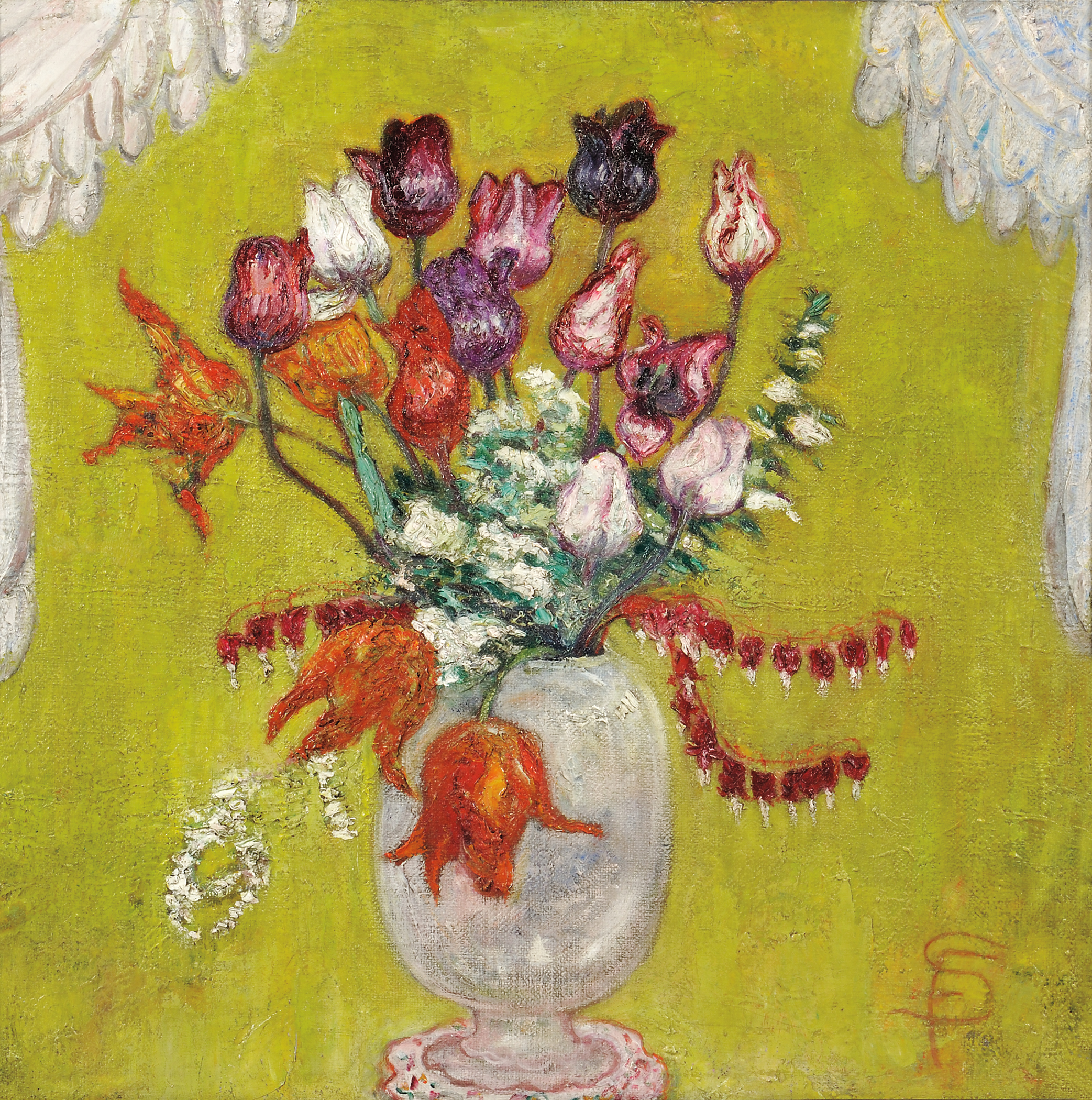
An undated floral still life by Florine Stettheimer. Skinner sold it in January 2016 for $375,000 against an estimate of $75,000 to $100,000, a record for the artist at auction.

What you see: An undated floral still life by Florine Stettheimer. Skinner sold it in January 2016 for $375,000 against an estimate of $75,000 to $100,000, a record for the artist at auction.

Who was Florine Stettheimer? She was a wealthy American woman who was, and is, regarded as an artist’s artist. Marcel Duchamp and Georgia O’Keeffe attended her salon. She might be the first woman artist in history to paint a nude self-portrait. She wasn’t keen on self-promotion; she had one small solo show at the Knoedler gallery in 1916, which flopped, and she never did another. While Stettheimer’s sisters ignored her wish to have her art destroyed after she died, they gave most of it to museums, leaving little for collectors to acquire. Two years after her death, the Museum of Modern art staged a Stettheimer retrospective. The Jewish Museum in New York is showing Florine Stettheimer: Painting Poetry, until September 24, 2017. She died in 1944 at the age of 72.

How did the Florine Stettheimer still life come to Skinner? “It came out of a house where it had been for decades,” says Robin S. R. Starr, director of American and European Works of Art at Skinner. “It was an estate situation. The family didn’t know much about it.”

How does this Florine Stettheimer still life show off her skills as an artist? “What could be a smarmy, cutesy sort of subject has a wonderful, modernist, fresh vibe all its own,” Starr says. “She has a great, unique personal style. She doesn’t look like anybody else. She’s her own style. The fact that she wanted her work destroyed after she died says she didn’t think much of it, though now we’re rediscovering her and finding out how fantastic it really is.”

How does this Florine Stettheimer still life compare to other Stettheimer paintings? “This is a wonderful work, but in comparison, it is relatively minor,” she says. “This is a record-breaker because none of those works [of hers] in museums have come up at auction.”

How did you decide on the estimate of $75,000 to $100,000? “It takes a lot of chutzpah to put an estimate on something that you know is going to sell for a world record,” she says, noting that the previous record for a Stettheimer was set in 1997 by a painting that commanded $145,000 against an identical estimate. “Artnet has six records [for Stettheimer], and only one [of the six artworks] has real figures in it,” she says, adding, “It was really more of a gut instinct. You’ve got to decide what’s a fair estimate based on what little track record there is and how wonderful you think the picture is. Ultimately, an estimate is a guess. It’s a well-educated guess, but a guess.”

Were you surprised that the Florine Stettheimer still life did so well? “Yes and no, which isn’t a fair answer,” Starr says, laughing. “Yes, I was thrilled. I didn’t think it would do that well. I thought there was a very good chance it would go over its estimate. I didn’t think it would go two or three times over.”

How much of a role did Stettheimer’s personal story play in driving the record auction price? Did it help? “That was absolutely a part of it,” she says. “The story is important–just watch Antiques Roadshow. But ultimately, it has to come down to an object that’s beautiful enough or inventive enough to sell the story. If she was a mediocre painter, it’s not going to matter. The story isn’t enough.”

What else makes this Florine Stettheimer still life special? “That palette is just–apparently, I’m going to keep using food terms–it’s so delicious. Instead of saccharine, we get that acidity, and that combination is just a gut punch. It’s one of those objects you see and you’re just stopped in your tracks. There’s nothing like it. It’s just its own thing.”

How to subscribe to The Hot BidClick the trio of dots at the upper right of this page. You can also follow The Hot Bid on Instagram and follow the author on Twitter.

You can follow Skinner on Twitter and Instagram, and you can follow Robin S. R. Starr on Twitter and Instagram as well.

Image is courtesy of Skinner.

Would you like to hire Sheila Gibson Stoodley for writing or editing work? Click the word “Menu” at the upper right for contact details.

RECORD! A Wharton Esherick Sculpture Commands $123,750

cocobolo wood. Estimated at $60,000 to $80,000, it sold for $123,750 in November 2014 at Freeman's. The sculpture now belongs to the Modernism Museum Mount Dora in Mount Dora, Fla.

What you see: Wharton Esherick’s 1933 sculpture “essie”/”rebecca”, fashioned from cocobolo wood. Estimated at $60,000 to $80,000, it sold for $123,750 in November 2014 at Freeman’s. The sculpture now belongs to the Modernism Museum Mount Dora in Mount Dora, Fla.

Who is Wharton Esherick? He’s an American artist who is best known for his sculptural furnishings, which foreshadowed the American studio furniture movement. Esherick started out as a painter but shifted his focus when people reacted to his hand-carved frames more than his canvases. He died in 1970 at the age of 82.

How rare are Wharton Esherick sculptures? “They’re incredibly rare,” says Tim Andreadis, department head of 20th century design at Freeman’s. “All of Esherick’s things are rare in comparison to the generation of craftsmen who came after him. Esherick produced maybe a few thousand pieces and maybe a hundred sculptures, if that.”

Is the Wharton Esherick sculpture “essie”/”rebecca” based on a human model? It was his daughter, Mary, who played a character named Essie in a production at a local theater that the Eshericks supported. “He often used family members and friends as models, and turned the sketches and maquettes into fully realized sculptures,” Andreadis says. “This was later named Rebecca after the Biblical figure of Rebecca at the well. In the 1960s, it finally found a buyer, and it had been with that family ever since.”

What makes “essie”/”rebecca” stand out among Esherick’s works? “This would have been a little more unusual. He would have carved it in one solid piece. It makes it much more challenging,” he says. “It was a celebrated piece, one of those works that were really personal to the artist. And it’s beautiful from any angle. It’s definitely made to be viewed in the round.”

Why did the Wharton Esherick sculpture do so well? “The stars were perfectly aligned,” Andreadis says. “It was a sculpture of grand scale. Esherick used cocobolo, a rare, exotic wood. Its patina has never been touched. There aren’t many Esherick pieces in private hands. And it’s really personal subject matter, using his daughter as a model for the work. It’s beautifully signed by Esherick. And you can never ask for anything better than to see period photos of the artist standing with the work. Buyers just responded to that. They recognized a rare opportunity that’s not going to come up again for some time.”

How to subscribe to The Hot BidClick the trio of dots at the upper right of this page. You can also follow The Hot Bid on Instagram and follow the author on Twitter.

Image is courtesy of Freeman’s.

Would you like to hire Sheila Gibson Stoodley for writing or editing work? Click the word “Menu” at the upper right for contact details.

SOLD! The Apollo 13 Flight Plan Sells for $275,000

A page from the flight plan used during the Apollo 13 lunar mission, showing a caricature of astronaut Jack Swigert.

Update: The Apollo 13 flown flight plan sold for $275,000–more than six times its high estimate.

What you see: A page from the flight plan used during the Apollo 13 lunar mission. Sotheby’s estimates it at $30,000 to $40,000.

What was Apollo 13? It was a 1970 moon voyage that never made it to the moon. An oxygen tank exploded 56 hours after liftoff, transforming the lunar mission into a rescue mission. The wounded vessel returned to Earth after four tense and terrifying days. The crew of three drank little, ate less, and slept even less than that. They arrived home on April 17, 1970, alive but collectively 31 and a half pounds lighter. The tale of Apollo 13 might be best known through the 1995 Academy Award-winning film that stars Tom Hanks, Kevin Bacon, and Bill Paxton.

Astronaut Fred Haise inscribed the Apollo 13 flight plan to “Bob.” Who is Bob? He is Robert “Bob” Lindsey, the lead flight planner for Apollo 13. “This plan contained all the steps they had to follow to get into space. Lindsey figured out everything that needed to be done. Of course, the spacecraft did not comply,” says Cassandra Hatton, vice president and senior specialist for books and manuscripts at Sotheby’s. “Though they didn’t make it to the moon, Lindsey was instrumental in getting them out there, and instrumental in getting them back.” His descendants consigned the flight plan to Sotheby’s.

Wait, so there was only one flight plan aboard Apollo 13? Was it a NASA tradition for Apollo crews to give the flown flight plan to the lead flight planner when they got back to Earth? “Yes, this is it,” Hatton says of the document, and adds that giving the flight plan to the lead planner was not routine: “It was just something the Apollo 13 crew decided to do as an extra thank-you to the people who saved their lives.”

Does the Apollo 13 flight plan contain handwritten notes from the astronauts after the oxygen tank exploded? Yes. The flight plan covers the voyage from liftoff to the point when astronauts Jack Swigert, Jim Lovell, and Haise abandoned the command module for the lunar lander, which they used as a lifeboat. The document also contains notes in red ink from Ken Mattingly, the original Apollo 13 command module pilot. He was removed from the crew days before the launch after fellow astronaut Charlie Duke unwittingly exposed him to German measles. Swigert replaced Mattingly.

What notes in the Apollo 13 flight plan show the reaction to the explosion? Page 3-38 corresponds to the time of the accident. Lovell, the mission commander, crossed out the typewritten plans and wrote new ones, which include leaving the main vessel for the lunar module (LM). Lovell observed the need to “insure proper 02 concentration in LM.” Maintaining oxygen levels in the LM did pose a challenge. NASA engineers later had to teach the astronauts to jerry-rig a carbon dioxide filter that would work in the LM with parts that the astronauts had on hand.

How do we know which astronaut wrote which notes? Hatton referenced the air-to-ground transcript that NASA took for Apollo 13. By matching the transcript against the flight plan, she was able to identify each author. “If you take the time to go through it and read it, page by page, and compare it to the transcript, it solidifies our perception of them as being heroes,” she says. “‘Ok, we have no heat, no water, no food, and we can’t get any sleep, but we’re not going to panic and we’re going to get home.’ My heart was pounding. It’s an incredible thing.”

Why are there cartoons in the Apollo 13 flight plan? NASA asked Johnson Space Centre artist Barbara Matelski to sketch caricatures of the crew in the flight plan before the launch as a jokey surprise for them to discover as they leafed through its pages. Shown here is the caricature of Swigert, who takes a ribbing over his political ambitions. He won the House of Representatives race for Colorado’s 6th district in November 1982, but died of bone cancer before he could be sworn in. He was 51 when he passed away. Lovell is now 89, Haise is 83, and Mattingly is 81.

The Apollo 13 flight plan’s presale estimate is $30,000 to $40,000. Isn’t that kind of low? “The estimate is very, very conservative. It is. I’m confident it will far exceed its estimate,” she says, adding that its closest analog is a document that was embroiled in controversy. In 2011, Lovell consigned the flown LM Apollo 13 checklist–which takes over where this flight plan leaves off–to auction. It sold for $388,375, but the transaction was voided when NASA objected. President Barack Obama subsequently signed a law that gives clear title to memorabilia received by astronauts during the course of their work with the Gemini, Mercury, and Apollo programs. “It’s interesting to see what the impact of the new law will be,” she says. “It’s very clear about who the title lays with, so bidders can have confidence in this.”

How to bid: The flown Apollo 13 flight plan is lot 140 in Sotheby’s Space Exploration auction in New York, scheduled for–of course–July 20, 2017.

How to subscribe to The Hot BidClick the trio of dots at the upper right of this page. You can follow The Hot Bid on Instagram and follow the author on Twitter.

Sotheby’s is on Twitter and Instagram, and you can follow Cassandra Hatton on Twitter and Instagram and read a story she wrote for Sotheby’s on the flown Apollo 13 flight plan.

Image is courtesy of Sotheby’s.

Would you like to hire Sheila Gibson Stoodley for writing or editing work? Click the word “Menu” at the upper right for contact details.

RECORD! A Paul Evans Cabinet Fetched $382,000

A unique vertical cabinet made by Paul Evans, featuring steel, 23 karat gold leaf, brass, and enameled finish. It stands just over seven feet tall, about four feet wide, and about 18 inches deep. It sold for $382,000 against a $140,000 to $160,000 estimate at Rago Auctions in January 2017, an auction record for Evans.

What you see: A unique vertical cabinet made by Paul Evans, featuring steel, 23 karat gold leaf, brass, and enameled finish. It stands just over seven feet tall, about four feet wide, and about 18 inches deep. It sold for $382,000 against a $140,000 to $160,000 estimate at Rago Auctions in January 2017, an auction record for Evans.

Who is Paul Evans? He was an American studio furniture maker based in New Hope, Pennsylvania. He was best known for furniture with distinctive, elaborate, sculpted metal fronts. He died in 1987, at 55.

This Paul Evans cabinet is a custom commission. How often did he accept commissions? “I haven’t heard of a lot of them,” says David Rago of Rago Auctions. “Custom commissions were often made to scale for certain interiors with only so much wall space or ceiling height. This is one of the few where [the commissioner] said, ‘I don’t like the other stuff you do, I want something like this.’ Paul Evans probably didn’t like to be told what to do. That’s probably why you don’t see many.”

The Paul Evans cabinet came directly from the person who commissioned it to your auction house. How rare is that? “Not as rare as you might think,” he says. “One of the reasons we get the prices we get [for Evans], is because we get them from the owners.”

Are the opportunities to receive Paul Evans consignments direct from original buyers drying up? “Not for us. Not yet,” Rago says. “He made furniture into the 1980s.”

Why did this Paul Evans cabinet do so well? “One, it was a one-of-a-kind bench-made piece. Two, it was consigned by the original owner, who worked with Paul Evans to get it made. Three, it’s a vertical cabinet, and most of these are horizontal,” he says. “Four, this is big, a big two-door vertical cabinet, so it has scale. Six, the New York Times highlighted this piece with a story titled Is This Cabinet Worth $500,000? That was a bit of a problem for me–I didn’t want people to think they had to spend $500,000 or they shouldn’t bother to bid. And the market was in a good place. People spend a lot of money on great things. There’s a lot of wealth in America.”

Were you surprised when the Paul Evans cabinet broke the auction record? “I thought it had potential, but I didn’t want to jinx it. I didn’t want to go there,” Rago says. “I was surprised it broke the record by that much. To break it by almost $100,000 is really unusual.”

Prior to the January 2017 Rago sale, the Paul Evans record seemed to change every six or eight months or 12 months, by $5,000 here and $10,000 there. Why do you think his auction record has been so volatile? “The more accepted Paul Evans becomes as an important, high-end designer, the more tastes change to accept other designs of his,” he says, adding that the cabinet is “A hybridized piece. It’s a little bit of a sculpture front, and a little bit of a wavy front. He put in a little of this and a little of that and he came up with a bench-made masterpiece.”

What does it feel like to have founded the auction house that set the record for Paul Evans furniture? “There’s probably one person on the planet who’s seen more Paul Evans than I have, and that’s Dorsey Reading, and he made the stuff. I grew up here. Some people say I’m geographically blessed as far as New Hope Modernism is concerned,” Rago says. “I have a lot of gratitude. It’s an honor for me to do this for a living. I started as a flea market three miles from here in 1977. To survive so long–this cabinet wasn’t made when I was at the flea market. It was made two miles from here. To do this, and handle stuff like this–I feel a bit of Jersey pride in that.”

How to subscribe to The Hot BidClick the trio of dots at the upper right of this page. You can also follow The Hot Bid on Instagram and follow the author on Twitter.

Image is courtesy of Rago Arts and Auctions.

Would you like to hire Sheila Gibson Stoodley for writing or editing work? Click the word “Menu” at the upper right for contact details.

Surprise! A Chinese Cloisonné Vase Fetches More Than $812,000

Chinese Cloissone vaseJPG(1)

What you see: A 10-inch-tall Chinese cloisonné bottle vase, initially believed to date to the 18th or 19th century, and estimated at $400 to $600. In April 2017 it sold for $812,500 at Quinn’s Auctions, via the iGavel online platform.

How did you arrive at the $400 to $600 estimate for the Chinese Cloisonné vase? “The first thing we did was look at the condition. It was heavily restored,” says Matthew Quinn, executive vice president of Quinn’s Auction Galleries. “We try always to have super-conservative estimates. We didn’t know the full extent until we watched it play out. We thought the vase might be 18th century. We didn’t know it was 14th century.”

Why did you describe the Chinese Cloisonné vase as dating to the 18th or 19th century? “It looked like it had sufficient age to fit that category. We were still wrong. That’s the beauty of the marketplace,” he says, laughing.

What marks the Chinese Cloisonné vase as being from the 14th century? “The form more than anything. The bottle form, and the colors of the enamels. We were told it’s from the late 14th or early 15th century. The bottle form was only done then, and it wasn’t copied until late in the 20th century. And the yellow and red–those particular colors were only used in that time frame,” he says.

Were you the auctioneer during the sale? “We sold it through iGavel, an online-only site,” he says. “Bidding comes in on iGavel every five minutes toward the end. It mimics what goes on in a sale room. With the five minute extensions, it took a long time to sell the vase–an hour, an hour and a half at least. It was fascinating to watch it go.”

Where were you as you watched the sale? “I was on the road. I expected it to do OK. A minute to close, it was at $12,000, then $15,000. I thought, ‘Eh, it’s doing OK.’ It got close to close. Then it was $30,000, and it went pretty handily up to $50,000. I called Lark [Mason, founder of iGavel] at that point. It kept going and going and going. It was wild. Bidders were taking two to three minutes to place each bid. They were taking their time, not like the high pace of an auction room, where the bids come in two or three seconds. I’m not sure if it was part of their strategy or not.”

Did the Chinese Cloisonné vase set an auction record? “We haven’t been able to find much [corroborating information],” Quinn says. “Lark thought it might have been in record territory for a bottle vase, but there are so few of them [reflected in auction archives] we weren’t able to find much. Rarity is not always a good thing. Just because it’s rare doesn’t mean it’s valuable, but in this case, it was.”

What else makes this vase interesting? “Everybody wants to know how we find these treasures. You find them in the places you least expect. This vase was stuck up in a barn, in the back of the butler’s pantry,” he says, explaining he was called in to sort through the contents of a family farm to prepare it for sale.

How to subscribe to The Hot BidClick the trio of dots at the upper right of this page. You can also follow The Hot Bid on Instagram and follow the author on Twitter. You can follow iGavel auctions on Twitter and Instagram as well.

Image is courtesy of Quinn’s Auction Galleries.

Would you like to hire Sheila Gibson Stoodley for writing or editing work? Click the word “Menu” at the upper right for contact details.

RECORD! A Houdini Poster is the Most Expensive Magic Poster Ever Sold

A 1912 poster touting Harry Houdini performing his famous water torture cell escape. It was printed in London one year after Houdini invented the trick, and it has a B+ condition rating. Potter & Potter sold it in February 2017 for $114,000--an auction record for any magic poster.

What you see: A 1912 poster touting Harry Houdini performing his famous water torture cell escape. It was printed in London one year after Houdini invented the trick, and it has a B+ condition rating. Potter & Potter sold it in February 2017 for $114,000–an auction record for any magic poster.

How rare is this Houdini poster? “There are three we know of,” says Gabe Fajuri, president of Potter & Potter, noting he has examined two of them.

How rare are Houdini posters, generally? “Rare is relative. Houdini had a lot of posters,” he says. “Some exist in only one copy. Some in 20 to 30.”

Is this the first time that Houdini’s water torture cell escape was depicted on a poster? “It’s possible,” Fajuri says, explaining that there is another 1912 poster that shows a closeup of Houdini’s face, upside down and under water, and it’s not clear which poster appeared first.

What was the bidding like for the Houdini poster? “We started at $25,000. There was active bidding in the room and on the phone from at least five phone bidders, including a few who were new to us,” he says. “There was active participation to $80,000 [around the sum of the previous magic poster record]. It was going to beat the record without a doubt, but I didn’t think it would go as high as it did. A few guys really wanted it. It sold to a phone bidder.”

Why did the Houdini poster do so well? Is it because it’s just one of three that exist? “That’s part of it, but it’s also from the Norm Nielsen collection, a very well-established if not legendary collection of posters. Everybody knows him and everybody knows his collection,” he says, adding that Potter & Potter will soon publish The Golden Age of Magic Posters, a limited-edition book based on the auction catalogue. “It’s Houdini. It’s one of his most famous, if not his most famous trick. It’s got all the elements that lead to success.”

How long do you think this auction record will stand? “This is the most expensive magic item sold with the exception of the water torture cell itself,” Fajuri says. “I would think it would stand for a while, but anything could happen. Hopefully, we’ll be the ones to break it.”

How to subscribe to The Hot BidClick the trio of dots at the upper right of this page. You can also follow The Hot Bid on Instagram and follow the author on Twitter.

Follow Potter & Potter on Instagram and Twitter.

Image is courtesy of Potter & Potter.

Would you like to hire Sheila Gibson Stoodley for writing or editing work? Click the word “Menu” at the upper right for contact details.
An Original Song of the South Cel with Walt Disney’s Signature Gets Almost $9,000

An original production cel from Song of the South, a Disney film released in 1946. It pictures Br'er Rabbit, the lead character of the stories depicted in the film. Walt Disney signed it on its cream-colored mat.

Update: The production cel from Song of the South, signed by Walt Disney, sold for $8,962.50.

What you see: An original production cel from Song of the South, a Disney film released in 1946. It pictures Br’er Rabbit, the lead character of the stories depicted in the film. Walt Disney signed it on its cream-colored mat. Jim Lentz, director of animation art for Heritage Auctions, says it could sell for as much as $5,000.

Are original Song of the South cels scarcer than original cels from other Disney movies? “There are fewer in that Song of the South wasn’t all animated. Some was live action,” Lentz says.

Are original Song of the South cels more sought-after than those from other Disney cels? “They’re considered highly desirable because they have an aura of the unknown,” he says. “Disney has not released the film in any format in the United States because of political incorrectness.” Set in the Reconstruction-era South, the film follows young Johnny’s visit to his grandfather’s plantation in Georgia, where he meets Uncle Remus, a plantation worker who tells the boy folk tales.

How rare is it to find an original Song of the South cel with a Walt Disney signature? “The thing about Walt Disney was he was a very, very busy man. A lot of Disney signatures were done by studio artists. Even secretaries did them. So when you get one done by Walt, that is rare,” Lentz says, noting that he has handled fewer than three Disney-signed original production cels from Song of the South.

How do we know that the Walt Disney signature is genuine? Lentz consulted another expert for verification. “I sent it to someone in the business who specializes,” he says.

According to the lot notes, this original Song of the South cel has an ‘original Courvoisier cel setup’ and is in its ‘original Courvoisier mat.’ What does that mean, and why is that good? In the 1930s and 1940s, Disney worked with Gustav Courvoisier to sell animation cels through the latter’s San Francisco gallery. “The studio thought it was a great way to promote the films,” Lentz says. Disney studio artists painted backgrounds for cels offered through Courvoisier. These cels usually have a cream-colored mat and notations in tiny script that identify which films they brought to life. Courvoisier died around the time Song of the South came out.

How does this cel stack up to other original Song of the South cels you’ve handled? “It’s one of the few I’ve seen with a Walt Disney signature and a happy Br’er Rabbit, who is the star of the show,” he says. “It’s a great, great piece. This is as good as it gets.”

How to bid: The Disney-signed Song of the South cel is lot #95187 in the Animation Art sale Heritage Auctions will hold in Dallas on July 1-2.

How to subscribe to The Hot BidClick the trio of dots at the upper right of this page. You can also follow The Hot Bid on Instagram and follow the author on Twitter.

Image is courtesy of Heritage Auctions.

Would you like to hire Sheila Gibson Stoodley for writing or editing work? Click the word “Menu” at the upper right for contact details.
SOLD! A Bobby Orr Hockey Card Scored $6,600

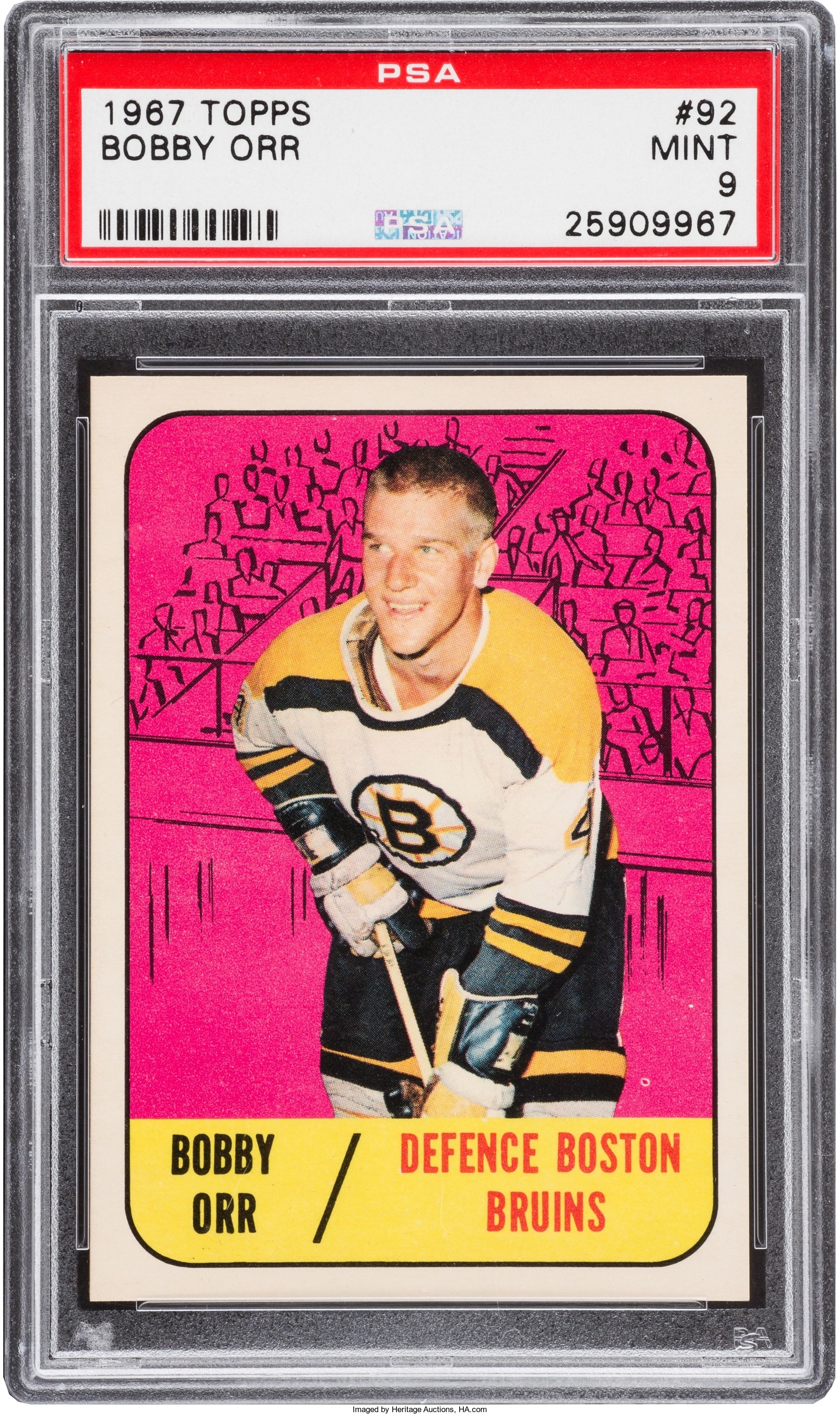
1967 Topps Bobby Orr #92 PSA Mint 9

Update: The 1967 Topps Bobby Orr hockey card sold for $6,600.

What you see: A 1967 Topps Bobby Orr hockey card with a PSA Mint 9 grade. Only three other 1967 Topps Orr cards have a higher PSA grade. Heritage Auctions has (coincidentally) estimated it at $4,000 and up.

Who is Bobby Orr? Also known as “Number 4,” he is considered one of the best hockey players ever. Born in Canada, Orr spent his professional career as a defenseman for the Boston Bruins. An iconic shot of him leaping, full-bodied, into the air after scoring the sudden death overtime goal that won his team the 1970 Stanley Cup is immortalized in bronze at the TD Garden, where the Bruins play. Orr turned 69 in March.

Let’s back up a step. When did hockey cards become a thing? “They go back to the early 20th century, the 1909-1911 era, when baseball cards exploded,” says Heritage sports card expert Peter Calderon, explaining that Topps entered the hockey card market in 1954.

How popular are hockey cards? “They’re pretty popular. They’ve been popular in Canada for a long time and their popularity is growing in the states,” he says. “What really drives it is rookie cards of Wayne Gretzky and Mario Lemieux.” He adds that the top four names in the hockey card realm are Gretzky, Lemieux, Orr, and Gordie Howe.

Are 1960s hockey cards more rare than 1960s baseball cards? Yes. “No other sport matches baseball [for collectibility], but it’s very hard to find high-grade hockey cards,” he says. “The availability is not there, not to the same extent as baseball cards.”

This Bobby Orr hockey card is from 1967–his second year in the pros. Does that make it desirable? In addition to its high grade–PSA gave it a 9 on a scale that goes to 10–it represents a sweet bargain of sorts. “Rookie cards are like rookie Mickey Mantle cards–outside the budget of most collectors,” Calderon says. “This is really early in his career, but it’s a little more affordable to most people.” He notes that Heritage sold another 1967 Topps Orr card that had a PSA Gem Mint 10 grade for $9,560 in May 2014.

It’s a nice-looking card, too. “The production values are just as high and just as well-done as baseball cards,” he says.

But the Bobby Orr hockey card is only partially photographic–the background is illustrated and colored pink, presumably because it contrasts nicely with the black and gold of his uniform. Why would Topps design it that way? “To make it a more interesting card, I imagine,” he says. “The atmosphere you see hockey players in…the walls are white, the ice is white. There’s nothing exciting about that.”

How to bid: The 1967 Bobby Orr hockey card is lot #80694 in Heritage Auctions’ Premium Sportscard Catalog Auction on June 29, 2017 in Dallas.

How to subscribe to The Hot BidClick the trio of dots at the upper right of this page. You can also follow The Hot Bid on Instagram and follow the author on Twitter.

Image is courtesy of Heritage Auctions.

Would you like to hire Sheila Gibson Stoodley for writing or editing work? Click the word “Menu” at the upper right for contact details.

SOLD! A Bonnie and Clyde Ring Commands $25,000

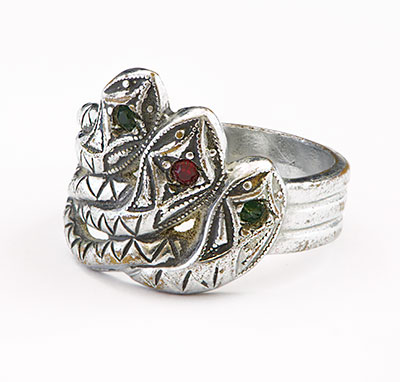
A silver-toned three-headed snake ring with red and green gemstones, made by Clyde Barrow during a prison stay at Eastham Prison Farm in Texas and later given to Bonnie Parker.

Update: The Bonnie and Clyde ring sold for $25,000.

What you see: A silver-toned three-headed snake ring with red and green gemstones, made by Clyde Barrow during a prison stay at Eastham Prison Farm in Texas and later given to Bonnie Parker. RR Auction estimates it at more than $40,000.

Who were Clyde Barrow and Bonnie Parker? Better known as Bonnie and Clyde, the couple were notorious Depression-era bank robbers who were romanticized in the press. They died in a police ambush in Louisiana in May 1934 in which officers fired 130 rounds at their car. Barrow was 25. Parker was 23.

How do we know that Bonnie Parker wore this ring, and how do we know that Clyde Barrow made it for her? Barrow left a maker’s mark on the ring: A B-note with an arrow. “When I sat next to the jeweler and he deciphered the logo, it was like, ‘Eureka!’,” says Bobby Livingston, executive vice president at RR Auction. “Things like that happen only a few times in a career. It was one of the most incredible finds I’ve ever had.” We don’t know when Barrow gave the ring to Parker, but we do know he made a belt with a snake motif during the same prison stay and mailed it to his sister.

How did Parker lose the ring? She left it behind when she and Barrow fled their stolen 1933 Ford Model B on November 22, 1933, near Sowers, Texas. Sheriff Smoot Schmid, who led the raid, recovered the ring from the bullet-strafed car, noting it in his inventory as “Bonnie Parker Ring (3 Silver Snakes with Tiny Jewels).” Schmid’s heirs consigned it to RR Auctions.

Why did Schmid keep the Bonnie and Clyde ring? “It was very common for Bonnie and Clyde to abandon property,” Livingston says. “The police didn’t get paid a lot. Bonnie and Clyde were infamous. They took these things as souvenirs, and were known to.”

What size is the Bonnie and Clyde ring? “I think it’s a size four. Bonnie was very small,” Livingston says. “I looked at it under a high-powered microscope. It’s worn, for sure, but you would not want to wear it. We expect it to sell for a lot of money, and expect it to be curated as an artifact and never worn again.”

Is the Bonnie and Clyde ring well-made? “It’s pretty nice. It’s not by an amateur,” Livingston says. “He was talented. It’s not crude at all.”

What else makes this Bonnie and Clyde ring special? “This is the closest thing Bonnie and Clyde had to a wedding ring,” he says, adding that Parker was wearing a wedding ring when she died (she married a fellow high school student at 16, but was estranged from her husband and had never sought a divorce). “It’s one of the few pieces made by Clyde and given to Bonnie, and she wore it. To me, the ring represents the deep love they had for each other.”

How to bid: Bonnie Parker’s promise ring is lot 2039 in the Gangsters, Outlaws, and Lawmen sale at RR Auction. Online pre-bidding takes place from June 16 through June 23; the live auction takes place June 24, 2017 in Boston.

How to subscribe to The Hot Bid: Click the trio of dots at the upper right of this page. You can also follow The Hot Bid on Instagram and follow the author on Twitter.

Image is courtesy of RR Auction.

Would you like to hire Sheila Gibson Stoodley for writing or editing work? Click the word “Menu” at the upper right for contact details.
Willie Stargell’s Bronze MLB Lifetime Passes Get $4,555 at SCP Auctions

The Major League Baseball (MLB) and National Baseball Hall of Fame and Museum lifetime passes that belonged to Willie Stargell.

What you see: The Major League Baseball (MLB) and National Baseball Hall of Fame and Museum lifetime passes that belonged to Willie Stargell. SCP Auctions estimates the group, which includes a personalized leather carrying case, at $3,000 to $5,000.

Who was Willie Stargell? Wilver Dornell “Willie” Stargell was a legendary left fielder and first baseman for the Pittsburgh Pirates. He appeared on two World Series-winning Pirates teams, in 1971 and 1979. He holds the distinction of being the only baseball player to win the Major League Baseball  Most Valuable Player (MVP) award, the League Championship Series MVP award, and the World Series MVP award in the same year, and he did it at the age of 39. He was 25 home runs shy of the magical threshold of 500 when he retired from baseball in 1982. He died in 2001, at 61, two days before the Pirates unveiled a statue of him at PNC Park.

When did Stargell receive these bronze MLB lifetime passes? It’s not clear, but he might have received the MLB lifetime pass on or around his retirement, and he probably earned the Cooperstown pass in 1988, after he was elected to the Baseball Hall of Fame in his first year of eligibility.

Are those passes made of gold? Nope, they’re bronze. “They’re solid metal, but both are about as thick as a credit card,” says Dan Imler, vice president of SCP Auctions.

Did Stargell have the personalized leather case made to hold them both? “The case was issued with the Hall of Fame pass,” says Imler. “It does accommodate two passes. He obviously got them separately. They happen to fit perfectly in this particular case.”

Did Stargell actually carry the bronze MLB lifetime passes on his person and use them? “It’s interesting,” Imler says. “We know he got the case with the Hall of Fame pass. The pass itself shows less wear than the MLB pass. There’s minor general wear on the case itself. It definitely has the appearance of having used the passes, but it’s hard to know how frequently.”

How often do you see bronze MLB lifetime passes kept together as a pair, as these have been? “I can’t recall ever receiving them together in a case,” Imler says. “They could be sold independently, but we feel like Willie Stargell viewed them as mates, and they were viewed as mates by the family. We want to keep the presentation as it was kept by him.”

How to bid: The bronze MLB lifetime passes given to Stargell are lot 145 in SCP Auctions’s Spring Premier Auction, which opens on May 24 and ends on June 10, 2017.

How to subscribe to The Hot BidClick the trio of dots at the upper right of this page. You can also follow The Hot Bid on Instagram and follow the author on Twitter.

Image is courtesy of SCP Auctions.

Would you like to hire Sheila Gibson Stoodley for writing or editing work? Click the word “Menu” at the upper right for contact details.
Rockwell Kent’s Moby Dick Commands $1,560

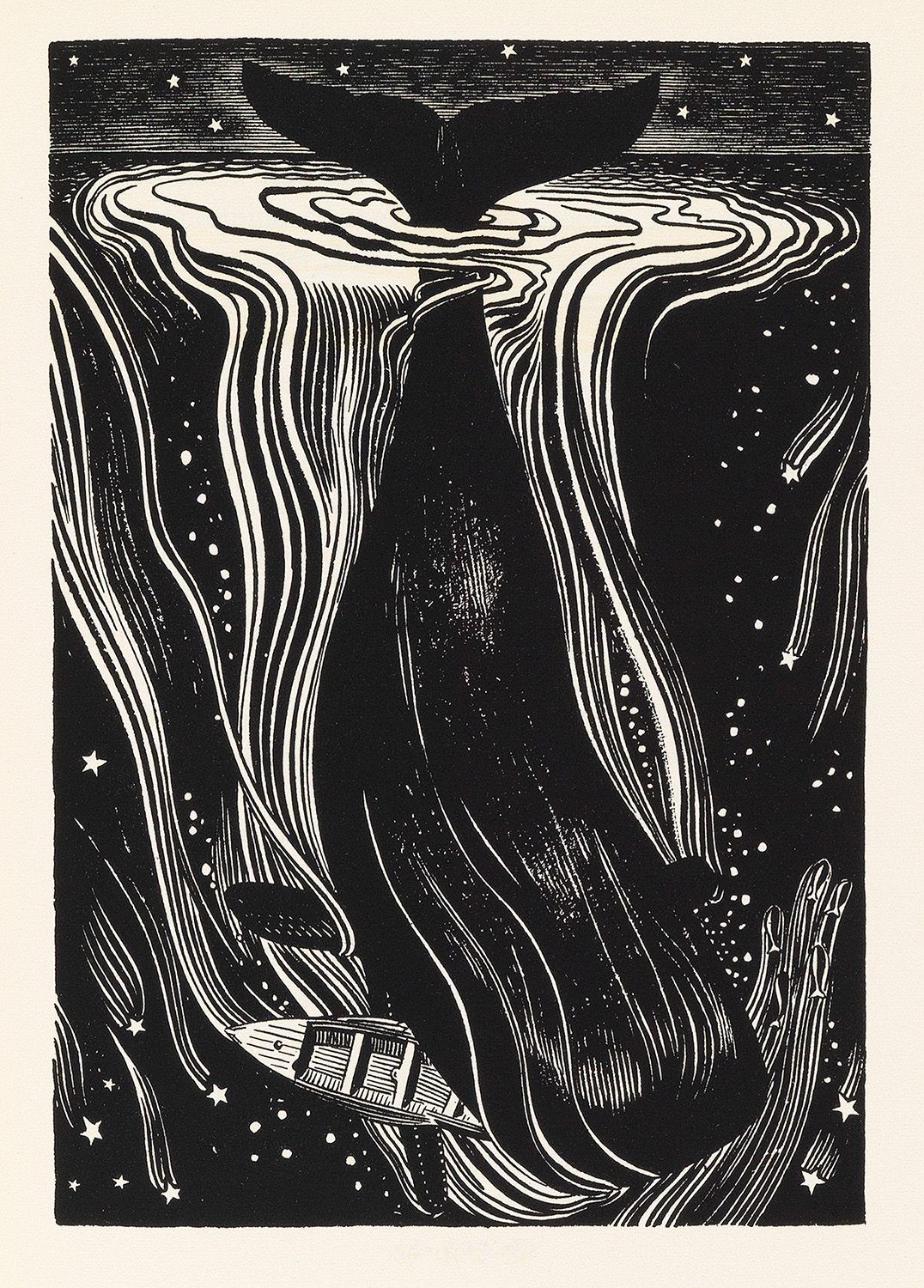
One of the 280 pen-and-ink illustrations that Rockwell Kent did for a three-volume 1930 limited edition release of Moby Dick. This particular copy lacks its aluminum slipcase.

What you see: One of the 280 pen-and-ink illustrations that Rockwell Kent did for a three-volume 1930 limited edition release of Moby Dick. This particular copy lacks its aluminum slipcase. Swann Auction Galleries estimates it at $2,000 to $3,000.

Who was Rockwell Kent? He was one of the best-known American artists of the first half of the 20th century. He was noted for his landscapes and seascapes before making his name as an illustrator. People mixed him up with Norman Rockwell so often that it became a running joke between the two men. Kent died in 1971 at the age of 88.

How did the limited edition printing of Moby Dick come about? Publisher R.R. Donnelley approached Kent in 1926 to do a version of Two Years Before the Mast, and he suggested doing the Melville novel instead. “Kent loved the sea, and the water. He was a master of painting light, and was able to capture that, even in his woodcuts,” says Christine von der Linn, specialist at Swann. “Moby Dick was originally slated to be a one-volume book, and it grew to three.”

Rockwell Kent’s Moby Dick came out in 1930, during the Great Depression. How well did it sell? “It was so popular, the limited edition of 1,000 sold out,” she says. “It launched Kent’s name, and caused a revival of interest in Moby Dick. It was so popular that a one-volume trade edition was put out.”

This copy of Rockwell Kent’s Moby Dick lacks its aluminum slipcase. Does that affect its value? Yes. It’d be worth one-third to one-half more if it came with the slipcase, von der Linn says, noting that the Kent limited edition was jokingly referred to as ‘Moby Dick in a can.’

That image of the whale diving deep into the ocean with the boat in its mouth looks cinematic. Was Kent influenced by the movies at all? “He was certainly aware of the current culture and would have seen movies, but he was not thinking in a cinematic way,” she says. “He loved black and white, and he tried to distill the most dramatic details out of a scene. He was always thinking about reaching the reader in the most visually direct way possible.”

M35763-7 002

But that drawing, tho. “That image is phenomenal. You can’t look at that and not get chills,” she says. “You understand everything about the novel. It’s incredible.”

What else makes Rockwell Kent’s Moby Dick so spectacular? “It blows you away with the overall beauty of it,” she says. “As you flip through the pages, you feel it come to life through Kent’s illustrations. That’s the mark of a successful illustrated book–if you can make the words leap off the page and spring to life.”

How to bid: Rockwell Kent’s Moby Dick is lot 184 in Swann’s Art, Press & Illustrated Books sale on June 13, 2017.

How to subscribe to The Hot BidClick the trio of dots at the upper right of this page. You can also follow The Hot Bid on Instagram and follow the author on Twitter.

Image is courtesy of Swann Auction Galleries.

Would you like to hire Sheila Gibson Stoodley for writing or editing work? Click the word “Menu” at the upper right for contact details.

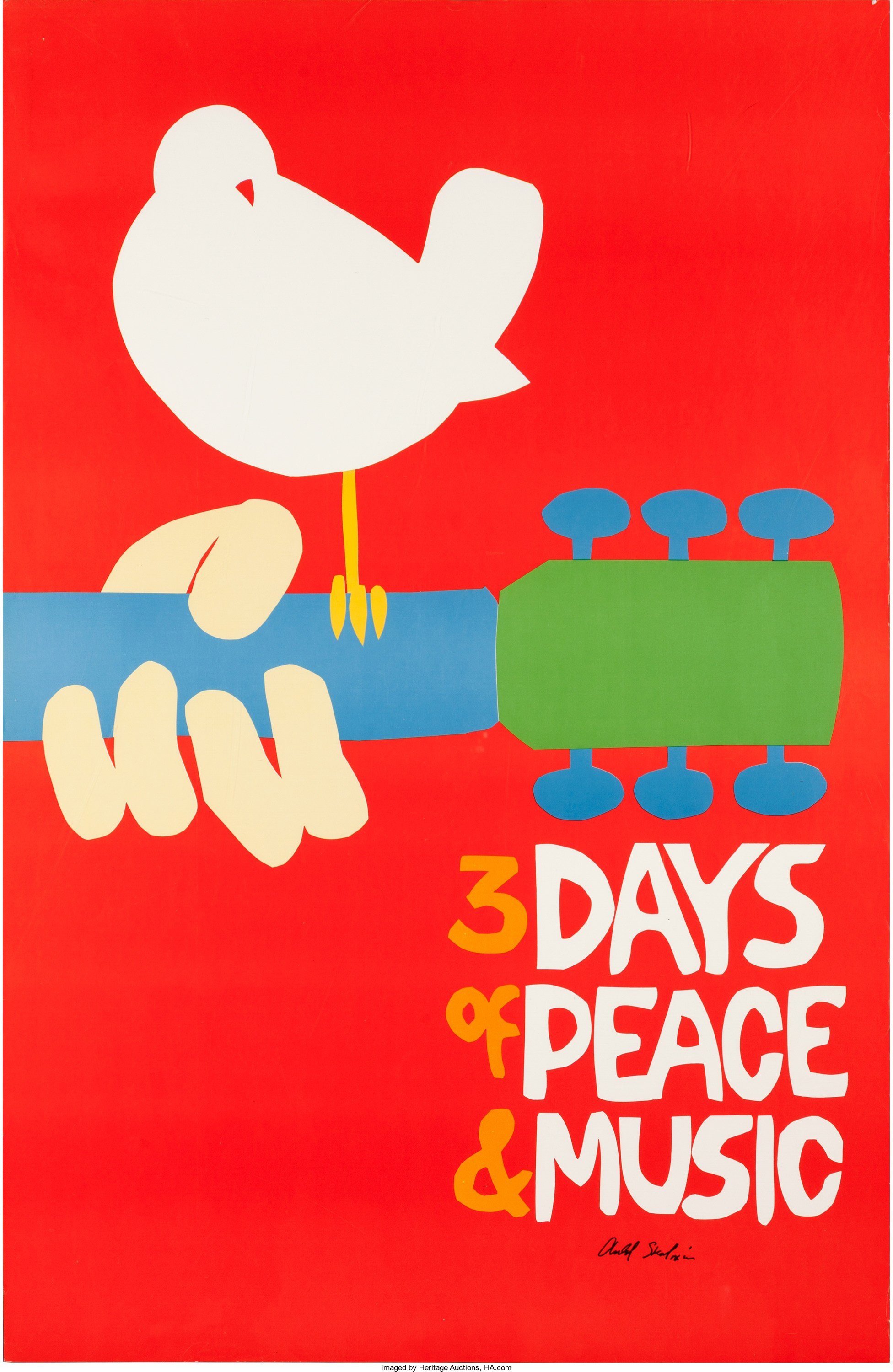
An Original Woodstock Concert Poster Could Command $2,500

An original 1969 Woodstock concert poster that shows just the artwork--no small text--and is signed by Arnold Skolnik, the artist who designed it.

What you see: An original 1969 Woodstock concert poster that shows just the artwork–no small text–and is signed by Arnold Skolnik, the artist who designed it. It’s in Very Good Plus condition and is estimated at $2,500.

How rare are original Woodstock concert posters in general, and how rare is it to find one that lacks the band names, the concert dates, and other small text? “Woodstock concert posters are rare, and this one is unusual,” says Giles Moon, consignment director of entertainment and music memorabilia at Heritage Auctions, adding, “I think that purist concert poster collectors want the version used to advertise the concert.”

The lot just before this one in the sale is a signed original Woodstock concert poster that has the small text. Its starting bid is $1,000, but the starting bid for this poster is $1,250. Why? “That’s intriguing. I’m not certain why that is,” he says, noting that this is the first artwork-only original Woodstock poster that he has handled. “This one might be more unusual, and that might be why there’s a higher starting bid on it.”

The original Woodstock concert poster is signed by Arnold Skolnik, the artist who designed it. Does that add to its value? “It adds several hundred dollars to the poster,” he says. “It doesn’t double the value, but it adds 20 to 30 percent. It’s difficult to say how many original Woodstock concert posters he signed. The majority of the originals have not been signed. In 2009, we sold one for $1,000, and I would expect the price to have jumped a bit since then.”

Were Woodstock posters collected at the time of the concert, or only later on? “It’s nearly always the case that they’re collected later on. That’s why the posters are so rare,” Moon says. “No one imagined they’d become collectible or valuable. They were just discarded. People who saved them were keeping them for aesthetic reasons.”

What makes this original Woodstock concert poster so successful? “It’s a simple, strong image that gets across the concept of what the festival was,” he says. “And it was a departure from the psychedelia as well. Lots of posters were trippy, intricate and complicated. This is simplistic.”

How to bid: The artwork-only original Woodstock concert poster is lot #89705 in Heritage Auctions’s Entertainment & Music Memorabilia Signature Auction on June 17 and 18 in Beverly Hills, Calif.

How to subscribe to The Hot BidClick the trio of dots at the upper right of this page. You can also follow The Hot Bid on Instagram and follow the author on Twitter.

Image is courtesy of Heritage Auctions.

Would you like to hire Sheila Gibson Stoodley for writing or editing work? Click the word “Menu” at the upper right for contact details.
SOLD! Wright Sold That Amazing Macchie Vase for $8,450

A macchie (mah-key-aye) vase created circa 1890 by the Italian company Francesco Ferro e Figlio.

Update: The macchie vase sold for $8,450.

What you see: A macchie (mah-key-aye) vase created circa 1890 by the Italian company Francesco Ferro e Figlio. Wright estimates it at $4,000 to $6,000.

What is Francesco Ferro e Figlio? It was a company founded in 1880 by Francesco Ferro and his son, Ferdinando. It ceased doing business under this name after Francesco died in 1901.

Wait, this vase was made in 1890? The late 19th century? Seriously? “So many 19th century pieces really do look modern,” says Sara Blumberg, a consultant for Wright. “This has no handles and no great ornamentation except for the glass itself. They really were making a step forward out of the baroque.”

How difficult would this macchie vase have been to make in 1890? “Regardless of the technique, there are great losses. There’s a level of difficulty when dealing with different types of glass in the same vessel. You can think of it as studio glass in that regard,” she says. “A lot of the aspects are dependent on the day, the blower, the conditions, and luck as well.”

The macchie vase stands 12 inches tall. Did its size pose a challenge to the glassblower? “Generally speaking, the larger a vessel becomes, the more difficult it is to make,” Blumberg says. “Twelve inches may not seem incredibly large, but for the 19th century, it is.”

Is the macchie vase unique? “It’s unique in the sense that every vase is hand-blown. But in 25 years, I’ve never handled one,” she says. “It’s really very rare.”

What does “macchie” mean? It means “spot,” or “spotted.” It’s a literal description of the vase’s appearance.

What else makes this macchie vase special? “It’s rather startling to look at. It’s a simple vessel, but there’s all this activity on the surface. It’s like looking at an abstract painting,” she says. “It’s quite early, but it has a modernity to it. There’s an artistic presence here that’s very intentional, and beautiful to see. That’s what makes the piece so exciting and rare. You don’t come across it very often.”

How to bid: The macchie vase is lot 223 in The Design Collection of Dimitri Levas, taking place June 8, 2017 at Wright.

How to subscribe to The Hot BidClick the trio of dots at the upper right of this page. You can also follow The Hot Bid on Instagram and follow the author on Twitter.

Image is courtesy of Wright.

Would you like to hire Sheila Gibson Stoodley for writing or editing work? Click the word “Menu” at the upper right for contact details.

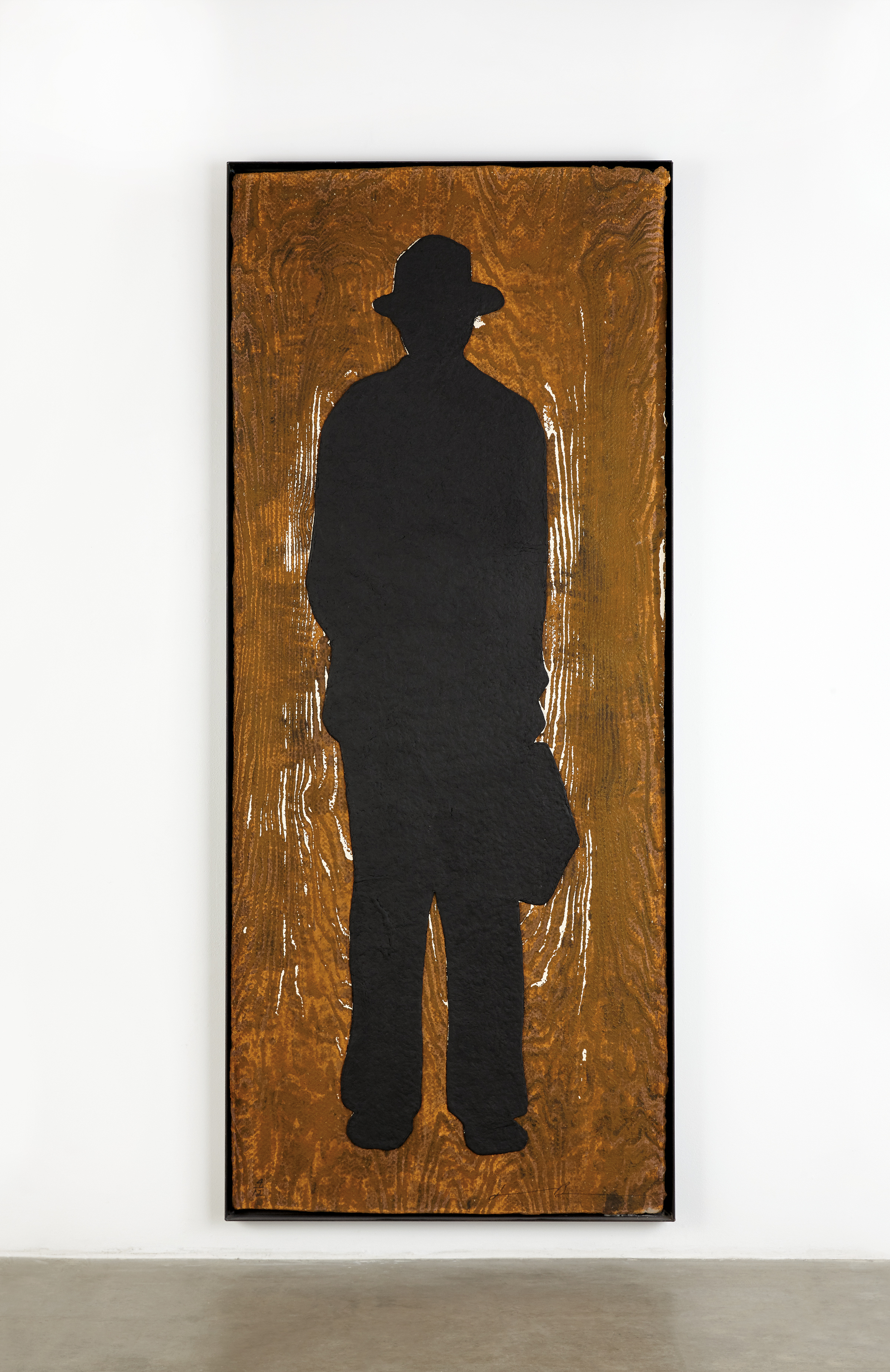
SOLD! A Jonathan Borofsky Work Fetches $9,375 at LAMA

Man with a Briefcase (C), a woodcut with collage on handmade paper by Jonathan Borofsky. It's the fourth of a 1991 limited edition of 12, and it measures 92 inches by 39 inches.

Update: The Jonathan Borofsky work sold for $9,375.

What you see: Man with a Briefcase (C), a woodcut with collage on handmade paper by Jonathan Borofsky. It’s the fourth of a 1991 limited edition of 12, and it measures 92 inches by 39 inches. Los Angeles Modern Auctions (LAMA) estimates it at $5,000 to $7,000.

Who is Jonathan Borofsky? He is an American artist who works in many media, but he might be best known for his monumental sculptures, which have been displayed outdoors in cities around the world. Man with Briefcase is a motif that appears often in his work, and has appeared since at least 1980, in sizes ranging from 11 inches to 32 feet. Borofsky will turn 75 in December.

What makes the Man with a Briefcase image so strong? “It’s an object in a square, a simple cutout of a man with a briefcase in silhouette, with no details,” says Peter Loughrey, founder of LAMA. “In this case, with this image, there’s no horizon. It’s kind of floating in space in an almost surrealistic fashion. It’s almost impossible to tell if the figure is facing away from you or facing toward you. It’s almost a mirror. You kind of see what you want to see. Is it a man going to work? A man who lost his job? There are so many ways to look at it and bring your own imagination to bear.”

Los Angeles Modern Auctions (LAMA) May 21, 2017 Auction

Borofsky explores the Man with a Briefcase image in different mediums, at wildly different sizes, over several years. Is that a drawback for collectors? “Just the opposite, from a market perspective,” Loughrey says. “The market reacts positively to artists who continue and hold these themes and give interesting variations on those themes. You can see it in Picasso, you can see it in Warhol, you can see it in Lichtenstein. It shows that Borofsky is one of the great contemporary artists. I’ve never seen this particular piece before, but it’s obvious it’s Borofsky. It couldn’t be anyone else. It’s that instant recognition that’s rewarding and comforting and helps you understand an artist’s work.”

How to bid: The Jonathan Borofsky work is lot 39 in the May 21 Modern Art & Design Auction at LAMA.

How to subscribe to The Hot Bid: Click the trio of dots at the upper right of this page. You can also follow The Hot Bid on Instagram and follow the author on Twitter.

Image is courtesy of Los Angeles Modern Auctions.

Would you like to hire Sheila Gibson Stoodley for writing or editing work? Click the word “Menu” at the upper right for contact details.

A Martial Raysse Work Given to the Manger of the Hotel Chelsea Commands $50,000

UNTITLED (EYES), a 1963 mixed media collage by the French artist Martial Raysse. He inscribed it, "To Stanley Bard Avec l'amitié de Martial Raysse (To Stanley Bard, with the friendship of Martial Raysse)."

Update: The Martial Raysse work sold for $50,000–ten times its low estimate.

What you see: UNTITLED (EYES), a 1963 mixed media collage by the French artist Martial Raysse. He inscribed it, “To Stanley Bard Avec l’amitié de Martial Raysse (To Stanley Bard, with the friendship of Martial Raysse).” Freeman’s estimates it at $5,000 to $8,000.

Who is Martial Raysse? In the 1960s Raysse cofounded the Nouveau Réalisme art movement with Yves Klein and Arman, two fellow residents of the Hotel Chelsea in Manhattan. His compatriots banished him from the group after he abandoned making art from consumer objects to paint on canvas instead. It’s unclear when he moved out of the Hotel Chelsea. Raysse set the auction record for the most expensive painting by a living French artist when his Last Year in Capri (Exotic Title) garnered $6.58 million at Christie’s London in 2011. He turned 81 in February.

Who is Stanley Bard? He managed the Hotel Chelsea for more than 40 years, enhancing and cementing its reputation as an artists’ sanctuary. He died in February at the age of 82. Freeman’s is selling almost 100 works from his personal collection–art that graced his own apartment rather than the walls of the hotel he ran.

What led Martial Raysse to give Stanley Bard this work? We’re not sure what the circumstances were, but the two would have met at the Chelsea. “We didn’t know what it was at first,” says Alasdair Nichol, vice chairman at Freeman’s. “Nobody seemed to know. The writing was hard to make out. I loved it as an image even by an anonymous artist. When it turned out to be a Martial Raysse, it made it a more interesting proposition.”

What makes the Martial Raysse work so strong? “The bright red color, and the eyes,” Nichol says. “I love it. The moment you see it, it stays with you. It’s a pretty indelible image. It feels very much of its time as well, with the 1960s model eyelashes. The neon color reinforces it. It’s electric.”

How to bid: The Martial Raysse work is lot 32 in the Stanley Bard Collection: Life at the Chelsea sale at Freeman’s on May 16.

How to subscribe to The Hot BidClick the trio of dots at the upper right of this page. You can also follow The Hot Bid on Instagram and follow the author on Twitter.

Image is courtesy of Freeman’s.

Would you like to hire Sheila Gibson Stoodley for writing or editing work? Click the word “Menu” at the upper right for contact details.

An Onyx Noguchi Sculpture Could Exceed $500,000

Magatama, a 1946 sculpture carved from onyx by Isamu Noguchi.

What you see: Magatama, a 1946 sculpture carved from onyx by Isamu Noguchi. Wright estimates it at $300,000 to $500,000.

Who is Isamu Noguchi? Born in Los Angeles to an American mother and a Japanese father, he grew up in both countries and became a leading sculptor of the 20th century. He also created memorable furniture designs for the Herman Miller company. He created what is now the Noguchi Museum in 1985 in Queens. He died in Manhattan in 1988 at the age of 84.

What does Magatama mean? It’s a word that describes curved beads that appear in jewelry and ceremonial objects from pre-historic Japan.

How often did Noguchi sculpt in onyx? “Pretty darn infrequently. The sculpture itself is unique,” says Richard Wright, founder and president of the eponymous auction house, noting that he made at least one other sculpture in the semi-precious material. Its whereabouts are unknown.

What makes the onyx Noguchi sculpture so powerful? “The best Noguchi sculptures, to my thinking, are directly carved in stone. He did work in other materials, but stone is best,” he says. “To me, the striations are almost like a counterpoint. It’s linear, while the form is round and smooth. It’s sensuously curved. He must have enjoyed the opposition of the strong, linear lines over the curved form. And the spiral itself is an ancient symbol of the universal and the infinite.”

How does the onyx Noguchi sculpture’s celebrity provenance–the artist gave it to director John Huston, and it was later owned by actor Tab Hunter–affect its presale estimate? “It’s been 20 years since a Noguchi stone sculpture from the 1940s has come to market,” he says. “It’s never been to auction. It’s clearly a work that’s exceptional and has a nice backstory. It adds collector interest that hopefully translates to additional value.”

Magatama measures just over three inches high, just over five inches wide, and five inches in diameter. How does it feel to hold it in your hand? “It feels pretty good,” Wright says. “I’m sure through its life it was often picked up. The scale of it, the weight of it, the smooth feeling of it makes you want to hold it. It’s impressive. And it does have a really strong presence in person. It radiates an aura.”

How to bid: The onyx Noguchi sculpture is lot 5 in the Masterworks auction at Wright on May 25.

How to subscribe to The Hot BidClick the trio of dots at the upper right of this page. You can also follow The Hot Bid on Instagram and follow the author on Twitter.

Images are courtesy of Wright.

Would you like to hire Sheila Gibson Stoodley for writing or editing work? Click the word “Menu” at the upper right for contact details.
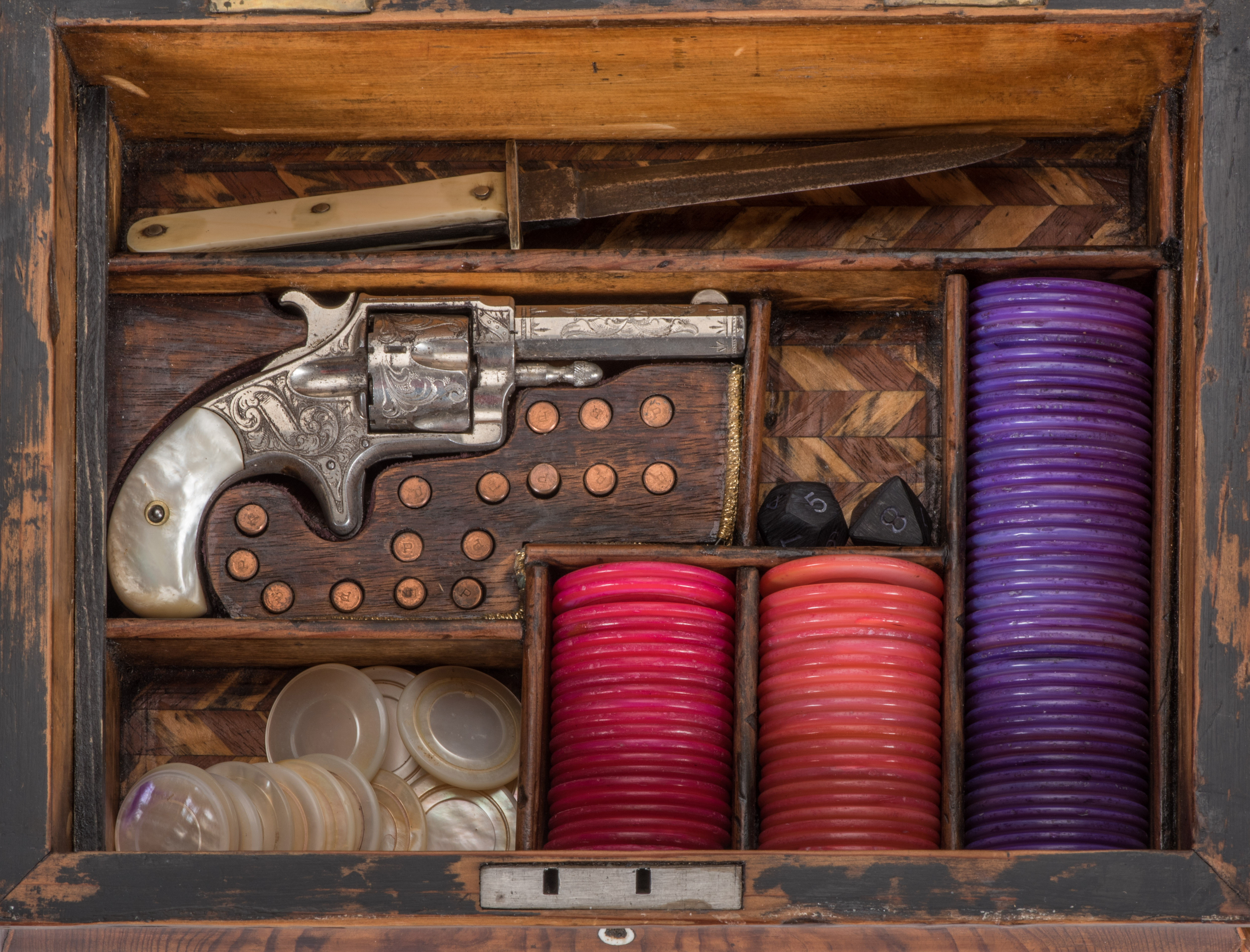
A Ty Cobb Baseball Postcard That He Used and Mailed Sold for $84,000

A 1907 Seamless Steel Tubes postcard picturing Ty Cobb in his rookie year. Cobb wrote a message on it and mailed it from Chicago on October 7, 1907, the day before he played in the World Series against the Cubs, who ultimately won in four games.

UPDATE: The Ty Cobb baseball postcard, which Cobb used and mailed just before playing his first World Series game, commanded $84,000–seven times its estimate.

What you see: A 1907 Seamless Steel Tubes postcard picturing Ty Cobb in his rookie year. Cobb wrote a message on it and mailed it from Chicago on October 7, 1907, the day before he played in the World Series against the Cubs, who ultimately won in four games. Heritage Auctions estimates the postcard at $10,000 plus.

What Cobb wrote on the postcard: “Well, we have won the pennant and here for world series. I led in hitting, stolen bases 60, assists, and second 100 runs, hit 355 unofficially – hope you lots of luck, will be glad to hear at any time. Royston GA., have an offer to go with all-Americans out to California. Excuse this advertising card.”

So, just how rare is this Ty Cobb baseball postcard? “The card itself, without writing, is $3,500 to $5,000 because a handful of them are known,” says Heritage sports card expert Peter Calderon. “A note on a vintage card is extremely hard to find, and a message from a player is very, very rare.”

This Ty Cobb baseball postcard was commissioned by a Detroit factory that made exhaust systems for steam locomotives–not a tobacco company or a gum manufacturer. Why would a company like that want to offer something like this? “It was based out of Detroit, and using players was common,” says Calderon. “Considering how rare the card is, it probably wasn’t produced in large numbers. It may have been just a giveaway [in Detroit] by the company.”

Who did Cobb send this to? Tom Bird, who was a teammate of his when he was playing in the minor leagues with the Augusta Tourists. The postcard has descended in Bird’s family and comes directly to Heritage from them. “He probably had it sitting around and wanted to send a note. That’s one of the neat things about it,” says Calderon. “Cobb had a reputation of being a dirty player, but he signs it ‘Tyrus,’ like he’s signing a Christmas card, and he says, ‘Excuse this advertising card.’ It shows the humbler and humane side of him, which he is not known for.”

The Ty Cobb baseball postcard has an estimate of $10,000 and up, but as of April 24, the high bid was $28,000–$33,600 with buyer’s premium. Where do you think it is headed? “It could go to $40,000, $50,000–who knows?” says Calderon. “It’s the first time I’ve ever seen a used postcard like this. It’s one of a kind. On every level, it has everything. It’s Ty Cobb. It’s a full message. It’s about baseball. It’s everything a collector could want.”

How to bid: The Ty Cobb baseball postcard is lot #80708 in the May 11-13 Sports Collectibles Catalog Auction at Heritage.

How to subscribe to The Hot BidClick the trio of dots at the upper right of this page. You can also follow The Hot Bid on Instagram and follow the author on Twitter.

Images are courtesy of Heritage Auctions.

Would you like to hire Sheila Gibson Stoodley for writing or editing work? Click the word “Menu” at the upper right for contact details.

A 19th Century Gambler’s Case Fetches $6,765

A circa 1880 American-made gambler's case, with several sets of mother-of-pearl chips, a pistol with a mother-of-pearl handle, a full set of playing cards, a cigar cutter with a mother-of-pearl handle, a two-bladed pocket knife with a scrimshawed ivory handle, an ivory dice cup, and miscellaneous dice.

Update: The 19th century gambler’s case sold for $6,765.

What you see: A circa 1880 American-made gambler’s case, with several sets of mother-of-pearl chips, a pistol with a mother-of-pearl handle, a full set of playing cards, a cigar cutter with a mother-of-pearl handle, a two-bladed pocket knife with a scrimshawed ivory handle, an ivory dice cup, and miscellaneous dice. Potter & Potter estimates it at $3,000 to $5,000.

Why would a gambler need a case with all this gear? Why not rely on house equipment? “You don’t want to miss an opportunity for a game,” says Gabe Fajuri of Potter & Potter. “You’ve got your deck of cards, your chips. Put in your ante, and let’s go.”

The lot description says this 19th century gambler’s case is ‘one of the few gambler’s boxes we have seen composed of apparently all-original material.’ What does that mean? “The problem is, a lot of gambler’s cases end up being put together. Collectors call those ‘fantasy pieces.’ I don’t think that’s true here,” Fajuri says. “Can I prove the dice are original to it? No. Can I prove the cigar cutter, the knife, the gun are original to it? No. But the pieces fit together. The style fits together. They all have the same age and wear. It’s what an antiques dealer would call ‘right.'”

How complete is this 19th century gambler’s case? “It’s hard to say. It’s not like this was a catalog item,” he says. “My guess is [the gambler who commissioned it] said, ‘Please make this to my specifications’ around the gun or the chips.”

Is anything in the 19th century gambler’s case gaffed or altered? “There’s nothing crooked about any of this stuff,” he says. “If you find real cheating devices in a case, you almost have to dismiss it out of hand. It’s not a magician’s case. It’s not hidden away.”

Ivory and mother-of-pearl are luxury materials. Does this mean the gambler who owned this case was successful? “It could be to intimidate [other players] or put them at ease, depending on what he was going for,” he says. “Or maybe he shot somebody and took his stuff. I don’t know.”

Have you had a genuine gambler’s case before at Potter & Potter? “One or two. This is nicer,” Fajuri says. “Again, the feel, the fit, the material used to make it has a quality and an authenticity that makes me feel good about it.”

How to bid: The 19th century gambler’s case is lot 978 in Potter & Potter’s Gambling Memorabilia Auction on May 6 and 7, 2017.

How to subscribe to The Hot BidClick the trio of dots at the upper right of this page.

Images are courtesy of Potter & Potter.

Would you like to hire Sheila Gibson Stoodley for writing or editing work? Click the word “Menu” at the upper right for contact details.
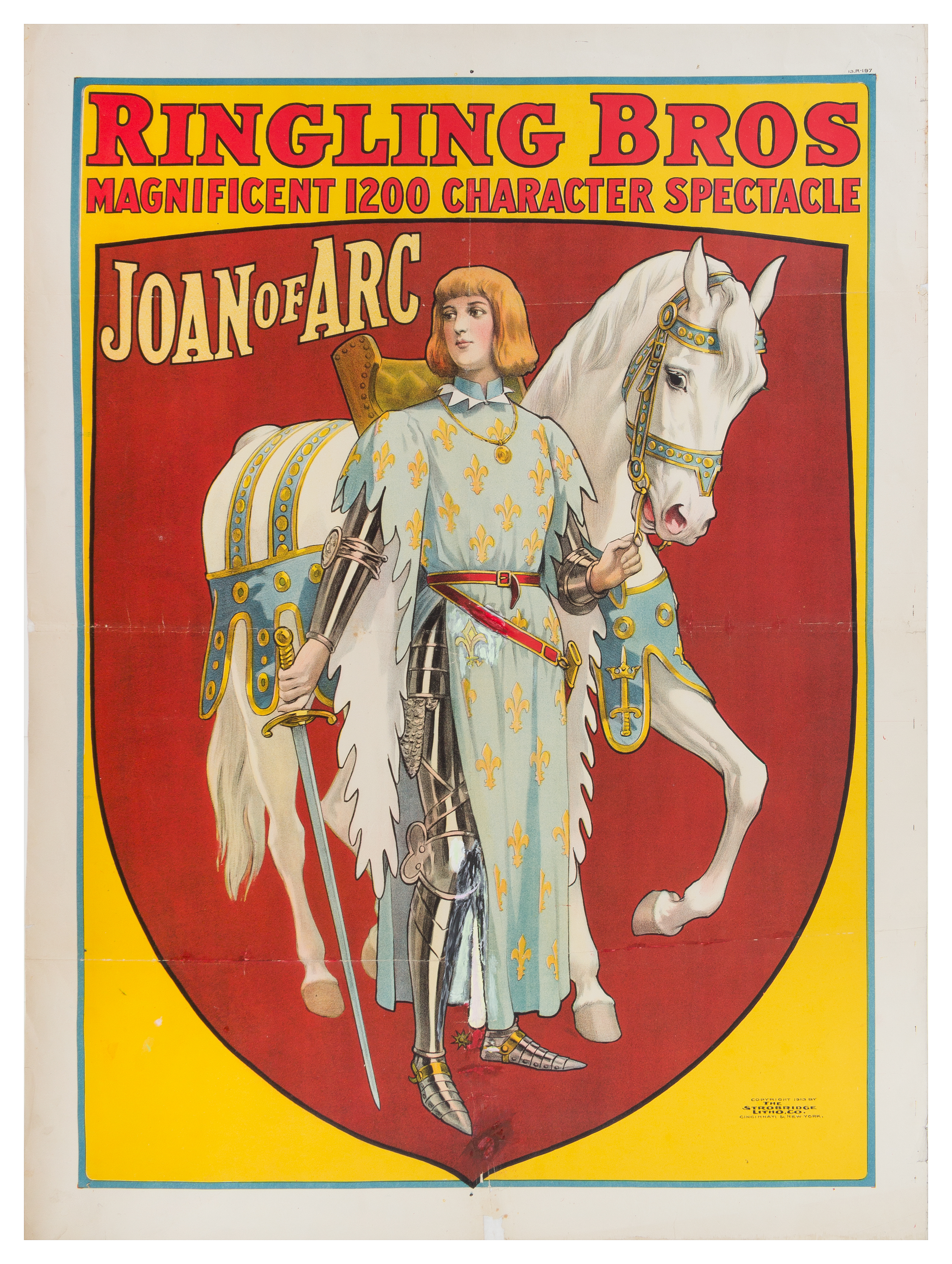
A Ringling Bros Joan of Arc Poster Collects $469

A 1913 poster by Ringling Brothers, featuring Joan of Arc and promising a 'Magnificent 1200 Character Spectacle.' It's from the Richard Bennett Collection of Circus Memorabilia.

Update: The Ringling Brothers Joan of Arc poster sold for $439.

What you see: A 1913 poster by Ringling Brothers, featuring Joan of Arc and promising a ‘Magnificent 1200 Character Spectacle.’ It’s from the Richard Bennett Collection of Circus Memorabilia. Leslie Hindman Auctioneers estimates the poster at $400 to $600.

Why is Joan of Arc on this Ringling Brothers poster? Where are the tigers, elephants, and clowns? “Circuses were not seen as the most classical or tasteful form of entertainment. To drum up business and legitimize the circus, the performers would parade through the streets dressed as classical Romans or knights with Joan of Arc,” says Nicholas Coombs, associate specialist at Leslie Hindman Auctioneers. “This spectacle was the first encounter the town would have with the circus, and it was a free parade down the main street.”

Why build a parade around Joan of Arc? Why would that be a draw in 1913? “Joan of Arc was a character who would have been known to a large slice of the population,” he says. “Ringling Brothers tried to appeal to as many people as possible. Joan of Arc certainly had that sort of cache among everyday, average Americans.”

What would the parade-goers have seen? “It would have been a fully-costumed production,” he says. “They probably tried to have as large a French army as possible, dressed up as knights. They tried to depict a mighty spectacle to get people to go to the circus later. They would have showed some animals as well.”

What other forms of entertainment was Ringling Brothers competing against in 1913? “It really didn’t have much competition,” Coombs says. “The circus was its own form of entertainment. A production this large, with thousands of people coming to your town–it was an event. Everyone came out to see it for miles around.”

The poster trumpets a 1200-person spectacle, but it only shows Joan of Arc and her horse. Is that unusual? “From the ones we’ve encountered, they try to sell the cast of a thousand characters aspect,” he says. “This stands out for its visual strength and its simplicity.”

How to bid: The Ringling Brothers Joan of Arc poster is lot 427 in the Documenting History: Science, Exploration sale at Leslie Hindman Auctioneers on May 4, 2017.

How to subscribe to The Hot BidClick the trio of dots at the upper right of this page.

Image is courtesy of Leslie Hindman Auctioneers.

Would you like to hire Sheila Gibson Stoodley for writing or editing work? Click the word “Menu” at the upper right for contact details.
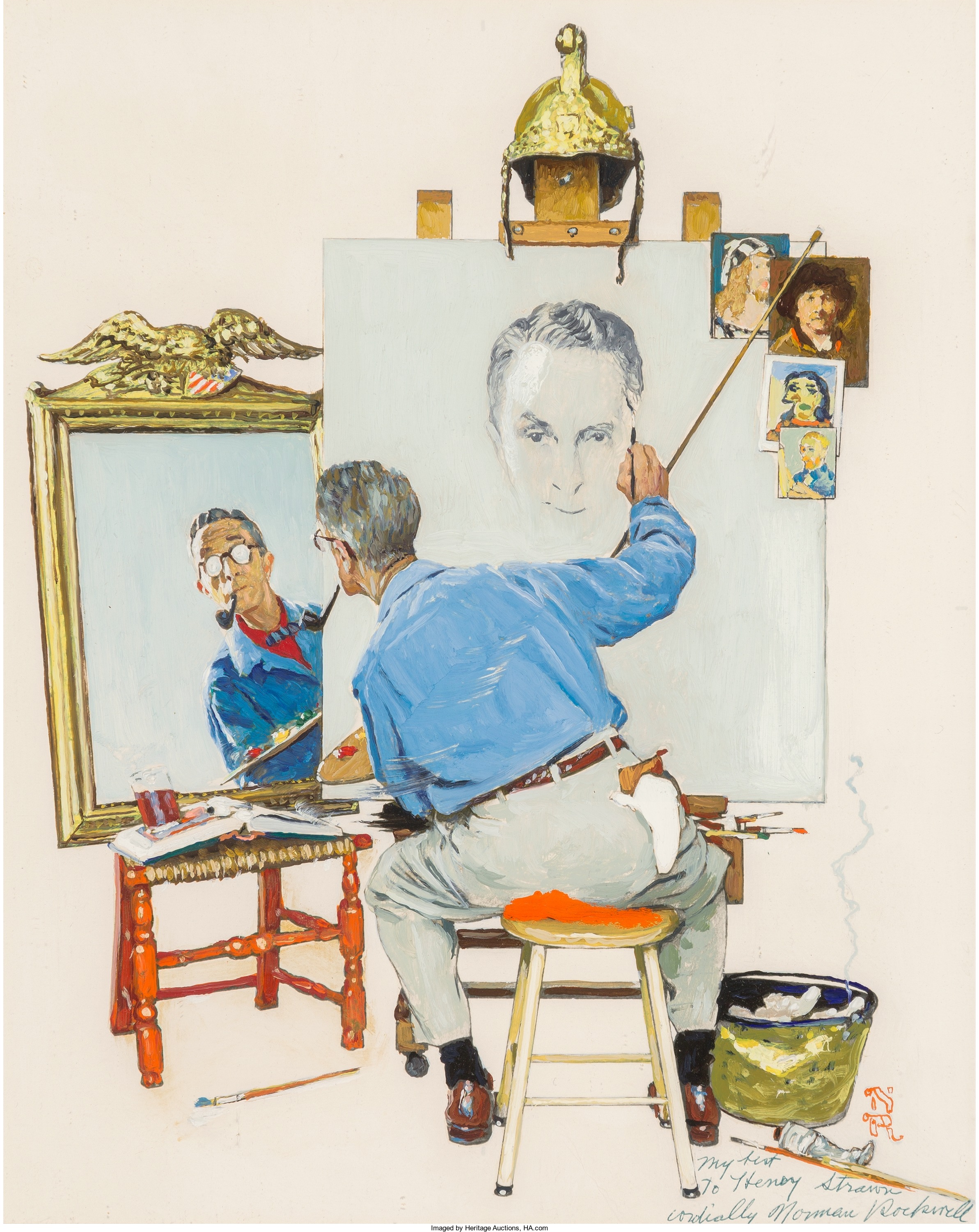
Norman Rockwell’s Study for Triple Self Portrait Sells for $1.3 Million

Study for Triple Self Portrait, a 1960 oil on photographic paper laid on panel by Norman Rockwell. The final version graced the cover of the February 13, 1960 edition of The Saturday Evening Post.

Update: Heritage sold Norman Rockwell’s Study for Triple Self Portrait for $1.3 million–a record for a Rockwell study at auction.

What you see: Study for Triple Self Portrait, a 1960 oil on photographic paper laid on panel by Norman Rockwell. The final version graced the cover of the February 13, 1960 edition of The Saturday Evening Post. Heritage Auctions estimates the study at $150,000 to $250,000.

Who was Norman Rockwell? He was the best-known and most-loved American illustrator of the 20th century. He created 321 covers for The Saturday Evening Post as well as many works for Look magazine, calendar companies, and the Boy Scouts of America. He died in 1978 at the age of 84.

How many studies did Rockwell make for Triple Self Portrait, and how many have come to auction? It’s unclear, but according to Ed Jaster, senior vice president at Heritage Auctions, Rockwell typically made between five and 10 studies or preliminary works for a Post cover. “To the best of my knowledge, this is the only study for Triple Self Portrait that exists in private hands,” Jaster says. The finished Triple Self Portrait cover art belongs to the Norman Rockwell Museum in Stockbridge, Mass.

Where was Rockwell in his career in 1960? Jaster points to the language that appeared on that February 1960 Post cover, which dubbed Rockwell “America’s Best Loved Artist,” and adds, “In the eyes of museum curators and critics, not so much. Rockwell, in his lifetime, never got true recognition as a painter, and never as a fine art painter. He didn’t ascend to major museums until well after his death.”

How close is this Norman Rockwell Study for Triple Self Portrait to the final version? “It’s a nice, tight color study with a fair amount of work put into it,” says Jaster, noting that the differences between the two are few–the final places pipes in all three Rockwell mouths, adds sketches of Rockwell’s head to the left of the easel and changes the Picasso clipped to the right of the easel. Rockwell’s signature also appears on the lower right of the canvas-in-progress, but that’s about it. “This is close to the final composition, and it works as a painting.”

Who is Henry Strawn, the person to whom Rockwell inscribed the study? We don’t know, and we don’t know when he would have received it from Rockwell. We do know that the artist freely bestowed his originals on models, friends, neighbors, and acquaintances. “He was a generous guy who didn’t take himself seriously,” says Jaster. “We see a lot of [Rockwells] come out from the families of sitters. One consigner [not Strawn–ed.] was a truck driver who traded him cider and cheese from Vermont.”

What makes Norman Rockwell’s Study for Triple Self Portrait special? “Rockwell is almost certainly the most famous illustrator and maybe the greatest illustrator who ever lived,” says Jaster. “Triple Self Portrait is a top 10 painting. It’s a tight study, it doesn’t have a long auction history, and it’s fresh to market. That all makes it wonderful. I hope you can hear the smile in my voice.”

How to bid: Norman Rockwell’s Study for Triple Self Portrait is lot #68139 in Heritage Auctions’s American Art Signature Auction on May 3, 2017 in Dallas.

How to subscribe to The Hot BidClick the trio of dots at the upper right of this page. You can also follow The Hot Bid on Instagram and follow the author on Twitter.

Image is courtesy of  Heritage Auctions, HA.com.

Would you like to hire Sheila Gibson Stoodley for writing or editing work? Click the word “Menu” at the upper right for contact details.
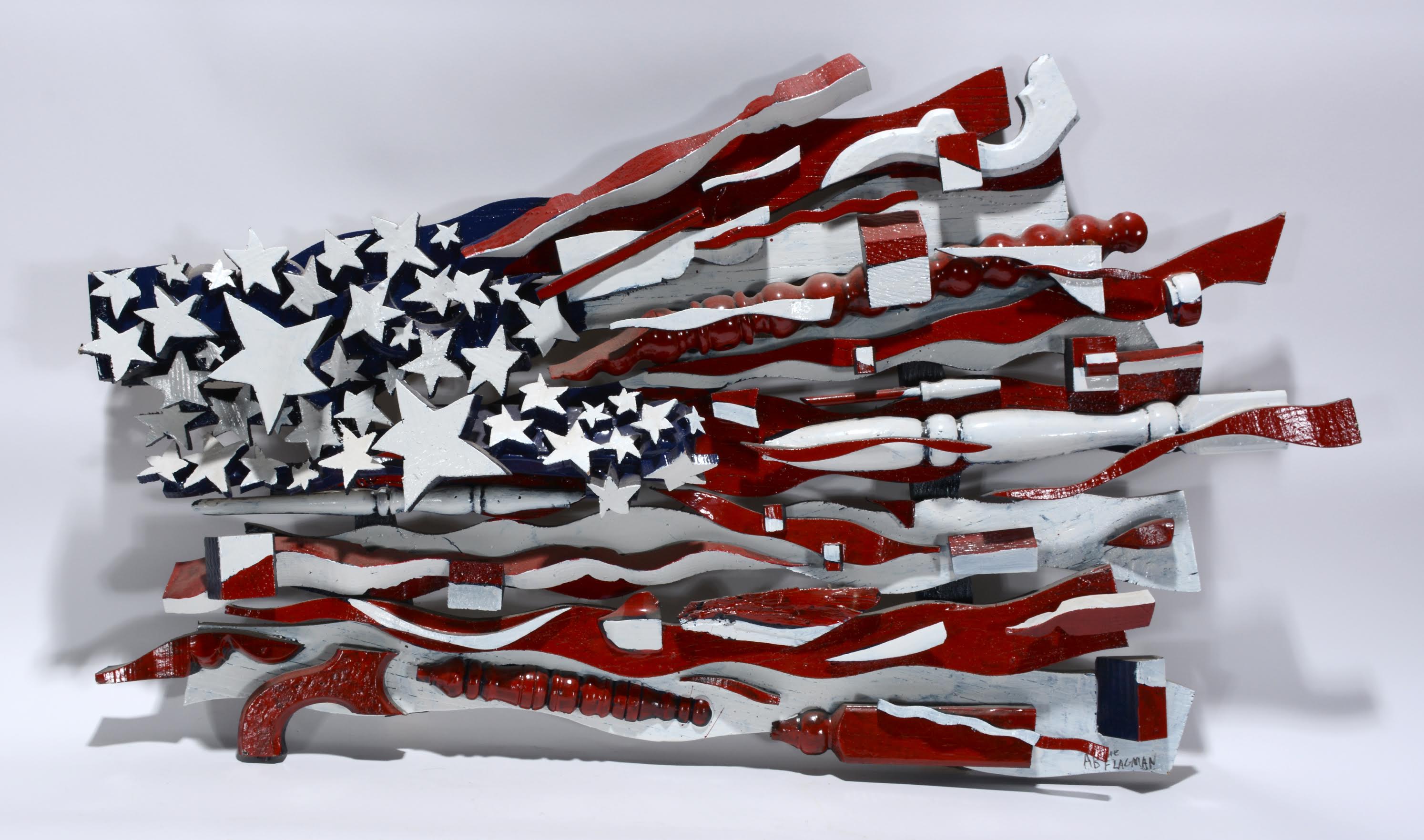
A Sculpture by Ab the Flag Man Fetches $1,200

An undated piece by American folk artist Ab the Flag Man. It is described as a "Medium Size American Flag."

Update: The sculpture by Ab the Flag Man sold for $1,200.

What you see: An undated piece by American folk artist Ab the Flag Man. It is described as a “Medium Size American Flag.” Slotin Folk Art Auction estimates it at $600 to $900, plus $75 for shipping.

Who is Ab the Flag Man? “He has a real name, but no one ever calls him by it,” says Steve Slotin, of Slotin Folk Art Auction, an auctioneer in Buford, Ga., that specializes in self-taught, outsider, and folk art. Ab the Flag Man was born with the name Roger Lee Ivens in Tennessee in 1964. He picked up the nickname “Abstract” during his school days, after asking his teacher about abstract art. It got shortened to “Ab” by co-workers on construction sites. He traces his interest in flags to the age of seven, when he witnessed the military funeral of his father. The sight of his casket covered with a flag never left him.

How long has Ab the Flag Man been an artist? He quit carpentry in 1995 to make art full-time, but it’s unclear precisely when he began–it could have been the late 1980s or early 1990s. He was discovered in a parking lot in Atlanta’s Virginia-Highland neighborhood, where he had set up alongside another folk artist to sell his works. “Specific dates in folk art are hard to come by. It’s not like he came out of art school and we tracked his progress,” says Slotin. “With Ab, people liked his stuff, and it was immediately popular.”

How prolific is he? “We’ve been doing auctions for 25 years, and since we began, we’ve had a few in each auction,” says Slotin. “There’s got to be a thousand pieces out there.”

Does Ab the Flag Man work alone, or does he have assistants? “That’s the thing with folk artists. There’s no team behind them, and no staff that prepares [materials],” Slotin says. “Typically, it’s all them.”

Wait, are there chair legs in there? “You see furniture legs in a lot of his stuff,” Slotin says. “Furniture legs, blocks, parts of house moldings, discards, it varies. It’s all scraps.”

What are the dimensions of this sculpture by Ab the Flag Man? It’s 35 inches long, 21 inches high, and four inches deep. “It really pops out at you,” Slotin says. “It has a lot of movement to it, like it’s waving at you. Most of his pieces have movement, like they’re waving in the wind.”

What else makes this sculpture by Ab the Flag Man special? “The great thing about almost all of our artists is they’re untrained and unschooled. They don’t have art school or European influences,” Slotin says. “A kid out of art school, who’s trained on what is and isn’t art, makes art that’s pretty homogenized. With Ab, his background is in construction, and his dad passed away–you see his experience in his work. And no one saw it [Ab’s style of flag-themed art] till he started doing it. That’s what I like. What he’s doing is original.”

How to bid: The sculpture by Ab the Flag Man is Lot 322 in Slotin Folk Art Auction’s Spring Masterpiece sale, taking place April 29 and 30, 2017 in Buford.

How to subscribe to The Hot BidClick the trio of dots at the upper right of this page.

Image is courtesy of Slotin Folk Art Auction.

Would you like to hire Sheila Gibson Stoodley for writing or editing work? Click the word “Menu” at the upper right for contact details.

A Unique Model Airplane by Ernest Burke Soared to $11,070

A 1/12 scale Republic 47D Thunderbolt U-control model airplane, built by Ernest Burke of Elmont, Long Island, between 1956 and 1965. It weighs seven and a half pounds, has a wingspan of 43 inches, and measures 36 inches from nose to tail. It features a single cylinder Hassad gasoline-powered engine.

Update: The unique 1/12 scale Republic 47D Thunderbolt U-control model airplane fetched $11,070.

What you see: A 1/12 scale Republic 47D Thunderbolt U-control model airplane, built by Ernest Burke of Elmont, Long Island, between 1956 and 1965. It weighs seven and a half pounds, has a wingspan of 43 inches, and measures 36 inches from nose to tail. It features a single cylinder Hassad gasoline-powered engine. Skinner estimates the unique model plane at $6,000 to $8,000.

Who was Ernest Burke? Born in New York City in 1921, he’s best known as a Western artist, having made more than 2,500 paintings and 80 sculptures with frontier themes. His works are in the permanent collections of the Amon Carter Museum of the American Indian, the Buffalo Bill Historical Center, and the Crazy Horse Memorial, among others. Burke’s parents recognized his artistic talent early, and supported his pursuits. Model-making was a boyhood hobby. He would scavenge wood from fruit crates from markets around the city. Burke died in 2010.

Have you ever seen anything like this? “No, we haven’t!” says Jonathan Dowling, a specialist in the clocks, watches, and scientific instruments department at Skinner. “Nothing like this–the scale, the detail, nothing like this in other auctions. We haven’t.”

What challenges did Ernest Burke face when making this model P-47 plane? “He had to do some serious legwork on trying to find the scale, and drop the scale down,” says Dowling, explaining that Burke wrote to the Republic Aviation Company to obtain blueprints of the World War II-era fighter plane. “He was almost an engineer at heart. He took his time to do research before he even attempted to create this.”

Just how faithful is this 1/12 scale model to the original? “The accuracy is incomprehensible, down to the detail of the cockpit,” Dowling says, noting that Burke worked alone over the course of nine years to complete it. His efforts paid off with a first place prize at a model plane enthusiasts’ meeting in Chicago in 1964. He retired his masterpiece after that, and never flew it again.

Does the unique model airplane still fly? “We have not tested it, but I would not see why it wouldn’t,” says Dowling, while pointing out that the U-control, which is a forerunner to the remote control, is not included in the lot (Burke’s heirs couldn’t find it).

What else makes the unique model airplane special? “I have never seen anything this accurate, this well-preserved, and this off-the-wall odd,” says Dowling. “I saw the pictures, and it didn’t do it for me. When it came through the door, it sparked my interest. They [the heirs] brought it to the lobby and we were all amazed.”

How to bid: Ernest Berke’s Republic 47D Thunderbolt U-control model airplane is lot 414 in the Clocks, Watches, & Scientific Instruments auction at Skinner on April 28, 2017.

How to subscribe to The Hot BidClick the trio of dots at the upper right of this page.

Image is courtesy of Skinner.

Would you like to hire Sheila Gibson Stoodley for writing or editing work? Click the word “Menu” at the upper right for contact details.
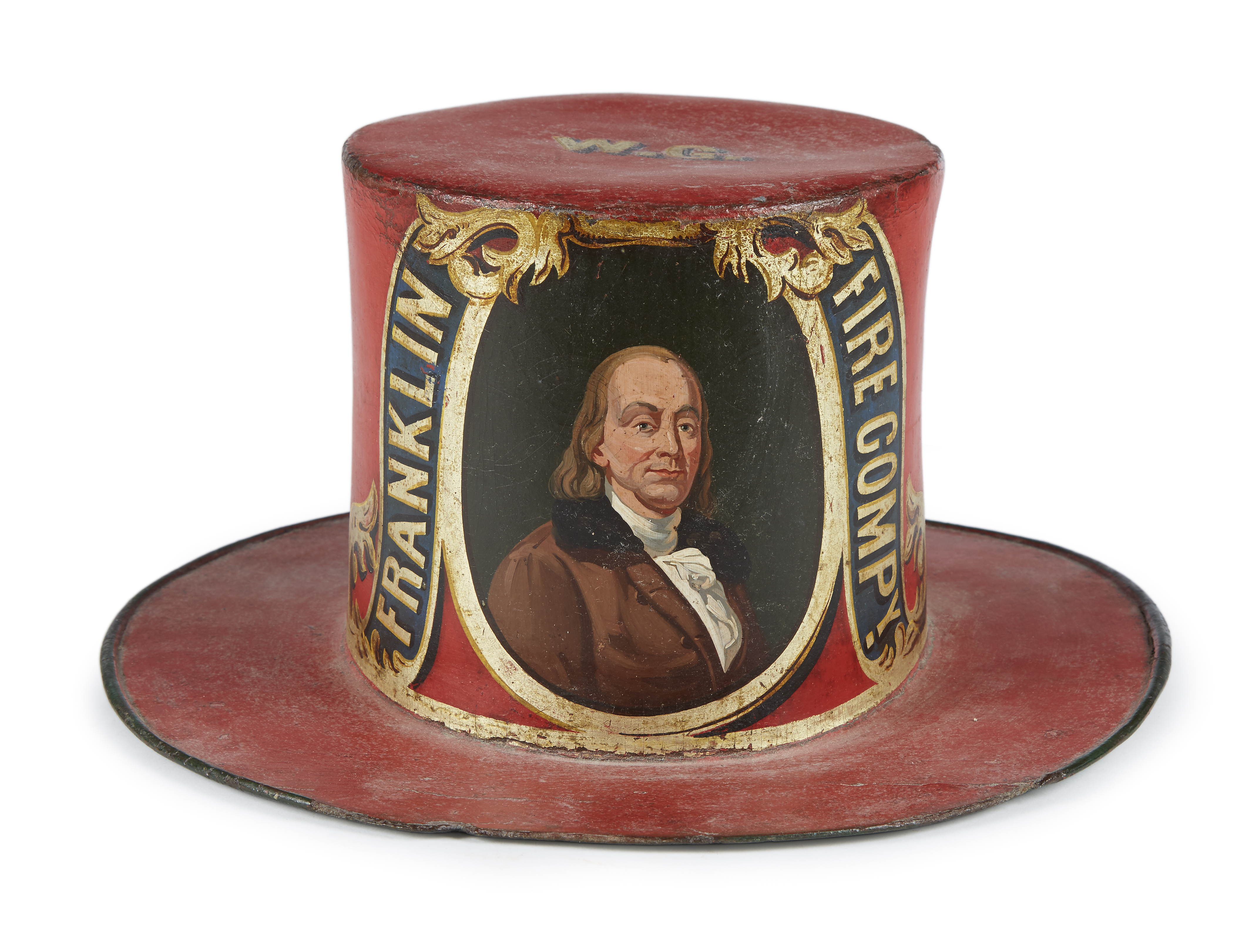
A Franklin Fire Company Hat Commands $18,750

A painted and decorated leather and felt parade hat for the Franklin Fire Company, a volunteer fire-fighting company which was active in Germantown, Philadelphia, Pennsylvania. It dates to between 1840 and 1860, stands six and a half inches tall, and measures a bit over 13 inches in diameter.

Update: The Franklin Fire Company hat sold for $18,750.

What you see: A painted and decorated leather and felt parade hat for the Franklin Fire Company, a volunteer fire-fighting company which was active in Germantown, Philadelphia, Pennsylvania. It dates to between 1840 and 1860, stands six and a half inches tall, and measures a bit over 13 inches in diameter. Freeman’s estimates it at $8,000 to $12,000.

What was the Franklin Fire Company? It was one of several volunteer fire-fighting companies in pre-Civil War America. “It was kind of a club, but you didn’t just get together as a fraternity–you did something. You saved property, you saved lives. You were heroes,” says Lynda Cain, vice president and department head for American furniture, folk and decorative arts at Freeman’s. “Fires were an everyday terror in 18th and 19th century America. Heating, cooking, and lighting were all hazardous. Volunteer fire-fighters had a hugely important role to play. The company was a great melting pot. You could have laborers, lawyers, and doctors. You were selected by ballot, and not everybody got in.”

Why did someone in the Franklin Fire Company need a parade hat? “This was for special occasions, such as celebrations and competitive events. The hats emphasized their group, their fraternity,” Cain says. “It shows your affiliation. It advertised your fire department, and your membership in it.”

Who in the Franklin Fire Company would have worn this hat? Everyone would have worn matching red parade hats with Franklin’s face on the front. “These guys would have proudly gathered and marched in their groups,” she says, noting that the initials ‘W.G.’ are lettered on the crown of the hat in black and gilded paint. “They had capes, too, but fewer of those survive.”

Who painted the portrait of Benjamin Franklin on the front? We don’t know, but it wasn’t the same artisan who made the hat. “It’s beautifully done,” Cain says, adding that it’s the first hat of its type with a Benjamin Franklin image to come to auction. “This particular hat has Franklin, but others had Washington, or Lafayette, or eagles, or classical figures, or scantily clad ladies in the 19th century sense.”

How rare are fire company parade hats? “I’ve been here 15 years and I’ve had five,” she says. “I love this hat. It’s been cleaned, but it’s in very fine shape. And Philadelphia and Franklin are a perfect pair.”

How to bid: The Franklin Fire Company hat is lot 148 in the American Furniture, Folk & Decorative Arts sale at Freeman’s in Philadelphia on April 26, 2017.

How to subscribe to The Hot BidClick the trio of dots at the upper right of this page. You can also follow The Hot Bid on Instagram and follow the author on Twitter.

Image is courtesy of Freeman’s.

Would you like to hire Sheila Gibson Stoodley for writing or editing work? Click the word “Menu” at the upper right for contact details.
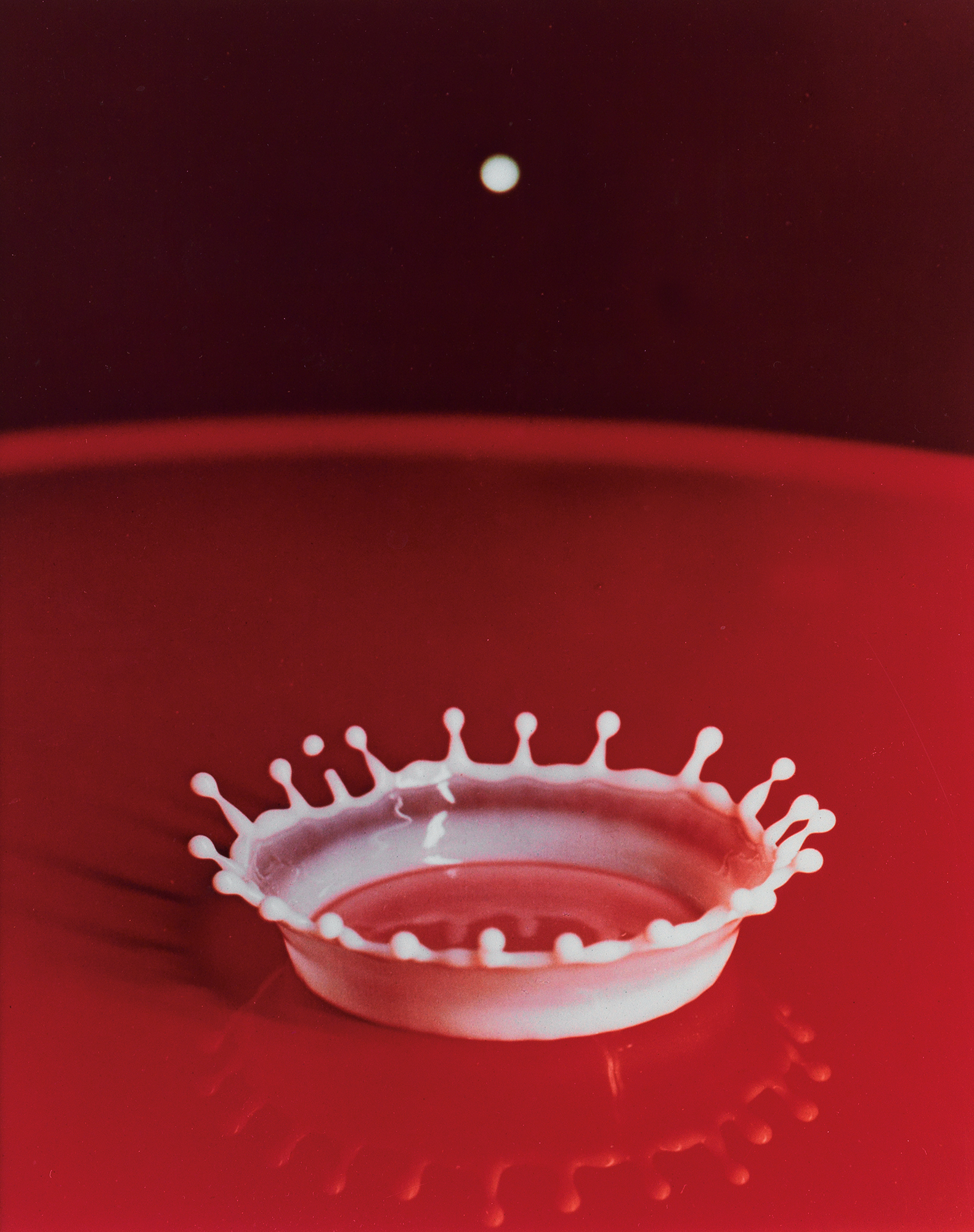
Milk Drop Coronet, by Harold Edgerton, Commanded $4,250

Milk Drop Coronet, a photograph taken by Harold Edgerton in 1957 and printed via the dye transfer technique in the 1970s, when Edgerton signed it in pencil.

Update: Milk Drop Coronet sold for $4,250.

What you see: Milk Drop Coronet, a photograph taken by Harold Edgerton in 1957 and printed via the dye transfer technique in the 1970s, when Edgerton signed it in pencil. Swann Auction Galleries estimates it at $4,000 to $6,000.

Who was Harold Edgerton? Harold “Doc” Edgerton was an electrical engineering professor at the Massachusetts Institute of Technology (MIT). He used his knowhow to create an electric flash that could fire extremely briefly–10 microseconds, or 1/100,000th of a second–allowing his camera to capture events that happen too fast for the eye to see. His mastery earned him the nickname “Papa Flash.” He died in 1990 at the age of 86.

Where was Harold Edgerton in his career in 1957? “He was still at MIT, but by 1957 he had achieved recognition for his inventions and his visionary approach to making images,” says Daile Kaplan, vice president and director of photographs and photobooks at Swann Galleries. “But the photography market didn’t happen until the first galleries opened their doors in the late 1960s and early 1970s.”

Is that why Milk Drop Coronet was shot in 1957 and printed in the 1970s? Yes. “Edgerton did not identify himself as an artist, which isn’t surprising,” Kaplan says, “At the start of the market for photography, dealers realized that a picture of this elegance could be a full-fledged artistic image. Edgerton was a very brilliant man. He acknowledged that his work had taken on a new audience, a new form.”

How does the dye transfer process improve the image? “It’s probably the most stable and vivid technique in relation to reproducing color,” she says, noting that dye transfer is no longer used. “It was the blue-chip technique. The reds [of Milk Drop Coronet] are vivid and saturated–they pop.”

Does Milk Drop Coronet belong to a limited edition? “Multiple prints were made during this period, but it was not a common practice to edition prints. The market was still articulating itself,” Kaplan says. Later, she stated that she had handled versions of the photograph in eight Swann Galleries auctions over the last 10 years: Three dye transfers, two chromogenic (color) prints, and three that were black and white.

M34957-2 001

What makes Milk Drop Coronet special? “This is one of the top Edgerton images, and I have to say, one of the most popular images of the 20th century,” she says. Speaking of Edgerton’s 20th century stop-motion achievements, she adds, “It’s startling in its prescience. Time is accelerating, people are moving at faster and faster paces. He looked at it from an academic and a scientific perspective, but he was able to articulate in his images what people were beginning to feel.”

How to bid: Milk Drop Coronet is lot 214 in Swann Auction Galleries’s Images & Objects: Photographs & Photobooks auction on April 20.

How to subscribe to The Hot BidClick the trio of dots at the upper right of this page.

Image is courtesy of Swann Auction Galleries.

Would you like to hire Sheila Gibson Stoodley for writing or editing work? Click the word “Menu” at the upper right for contact details.

An I Dream of Jeannie Original Prop Bottle Will Sell at Julien’s

The original prop bottle from the NBC sitcom I Dream of Jeannie (1965-1970). It's hand-painted and stands 14 inches tall.

What you see: The original prop bottle from the NBC sitcom I Dream of Jeannie (1965-1970). It’s hand-painted and stands 14 inches tall. Julien’s estimates it at $40,000 to $60,000.

How do we know this is an I Dream of Jeannie original prop bottle? It comes directly to Julien’s from the estate of Gene Nelson, who directed six episodes of the show’s first season, including the pilot, titled The Lady in the Bottle. At some point, Nelson obtained a letter of authenticity from Barbara Eden, who played the title character, Jeannie. Nelson died in 1996. Eden will turn 86 in August.

Did Nelson create the I Dream of Jeannie bottle? Nelson has the strongest claim on its origin story. He was hunting for something that didn’t look like Aladdin’s lamp, spotted a Jim Beam decanter in a liquor store window, snapped it up, and handed it over to the folks in the prop department, who peeled the labels off the glass and decorated it with paint. “There’s something unique in the fact that he saw this,” says Darren Julien, founder and CEO of Julien’s Auctions. “He was scouting around, found the bottle, and had the vision to paint it. He was a good visionary.”

Was the I Dream of Jeannie original prop bottle used on the set? Almost certainly, but coming up with a precise photo match is tough, given that the prop bottles were painted to look identical. But according to Julien, the animators would have referenced photos of this bottle when creating the opening credit sequence, and it’s safe to say it was shown in the early episodes that Nelson directed. He left I Dream of Jeannie after repeated clashes with Larry Hagman, who played astronaut Tony Nelson on the show.

How rare is the I Dream of Jeannie original prop bottle? “It’s very rare. We have not handled one before. Not many survive, and nobody back then would have saved anything like that,” says Julien, adding, “It’s the Holy Grail of the series to have. It’s what the show is about. Provenance is king, and it has such a solid history. It’s an iconic piece that’s going to sell for a lot more than our estimate.”

So, does it come with Barbara Eden? No, but it does include the letter of authentication that she wrote for Nelson. The bottle’s interior is also unfurnished and long since emptied of its whiskey. And neither Julien’s nor The Hot Bid is responsible for the I Dream of Jeannie theme song getting stuck in your head.

Damn you! #SorryNotSorry

How to bid: The I Dream of Jeannie original prop bottle is lot 486 in the Property from the Estate of Patrick Swayze and Hollywood Legends 2017 auction on April 28 at Julien’s.

How to subscribe to The Hot BidClick the trio of dots at the upper right of this page.

Image is courtesy of Julien’s Auctions.

Da DA dadadadada Da DA dadadadada Da DA dadadadadada. BadadaDA!

Would you like to hire Sheila Gibson Stoodley for writing or editing work? Click the word “Menu” at the upper right for contact details.

A 19th Century Fire Company Parade Hat Could Sell For $12,000

A painted and decorated leather and felt parade hat for the Franklin Fire Company, a volunteer fire-fighting company which was active in Germantown, Philadelphia, Pennsylvania. It dates to between 1840 and 1860, stands six and a half inches tall, and measures a bit over 13 inches in diameter.

What you see: A painted and decorated leather and felt parade hat for the Franklin Fire Company, a volunteer fire-fighting company which was active in Germantown, Philadelphia, Pennsylvania. It dates to between 1840 and 1860, stands six and a half inches tall, and measures a bit over 13 inches in diameter. Freeman’s estimates it at $8,000 to $12,000.

What was the Franklin Fire Company? It was one of several volunteer fire-fighting companies in pre-Civil War America. “It was kind of a club, but you didn’t just get together as a fraternity–you did something. You saved property, you saved lives. You were heroes,” says Lynda Cain, vice president and department head for American furniture, folk and decorative arts at Freeman’s. “Fires were an everyday terror in 18th and 19th century America. Heating, cooking, and lighting were all hazardous. Volunteer fire-fighters had a hugely important role to play. The company was a great melting pot. You could have laborers, lawyers, and doctors. You were selected by ballot, and not everybody got in.”

Why did someone in the Franklin Fire Company need a parade hat? “This was for special occasions, such as celebrations and competitive events. The hats emphasized their group, their fraternity,” Cain says. “It shows your affiliation. It advertised your fire department, and your membership in it.”

Who in the Franklin Fire Company would have worn this fire company parade hat? Everyone would have worn matching red parade hats with Franklin’s face on the front. “These guys would have proudly gathered and marched in their groups,” she says, noting that the initials ‘W.G.’ are lettered on the crown of the hat in black and gilded paint. “They had capes, too, but fewer of those survive.”

Who painted the portrait of Benjamin Franklin on the front of the fire company parade hat? We don’t know, but it wasn’t the same artisan who made the hat. “It’s beautifully done,” Cain says, adding that it’s the first hat of its type with a Benjamin Franklin image to come to auction. “This particular hat has Franklin, but others had Washington, or Lafayette, or eagles, or classical figures, or scantily clad ladies in the 19th century sense.”

How rare are fire company parade hats? “I’ve been here 15 years and I’ve had five,” she says. “I love this hat. It’s been cleaned, but it’s in very fine shape. And Philadelphia and Franklin are a perfect pair.”

How to bid: The fire company parade hat is lot 148 in the American Furniture, Folk & Decorative Arts sale at Freeman’s in Philadelphia on April 26, 2017.

How to subscribe to The Hot BidClick the trio of dots at the upper right of this page. You can also follow The Hot Bid on Instagram and follow the author on Twitter.

Image is courtesy of Freeman’s.

Would you like to hire Sheila Gibson Stoodley for writing or editing work? Click the word “Menu” at the upper right for contact details.

Untitled (Negro Mother) by Sargent Johnson Sells for $100,000

Sargent Johnson's Untitled (Negro Mother), a copper repoussé mask created circa 1935-36. It measures about 12 inches long and is estimated at $80,000 to $120,000.

Update: Sargent Johnson’s Untitled (Negro Mother) sold for $100,000–a record for the artist at auction.

What you see: Sargent Johnson’s Untitled (Negro Mother), a copper repoussé mask created circa 1935-36. It measures about 12 inches long and is estimated at $80,000 to $120,000.

Who is Sargent Johnson? He was a 20th century African-American artist who spent most of his career in San Francisco, and worked in a wide range of artistic media. He earned a national profile with his compelling, sensitive images of African-American subjects. “He worked to convey a more positive view of African-American femininity and womanhood in a time when the images were racist stereotypes,” says Nigel Freeman, director of the African-American fine art department at Swann Galleries. Johnson died in 1967.

What makes Untitled (Negro Mother) so intriguing? It’s one of perhaps ten copper repoussé masks that Johnson made, and most of those are in museum collections. Untitled (Negro Mother) is only the second Johnson mask to come to auction. Swann Galleries sold the first, a 1933 work simply called Mask, for $67,200 against an estimate of $30,000 to $50,000 in 2010. The consigner owned it for 50-odd years, having bought it as an unattributed mask and learning later who created it: “Somebody just sold it as a mask, and the owner discovered the signature on the back and discovered who Sargent Johnson was,” says Freeman.

M35509-1 009

What else makes Untitled (Negro Mother) a powerful work of art? “It has the character, stature, and dignity that all Johnson’s figures have,” says Freeman. “It’s beautifully proportioned, and you get a sense of the artist being very careful to have everything perfectly balanced. At the same time, you have a strong human presence. That’s what makes his work stand out.”

How to bid: Untitled (Negro Mother) is lot 13 in Swann Auction Galleries’s African-American Fine Art auction on April 6, 2017.

How to subscribe to The Hot BidClick the trio of dots at the upper right of this page.

Image is courtesy of Swann Auction Galleries.

Would you like to hire Sheila Gibson Stoodley for writing or editing work? Click the word “Menu” at the upper right for contact details.

An Albert Paley Coffee Table Commands $8,125

A coffee table created in 1991 by American sculptor Albert Paley.

Update: The Albert Paley coffee table sold for $8,125.

What you see: A coffee table created in 1991 by American sculptor Albert Paley. It is estimated at $8,000 to $12,000.

Who is Albert Paley? He is one of the world’s foremost metal sculptors. He might be best known for the Portal Gates that he created for the Renwick Gallery at the Smithsonian Institution in Washington, D.C. He’s made about 50 coffee tables to date.

What makes this coffee table a powerful example of Paley’s work? “What people find appealing about Paley is he takes metal and makes it feel like flowing drapery,” says Tim Andreadis, department head for 20th century design at Freeman’s. “He bends and manipulates it like fabric, or pulled taffy. It’s inviting, and yet sort of curious. A lot goes into controlling the metal and getting it to look the way he wants.”

What else makes the Albert Paley coffee table stand out? “If you took the glass top off it, you’d think it was a really beautiful sculpture, and you wouldn’t question it,” says Andreadis. “That’s what’s so great about Paley–the combination of art, craft, technique, and design, all melded together to create pieces that are unique. It could look amazing in a Silicon Valley tech executive’s home, with edgy contemporary pieces, or something a bit more traditional.”

Who is Jeffrey Kaplan? Did he commission the table directly from Paley? Kaplan, a retired lawyer, placed the coffee table in the living room of his Washington, D.C. apartment. He bought it from a gallery in the city and kept the receipts. (The winning bidder will receive copies of the paperwork.)

How to bid: The Albert Paley coffee table is lot 450 in 1,000 Years of Collecting: The Jeffrey M. Kaplan Collection on April 6, 2017 at Freeman’s auction house in Philadelphia.

Subscribe to The Hot Bid: Click the trio of dots at the upper right of this page.

Image courtesy of Freeman’s.

Would you like to hire Sheila Gibson Stoodley for writing or editing work? Click the word “Menu” at the upper right for contact details.

Children of the Sun, a Nudist Film Poster, Offered at Heritage Auctions

A movie poster for the 1934 nudist film Children of the Sun, which Heritage Auctions estimates at $400 to $800.

What you see: A movie poster for the 1934 nudist film Children of the Sun, which Heritage Auctions estimates at $400 to $800.

Who made this movie? Samuel Cummins, an exploitation film impresario who launched his career with the silent 1919 opus The Solitary Sin and went on to release Wild Oats, Trial Marriage, and Unguarded Girls, among others. He died in New York City sometime in the 1960s.

Would this nudist film poster have been displayed in public? In 1934? Where? At an independent or second-run movie house. The blank area at the top of the poster would have been printed with the venue name and maybe the screening dates. “Most theaters wouldn’t touch films such as these,” says Grey Smith, director of vintage movie poster auctions at Heritage. “A lot of these low-budget indie films had very eye-catching posters. I love the tagline–‘Nature in the raw.'”

Why risk printing a poster at all? Why not rely on word-of-mouth to lure people to the theater? “Your poster was the biggest selling tool you had,” says Smith. “You want to make it semi-tasteful, but just explicit enough to pique one’s interest.”

How racy was the nudist film poster for its time? “It is surprisingly up front. I can imagine a family passing this poster and the mother being outraged that the theater displayed something like this,” Smith says, adding, “In some areas, the theater owner might have taken some poster paint and painted a dress on her.”

What makes this nudist film poster special? Smith has not handled another Children of the Sun poster, save for a different version that was consigned along with this one. It has survived in relatively excellent shape, with its navy blues and butter yellows intact and its paper unfolded. “It’s a good poster for a taboo subject from an earlier period,” he says.

How to bid: The Children of the Sun poster is lot 86694 in Heritage Auctions’s Vintage Movie Posters Signature Auction in Dallas, which takes place March 25 and 26, 2017.

To subscribe to The Hot Bid: Click the trio of dots at the upper right of this page.

Image is courtesy of Heritage Auctions, HA.com.

Would you like to hire Sheila Gibson Stoodley for writing or editing work? Click the word “Menu” at the upper right for contact details.
A Piece of Erté Original Cover Art for Harper’s Bazaar Fetched $8,125

An original gouache on board, Sports d'Hiver, created by Erté for the February 1933 cover of Harper's Bazaar.

Update: The Erté original cover art sold for $8,125 on March 21, 2017.

What you see: An original gouache on board, Sports d’Hiver, created by Erté for the February 1933 cover of Harper’s Bazaar.

Who was Erté? He was a Russian-born designer and artist who tried his hand at fashion, stage costumes, jewelry, set design, and commercial art, and succeeded at all. His luxurious images helped define the Art Deco style. Born Roman Petrovich Tyrtov in Russia, he went by the name “Erté” to spare the feelings of his family, who disapproved of his career.”Erté” is how his initials, RT, sound when pronounced in French. He had a long professional relationship with Harper’s Bazaar, delivering more than 200 pieces of cover art between 1915 and 1937.

How rare is original Erté cover art? “They don’t come up with great frequency,” says Swann Galleries specialist Christine von der Linn. “We were lucky to get the cover, because we sold one in September,” she says, referring to a July 1922 Harper’s Bazaar cover by Erté, La Cage Improvisée, which Swann Galleries sold last September for $45,000 against an estimate of $6,000 to $9,000.

Why is the Erté original cover art estimated at $8,000 to $12,000? “What I love about it is it reflects the quintessential Erté characteristics,” von der Linn says. “There’s a beautiful woman in a vibrant outfit. There’s a sense of movement. The distant mountains in the background give you a sense of where she is. And there’s this perfect detail of hundreds of painstakingly detailed dots, representing snow, kicking up behind her. That makes the piece. That was something he was known for.”

Wait, do you mean that Erté personally painted all those little white dots by hand? Yes. “When he worked, he was in a different world,” says von der Linn, recalling a passage in which Erté discussed his routine of putting classical music on in the background and disappearing into a work-trance. “His dedication to the piece blossomed in creating that detail,” she says.

How to bid: The Erté original cover art for the February 1933 Harper’s Bazaar cover is lot 85  in Swann Galleries’s March 21 Illustration Art sale.

To subscribe to The Hot Bid: Click the trio of dots at the upper right of this page.

The Erté image is courtesy of Swann Galleries.

Would you like to hire Sheila Gibson Stoodley for writing or editing work? Click the word “Menu” at the upper right for contact details.

A Double Folk Portrait of Young Sisters Sells for Almost $10,000

A double portrait of sisters Mary Elizabeth and Caroline Brackett of Newton, Mass., painted between the 1830s and the 1840s.

Update: This winsome double folk portrait sold at Skinner for $9,840 on March 4, 2017, well above its $4,000 to $6,000 estimate.

What you see: A double folk portrait of sisters Mary Elizabeth and Caroline Brackett of Newton, Mass., painted between the 1830s and the 1840s.

Who painted the double folk portrait? We don’t know. It’s unsigned. Nor do we know which girl is Mary Elizabeth and which girl is Caroline, or what happened to the girls later in life, or whether the flowers pictured in the sketch book they hold have any special symbolism. We do know that the artist lived with the Brackett family for a year at their Waverly Avenue home in Newton and paid the rent with his brush. Before moving on, he depicted all nine Brackett children and rendered a full-length portrait of their parents, Charles and Lucy.

What sets this double folk portrait apart from other folk portraits? “I’ve seen a lot of folk portraits over the last 13 years. The good ones pop right out, for whatever reason–a modern look, an interesting composition, or interesting elements incorporated in the overall painting,” says Chris Barber, deputy director of American furniture and decorative arts at Skinner. “I liked it since the first time I saw a picture of it. It sticks out because it’s an interestingly composed double portrait, and the girls wear bright colors under a bright sky.” The portrait is also notable for showing the two outdoors and holding a sketch book rather than a pet or a toy. Girls were encouraged to draw, but drawing was seen as an indoor activity.

Why is the double folk portrait estimated at $4,000 to $6,000? It is fresh to market, having remained in the sitters’ family until they consigned it to Skinner. Its subject matter–a pair of pretty little girls, dressed in identical pink gowns–increases its value. “There were many more old men who could afford to have their portraits painted than families who could afford to have all their children painted,” says Barber. “It could be just a rarity issue.”

How to bid: The double folk portrait of the Brackett sisters is lot 332 in Skinner’s March 4, 2017 auction of American furniture and decorative arts.

To subscribe to The Hot Bid: Click the trio of dots at the upper right of this page.

Image is courtesy of Skinner.

Would you like to hire Sheila Gibson Stoodley for writing or editing work? Click the word “Menu” at the upper right for contact details.

An Alphonse Mucha Poster of Sarah Bernhardt Commanded $8,750

A poster that advertises Sarah Bernhardt's 1896 American Tour. Alphonse Mucha designed it.

Update: The Alphonse Mucha poster of Sarah Bernhardt sold for $8,750.

What you see: A poster that advertises Sarah Bernhardt’s 1896 American Tour. Alphonse Mucha designed it.

Who is Sarah Bernhardt? The French actress was the world’s first superstar. Dubbed “The Divine Sarah” by her fans, she dominated the stage and later acted on film, posthumously earning a star on the Hollywood Walk of Fame.

Who is Alphonse Mucha? He was a Czech-born artist whose distinctive, alluring style shaped the visuals of the Art Nouveau movement.

What makes this Alphonse Mucha poster of Sarah Bernhardt special? “This was the image that was used for the very first Bernhardt poster. It catapulted Mucha to international recognition and stardom,” says Nicholas Lowry, director of Swann Galleries’ vintage poster department. The poster’s origin story sounds like a fairy tale. In December 1894, Bernhardt contacted the Paris print shop where he worked to commission an image to advertise her new play, Gismonda. The city was shutting down for Christmas, so the task fell to Mucha. “He was the only employee there, the poor lonely expat. He was the only one who could possibly help, and he does so.” He produced a long, slim design that was bracingly fresh and new. Bernhardt, overjoyed, demanded to see Mucha, reportedly telling him, “You have made me immortal.”

Why is the Alphonse Mucha poster of Sarah Bernhardt estimated at $7,000 to $10,000? The poster boasts the image that made Mucha famous, and it debuts motifs that would define Mucha’s style–the halo around Bernhardt’s head, and the mosaic-inspired details. It’s definitely valuable, but it lags behind the $12,000 to $18,000 sum typically asked for an original 1894 Gismonda poster. It was printed in 1896, in America; it’s seven inches shorter, probably due to removing the word ‘Gismonda’ from the top of the design; and the text at the bottom is different. “The Gismonda is more collectible, mostly because it’s his first big poster,” says Lowry.

How to bid: The Alphonse Mucha poster of Sarah Bernhardt is lot 286 in Swann Galleries’ Vintage Posters sale on March 16, 2017.

To subscribe to The Hot Bid: Click the trio of dots at the upper right of this page. You can follow The Hot Bid on Instagram and follow the author on Twitter.

Swann Auction Galleries is on Instagram and Twitter, and Lowry is on Instagram and Twitter as well.

Photo is courtesy of Swann Auction Galleries.

Would you like to hire Sheila Gibson Stoodley for writing or editing work? Click the word “Menu” at the upper right for contact details.

Larry McMurtry’s Lonesome Dove Typewriters Sell for $37,500

A pair of pale green Hermes 3000 typewriters, made between 1963-1970, which belonged to Larry McMurtry.

Update: Larry McMurtry’s Lonesome Dove typewriters sold for $37,500 on March 8, 2017.

What you see: A pair of pale green Hermes 3000 typewriters, made between 1963-1970, which belonged to Larry McMurtry.

Who is Larry McMurtry? He operates Booked Up, a used bookstore in Archer City, Texas, but he’s probably better known as the author of Lonesome DoveThe Last Picture Show, and Terms of Endearment. All three books became movies or miniseries; Lonesome Dove won a Pulitzer Prize, and films based on McMurtry’s books have won 10 Academy Awards. He and a co-writer won three more Oscars for their adaption of the screenplay for Brokeback Mountain.

Why are these typewriters special? McMurtry used them to write Lonesome Dove, his masterpiece about Texas rangers on a cattle drive, which was published in 1985. The author is particular about his tools; even now, at age 80, he has no interest in switching to a computer.

Why are there two Lonesome Dove typewriters? McMurtry kept one typewriter in Archer City, Texas, and the other in Washington, D.C., the site of the original Booked Up store (it has since closed). Each weighs 16 pounds. It made more sense for McMurtry to keep a typewriter in Texas and another in D.C. rather than lug one machine between both places.

How do we know that McMurtry definitely wrote Lonesome Dove on them? “Larry McMurtry gave them to me and said, ‘I wrote Lonesome Dove on them,” says James Gannon, director of Rare Books for Heritage Auctions of Dallas, who collected the typewriters from the author on November 1 of last year. Gannon is obtaining a letter of provenance from McMurtry.

Why do the Lonesome Dove typewriters carry an estimate of $10,000? Typewriters that can be linked to prominent authors are rare; typewriters that were unquestionably and exclusively used to write legendary books are even rarer. The Lettera 32 Olivetti typewriter that author Cormac McCarthy relied on to write The Road, Blood Meridian, No Country for Old Men, and All the Pretty Horses sold at Christie’s in 2009 for $254,500–well above its $20,000 estimate. “It’s like owning one of Dickens’s pens or one of Shakespeare’s quills,” says Gannon. “A typewriter is the focus of a writer’s day-in, day-out existence. That seems to resonate with collectors.”

How to bid: Larry McMurtry’s Lonesome Dove typewriters are lot #45314 in Heritage Auction’s Rare Books Signature Auction on March 8, 2017 in New York.

How to subscribe to The Hot Bid: Click the trio of dots at the upper right of this page.

Image is courtesy of Heritage Auctions, HA.com.

Would you like to hire Sheila Gibson Stoodley for writing or editing work? Click the word “Menu” at the upper right for contact details.